SUBSCRIBE TO OUR FREE NEWSLETTER
Daily news & progressive opinion—funded by the people, not the corporations—delivered straight to your inbox.
5
#000000
#FFFFFF
To donate by check, phone, or other method, see our More Ways to Give page.
A 77-year-old retired pharmacist shot himself in the head Wednesday in central Athens, drawing an emotional response from Greeks who flooded the area in a spontaneous anti-austerity protest in a nation on the brink of economic collapse.
The victim, whose name has not been released, shot himself outside the parliament building today. His suicide note reportedly said, "I have no other way to react apart from finding a dignified end before I start sifting through garbage for food."
Since the suicide, activists and opponents of austerity measures, who have been fighting massive cuts to Greece's economy for more than a year, came out to protest the economic injustices that are rampant in their nation. Some of the more than 1,500 protesters who took to the public square in Athens today, said, "This was not suicide - it was murder committed by the state." Suicide rates have skyrocketed in Greece since the country starting making excessive salary and pension cuts.
The Arab Spring is largely cited as having been sparked by the death of a food vendor in Tunisia, who was protesting similar economic injustices as today's victim.
* * *
From Reuters:
Greek Retiree's Public Suicide Brings More Outcry Against Austerity
A cash-strapped Greek pensioner shot and killed himself outside parliament in Athens on Wednesday saying he refused to scrounge for food in the rubbish, touching a nerve among ordinary Greeks feeling the brunt of the country's economic crisis.
Acts of suicide have been catalysts for provoking popular protest in the past. A Tunisian vegetable seller triggered the start of the so-called "Arab Spring" protests by setting himself on fire in December 2010.The public suicide of the 77-year-old retired pharmacist quickly triggered an outpouring of sympathy in a country where one in five is jobless and a sense of national humiliation has accompanied successive rounds of salary and pension cuts.
Just hours after the death, an impromptu shrine with candles, flowers and hand-written notes condemning the crisis sprung up in the central Syntagma square where the suicide occurred. Bystanders gathered to pay their respects.
One note nailed to a tree said "Enough is enough", while another asked, "Who will be the next victim?"
A few hundred indignant protesters, who staged mass protests in 2011 against austerity measures imposed by foreign lenders in return for bailout loans, marched into Syntagma square on Wednesday evening.
By nightfall, the crowd huddled around the suicide site had swelled to a few thousand, with some chanting: "This was not suicide - it was murder committed by the state".
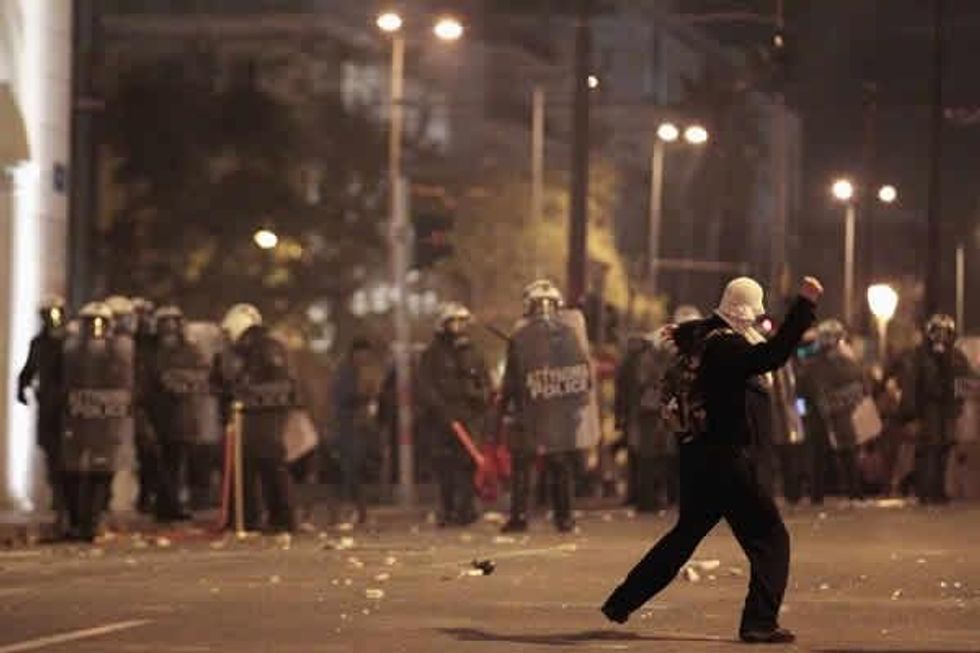
There were brief moments of tension near parliament when police fired teargas at a group of about a dozen protesters throwing petrol bombs at them. Rocks were also throw at a luxury hotel in the square.
Acts of suicide have been catalysts for provoking popular protest in the past. A Tunisian vegetable seller triggered the start of the so-called "Arab Spring" protests by setting himself on fire in December 2010.
In Athens, witnesses said the man appeared in the busy square during the morning rush hour, put a gun to his head and pulled the trigger after yelling out: "I have debts, I can't stand this anymore."
Another passerby told Greek television the man said, "I don't want to leave my debts to my children."
A suicide note found in his pocket blamed politicians and financial troubles for pushing him over the edge, police said.
The government had "annihilated any hope for my survival and I could not get any justice. I cannot find any other form of struggle except a dignified end before I have to start scrounging for food from the rubbish," the note said. [...]
The president of the pharmacists' union in the broader Attica region, Costas Lourantos, said he recalled meeting the victim several years ago and was struck by his dignified manner.
"When dignified people like him are brought to this state, somebody must answer for it," said Lourantos. "There is a moral instigator to this crime - which is the government that has brought people to such despair."
Shortly after news of the man's death, Lourantos says he received an anonymous call from a pharmacist saying she would be next to follow suit.
"I am now frantically looking to find out who it was so we can stop her," Lourantos said.
"This is the point to which they've brought us. Do they really expect a pensioner to live on 300 euros?" asked 54-year old Maria Parashou, who rushed to the square to pay her respects after reading about the suicide.
"They've cut our salaries, they've humiliated us. I have one daughter who is unemployed and my husband has lost half of his income, but I won't allow myself to lose hope."
* * *
A 77-year-old retired pharmacist shot himself in the head Wednesday in central Athens, drawing an emotional response from Greeks who flooded the area in a spontaneous anti-austerity protest in a nation on the brink of economic collapse.
The victim, whose name has not been released, shot himself outside the parliament building today. His suicide note reportedly said, "I have no other way to react apart from finding a dignified end before I start sifting through garbage for food."
Since the suicide, activists and opponents of austerity measures, who have been fighting massive cuts to Greece's economy for more than a year, came out to protest the economic injustices that are rampant in their nation. Some of the more than 1,500 protesters who took to the public square in Athens today, said, "This was not suicide - it was murder committed by the state." Suicide rates have skyrocketed in Greece since the country starting making excessive salary and pension cuts.
The Arab Spring is largely cited as having been sparked by the death of a food vendor in Tunisia, who was protesting similar economic injustices as today's victim.
* * *
From Reuters:
Greek Retiree's Public Suicide Brings More Outcry Against Austerity
A cash-strapped Greek pensioner shot and killed himself outside parliament in Athens on Wednesday saying he refused to scrounge for food in the rubbish, touching a nerve among ordinary Greeks feeling the brunt of the country's economic crisis.
Acts of suicide have been catalysts for provoking popular protest in the past. A Tunisian vegetable seller triggered the start of the so-called "Arab Spring" protests by setting himself on fire in December 2010.The public suicide of the 77-year-old retired pharmacist quickly triggered an outpouring of sympathy in a country where one in five is jobless and a sense of national humiliation has accompanied successive rounds of salary and pension cuts.
Just hours after the death, an impromptu shrine with candles, flowers and hand-written notes condemning the crisis sprung up in the central Syntagma square where the suicide occurred. Bystanders gathered to pay their respects.
One note nailed to a tree said "Enough is enough", while another asked, "Who will be the next victim?"
A few hundred indignant protesters, who staged mass protests in 2011 against austerity measures imposed by foreign lenders in return for bailout loans, marched into Syntagma square on Wednesday evening.
By nightfall, the crowd huddled around the suicide site had swelled to a few thousand, with some chanting: "This was not suicide - it was murder committed by the state".
There were brief moments of tension near parliament when police fired teargas at a group of about a dozen protesters throwing petrol bombs at them. Rocks were also throw at a luxury hotel in the square.
Acts of suicide have been catalysts for provoking popular protest in the past. A Tunisian vegetable seller triggered the start of the so-called "Arab Spring" protests by setting himself on fire in December 2010.
In Athens, witnesses said the man appeared in the busy square during the morning rush hour, put a gun to his head and pulled the trigger after yelling out: "I have debts, I can't stand this anymore."
Another passerby told Greek television the man said, "I don't want to leave my debts to my children."
A suicide note found in his pocket blamed politicians and financial troubles for pushing him over the edge, police said.
The government had "annihilated any hope for my survival and I could not get any justice. I cannot find any other form of struggle except a dignified end before I have to start scrounging for food from the rubbish," the note said. [...]
The president of the pharmacists' union in the broader Attica region, Costas Lourantos, said he recalled meeting the victim several years ago and was struck by his dignified manner.
"When dignified people like him are brought to this state, somebody must answer for it," said Lourantos. "There is a moral instigator to this crime - which is the government that has brought people to such despair."
Shortly after news of the man's death, Lourantos says he received an anonymous call from a pharmacist saying she would be next to follow suit.
"I am now frantically looking to find out who it was so we can stop her," Lourantos said.
"This is the point to which they've brought us. Do they really expect a pensioner to live on 300 euros?" asked 54-year old Maria Parashou, who rushed to the square to pay her respects after reading about the suicide.
"They've cut our salaries, they've humiliated us. I have one daughter who is unemployed and my husband has lost half of his income, but I won't allow myself to lose hope."
* * *
A 77-year-old retired pharmacist shot himself in the head Wednesday in central Athens, drawing an emotional response from Greeks who flooded the area in a spontaneous anti-austerity protest in a nation on the brink of economic collapse.
The victim, whose name has not been released, shot himself outside the parliament building today. His suicide note reportedly said, "I have no other way to react apart from finding a dignified end before I start sifting through garbage for food."
Since the suicide, activists and opponents of austerity measures, who have been fighting massive cuts to Greece's economy for more than a year, came out to protest the economic injustices that are rampant in their nation. Some of the more than 1,500 protesters who took to the public square in Athens today, said, "This was not suicide - it was murder committed by the state." Suicide rates have skyrocketed in Greece since the country starting making excessive salary and pension cuts.
The Arab Spring is largely cited as having been sparked by the death of a food vendor in Tunisia, who was protesting similar economic injustices as today's victim.
* * *
From Reuters:
Greek Retiree's Public Suicide Brings More Outcry Against Austerity
A cash-strapped Greek pensioner shot and killed himself outside parliament in Athens on Wednesday saying he refused to scrounge for food in the rubbish, touching a nerve among ordinary Greeks feeling the brunt of the country's economic crisis.
Acts of suicide have been catalysts for provoking popular protest in the past. A Tunisian vegetable seller triggered the start of the so-called "Arab Spring" protests by setting himself on fire in December 2010.The public suicide of the 77-year-old retired pharmacist quickly triggered an outpouring of sympathy in a country where one in five is jobless and a sense of national humiliation has accompanied successive rounds of salary and pension cuts.
Just hours after the death, an impromptu shrine with candles, flowers and hand-written notes condemning the crisis sprung up in the central Syntagma square where the suicide occurred. Bystanders gathered to pay their respects.
One note nailed to a tree said "Enough is enough", while another asked, "Who will be the next victim?"
A few hundred indignant protesters, who staged mass protests in 2011 against austerity measures imposed by foreign lenders in return for bailout loans, marched into Syntagma square on Wednesday evening.
By nightfall, the crowd huddled around the suicide site had swelled to a few thousand, with some chanting: "This was not suicide - it was murder committed by the state".
There were brief moments of tension near parliament when police fired teargas at a group of about a dozen protesters throwing petrol bombs at them. Rocks were also throw at a luxury hotel in the square.
Acts of suicide have been catalysts for provoking popular protest in the past. A Tunisian vegetable seller triggered the start of the so-called "Arab Spring" protests by setting himself on fire in December 2010.
In Athens, witnesses said the man appeared in the busy square during the morning rush hour, put a gun to his head and pulled the trigger after yelling out: "I have debts, I can't stand this anymore."
Another passerby told Greek television the man said, "I don't want to leave my debts to my children."
A suicide note found in his pocket blamed politicians and financial troubles for pushing him over the edge, police said.
The government had "annihilated any hope for my survival and I could not get any justice. I cannot find any other form of struggle except a dignified end before I have to start scrounging for food from the rubbish," the note said. [...]
The president of the pharmacists' union in the broader Attica region, Costas Lourantos, said he recalled meeting the victim several years ago and was struck by his dignified manner.
"When dignified people like him are brought to this state, somebody must answer for it," said Lourantos. "There is a moral instigator to this crime - which is the government that has brought people to such despair."
Shortly after news of the man's death, Lourantos says he received an anonymous call from a pharmacist saying she would be next to follow suit.
"I am now frantically looking to find out who it was so we can stop her," Lourantos said.
"This is the point to which they've brought us. Do they really expect a pensioner to live on 300 euros?" asked 54-year old Maria Parashou, who rushed to the square to pay her respects after reading about the suicide.
"They've cut our salaries, they've humiliated us. I have one daughter who is unemployed and my husband has lost half of his income, but I won't allow myself to lose hope."
* * *