SUBSCRIBE TO OUR FREE NEWSLETTER
Daily news & progressive opinion—funded by the people, not the corporations—delivered straight to your inbox.
5
#000000
#FFFFFF
To donate by check, phone, or other method, see our More Ways to Give page.
Daily news & progressive opinion—funded by the people, not the corporations—delivered straight to your inbox.
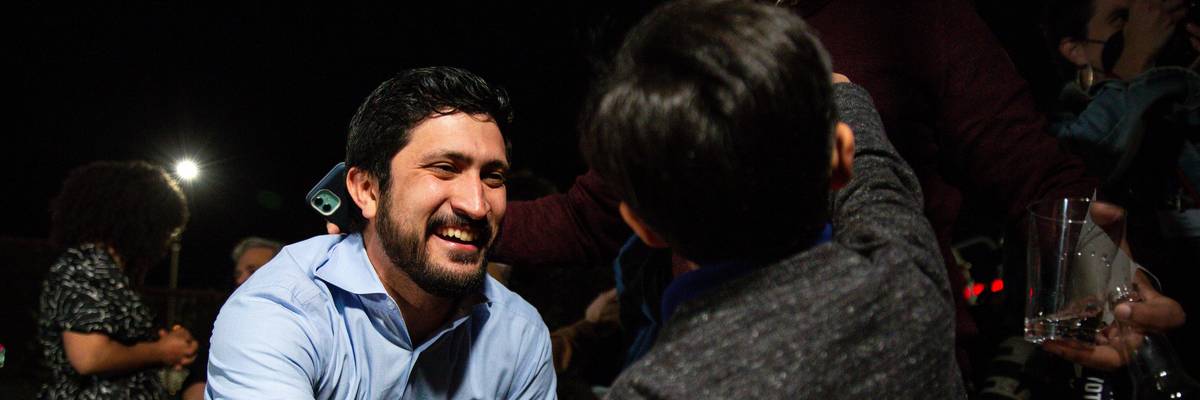
Democrat Greg Casar of Texas, who won a seat in the U.S. House in Tuesday's midterm election, is pictured here after winning the Democratic primary on March 1, 2022 in Austin, Texas. (Photo by Montinique Monroe/Getty Images)
After the election comes . . . the coverage, which always, at least in the mainstream media, seems to reduce everything to winning and losing, to strategy and tactics, rather than to the deep issues shaping the future.
The mainstream-created context of this year's midterms amounted to: Will there be a "red tsunami"? That is, will the GOP, riding joyfully on the back of the bucking bronco of inflation, overwhelm Sleepy Joe's Democratic Party and grab control over the House and Senate? Or will the Dems hold on, luck out, lose only minimally?
And the post-election news, of course, is the latter. The count continues as I write and not all election results, at national and state levels, are known yet, but what is known indicates that both parties more or less held their own and there definitely was no red tsunami. For the Democrats, this is the equivalent of a big victory.
The New York Times, for instance, noted:
"Across the East Coast, in Virginia's northern suburbs and mixed areas of Rhode Island and New Hampshire, embattled Democrats managed to hang on. They even knocked off a few Republicans here and there. In many tight races, abortion and Mr. Trump's looming presence may have been the GOP's undoing."
Wow. Go, Democrats! Their milk-toast centrism kind of worked, with the help of the Supreme Court, which shocked the country by overturning Roe v. Wade and taking away American women's 49 years of abortion rights. Perhaps "Mr. Trump's" 2020 election denial, his MAGA base's 2021 attempted coup and the looming threat of civil war also figured into the results. A fair number of American voters didn't want that, apparently, and more of them than usual actually took the trouble to vote in this year's midterms.
That, at any rate, is the context -- corporate normalcy, you might say -- in which the mainstream media is attempting to frame the 2022 elections. The Republicans get to go off the deep end and actually stand for something radical (proto-fascism), but the Democrats are just trying to keep America normal.
Fortunately, there is a progressive movement in this country, and this movement -- this stand for sanity, this embrace of the future -- was indeed present in the midterms, and had a significant impact. The Democratic Party, much to its own chagrin, is actually being forced to stand for something . . . beyond compromise.
"A number of newly elected progressives from across the country are poised to join the 'Squad' of left-wing champions in the U.S. House following Tuesday's midterm elections," Julia Conley reported Wednesday for Common Dreams.
These include Summer Lee of Pennsylvania, Maxwell Frost of Florida, Delia Ramirez of Illinois, Greg Casar of Texas, and Becca Balint of Vermont. Their issues include an increased minimum wage, labor rights and the right to unionize, gun sanity -- and no doubt much, much more: issues that actually impact the global future. I'm sure they include the transcendence of racism and militarism, real voting rights, and, of course, seriously facing, and dealing with, climate change and the maintenance of a habitable planet.
You think?
To put it another way, these voting events aren't just political game playing, winning vs. losing. And the issues don't end when the election is over. There is a movement -- a cry for profound change -- on the left as well as on the right, though they have nothing in common with one another. The progressive movement is nonviolent and is not about claiming power for its own sake (or to gratify the ego of its Dear Leader).
Becca Balint put it this way, speaking Tuesday night on Democracy Now!: "Whether we hold the House or lose the House, the work is the same. We still have a democracy to save."
In contrast, as Ralph Nader pointed out, the mainstream Democrats barely ran on any issues at all. "The Democrats are enchained by political-media consultants. If they lose the House and Senate, it'll be because they lost it, not because the Republicans won it."
Greg Casar, talking about Texas (which of course re-elected its far-right Republican governor, Greg Abbott), said: "We're not a red state. We're an underorganized state, a voter-suppressed state. It's harder to vote in Texas than anywhere else in the country."
Nonetheless, this is changing, progress is happening. Democratic victories aren't about "out-centering" the Republicans (we're against immigrants too, but in a nicer way). No! It's about standing up for our values.
"You can win or lose elections," Casar said, "but you don't ever lose a movement. Our work is on a much greater horizon than one election."
What if we lived in a country that saw beyond itself, beyond its current institutions? Well, we do, but just not in an officially acknowledged way. The country and the world are changing, a.k.a., evolving, in both terrifying and hope-creating ways, whether we like it or not. These changes are well beyond the control of contemporary politics -- but not beyond humanity's involvement.
This is the "greater horizon" to which we must open ourselves.
Dear Common Dreams reader, It’s been nearly 30 years since I co-founded Common Dreams with my late wife, Lina Newhouser. We had the radical notion that journalism should serve the public good, not corporate profits. It was clear to us from the outset what it would take to build such a project. No paid advertisements. No corporate sponsors. No millionaire publisher telling us what to think or do. Many people said we wouldn't last a year, but we proved those doubters wrong. Together with a tremendous team of journalists and dedicated staff, we built an independent media outlet free from the constraints of profits and corporate control. Our mission has always been simple: To inform. To inspire. To ignite change for the common good. Building Common Dreams was not easy. Our survival was never guaranteed. When you take on the most powerful forces—Wall Street greed, fossil fuel industry destruction, Big Tech lobbyists, and uber-rich oligarchs who have spent billions upon billions rigging the economy and democracy in their favor—the only bulwark you have is supporters who believe in your work. But here’s the urgent message from me today. It's never been this bad out there. And it's never been this hard to keep us going. At the very moment Common Dreams is most needed, the threats we face are intensifying. We need your support now more than ever. We don't accept corporate advertising and never will. We don't have a paywall because we don't think people should be blocked from critical news based on their ability to pay. Everything we do is funded by the donations of readers like you. When everyone does the little they can afford, we are strong. But if that support retreats or dries up, so do we. Will you donate now to make sure Common Dreams not only survives but thrives? —Craig Brown, Co-founder |
After the election comes . . . the coverage, which always, at least in the mainstream media, seems to reduce everything to winning and losing, to strategy and tactics, rather than to the deep issues shaping the future.
The mainstream-created context of this year's midterms amounted to: Will there be a "red tsunami"? That is, will the GOP, riding joyfully on the back of the bucking bronco of inflation, overwhelm Sleepy Joe's Democratic Party and grab control over the House and Senate? Or will the Dems hold on, luck out, lose only minimally?
And the post-election news, of course, is the latter. The count continues as I write and not all election results, at national and state levels, are known yet, but what is known indicates that both parties more or less held their own and there definitely was no red tsunami. For the Democrats, this is the equivalent of a big victory.
The New York Times, for instance, noted:
"Across the East Coast, in Virginia's northern suburbs and mixed areas of Rhode Island and New Hampshire, embattled Democrats managed to hang on. They even knocked off a few Republicans here and there. In many tight races, abortion and Mr. Trump's looming presence may have been the GOP's undoing."
Wow. Go, Democrats! Their milk-toast centrism kind of worked, with the help of the Supreme Court, which shocked the country by overturning Roe v. Wade and taking away American women's 49 years of abortion rights. Perhaps "Mr. Trump's" 2020 election denial, his MAGA base's 2021 attempted coup and the looming threat of civil war also figured into the results. A fair number of American voters didn't want that, apparently, and more of them than usual actually took the trouble to vote in this year's midterms.
That, at any rate, is the context -- corporate normalcy, you might say -- in which the mainstream media is attempting to frame the 2022 elections. The Republicans get to go off the deep end and actually stand for something radical (proto-fascism), but the Democrats are just trying to keep America normal.
Fortunately, there is a progressive movement in this country, and this movement -- this stand for sanity, this embrace of the future -- was indeed present in the midterms, and had a significant impact. The Democratic Party, much to its own chagrin, is actually being forced to stand for something . . . beyond compromise.
"A number of newly elected progressives from across the country are poised to join the 'Squad' of left-wing champions in the U.S. House following Tuesday's midterm elections," Julia Conley reported Wednesday for Common Dreams.
These include Summer Lee of Pennsylvania, Maxwell Frost of Florida, Delia Ramirez of Illinois, Greg Casar of Texas, and Becca Balint of Vermont. Their issues include an increased minimum wage, labor rights and the right to unionize, gun sanity -- and no doubt much, much more: issues that actually impact the global future. I'm sure they include the transcendence of racism and militarism, real voting rights, and, of course, seriously facing, and dealing with, climate change and the maintenance of a habitable planet.
You think?
To put it another way, these voting events aren't just political game playing, winning vs. losing. And the issues don't end when the election is over. There is a movement -- a cry for profound change -- on the left as well as on the right, though they have nothing in common with one another. The progressive movement is nonviolent and is not about claiming power for its own sake (or to gratify the ego of its Dear Leader).
Becca Balint put it this way, speaking Tuesday night on Democracy Now!: "Whether we hold the House or lose the House, the work is the same. We still have a democracy to save."
In contrast, as Ralph Nader pointed out, the mainstream Democrats barely ran on any issues at all. "The Democrats are enchained by political-media consultants. If they lose the House and Senate, it'll be because they lost it, not because the Republicans won it."
Greg Casar, talking about Texas (which of course re-elected its far-right Republican governor, Greg Abbott), said: "We're not a red state. We're an underorganized state, a voter-suppressed state. It's harder to vote in Texas than anywhere else in the country."
Nonetheless, this is changing, progress is happening. Democratic victories aren't about "out-centering" the Republicans (we're against immigrants too, but in a nicer way). No! It's about standing up for our values.
"You can win or lose elections," Casar said, "but you don't ever lose a movement. Our work is on a much greater horizon than one election."
What if we lived in a country that saw beyond itself, beyond its current institutions? Well, we do, but just not in an officially acknowledged way. The country and the world are changing, a.k.a., evolving, in both terrifying and hope-creating ways, whether we like it or not. These changes are well beyond the control of contemporary politics -- but not beyond humanity's involvement.
This is the "greater horizon" to which we must open ourselves.
After the election comes . . . the coverage, which always, at least in the mainstream media, seems to reduce everything to winning and losing, to strategy and tactics, rather than to the deep issues shaping the future.
The mainstream-created context of this year's midterms amounted to: Will there be a "red tsunami"? That is, will the GOP, riding joyfully on the back of the bucking bronco of inflation, overwhelm Sleepy Joe's Democratic Party and grab control over the House and Senate? Or will the Dems hold on, luck out, lose only minimally?
And the post-election news, of course, is the latter. The count continues as I write and not all election results, at national and state levels, are known yet, but what is known indicates that both parties more or less held their own and there definitely was no red tsunami. For the Democrats, this is the equivalent of a big victory.
The New York Times, for instance, noted:
"Across the East Coast, in Virginia's northern suburbs and mixed areas of Rhode Island and New Hampshire, embattled Democrats managed to hang on. They even knocked off a few Republicans here and there. In many tight races, abortion and Mr. Trump's looming presence may have been the GOP's undoing."
Wow. Go, Democrats! Their milk-toast centrism kind of worked, with the help of the Supreme Court, which shocked the country by overturning Roe v. Wade and taking away American women's 49 years of abortion rights. Perhaps "Mr. Trump's" 2020 election denial, his MAGA base's 2021 attempted coup and the looming threat of civil war also figured into the results. A fair number of American voters didn't want that, apparently, and more of them than usual actually took the trouble to vote in this year's midterms.
That, at any rate, is the context -- corporate normalcy, you might say -- in which the mainstream media is attempting to frame the 2022 elections. The Republicans get to go off the deep end and actually stand for something radical (proto-fascism), but the Democrats are just trying to keep America normal.
Fortunately, there is a progressive movement in this country, and this movement -- this stand for sanity, this embrace of the future -- was indeed present in the midterms, and had a significant impact. The Democratic Party, much to its own chagrin, is actually being forced to stand for something . . . beyond compromise.
"A number of newly elected progressives from across the country are poised to join the 'Squad' of left-wing champions in the U.S. House following Tuesday's midterm elections," Julia Conley reported Wednesday for Common Dreams.
These include Summer Lee of Pennsylvania, Maxwell Frost of Florida, Delia Ramirez of Illinois, Greg Casar of Texas, and Becca Balint of Vermont. Their issues include an increased minimum wage, labor rights and the right to unionize, gun sanity -- and no doubt much, much more: issues that actually impact the global future. I'm sure they include the transcendence of racism and militarism, real voting rights, and, of course, seriously facing, and dealing with, climate change and the maintenance of a habitable planet.
You think?
To put it another way, these voting events aren't just political game playing, winning vs. losing. And the issues don't end when the election is over. There is a movement -- a cry for profound change -- on the left as well as on the right, though they have nothing in common with one another. The progressive movement is nonviolent and is not about claiming power for its own sake (or to gratify the ego of its Dear Leader).
Becca Balint put it this way, speaking Tuesday night on Democracy Now!: "Whether we hold the House or lose the House, the work is the same. We still have a democracy to save."
In contrast, as Ralph Nader pointed out, the mainstream Democrats barely ran on any issues at all. "The Democrats are enchained by political-media consultants. If they lose the House and Senate, it'll be because they lost it, not because the Republicans won it."
Greg Casar, talking about Texas (which of course re-elected its far-right Republican governor, Greg Abbott), said: "We're not a red state. We're an underorganized state, a voter-suppressed state. It's harder to vote in Texas than anywhere else in the country."
Nonetheless, this is changing, progress is happening. Democratic victories aren't about "out-centering" the Republicans (we're against immigrants too, but in a nicer way). No! It's about standing up for our values.
"You can win or lose elections," Casar said, "but you don't ever lose a movement. Our work is on a much greater horizon than one election."
What if we lived in a country that saw beyond itself, beyond its current institutions? Well, we do, but just not in an officially acknowledged way. The country and the world are changing, a.k.a., evolving, in both terrifying and hope-creating ways, whether we like it or not. These changes are well beyond the control of contemporary politics -- but not beyond humanity's involvement.
This is the "greater horizon" to which we must open ourselves.