SUBSCRIBE TO OUR FREE NEWSLETTER
Daily news & progressive opinion—funded by the people, not the corporations—delivered straight to your inbox.
5
#000000
#FFFFFF
To donate by check, phone, or other method, see our More Ways to Give page.
Daily news & progressive opinion—funded by the people, not the corporations—delivered straight to your inbox.
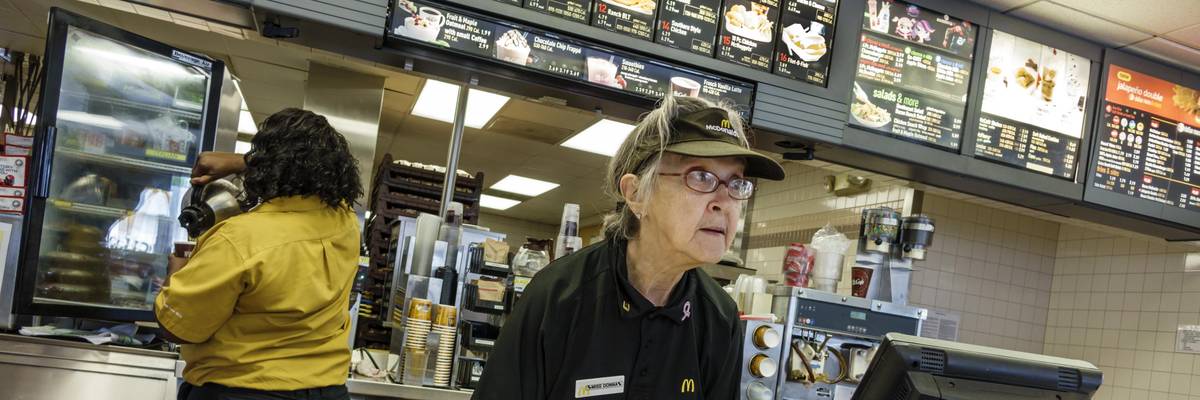
Senior woman working in McDonald's fast food restaurant. (Photo: Jeffrey Greenberg/Universal Images Group via Getty Images)
California Governor Gavin News has signed AB 257--a bill championing workers' rights in the fast food industry--into law. Despite being a huge step forward for workers, tens of millions of dollars will be spent trying to kill it. Before anyone has a chance to vote on it via a possible ballot measure, it's key that people understand the bigger picture of just how damaging, pervasive, and exploitative "workplace fissuring" is throughout almost every industry.
Workplace fissuring occurs when an employer starts to crack little bits of its business off in order to outsource these tasks. Fissuring began in the 1970s with companies seeking to maximize profits by shedding janitorial or security work, but the practice has grown exponentially across almost every sector of our economy. The reason is clear: by sidestepping their responsibility for workers through the use of contractors, companies take on less responsibility and gain higher profit margins.
If exploiting workers for a more profitable McDonald's turns your stomach, you'll want to reconsider where you sleep, seek care for your aging parents, or even where you get legal advice.
At the heart of AB 257 are franchised restaurants: Most of us are familiar with the concept--a franchise owner may run and control a particular McDonald's, but they are beholden to the McDonald's corporation to operate that restaurant according to strict standards set by the parent corporation. A Big Mac tastes the same everywhere. But those standards place such pressure on individual franchisees that their workers inevitably suffer wage theft, discrimination, unsafe work environments, unstable schedules, and chronic understaffing. Franchisees are so squeezed by their corporate bosses that the only avenue to eke out profit is through cutting labor costs, which incentivizes franchises to act illegally when it comes to their workers. And while workers suffer, corporate executives and shareholders win big: the McDonald's corporation reported a $13 billion profit in 2021.
The fast food industry is the epitome of an exploitative work environment. It's harder to enjoy that Big Mac when you become aware of the human cost behind it. Not very appetizing.
If exploiting workers for a more profitable McDonald's turns your stomach, you'll want to reconsider where you sleep, seek care for your aging parents, or even where you get legal advice. That's because hotels, the homecare industry, law firms, and just about every other white collar sector profit thanks to workplace fissuring.
In my work I focus specifically on improving job quality and how empowering workers ultimately builds better public policy. The evidence is clear: more and more, any task that employers can outsource gets downgraded into a hazy web of subcontractors. It began with things like payroll, accounting, and human resources, then moved on to janitorial services and customer service. In some industries, it's gone far beyond that to some of the functions most of us consider far more "front of house" tasks such as home care workers, university staff, and, yes, actual front desk workers. Step into a hotel and most of the people you encounter are unlikely to actually be employed by that hotel.
Even workplaces that we understand as social goods--hospitals and nursing homes, schools and childcare centers, and social work--are all experiencing fissures. The bottomline for employers is improved profit margins, while the bottom line for workers is fewer rights, protections, and dollars in their paychecks. In our McDonald's example, the corporation or franchisor, avoids paying into unemployment insurance, workers compensation, and payroll taxes, yet the corporation dictates almost every detail of the working lives of the people in those roles.
In his landmark book, "The Fissured Workplace," David Weil found that the chance of a labor violation being investigated in fissured industries was as little as one in 1,000, compared to one in 100 at a non-fissured workplace.
If workplace fissuring continues to grow at the exponential rate we're currently seeing, the result will be that workers' rights, power, and pay will suffer. But as California showed us, the slow erosion of our rights at work isn't inevitable. Hopefully, the law in California will stand and more states follow that lead, so that we may see the trend moving in a much more just direction.
Dear Common Dreams reader, It’s been nearly 30 years since I co-founded Common Dreams with my late wife, Lina Newhouser. We had the radical notion that journalism should serve the public good, not corporate profits. It was clear to us from the outset what it would take to build such a project. No paid advertisements. No corporate sponsors. No millionaire publisher telling us what to think or do. Many people said we wouldn't last a year, but we proved those doubters wrong. Together with a tremendous team of journalists and dedicated staff, we built an independent media outlet free from the constraints of profits and corporate control. Our mission has always been simple: To inform. To inspire. To ignite change for the common good. Building Common Dreams was not easy. Our survival was never guaranteed. When you take on the most powerful forces—Wall Street greed, fossil fuel industry destruction, Big Tech lobbyists, and uber-rich oligarchs who have spent billions upon billions rigging the economy and democracy in their favor—the only bulwark you have is supporters who believe in your work. But here’s the urgent message from me today. It's never been this bad out there. And it's never been this hard to keep us going. At the very moment Common Dreams is most needed, the threats we face are intensifying. We need your support now more than ever. We don't accept corporate advertising and never will. We don't have a paywall because we don't think people should be blocked from critical news based on their ability to pay. Everything we do is funded by the donations of readers like you. When everyone does the little they can afford, we are strong. But if that support retreats or dries up, so do we. Will you donate now to make sure Common Dreams not only survives but thrives? —Craig Brown, Co-founder |
California Governor Gavin News has signed AB 257--a bill championing workers' rights in the fast food industry--into law. Despite being a huge step forward for workers, tens of millions of dollars will be spent trying to kill it. Before anyone has a chance to vote on it via a possible ballot measure, it's key that people understand the bigger picture of just how damaging, pervasive, and exploitative "workplace fissuring" is throughout almost every industry.
Workplace fissuring occurs when an employer starts to crack little bits of its business off in order to outsource these tasks. Fissuring began in the 1970s with companies seeking to maximize profits by shedding janitorial or security work, but the practice has grown exponentially across almost every sector of our economy. The reason is clear: by sidestepping their responsibility for workers through the use of contractors, companies take on less responsibility and gain higher profit margins.
If exploiting workers for a more profitable McDonald's turns your stomach, you'll want to reconsider where you sleep, seek care for your aging parents, or even where you get legal advice.
At the heart of AB 257 are franchised restaurants: Most of us are familiar with the concept--a franchise owner may run and control a particular McDonald's, but they are beholden to the McDonald's corporation to operate that restaurant according to strict standards set by the parent corporation. A Big Mac tastes the same everywhere. But those standards place such pressure on individual franchisees that their workers inevitably suffer wage theft, discrimination, unsafe work environments, unstable schedules, and chronic understaffing. Franchisees are so squeezed by their corporate bosses that the only avenue to eke out profit is through cutting labor costs, which incentivizes franchises to act illegally when it comes to their workers. And while workers suffer, corporate executives and shareholders win big: the McDonald's corporation reported a $13 billion profit in 2021.
The fast food industry is the epitome of an exploitative work environment. It's harder to enjoy that Big Mac when you become aware of the human cost behind it. Not very appetizing.
If exploiting workers for a more profitable McDonald's turns your stomach, you'll want to reconsider where you sleep, seek care for your aging parents, or even where you get legal advice. That's because hotels, the homecare industry, law firms, and just about every other white collar sector profit thanks to workplace fissuring.
In my work I focus specifically on improving job quality and how empowering workers ultimately builds better public policy. The evidence is clear: more and more, any task that employers can outsource gets downgraded into a hazy web of subcontractors. It began with things like payroll, accounting, and human resources, then moved on to janitorial services and customer service. In some industries, it's gone far beyond that to some of the functions most of us consider far more "front of house" tasks such as home care workers, university staff, and, yes, actual front desk workers. Step into a hotel and most of the people you encounter are unlikely to actually be employed by that hotel.
Even workplaces that we understand as social goods--hospitals and nursing homes, schools and childcare centers, and social work--are all experiencing fissures. The bottomline for employers is improved profit margins, while the bottom line for workers is fewer rights, protections, and dollars in their paychecks. In our McDonald's example, the corporation or franchisor, avoids paying into unemployment insurance, workers compensation, and payroll taxes, yet the corporation dictates almost every detail of the working lives of the people in those roles.
In his landmark book, "The Fissured Workplace," David Weil found that the chance of a labor violation being investigated in fissured industries was as little as one in 1,000, compared to one in 100 at a non-fissured workplace.
If workplace fissuring continues to grow at the exponential rate we're currently seeing, the result will be that workers' rights, power, and pay will suffer. But as California showed us, the slow erosion of our rights at work isn't inevitable. Hopefully, the law in California will stand and more states follow that lead, so that we may see the trend moving in a much more just direction.
California Governor Gavin News has signed AB 257--a bill championing workers' rights in the fast food industry--into law. Despite being a huge step forward for workers, tens of millions of dollars will be spent trying to kill it. Before anyone has a chance to vote on it via a possible ballot measure, it's key that people understand the bigger picture of just how damaging, pervasive, and exploitative "workplace fissuring" is throughout almost every industry.
Workplace fissuring occurs when an employer starts to crack little bits of its business off in order to outsource these tasks. Fissuring began in the 1970s with companies seeking to maximize profits by shedding janitorial or security work, but the practice has grown exponentially across almost every sector of our economy. The reason is clear: by sidestepping their responsibility for workers through the use of contractors, companies take on less responsibility and gain higher profit margins.
If exploiting workers for a more profitable McDonald's turns your stomach, you'll want to reconsider where you sleep, seek care for your aging parents, or even where you get legal advice.
At the heart of AB 257 are franchised restaurants: Most of us are familiar with the concept--a franchise owner may run and control a particular McDonald's, but they are beholden to the McDonald's corporation to operate that restaurant according to strict standards set by the parent corporation. A Big Mac tastes the same everywhere. But those standards place such pressure on individual franchisees that their workers inevitably suffer wage theft, discrimination, unsafe work environments, unstable schedules, and chronic understaffing. Franchisees are so squeezed by their corporate bosses that the only avenue to eke out profit is through cutting labor costs, which incentivizes franchises to act illegally when it comes to their workers. And while workers suffer, corporate executives and shareholders win big: the McDonald's corporation reported a $13 billion profit in 2021.
The fast food industry is the epitome of an exploitative work environment. It's harder to enjoy that Big Mac when you become aware of the human cost behind it. Not very appetizing.
If exploiting workers for a more profitable McDonald's turns your stomach, you'll want to reconsider where you sleep, seek care for your aging parents, or even where you get legal advice. That's because hotels, the homecare industry, law firms, and just about every other white collar sector profit thanks to workplace fissuring.
In my work I focus specifically on improving job quality and how empowering workers ultimately builds better public policy. The evidence is clear: more and more, any task that employers can outsource gets downgraded into a hazy web of subcontractors. It began with things like payroll, accounting, and human resources, then moved on to janitorial services and customer service. In some industries, it's gone far beyond that to some of the functions most of us consider far more "front of house" tasks such as home care workers, university staff, and, yes, actual front desk workers. Step into a hotel and most of the people you encounter are unlikely to actually be employed by that hotel.
Even workplaces that we understand as social goods--hospitals and nursing homes, schools and childcare centers, and social work--are all experiencing fissures. The bottomline for employers is improved profit margins, while the bottom line for workers is fewer rights, protections, and dollars in their paychecks. In our McDonald's example, the corporation or franchisor, avoids paying into unemployment insurance, workers compensation, and payroll taxes, yet the corporation dictates almost every detail of the working lives of the people in those roles.
In his landmark book, "The Fissured Workplace," David Weil found that the chance of a labor violation being investigated in fissured industries was as little as one in 1,000, compared to one in 100 at a non-fissured workplace.
If workplace fissuring continues to grow at the exponential rate we're currently seeing, the result will be that workers' rights, power, and pay will suffer. But as California showed us, the slow erosion of our rights at work isn't inevitable. Hopefully, the law in California will stand and more states follow that lead, so that we may see the trend moving in a much more just direction.