SUBSCRIBE TO OUR FREE NEWSLETTER
Daily news & progressive opinion—funded by the people, not the corporations—delivered straight to your inbox.
5
#000000
#FFFFFF
To donate by check, phone, or other method, see our More Ways to Give page.
Daily news & progressive opinion—funded by the people, not the corporations—delivered straight to your inbox.
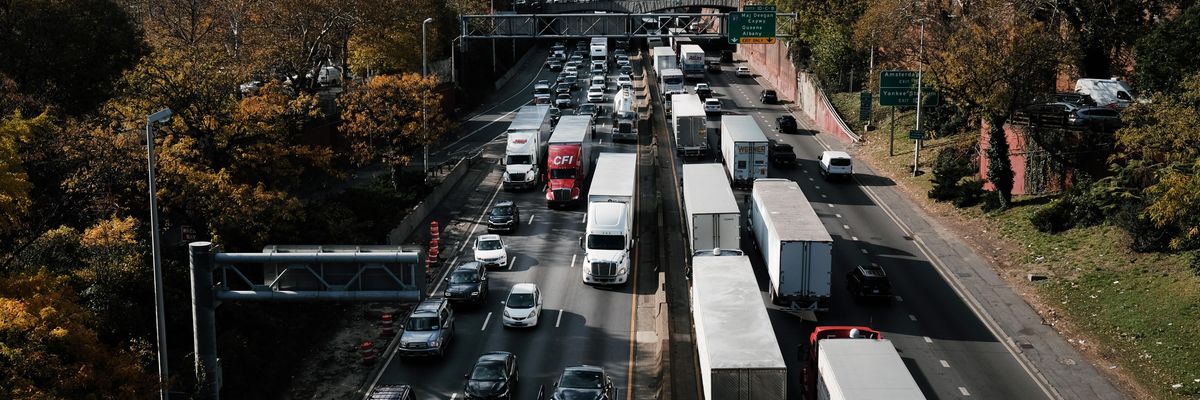
Cars and trucks move along the Cross Bronx Expressway, a notorious stretch of highway in New York City that is often choked with traffic and contributes to pollution and poor air quality on November 16, 2021 in New York City. Funds allocated from the Biden administration's infrastructure legislation will be used to study capping, or putting a deck over, a stretch of the highway as a way to decrease pollution that has caused high rates of asthma in the borough. (Photo: Spencer Platt/Getty Images)
The heat. It's never been hotter in our lifetimes.
This past spring the mercury hit nearly 124 degrees Fahrenheit in the Pakistani city of Jacobabad--"just below the conventional estimate for the threshold of human survival," notes science writer David Wallace-Wells.
The vast majority of the South Bronx has no tree cover, and that absence--coupled with asphalt everywhere--nurtures heat pockets that compound air pollution.
This summer's U.S. daily high temperatures continued our globe's torrid pace.
In Phoenix, daily highs averaged well over 100 all summer long. Citing the "imminent threat" of heat-driven wildfires, Oregon's governor declared a state of emergency last month. California, meanwhile, declared a statewide grid emergency amid surging demand for power during another record heatwave.
Stories like these might well be focusing people's attention on climate change. But what's getting less coverage is how these temperatures are connected to inequality.
The inequality of modern America doesn't just determine who suffers the most from all the heat. Inequality is actually driving the mercury higher, as new research from New York details.
A block-by-block heat assessment--the first ever--found that temperatures in the city's low-income South Bronx run 8 degrees higher than in the high-income neighborhoods of Manhattan's Upper West and East Sides.
How does economic inequality generate temperature differentials? At a most basic level, the rich and powerful use their wealth and power to shunt the most undesirable aspects of modern life onto poor neighborhoods.
Take transportation.
Five major highways--the notorious Cross Bronx Expressway among them--cut through and encircle the South Bronx. These high-traffic corridors spew contaminants into the air and deny South Bronx residents access to heat-relieving green and "blue"--public waterfront--spaces.
In the South Bronx, these spaces barely even exist. The area has about only one park for every 60,000 residents.
In New York's most affluent neighborhoods, streets themselves can actually become park-like when they sport plenty of tree cover. The vast majority of the South Bronx has no tree cover, and that absence--coupled with asphalt everywhere--nurtures heat pockets that compound air pollution. And the South Bronx's old housing stock leaves residents few escapes from all this bad air and heat.
One result: The Bronx overall commands just 17 percent of New York City's population but 95 percent of the city's hospitalizations for asthma.
Community activists in the advocacy group South Bronx Unite are working to overturn these deadly social and environmental dynamics. They've proposed a plan "to provide 100,000+ people access to a public waterfront that, for decades, has been inaccessible."
Activists are also working to offset the incredible environmental damage that comes from the heavy daily traffic on the Cross Bronx Expressway, where the rumblings of 300 diesel trucks every hour are fouling the air and leaving the South Bronx ever hotter.
They're pushing for an ambitious project that "would add a deck on top of below-grade sections of the Cross Bronx Expressway, with filtered vents to scrub exhaust," according to Columbia University's public health school.
Atop the deck, under the project plan, would be a green park--a project akin to others in cities like Boston, Dallas, and Seattle.
Building out such an effort, analysts believe, would cost $750 million. Too ambitious? Maybe not. New York City, Forbes reported this past spring, now boasts more billionaires "than any other city on the planet."
The city's 107 billionaire residents have a combined net worth of $640 billion. A 1-percent annual wealth tax on that combined fortune would raise over eight times the cost of the proposed cap-the-Cross-Bronx-Expressway project in just one year.
If rising inequality can drive climate change, then closing those gaps can help reverse it--in New York and anywhere else.
Dear Common Dreams reader, It’s been nearly 30 years since I co-founded Common Dreams with my late wife, Lina Newhouser. We had the radical notion that journalism should serve the public good, not corporate profits. It was clear to us from the outset what it would take to build such a project. No paid advertisements. No corporate sponsors. No millionaire publisher telling us what to think or do. Many people said we wouldn't last a year, but we proved those doubters wrong. Together with a tremendous team of journalists and dedicated staff, we built an independent media outlet free from the constraints of profits and corporate control. Our mission has always been simple: To inform. To inspire. To ignite change for the common good. Building Common Dreams was not easy. Our survival was never guaranteed. When you take on the most powerful forces—Wall Street greed, fossil fuel industry destruction, Big Tech lobbyists, and uber-rich oligarchs who have spent billions upon billions rigging the economy and democracy in their favor—the only bulwark you have is supporters who believe in your work. But here’s the urgent message from me today. It's never been this bad out there. And it's never been this hard to keep us going. At the very moment Common Dreams is most needed, the threats we face are intensifying. We need your support now more than ever. We don't accept corporate advertising and never will. We don't have a paywall because we don't think people should be blocked from critical news based on their ability to pay. Everything we do is funded by the donations of readers like you. When everyone does the little they can afford, we are strong. But if that support retreats or dries up, so do we. Will you donate now to make sure Common Dreams not only survives but thrives? —Craig Brown, Co-founder |
The heat. It's never been hotter in our lifetimes.
This past spring the mercury hit nearly 124 degrees Fahrenheit in the Pakistani city of Jacobabad--"just below the conventional estimate for the threshold of human survival," notes science writer David Wallace-Wells.
The vast majority of the South Bronx has no tree cover, and that absence--coupled with asphalt everywhere--nurtures heat pockets that compound air pollution.
This summer's U.S. daily high temperatures continued our globe's torrid pace.
In Phoenix, daily highs averaged well over 100 all summer long. Citing the "imminent threat" of heat-driven wildfires, Oregon's governor declared a state of emergency last month. California, meanwhile, declared a statewide grid emergency amid surging demand for power during another record heatwave.
Stories like these might well be focusing people's attention on climate change. But what's getting less coverage is how these temperatures are connected to inequality.
The inequality of modern America doesn't just determine who suffers the most from all the heat. Inequality is actually driving the mercury higher, as new research from New York details.
A block-by-block heat assessment--the first ever--found that temperatures in the city's low-income South Bronx run 8 degrees higher than in the high-income neighborhoods of Manhattan's Upper West and East Sides.
How does economic inequality generate temperature differentials? At a most basic level, the rich and powerful use their wealth and power to shunt the most undesirable aspects of modern life onto poor neighborhoods.
Take transportation.
Five major highways--the notorious Cross Bronx Expressway among them--cut through and encircle the South Bronx. These high-traffic corridors spew contaminants into the air and deny South Bronx residents access to heat-relieving green and "blue"--public waterfront--spaces.
In the South Bronx, these spaces barely even exist. The area has about only one park for every 60,000 residents.
In New York's most affluent neighborhoods, streets themselves can actually become park-like when they sport plenty of tree cover. The vast majority of the South Bronx has no tree cover, and that absence--coupled with asphalt everywhere--nurtures heat pockets that compound air pollution. And the South Bronx's old housing stock leaves residents few escapes from all this bad air and heat.
One result: The Bronx overall commands just 17 percent of New York City's population but 95 percent of the city's hospitalizations for asthma.
Community activists in the advocacy group South Bronx Unite are working to overturn these deadly social and environmental dynamics. They've proposed a plan "to provide 100,000+ people access to a public waterfront that, for decades, has been inaccessible."
Activists are also working to offset the incredible environmental damage that comes from the heavy daily traffic on the Cross Bronx Expressway, where the rumblings of 300 diesel trucks every hour are fouling the air and leaving the South Bronx ever hotter.
They're pushing for an ambitious project that "would add a deck on top of below-grade sections of the Cross Bronx Expressway, with filtered vents to scrub exhaust," according to Columbia University's public health school.
Atop the deck, under the project plan, would be a green park--a project akin to others in cities like Boston, Dallas, and Seattle.
Building out such an effort, analysts believe, would cost $750 million. Too ambitious? Maybe not. New York City, Forbes reported this past spring, now boasts more billionaires "than any other city on the planet."
The city's 107 billionaire residents have a combined net worth of $640 billion. A 1-percent annual wealth tax on that combined fortune would raise over eight times the cost of the proposed cap-the-Cross-Bronx-Expressway project in just one year.
If rising inequality can drive climate change, then closing those gaps can help reverse it--in New York and anywhere else.
The heat. It's never been hotter in our lifetimes.
This past spring the mercury hit nearly 124 degrees Fahrenheit in the Pakistani city of Jacobabad--"just below the conventional estimate for the threshold of human survival," notes science writer David Wallace-Wells.
The vast majority of the South Bronx has no tree cover, and that absence--coupled with asphalt everywhere--nurtures heat pockets that compound air pollution.
This summer's U.S. daily high temperatures continued our globe's torrid pace.
In Phoenix, daily highs averaged well over 100 all summer long. Citing the "imminent threat" of heat-driven wildfires, Oregon's governor declared a state of emergency last month. California, meanwhile, declared a statewide grid emergency amid surging demand for power during another record heatwave.
Stories like these might well be focusing people's attention on climate change. But what's getting less coverage is how these temperatures are connected to inequality.
The inequality of modern America doesn't just determine who suffers the most from all the heat. Inequality is actually driving the mercury higher, as new research from New York details.
A block-by-block heat assessment--the first ever--found that temperatures in the city's low-income South Bronx run 8 degrees higher than in the high-income neighborhoods of Manhattan's Upper West and East Sides.
How does economic inequality generate temperature differentials? At a most basic level, the rich and powerful use their wealth and power to shunt the most undesirable aspects of modern life onto poor neighborhoods.
Take transportation.
Five major highways--the notorious Cross Bronx Expressway among them--cut through and encircle the South Bronx. These high-traffic corridors spew contaminants into the air and deny South Bronx residents access to heat-relieving green and "blue"--public waterfront--spaces.
In the South Bronx, these spaces barely even exist. The area has about only one park for every 60,000 residents.
In New York's most affluent neighborhoods, streets themselves can actually become park-like when they sport plenty of tree cover. The vast majority of the South Bronx has no tree cover, and that absence--coupled with asphalt everywhere--nurtures heat pockets that compound air pollution. And the South Bronx's old housing stock leaves residents few escapes from all this bad air and heat.
One result: The Bronx overall commands just 17 percent of New York City's population but 95 percent of the city's hospitalizations for asthma.
Community activists in the advocacy group South Bronx Unite are working to overturn these deadly social and environmental dynamics. They've proposed a plan "to provide 100,000+ people access to a public waterfront that, for decades, has been inaccessible."
Activists are also working to offset the incredible environmental damage that comes from the heavy daily traffic on the Cross Bronx Expressway, where the rumblings of 300 diesel trucks every hour are fouling the air and leaving the South Bronx ever hotter.
They're pushing for an ambitious project that "would add a deck on top of below-grade sections of the Cross Bronx Expressway, with filtered vents to scrub exhaust," according to Columbia University's public health school.
Atop the deck, under the project plan, would be a green park--a project akin to others in cities like Boston, Dallas, and Seattle.
Building out such an effort, analysts believe, would cost $750 million. Too ambitious? Maybe not. New York City, Forbes reported this past spring, now boasts more billionaires "than any other city on the planet."
The city's 107 billionaire residents have a combined net worth of $640 billion. A 1-percent annual wealth tax on that combined fortune would raise over eight times the cost of the proposed cap-the-Cross-Bronx-Expressway project in just one year.
If rising inequality can drive climate change, then closing those gaps can help reverse it--in New York and anywhere else.