SUBSCRIBE TO OUR FREE NEWSLETTER
Daily news & progressive opinion—funded by the people, not the corporations—delivered straight to your inbox.
5
#000000
#FFFFFF
To donate by check, phone, or other method, see our More Ways to Give page.
Daily news & progressive opinion—funded by the people, not the corporations—delivered straight to your inbox.
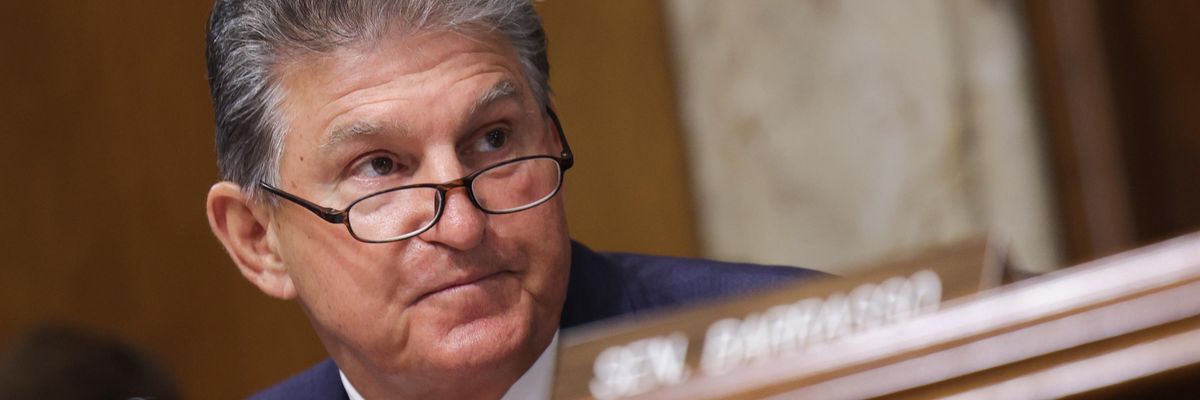
U.S. Sen. Joe Manchin (D-WV) participates in a Senate Energy and Natural Resources Committee mark up, on Capitol Hill on May 03, 2022 in Washington, DC. (Photo:Kevin Dietsch/Getty Images)
Assuming that the Democratic majority in the House passes the massive climate bill this week, the next round for federal climate action will come when Congress returns after its August recess, and it will center on something euphemistically called 'permitting reform.'
In return for Manchin's vote for the IRA--the first significant action Congress has ever taken on the climate crisis--Chuck Schumer apparently promised that 'permitting reform' language would be attached to some piece of 'must-pass' legislation in the fall. It's designed to make it easier to build energy projects of all kinds--but Manchin's clearest intention is to guarantee construction of the Mountain Valley Pipeline (MVP), an unnecessary piece of infrastructure that would extend the fossil fuel era in the region a few more decades, endangering local communities along the way.
Acting on climate doesn't entitle him to the pipeline of his choice
The opposition to that pipeline has been fierce enough to scare Manchin and his backers in the fracking industry. Indeed, second only to the young people from the Sunrise Movement, it's clear that the world owes those opponents a huge debt of gratitude: without them Manchin might never have come to the table with a bill that cuts emissions and gives the U.S. a role again in the global climate fight.
But that does not mean that Democrats owe Manchin his permitting reform (especially since they've already given him plenty of other gifts in the IRA, including lots of cash for dubious carbon-capture projects).
For one thing, he's demonstrated that promises aren't binding: House progressives passed the fossil-friendly Bipartisan Infrastructure bill on his word that he would support what was then called Build Back Better. But Manchin reneged, gutting much of what was best in that bill, and only at the bitter end (when it became clear that his lifetime legacy would be blocking any action on the greatest crisis in history) allowing the IRA to pass the Senate.
For another, Manchin's promise in this case was extracted by extortion. The IRA will save myriad lives: many thousands of people who will breathe fewer particulates and then die from the lung damage, and many millions who won't die in whatever portion of the climate crisis its emission cuts avert. Manchin--who has taken more money from the fossil fuel industry than anyone else in DC--essentially held a gun to the head of negotiators: give me my pipeline or these people perish. I've watched enough hostage dramas on tv to know that the guy with the bullhorn promises what he needs to in order to bring the crime to an end, but then feels no moral need to actually produce the helicopter.
Which is not to say it wouldn't be messy for progressives to blow Manchin off. As David Dayen points out in the American Prospect, this time environmentally-minded Senators may hold the balance of power, and they should use it; but then we need to be prepared for any number of scenarios (including the West Virginia Democrat becoming a West Virginia Republican and handing the Senate back to Mitch McConnell.) It's possible, however, that progressives may not have to act alone. The Wall Street Journal reported earlier today that the GOP--still profoundly annoyed that anyone did anything to lower the planet's temperature--has reasons of their own for potentially opposing the permitting reform.
"I will not vote for a continuing resolution that's part of a political payback scheme," Lindsay. Graham said at a press conference, adding that Republicans should ask Democrats for special concessions for each of their states. "If they won't do that, we should have a continuing resolution that's clean," without other measures tacked on. "I don't think West Virginians trust the likes of Nancy Pelosi, Chuck Schumer, and Joe Biden to follow through on a plan that would expand drilling, build pipelines or decrease regulations," Sen. Shelley Moore Capito (R., W.Va.) wrote recently in the Charleston Gazette-Mail. "And, given their track record, I can't either."
Whatever Republicans do--and in the end they will do what Big Oil instructs them to do--progressives should not sign off on permitting reform that helps expand the fossil fuel empire. The question for every energy project should be: does it add carbon to the atmosphere? If the answer is yes, then the answer should be No. We're in a life-and-death struggle for a working planet; the IRA advances our chances, and permitting reform would reduce them. The moral choice is therefore obvious.
Groups that worked to pass the IRA are now working to derail the permitting reform. Here's EarthJustice, for instance, which has used the current permitting system to prevent as much fossil fuel mischief as possible: "The National Environmental Policy Act is a bridge, not a barrier, to ensuring that we build out the clean energy infrastructure of the future in a just, equitable, sustainable, and timely way. Chipping away at NEPA prioritizes polluting industries and fossil fuel interests over people who are dealing with prolonged exposure to toxic pollution. No deal should do further harm to NEPA or force the president to endorse new fossil fuels projects in the midst of our climate emergency."
They're right--so let your Congressperson know. Manchin played games for years; it's time to play games with his game.
For more content like this, sign up for Bill McKibben's new substack newsletter, The Crucial Years.
Dear Common Dreams reader, It’s been nearly 30 years since I co-founded Common Dreams with my late wife, Lina Newhouser. We had the radical notion that journalism should serve the public good, not corporate profits. It was clear to us from the outset what it would take to build such a project. No paid advertisements. No corporate sponsors. No millionaire publisher telling us what to think or do. Many people said we wouldn't last a year, but we proved those doubters wrong. Together with a tremendous team of journalists and dedicated staff, we built an independent media outlet free from the constraints of profits and corporate control. Our mission has always been simple: To inform. To inspire. To ignite change for the common good. Building Common Dreams was not easy. Our survival was never guaranteed. When you take on the most powerful forces—Wall Street greed, fossil fuel industry destruction, Big Tech lobbyists, and uber-rich oligarchs who have spent billions upon billions rigging the economy and democracy in their favor—the only bulwark you have is supporters who believe in your work. But here’s the urgent message from me today. It's never been this bad out there. And it's never been this hard to keep us going. At the very moment Common Dreams is most needed, the threats we face are intensifying. We need your support now more than ever. We don't accept corporate advertising and never will. We don't have a paywall because we don't think people should be blocked from critical news based on their ability to pay. Everything we do is funded by the donations of readers like you. When everyone does the little they can afford, we are strong. But if that support retreats or dries up, so do we. Will you donate now to make sure Common Dreams not only survives but thrives? —Craig Brown, Co-founder |
Assuming that the Democratic majority in the House passes the massive climate bill this week, the next round for federal climate action will come when Congress returns after its August recess, and it will center on something euphemistically called 'permitting reform.'
In return for Manchin's vote for the IRA--the first significant action Congress has ever taken on the climate crisis--Chuck Schumer apparently promised that 'permitting reform' language would be attached to some piece of 'must-pass' legislation in the fall. It's designed to make it easier to build energy projects of all kinds--but Manchin's clearest intention is to guarantee construction of the Mountain Valley Pipeline (MVP), an unnecessary piece of infrastructure that would extend the fossil fuel era in the region a few more decades, endangering local communities along the way.
Acting on climate doesn't entitle him to the pipeline of his choice
The opposition to that pipeline has been fierce enough to scare Manchin and his backers in the fracking industry. Indeed, second only to the young people from the Sunrise Movement, it's clear that the world owes those opponents a huge debt of gratitude: without them Manchin might never have come to the table with a bill that cuts emissions and gives the U.S. a role again in the global climate fight.
But that does not mean that Democrats owe Manchin his permitting reform (especially since they've already given him plenty of other gifts in the IRA, including lots of cash for dubious carbon-capture projects).
For one thing, he's demonstrated that promises aren't binding: House progressives passed the fossil-friendly Bipartisan Infrastructure bill on his word that he would support what was then called Build Back Better. But Manchin reneged, gutting much of what was best in that bill, and only at the bitter end (when it became clear that his lifetime legacy would be blocking any action on the greatest crisis in history) allowing the IRA to pass the Senate.
For another, Manchin's promise in this case was extracted by extortion. The IRA will save myriad lives: many thousands of people who will breathe fewer particulates and then die from the lung damage, and many millions who won't die in whatever portion of the climate crisis its emission cuts avert. Manchin--who has taken more money from the fossil fuel industry than anyone else in DC--essentially held a gun to the head of negotiators: give me my pipeline or these people perish. I've watched enough hostage dramas on tv to know that the guy with the bullhorn promises what he needs to in order to bring the crime to an end, but then feels no moral need to actually produce the helicopter.
Which is not to say it wouldn't be messy for progressives to blow Manchin off. As David Dayen points out in the American Prospect, this time environmentally-minded Senators may hold the balance of power, and they should use it; but then we need to be prepared for any number of scenarios (including the West Virginia Democrat becoming a West Virginia Republican and handing the Senate back to Mitch McConnell.) It's possible, however, that progressives may not have to act alone. The Wall Street Journal reported earlier today that the GOP--still profoundly annoyed that anyone did anything to lower the planet's temperature--has reasons of their own for potentially opposing the permitting reform.
"I will not vote for a continuing resolution that's part of a political payback scheme," Lindsay. Graham said at a press conference, adding that Republicans should ask Democrats for special concessions for each of their states. "If they won't do that, we should have a continuing resolution that's clean," without other measures tacked on. "I don't think West Virginians trust the likes of Nancy Pelosi, Chuck Schumer, and Joe Biden to follow through on a plan that would expand drilling, build pipelines or decrease regulations," Sen. Shelley Moore Capito (R., W.Va.) wrote recently in the Charleston Gazette-Mail. "And, given their track record, I can't either."
Whatever Republicans do--and in the end they will do what Big Oil instructs them to do--progressives should not sign off on permitting reform that helps expand the fossil fuel empire. The question for every energy project should be: does it add carbon to the atmosphere? If the answer is yes, then the answer should be No. We're in a life-and-death struggle for a working planet; the IRA advances our chances, and permitting reform would reduce them. The moral choice is therefore obvious.
Groups that worked to pass the IRA are now working to derail the permitting reform. Here's EarthJustice, for instance, which has used the current permitting system to prevent as much fossil fuel mischief as possible: "The National Environmental Policy Act is a bridge, not a barrier, to ensuring that we build out the clean energy infrastructure of the future in a just, equitable, sustainable, and timely way. Chipping away at NEPA prioritizes polluting industries and fossil fuel interests over people who are dealing with prolonged exposure to toxic pollution. No deal should do further harm to NEPA or force the president to endorse new fossil fuels projects in the midst of our climate emergency."
They're right--so let your Congressperson know. Manchin played games for years; it's time to play games with his game.
For more content like this, sign up for Bill McKibben's new substack newsletter, The Crucial Years.
Assuming that the Democratic majority in the House passes the massive climate bill this week, the next round for federal climate action will come when Congress returns after its August recess, and it will center on something euphemistically called 'permitting reform.'
In return for Manchin's vote for the IRA--the first significant action Congress has ever taken on the climate crisis--Chuck Schumer apparently promised that 'permitting reform' language would be attached to some piece of 'must-pass' legislation in the fall. It's designed to make it easier to build energy projects of all kinds--but Manchin's clearest intention is to guarantee construction of the Mountain Valley Pipeline (MVP), an unnecessary piece of infrastructure that would extend the fossil fuel era in the region a few more decades, endangering local communities along the way.
Acting on climate doesn't entitle him to the pipeline of his choice
The opposition to that pipeline has been fierce enough to scare Manchin and his backers in the fracking industry. Indeed, second only to the young people from the Sunrise Movement, it's clear that the world owes those opponents a huge debt of gratitude: without them Manchin might never have come to the table with a bill that cuts emissions and gives the U.S. a role again in the global climate fight.
But that does not mean that Democrats owe Manchin his permitting reform (especially since they've already given him plenty of other gifts in the IRA, including lots of cash for dubious carbon-capture projects).
For one thing, he's demonstrated that promises aren't binding: House progressives passed the fossil-friendly Bipartisan Infrastructure bill on his word that he would support what was then called Build Back Better. But Manchin reneged, gutting much of what was best in that bill, and only at the bitter end (when it became clear that his lifetime legacy would be blocking any action on the greatest crisis in history) allowing the IRA to pass the Senate.
For another, Manchin's promise in this case was extracted by extortion. The IRA will save myriad lives: many thousands of people who will breathe fewer particulates and then die from the lung damage, and many millions who won't die in whatever portion of the climate crisis its emission cuts avert. Manchin--who has taken more money from the fossil fuel industry than anyone else in DC--essentially held a gun to the head of negotiators: give me my pipeline or these people perish. I've watched enough hostage dramas on tv to know that the guy with the bullhorn promises what he needs to in order to bring the crime to an end, but then feels no moral need to actually produce the helicopter.
Which is not to say it wouldn't be messy for progressives to blow Manchin off. As David Dayen points out in the American Prospect, this time environmentally-minded Senators may hold the balance of power, and they should use it; but then we need to be prepared for any number of scenarios (including the West Virginia Democrat becoming a West Virginia Republican and handing the Senate back to Mitch McConnell.) It's possible, however, that progressives may not have to act alone. The Wall Street Journal reported earlier today that the GOP--still profoundly annoyed that anyone did anything to lower the planet's temperature--has reasons of their own for potentially opposing the permitting reform.
"I will not vote for a continuing resolution that's part of a political payback scheme," Lindsay. Graham said at a press conference, adding that Republicans should ask Democrats for special concessions for each of their states. "If they won't do that, we should have a continuing resolution that's clean," without other measures tacked on. "I don't think West Virginians trust the likes of Nancy Pelosi, Chuck Schumer, and Joe Biden to follow through on a plan that would expand drilling, build pipelines or decrease regulations," Sen. Shelley Moore Capito (R., W.Va.) wrote recently in the Charleston Gazette-Mail. "And, given their track record, I can't either."
Whatever Republicans do--and in the end they will do what Big Oil instructs them to do--progressives should not sign off on permitting reform that helps expand the fossil fuel empire. The question for every energy project should be: does it add carbon to the atmosphere? If the answer is yes, then the answer should be No. We're in a life-and-death struggle for a working planet; the IRA advances our chances, and permitting reform would reduce them. The moral choice is therefore obvious.
Groups that worked to pass the IRA are now working to derail the permitting reform. Here's EarthJustice, for instance, which has used the current permitting system to prevent as much fossil fuel mischief as possible: "The National Environmental Policy Act is a bridge, not a barrier, to ensuring that we build out the clean energy infrastructure of the future in a just, equitable, sustainable, and timely way. Chipping away at NEPA prioritizes polluting industries and fossil fuel interests over people who are dealing with prolonged exposure to toxic pollution. No deal should do further harm to NEPA or force the president to endorse new fossil fuels projects in the midst of our climate emergency."
They're right--so let your Congressperson know. Manchin played games for years; it's time to play games with his game.
For more content like this, sign up for Bill McKibben's new substack newsletter, The Crucial Years.