SUBSCRIBE TO OUR FREE NEWSLETTER
Daily news & progressive opinion—funded by the people, not the corporations—delivered straight to your inbox.
5
#000000
#FFFFFF
To donate by check, phone, or other method, see our More Ways to Give page.
Daily news & progressive opinion—funded by the people, not the corporations—delivered straight to your inbox.
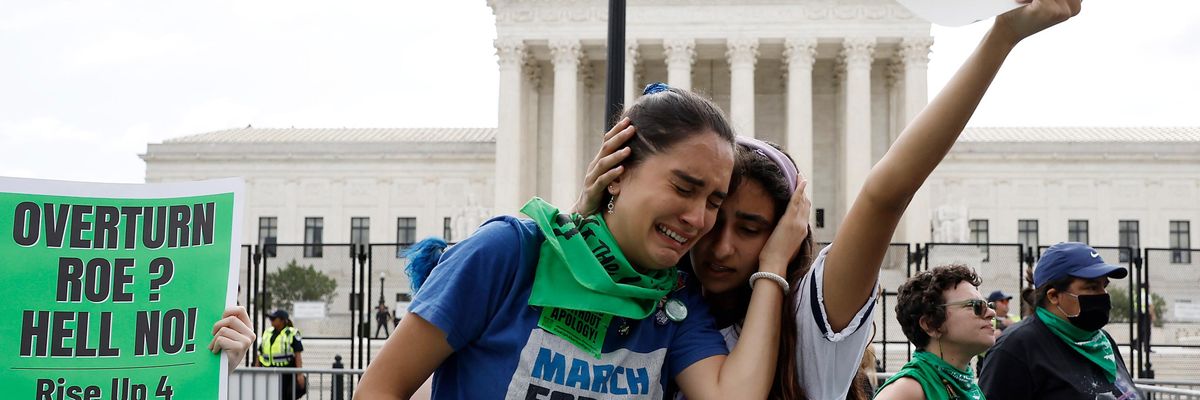
Abortion rights activists Carrie McDonald (L) and Soraya Bata react to the Dobbs v Jackson Women's Health Organization ruling which overturns the landmark abortion Roe v. Wade case in front of the U.S. Supreme Court on June 24, 2022 in Washington, DC. (Photo by Anna Moneymaker/Getty Images)
The Supreme Court's ruling in Dobbs v. Jackson Women's Health Organization is a devastating blow--for democracy and the rule of law, for the 64 percent of Americans who believe Roe v. Wade should stand, and for the low-income women and disproportionately women of color who will be most harmed.
What comes next? Inevitably, our work starts and ends with the ballot: voters must keep up the fight for free and fair elections and meaningful representation. And we must hold our elected leaders--from local prosecutors, to state legislators and governors, to members of Congress and the president of the United States--accountable to prioritizing matters of reproductive health, rights, and justice. Every one of them--and us--has a vital part to play.
In the courts, there are opportunities to bring to bear new arguments for expansive rights and reproductive autonomy under state constitutions. The long push to get the Equal Rights Amendment over the finish line could strengthen equality-based arguments and protections for abortion rights nationwide. And an ongoing jurisprudential drive to ensure more robust constitutional guardrails than Roe ever afforded remains essential.
In the first installment of Ms. magazine's Women & Democracy platform, a project I lead, experts from the Center for Reproductive Rights and others weighed in on some of the key legal and policy fights ahead. Here are excerpts from that collection, Beyond Roe: The Fight for Our Future.
Armed with human rights and global momentum, advocates around the world have won landmark victories protecting the right to abortion. In 2021, the Supreme Court of Mexico issued a ground-breaking decision, unanimously recognizing a constitutional right to safe, legal and free abortion services in early pregnancy and in other situations. The Court's landmark ruling, and the inclusive language used in the decision, constitute critically important steps towards decriminalization of abortion and its recognition as a human right.
That same year, the Inter-American Court ordered El Salvador to reform its legal and healthcare policies that criminalize women for seeking reproductive healthcare. Elsewhere in Latin America, Argentina, Ecuador, and, most recently, Colombia have also liberalized abortion access--what's been called the green wave. Examples in other regions of the world include Angola, India, Kenya, New Zealand, Northern Ireland, South Korea and Thailand. Since 1994, 60 countries have liberalized their abortion laws.
Here in the United States, we draw from that work to fight on--for stronger legal protections in Congress, including the Women's Health Protection Act that would secure a national right to access abortion, as well as the Equal Access to Abortion Coverage in Health Insurance (EACH) Act. We fight on in state legislatures. And we fight on in the courts, a critical pillar of democracy which we will never cede.
-Lourdes Rivera
Roe was never enough, especially as it was constricted in later cases. Though Roe provides an important foundation for reproductive autonomy rights beyond abortion, the law is underdeveloped when it comes to the constitutional right to have a healthy pregnancy, safely raise children and live without fear of being prosecuted for conduct during pregnancy or experiencing miscarriages or stillbirths.
The 14th Amendment requires the government to respect--and courts to protect--the constitutional and human right to reproductive autonomy, as follows: the right to liberty, which includes the right to bodily integrity and to make personal decisions related to family, marriage and childrearing; the right to equal protection, including from discriminatory laws that reinforce women's second-class status, that perpetuate racial inequality, and that deny equal justice to low-income people; and the right to life, much like human rights treaty bodies recognize the connection between abortion restrictions and maternal health and mortality.
-Diana Kasdan and Risa Kaufman
High courts in 11 states have recognized that their constitutions protect abortion rights independently from and more strongly than the U.S. Constitution, or have struck down restrictive laws that the Supreme Court has upheld. These opinions have not only protected access within the state, but also collectively influenced positive decisions in other states.
While state courts still have far to go--none have addressed the racial discrimination that undergirds restrictions, for example, or considered the intersection of pregnancy, childbirth and security for families as part of reproductive autonomy--they have built a legal foundation that goes beyond what the federal courts have allowed, including rulings rooted in fundamental privacy rights (Alaska, California, Florida, Massachusetts, Minnesota, Montana, New Jersey), equality arguments (Alaska, Arizona, California, New Jersey, New Mexico), and state traditions of personal autonomy (Kansas, Montana).
-Amy Myrick and Tamar Eisen
Each state has the power to ensure more equitable access for its own residents as well as anyone who travels there to access abortion care. Reforms can originate from the voters themselves via ballot initiatives -- like those underway now in Michigan and Vermont--or through the legislative process, whether forging new statutes or constitutional amendments. Beyond the repeal of medically unnecessary restrictions and all-out bans, among the policies passed or advancing in real-time across the country: financial help for patients, either via creating more public funding (Oregon) or requiring expanded private insurance coverage (California, New York); enabling a more diverse array of providers to be trained to provide safe care (Maryland, Washington); and stepping up protection for clinics and providers from harassment and violence (Maine). Abortion rights should never depend on someone's zip code.
-Elisabeth Smith
Dear Common Dreams reader, It’s been nearly 30 years since I co-founded Common Dreams with my late wife, Lina Newhouser. We had the radical notion that journalism should serve the public good, not corporate profits. It was clear to us from the outset what it would take to build such a project. No paid advertisements. No corporate sponsors. No millionaire publisher telling us what to think or do. Many people said we wouldn't last a year, but we proved those doubters wrong. Together with a tremendous team of journalists and dedicated staff, we built an independent media outlet free from the constraints of profits and corporate control. Our mission has always been simple: To inform. To inspire. To ignite change for the common good. Building Common Dreams was not easy. Our survival was never guaranteed. When you take on the most powerful forces—Wall Street greed, fossil fuel industry destruction, Big Tech lobbyists, and uber-rich oligarchs who have spent billions upon billions rigging the economy and democracy in their favor—the only bulwark you have is supporters who believe in your work. But here’s the urgent message from me today. It's never been this bad out there. And it's never been this hard to keep us going. At the very moment Common Dreams is most needed, the threats we face are intensifying. We need your support now more than ever. We don't accept corporate advertising and never will. We don't have a paywall because we don't think people should be blocked from critical news based on their ability to pay. Everything we do is funded by the donations of readers like you. When everyone does the little they can afford, we are strong. But if that support retreats or dries up, so do we. Will you donate now to make sure Common Dreams not only survives but thrives? —Craig Brown, Co-founder |
The Supreme Court's ruling in Dobbs v. Jackson Women's Health Organization is a devastating blow--for democracy and the rule of law, for the 64 percent of Americans who believe Roe v. Wade should stand, and for the low-income women and disproportionately women of color who will be most harmed.
What comes next? Inevitably, our work starts and ends with the ballot: voters must keep up the fight for free and fair elections and meaningful representation. And we must hold our elected leaders--from local prosecutors, to state legislators and governors, to members of Congress and the president of the United States--accountable to prioritizing matters of reproductive health, rights, and justice. Every one of them--and us--has a vital part to play.
In the courts, there are opportunities to bring to bear new arguments for expansive rights and reproductive autonomy under state constitutions. The long push to get the Equal Rights Amendment over the finish line could strengthen equality-based arguments and protections for abortion rights nationwide. And an ongoing jurisprudential drive to ensure more robust constitutional guardrails than Roe ever afforded remains essential.
In the first installment of Ms. magazine's Women & Democracy platform, a project I lead, experts from the Center for Reproductive Rights and others weighed in on some of the key legal and policy fights ahead. Here are excerpts from that collection, Beyond Roe: The Fight for Our Future.
Armed with human rights and global momentum, advocates around the world have won landmark victories protecting the right to abortion. In 2021, the Supreme Court of Mexico issued a ground-breaking decision, unanimously recognizing a constitutional right to safe, legal and free abortion services in early pregnancy and in other situations. The Court's landmark ruling, and the inclusive language used in the decision, constitute critically important steps towards decriminalization of abortion and its recognition as a human right.
That same year, the Inter-American Court ordered El Salvador to reform its legal and healthcare policies that criminalize women for seeking reproductive healthcare. Elsewhere in Latin America, Argentina, Ecuador, and, most recently, Colombia have also liberalized abortion access--what's been called the green wave. Examples in other regions of the world include Angola, India, Kenya, New Zealand, Northern Ireland, South Korea and Thailand. Since 1994, 60 countries have liberalized their abortion laws.
Here in the United States, we draw from that work to fight on--for stronger legal protections in Congress, including the Women's Health Protection Act that would secure a national right to access abortion, as well as the Equal Access to Abortion Coverage in Health Insurance (EACH) Act. We fight on in state legislatures. And we fight on in the courts, a critical pillar of democracy which we will never cede.
-Lourdes Rivera
Roe was never enough, especially as it was constricted in later cases. Though Roe provides an important foundation for reproductive autonomy rights beyond abortion, the law is underdeveloped when it comes to the constitutional right to have a healthy pregnancy, safely raise children and live without fear of being prosecuted for conduct during pregnancy or experiencing miscarriages or stillbirths.
The 14th Amendment requires the government to respect--and courts to protect--the constitutional and human right to reproductive autonomy, as follows: the right to liberty, which includes the right to bodily integrity and to make personal decisions related to family, marriage and childrearing; the right to equal protection, including from discriminatory laws that reinforce women's second-class status, that perpetuate racial inequality, and that deny equal justice to low-income people; and the right to life, much like human rights treaty bodies recognize the connection between abortion restrictions and maternal health and mortality.
-Diana Kasdan and Risa Kaufman
High courts in 11 states have recognized that their constitutions protect abortion rights independently from and more strongly than the U.S. Constitution, or have struck down restrictive laws that the Supreme Court has upheld. These opinions have not only protected access within the state, but also collectively influenced positive decisions in other states.
While state courts still have far to go--none have addressed the racial discrimination that undergirds restrictions, for example, or considered the intersection of pregnancy, childbirth and security for families as part of reproductive autonomy--they have built a legal foundation that goes beyond what the federal courts have allowed, including rulings rooted in fundamental privacy rights (Alaska, California, Florida, Massachusetts, Minnesota, Montana, New Jersey), equality arguments (Alaska, Arizona, California, New Jersey, New Mexico), and state traditions of personal autonomy (Kansas, Montana).
-Amy Myrick and Tamar Eisen
Each state has the power to ensure more equitable access for its own residents as well as anyone who travels there to access abortion care. Reforms can originate from the voters themselves via ballot initiatives -- like those underway now in Michigan and Vermont--or through the legislative process, whether forging new statutes or constitutional amendments. Beyond the repeal of medically unnecessary restrictions and all-out bans, among the policies passed or advancing in real-time across the country: financial help for patients, either via creating more public funding (Oregon) or requiring expanded private insurance coverage (California, New York); enabling a more diverse array of providers to be trained to provide safe care (Maryland, Washington); and stepping up protection for clinics and providers from harassment and violence (Maine). Abortion rights should never depend on someone's zip code.
-Elisabeth Smith
The Supreme Court's ruling in Dobbs v. Jackson Women's Health Organization is a devastating blow--for democracy and the rule of law, for the 64 percent of Americans who believe Roe v. Wade should stand, and for the low-income women and disproportionately women of color who will be most harmed.
What comes next? Inevitably, our work starts and ends with the ballot: voters must keep up the fight for free and fair elections and meaningful representation. And we must hold our elected leaders--from local prosecutors, to state legislators and governors, to members of Congress and the president of the United States--accountable to prioritizing matters of reproductive health, rights, and justice. Every one of them--and us--has a vital part to play.
In the courts, there are opportunities to bring to bear new arguments for expansive rights and reproductive autonomy under state constitutions. The long push to get the Equal Rights Amendment over the finish line could strengthen equality-based arguments and protections for abortion rights nationwide. And an ongoing jurisprudential drive to ensure more robust constitutional guardrails than Roe ever afforded remains essential.
In the first installment of Ms. magazine's Women & Democracy platform, a project I lead, experts from the Center for Reproductive Rights and others weighed in on some of the key legal and policy fights ahead. Here are excerpts from that collection, Beyond Roe: The Fight for Our Future.
Armed with human rights and global momentum, advocates around the world have won landmark victories protecting the right to abortion. In 2021, the Supreme Court of Mexico issued a ground-breaking decision, unanimously recognizing a constitutional right to safe, legal and free abortion services in early pregnancy and in other situations. The Court's landmark ruling, and the inclusive language used in the decision, constitute critically important steps towards decriminalization of abortion and its recognition as a human right.
That same year, the Inter-American Court ordered El Salvador to reform its legal and healthcare policies that criminalize women for seeking reproductive healthcare. Elsewhere in Latin America, Argentina, Ecuador, and, most recently, Colombia have also liberalized abortion access--what's been called the green wave. Examples in other regions of the world include Angola, India, Kenya, New Zealand, Northern Ireland, South Korea and Thailand. Since 1994, 60 countries have liberalized their abortion laws.
Here in the United States, we draw from that work to fight on--for stronger legal protections in Congress, including the Women's Health Protection Act that would secure a national right to access abortion, as well as the Equal Access to Abortion Coverage in Health Insurance (EACH) Act. We fight on in state legislatures. And we fight on in the courts, a critical pillar of democracy which we will never cede.
-Lourdes Rivera
Roe was never enough, especially as it was constricted in later cases. Though Roe provides an important foundation for reproductive autonomy rights beyond abortion, the law is underdeveloped when it comes to the constitutional right to have a healthy pregnancy, safely raise children and live without fear of being prosecuted for conduct during pregnancy or experiencing miscarriages or stillbirths.
The 14th Amendment requires the government to respect--and courts to protect--the constitutional and human right to reproductive autonomy, as follows: the right to liberty, which includes the right to bodily integrity and to make personal decisions related to family, marriage and childrearing; the right to equal protection, including from discriminatory laws that reinforce women's second-class status, that perpetuate racial inequality, and that deny equal justice to low-income people; and the right to life, much like human rights treaty bodies recognize the connection between abortion restrictions and maternal health and mortality.
-Diana Kasdan and Risa Kaufman
High courts in 11 states have recognized that their constitutions protect abortion rights independently from and more strongly than the U.S. Constitution, or have struck down restrictive laws that the Supreme Court has upheld. These opinions have not only protected access within the state, but also collectively influenced positive decisions in other states.
While state courts still have far to go--none have addressed the racial discrimination that undergirds restrictions, for example, or considered the intersection of pregnancy, childbirth and security for families as part of reproductive autonomy--they have built a legal foundation that goes beyond what the federal courts have allowed, including rulings rooted in fundamental privacy rights (Alaska, California, Florida, Massachusetts, Minnesota, Montana, New Jersey), equality arguments (Alaska, Arizona, California, New Jersey, New Mexico), and state traditions of personal autonomy (Kansas, Montana).
-Amy Myrick and Tamar Eisen
Each state has the power to ensure more equitable access for its own residents as well as anyone who travels there to access abortion care. Reforms can originate from the voters themselves via ballot initiatives -- like those underway now in Michigan and Vermont--or through the legislative process, whether forging new statutes or constitutional amendments. Beyond the repeal of medically unnecessary restrictions and all-out bans, among the policies passed or advancing in real-time across the country: financial help for patients, either via creating more public funding (Oregon) or requiring expanded private insurance coverage (California, New York); enabling a more diverse array of providers to be trained to provide safe care (Maryland, Washington); and stepping up protection for clinics and providers from harassment and violence (Maine). Abortion rights should never depend on someone's zip code.
-Elisabeth Smith