SUBSCRIBE TO OUR FREE NEWSLETTER
Daily news & progressive opinion—funded by the people, not the corporations—delivered straight to your inbox.
5
#000000
#FFFFFF
To donate by check, phone, or other method, see our More Ways to Give page.
Daily news & progressive opinion—funded by the people, not the corporations—delivered straight to your inbox.
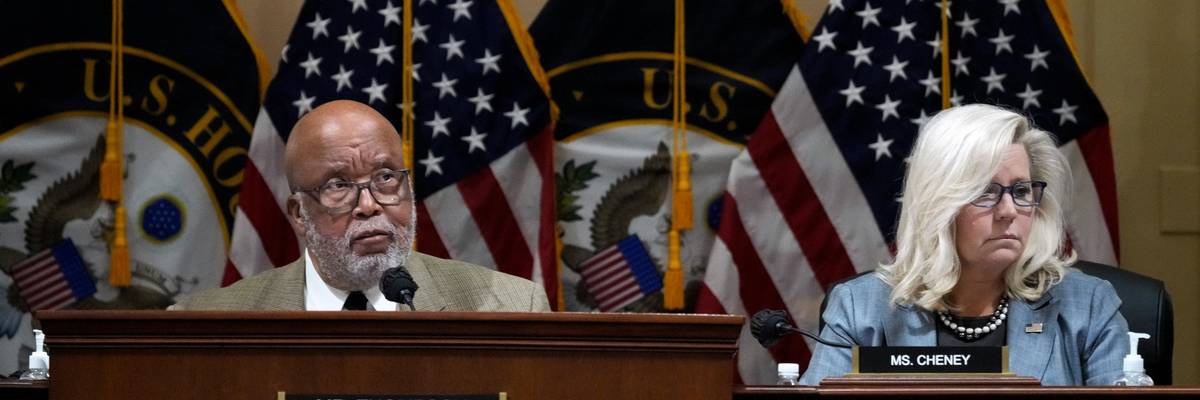
U.S. Rep. Bennie Thompson (D-Miss.), chair of the House Select Committee to Investigate the January 6th Attack on the U.S. Capitol, speaks alongside Rep. Liz Cheney (R-Wyo.) during a panel meeting on March 28, 2022 in Washington, D.C. (Photo: Drew Angerer/Getty Images)
On Monday, the House Select Committee to Investigate the January 6th Attack on the U.S. Capitol holds the second of several public hearings to reveal a detailed account of the insurrection and the individuals behind it. These hearings mark a pivotal first step in repudiating the attack and holding its perpetrators accountable for one of the most alarming assaults on American democracy in history. Today's hearing also serves an additional critical purpose: examining the election sabotage scheme that fueled the insurrection and its ongoing damage to our democracy.
Passing legislation will require rallying sustained political pressure, and the committee's hearings provide a critical opportunity to do exactly that.
The damage, detailed in Brennan Center testimony submitted to the committee in April, is striking. By tracking the Big Lie that Donald Trump actually won reelection, our research demonstrates that a direct through line exists between 2020 election denial, the election sabotage scheme behind the insurrection, and ongoing efforts to thwart the democratic process. In other words, the same Big Lie that fueled the insurrection continues to reverberate across the country, driving bids to undermine voting rights, interfere with electoral processes, and attack impartial election administrators.
Of course, it bears repeating that the Big Lie is, in fact, a lie. Its theory of a "stolen" election relies on racially charged allegations of voter fraud, ballot irregularities, and conspiracies to otherwise "rig" the 2020 presidential election. Each of these claims has been thoroughly disproven. None of the more than 60 lawsuits challenging the results of the 2020 election succeeded in proving fraud, and President Trump's own officials deemed the 2020 election "the most secure in American history." Nonetheless, these false claims drove the brazen scheme to overturn the election results through vote suppression, baseless litigation, and even outright attempts to override legitimate votes. Together, these efforts spiraled into the January 6 attack. But while this plot may have failed, the Big Lie is far from over.
Take, for example, aggressive developments in state legislatures. Efforts to pass restrictive voting laws hit unprecedented heights following the 2020 election and continue at a rapid pace this year. States also face a new, burgeoning trend in the form of legislation that enables partisan actors to meddle in election administration and vote-counting processes--otherwise known as election interference legislation.
These attacks are not coincidental. Brennan Center research found that in 2021, the vast majority of these bills were sponsored by the same state legislators who publicly questioned the validity of the 2020 election. And in many cases, these sponsors justified their legislation using the same discredited claims of widespread voter fraud and a stolen election that fueled the insurrection.
Our research also compared the text of new restrictive voting and election interference legislation with false allegations made in lawsuits brought by Trump and his allies to overturn the 2020 election. Like clockwork, the same disproven theories of widespread voter fraud, ballot irregularities, and conspiracies made in those lawsuits resurfaced with remarkable specificity in legislation introduced in 2021. Indeed, of the 17 states in which courts reviewed lawsuits challenging the 2020 election, 15 saw legislation that directly incorporated false claims from those suits.
Make no mistake--these legislative attacks work as intended. Mounting evidence shows that new voting restrictions already are disenfranchising voters, particularly voters of color, in post-2020 elections.
Beyond legislation, the Big Lie's damage also extends to attacks on impartial election administrators. Across the country, vigilantes (and in some cases, other state officials) are invoking false claims of voter fraud and a stolen election to threaten officials from both parties for simply doing their job. These attacks--which range from racist and gendered harassment and death threats to threats of criminal prosecution -- risk creating a retention crisis among experienced election administrators. Dozens of officials in Michigan, Pennsylvania, Wisconsin, and Nevada already left their positions. Nationwide, one in five local election officials surveyed by the Brennan Center plan to leave their position before 2024.
As many election officials prepare to resign, election denial also threatens to upend the races by which many of them are chosen. This year, for example, 27 states will hold elections for secretary of state--the official who typically serves as a state's chief election officer. At least 21 current candidates in these races espouse the Big Lie's theory of a stolen election. And as this disinformation proliferates, campaigns are raising more money, from more donors, with greater reliance than ever before on out-of-state donations. In other words, as Big Lie-driven onslaughts push experienced election officials out of their positions, their replacements will in many instances emerge from politically charged, nationalized races featuring election deniers. Look no further than last month's primary elections to see this phenomenon in action.
The insurrection made one thing clear: our existing guardrails cannot protect us from antidemocratic attacks. As the Big Lie continues to wreak havoc on our democracy, and with the 2024 presidential election around the corner, inaction is not an option.
In the short term, Americans and our institutions must mobilize to stave off the current wave of attacks. Many sectors of society and government have a role to play in thwarting Big Lie-driven efforts to sabotage future elections. And we know that this mobilization works. Even when confronted with a global pandemic and disinformation-fueled assaults on voters and the electoral process, 2020 saw a wide range of forces--including election officials, other state government entities, courts, community groups, businesses, and journalists--mobilize to safeguard the election with great success.
Ultimately, Congress also must act to strengthen our democratic guardrails. The push to outrun or out-organize vote suppression and election interference, while essential, can only go so far and last for so long. The narrowly defeated Freedom to Vote: John R. Lewis Act would address many of these problems by, for example, establishing national standards for casting and counting ballots in federal elections and revitalizing the Voting Rights Act's protections against racial discrimination in voting. It also would limit opportunities for partisan interference in election administration, increase protections for election officials, and curb disinformation in elections.
Passing legislation will require rallying sustained political pressure, and the committee's hearings provide a critical opportunity to do exactly that. The multipronged plot to overturn the election and the violent events of January 6 must never happen again, and legislation remains the best and only way to ensure that history never repeats itself. We must demand it.
Dear Common Dreams reader, It’s been nearly 30 years since I co-founded Common Dreams with my late wife, Lina Newhouser. We had the radical notion that journalism should serve the public good, not corporate profits. It was clear to us from the outset what it would take to build such a project. No paid advertisements. No corporate sponsors. No millionaire publisher telling us what to think or do. Many people said we wouldn't last a year, but we proved those doubters wrong. Together with a tremendous team of journalists and dedicated staff, we built an independent media outlet free from the constraints of profits and corporate control. Our mission has always been simple: To inform. To inspire. To ignite change for the common good. Building Common Dreams was not easy. Our survival was never guaranteed. When you take on the most powerful forces—Wall Street greed, fossil fuel industry destruction, Big Tech lobbyists, and uber-rich oligarchs who have spent billions upon billions rigging the economy and democracy in their favor—the only bulwark you have is supporters who believe in your work. But here’s the urgent message from me today. It's never been this bad out there. And it's never been this hard to keep us going. At the very moment Common Dreams is most needed, the threats we face are intensifying. We need your support now more than ever. We don't accept corporate advertising and never will. We don't have a paywall because we don't think people should be blocked from critical news based on their ability to pay. Everything we do is funded by the donations of readers like you. When everyone does the little they can afford, we are strong. But if that support retreats or dries up, so do we. Will you donate now to make sure Common Dreams not only survives but thrives? —Craig Brown, Co-founder |
On Monday, the House Select Committee to Investigate the January 6th Attack on the U.S. Capitol holds the second of several public hearings to reveal a detailed account of the insurrection and the individuals behind it. These hearings mark a pivotal first step in repudiating the attack and holding its perpetrators accountable for one of the most alarming assaults on American democracy in history. Today's hearing also serves an additional critical purpose: examining the election sabotage scheme that fueled the insurrection and its ongoing damage to our democracy.
Passing legislation will require rallying sustained political pressure, and the committee's hearings provide a critical opportunity to do exactly that.
The damage, detailed in Brennan Center testimony submitted to the committee in April, is striking. By tracking the Big Lie that Donald Trump actually won reelection, our research demonstrates that a direct through line exists between 2020 election denial, the election sabotage scheme behind the insurrection, and ongoing efforts to thwart the democratic process. In other words, the same Big Lie that fueled the insurrection continues to reverberate across the country, driving bids to undermine voting rights, interfere with electoral processes, and attack impartial election administrators.
Of course, it bears repeating that the Big Lie is, in fact, a lie. Its theory of a "stolen" election relies on racially charged allegations of voter fraud, ballot irregularities, and conspiracies to otherwise "rig" the 2020 presidential election. Each of these claims has been thoroughly disproven. None of the more than 60 lawsuits challenging the results of the 2020 election succeeded in proving fraud, and President Trump's own officials deemed the 2020 election "the most secure in American history." Nonetheless, these false claims drove the brazen scheme to overturn the election results through vote suppression, baseless litigation, and even outright attempts to override legitimate votes. Together, these efforts spiraled into the January 6 attack. But while this plot may have failed, the Big Lie is far from over.
Take, for example, aggressive developments in state legislatures. Efforts to pass restrictive voting laws hit unprecedented heights following the 2020 election and continue at a rapid pace this year. States also face a new, burgeoning trend in the form of legislation that enables partisan actors to meddle in election administration and vote-counting processes--otherwise known as election interference legislation.
These attacks are not coincidental. Brennan Center research found that in 2021, the vast majority of these bills were sponsored by the same state legislators who publicly questioned the validity of the 2020 election. And in many cases, these sponsors justified their legislation using the same discredited claims of widespread voter fraud and a stolen election that fueled the insurrection.
Our research also compared the text of new restrictive voting and election interference legislation with false allegations made in lawsuits brought by Trump and his allies to overturn the 2020 election. Like clockwork, the same disproven theories of widespread voter fraud, ballot irregularities, and conspiracies made in those lawsuits resurfaced with remarkable specificity in legislation introduced in 2021. Indeed, of the 17 states in which courts reviewed lawsuits challenging the 2020 election, 15 saw legislation that directly incorporated false claims from those suits.
Make no mistake--these legislative attacks work as intended. Mounting evidence shows that new voting restrictions already are disenfranchising voters, particularly voters of color, in post-2020 elections.
Beyond legislation, the Big Lie's damage also extends to attacks on impartial election administrators. Across the country, vigilantes (and in some cases, other state officials) are invoking false claims of voter fraud and a stolen election to threaten officials from both parties for simply doing their job. These attacks--which range from racist and gendered harassment and death threats to threats of criminal prosecution -- risk creating a retention crisis among experienced election administrators. Dozens of officials in Michigan, Pennsylvania, Wisconsin, and Nevada already left their positions. Nationwide, one in five local election officials surveyed by the Brennan Center plan to leave their position before 2024.
As many election officials prepare to resign, election denial also threatens to upend the races by which many of them are chosen. This year, for example, 27 states will hold elections for secretary of state--the official who typically serves as a state's chief election officer. At least 21 current candidates in these races espouse the Big Lie's theory of a stolen election. And as this disinformation proliferates, campaigns are raising more money, from more donors, with greater reliance than ever before on out-of-state donations. In other words, as Big Lie-driven onslaughts push experienced election officials out of their positions, their replacements will in many instances emerge from politically charged, nationalized races featuring election deniers. Look no further than last month's primary elections to see this phenomenon in action.
The insurrection made one thing clear: our existing guardrails cannot protect us from antidemocratic attacks. As the Big Lie continues to wreak havoc on our democracy, and with the 2024 presidential election around the corner, inaction is not an option.
In the short term, Americans and our institutions must mobilize to stave off the current wave of attacks. Many sectors of society and government have a role to play in thwarting Big Lie-driven efforts to sabotage future elections. And we know that this mobilization works. Even when confronted with a global pandemic and disinformation-fueled assaults on voters and the electoral process, 2020 saw a wide range of forces--including election officials, other state government entities, courts, community groups, businesses, and journalists--mobilize to safeguard the election with great success.
Ultimately, Congress also must act to strengthen our democratic guardrails. The push to outrun or out-organize vote suppression and election interference, while essential, can only go so far and last for so long. The narrowly defeated Freedom to Vote: John R. Lewis Act would address many of these problems by, for example, establishing national standards for casting and counting ballots in federal elections and revitalizing the Voting Rights Act's protections against racial discrimination in voting. It also would limit opportunities for partisan interference in election administration, increase protections for election officials, and curb disinformation in elections.
Passing legislation will require rallying sustained political pressure, and the committee's hearings provide a critical opportunity to do exactly that. The multipronged plot to overturn the election and the violent events of January 6 must never happen again, and legislation remains the best and only way to ensure that history never repeats itself. We must demand it.
On Monday, the House Select Committee to Investigate the January 6th Attack on the U.S. Capitol holds the second of several public hearings to reveal a detailed account of the insurrection and the individuals behind it. These hearings mark a pivotal first step in repudiating the attack and holding its perpetrators accountable for one of the most alarming assaults on American democracy in history. Today's hearing also serves an additional critical purpose: examining the election sabotage scheme that fueled the insurrection and its ongoing damage to our democracy.
Passing legislation will require rallying sustained political pressure, and the committee's hearings provide a critical opportunity to do exactly that.
The damage, detailed in Brennan Center testimony submitted to the committee in April, is striking. By tracking the Big Lie that Donald Trump actually won reelection, our research demonstrates that a direct through line exists between 2020 election denial, the election sabotage scheme behind the insurrection, and ongoing efforts to thwart the democratic process. In other words, the same Big Lie that fueled the insurrection continues to reverberate across the country, driving bids to undermine voting rights, interfere with electoral processes, and attack impartial election administrators.
Of course, it bears repeating that the Big Lie is, in fact, a lie. Its theory of a "stolen" election relies on racially charged allegations of voter fraud, ballot irregularities, and conspiracies to otherwise "rig" the 2020 presidential election. Each of these claims has been thoroughly disproven. None of the more than 60 lawsuits challenging the results of the 2020 election succeeded in proving fraud, and President Trump's own officials deemed the 2020 election "the most secure in American history." Nonetheless, these false claims drove the brazen scheme to overturn the election results through vote suppression, baseless litigation, and even outright attempts to override legitimate votes. Together, these efforts spiraled into the January 6 attack. But while this plot may have failed, the Big Lie is far from over.
Take, for example, aggressive developments in state legislatures. Efforts to pass restrictive voting laws hit unprecedented heights following the 2020 election and continue at a rapid pace this year. States also face a new, burgeoning trend in the form of legislation that enables partisan actors to meddle in election administration and vote-counting processes--otherwise known as election interference legislation.
These attacks are not coincidental. Brennan Center research found that in 2021, the vast majority of these bills were sponsored by the same state legislators who publicly questioned the validity of the 2020 election. And in many cases, these sponsors justified their legislation using the same discredited claims of widespread voter fraud and a stolen election that fueled the insurrection.
Our research also compared the text of new restrictive voting and election interference legislation with false allegations made in lawsuits brought by Trump and his allies to overturn the 2020 election. Like clockwork, the same disproven theories of widespread voter fraud, ballot irregularities, and conspiracies made in those lawsuits resurfaced with remarkable specificity in legislation introduced in 2021. Indeed, of the 17 states in which courts reviewed lawsuits challenging the 2020 election, 15 saw legislation that directly incorporated false claims from those suits.
Make no mistake--these legislative attacks work as intended. Mounting evidence shows that new voting restrictions already are disenfranchising voters, particularly voters of color, in post-2020 elections.
Beyond legislation, the Big Lie's damage also extends to attacks on impartial election administrators. Across the country, vigilantes (and in some cases, other state officials) are invoking false claims of voter fraud and a stolen election to threaten officials from both parties for simply doing their job. These attacks--which range from racist and gendered harassment and death threats to threats of criminal prosecution -- risk creating a retention crisis among experienced election administrators. Dozens of officials in Michigan, Pennsylvania, Wisconsin, and Nevada already left their positions. Nationwide, one in five local election officials surveyed by the Brennan Center plan to leave their position before 2024.
As many election officials prepare to resign, election denial also threatens to upend the races by which many of them are chosen. This year, for example, 27 states will hold elections for secretary of state--the official who typically serves as a state's chief election officer. At least 21 current candidates in these races espouse the Big Lie's theory of a stolen election. And as this disinformation proliferates, campaigns are raising more money, from more donors, with greater reliance than ever before on out-of-state donations. In other words, as Big Lie-driven onslaughts push experienced election officials out of their positions, their replacements will in many instances emerge from politically charged, nationalized races featuring election deniers. Look no further than last month's primary elections to see this phenomenon in action.
The insurrection made one thing clear: our existing guardrails cannot protect us from antidemocratic attacks. As the Big Lie continues to wreak havoc on our democracy, and with the 2024 presidential election around the corner, inaction is not an option.
In the short term, Americans and our institutions must mobilize to stave off the current wave of attacks. Many sectors of society and government have a role to play in thwarting Big Lie-driven efforts to sabotage future elections. And we know that this mobilization works. Even when confronted with a global pandemic and disinformation-fueled assaults on voters and the electoral process, 2020 saw a wide range of forces--including election officials, other state government entities, courts, community groups, businesses, and journalists--mobilize to safeguard the election with great success.
Ultimately, Congress also must act to strengthen our democratic guardrails. The push to outrun or out-organize vote suppression and election interference, while essential, can only go so far and last for so long. The narrowly defeated Freedom to Vote: John R. Lewis Act would address many of these problems by, for example, establishing national standards for casting and counting ballots in federal elections and revitalizing the Voting Rights Act's protections against racial discrimination in voting. It also would limit opportunities for partisan interference in election administration, increase protections for election officials, and curb disinformation in elections.
Passing legislation will require rallying sustained political pressure, and the committee's hearings provide a critical opportunity to do exactly that. The multipronged plot to overturn the election and the violent events of January 6 must never happen again, and legislation remains the best and only way to ensure that history never repeats itself. We must demand it.