SUBSCRIBE TO OUR FREE NEWSLETTER
Daily news & progressive opinion—funded by the people, not the corporations—delivered straight to your inbox.
5
#000000
#FFFFFF
To donate by check, phone, or other method, see our More Ways to Give page.
Daily news & progressive opinion—funded by the people, not the corporations—delivered straight to your inbox.
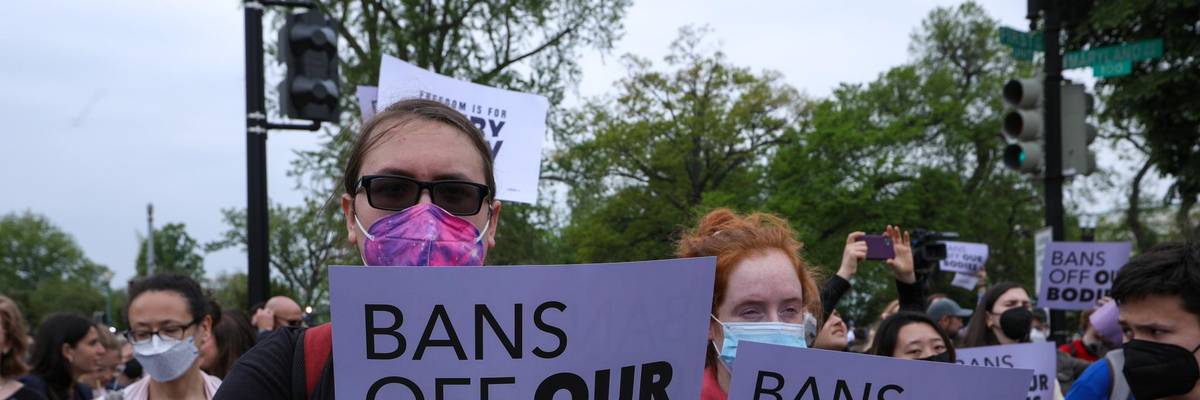
Activists rally outside the U.S. Supreme Court in Washington, D.C., on May 3.,2022., Tuesday after the leak of a draft majority opinion preparing for the court to overturn the landmark abortion decision in Roe v. Wade. (Photo: Yasin Ozturk/Anadolu Agency via Getty Images)
The draft opinion in Dobbs v. Jackson Women's Health Organization infamously decides that pregnant females' 49-year-old right to obtain an abortion no longer will be constitutionally protected. Writing for the five-justice majority, Justice Samuel Alito offers two reasons for this conclusion: The Constitution does not explicitly protect the right to abortion, and the right to obtain an abortion is neither "deeply rooted in [our] history and tradition" nor "essential to our Nation's 'scheme of ordered liberty.'"
Contrary to Justice Alito, however, a right may be constitutionally protected even if is not explicitly stated in the Constitution, not "deeply rooted in [our] history and tradition," and not "essential to our Nation's 'scheme of ordered liberty.'"As Justice Anthony Kennedy stated in County of Sacramento v. Lewis (1998), "[H]istory and tradition are the starting point but not in all cases the ending point of the substantive due process inquiry." (Substantive due process is the doctrine that specific language in the Fourteenth Amendment -- "No State shall ... deprive any person of life, liberty, or property, without due process of law ..." -- guarantees citizens not only procedural due process but also substantive autonomy or privacy rights.)
Seventeen years later, in Obergefell v. Hodges (2015), Justice Kennedy offered a fifth criterion in addition to explicit constitutional text, history, tradition, and essentiality to ordered liberty: "The fundamental liberties protected by [the Fourteenth Amendment Due Process] Clause ... extend to certain personal choices central to individual dignity and autonomy, including intimate choices that define personal identity and beliefs."
Yet a sixth criterion was offered in Griswold v. Connecticut (1964): An "unenumerated" right may be constitutionally protected as long as it can be reasonably inferred from rights that are explicitly stated in the Constitution. Writing for the majority, Justice William O. Douglas argued that the right of married couples to use contraception falls within a more general "right to privacy" and that this more general right itself derives from specific rights explicitly stated in the Constitution: the right of free association in the First Amendment, the right of domiciliary exclusion in the Third Amendment, the right to be secure "against unreasonable searches and seizures" in the Fourth Amendment, and the right against self-incrimination in the Fifth Amendment.
According to Justice Douglas, these specific rights of privacy are both more "secure" and more "meaningful" if it is assumed that the Constitution does indeed contain a general right to privacy. By analogy, our First Amendment right to freedom of speech is more robust, less vulnerable to government intervention, if we interpret it broadly rather than narrowly -- that is, if we interpret it to protect not merely the right to speak but also the rights to think, read, publish and teach. If thinking, reading, publishing, and teaching were not thought to be constitutionally protected -- because none of these verbs is explicitly mentioned in the First Amendment -- our right to freedom of speech would be much narrower and under threat of being narrowed even further.
While Justice Alito does not deny a general right to privacy, he also does not affirm it. This ominous omission leaves the right to privacy, and therefore all the specific autonomy rights that have been predicated upon it -- not only the right to use contraception but also the right to interracial marriage, to gay marriage, to consensual sodomy, to non-nuclear-familial cohabitation, and to refusal of medical assistance -- vulnerable to eradication in one fell swoop.
Because the Dobbs decision has not yet been formally issued, abortion remains -- at least on paper -- a constitutionally protected right. But once it is formally issued, expected in June, one to two dozen Republican-dominated states are likely to immediately criminalize this act. This transition from fundamental right to criminalization underscores the polarity of values that are in conflict here -- protection of fetal life at one end and "individual dignity and autonomy" at the other.
It may seem to make sense at first for Justice Alito to say that such intractable values-conflicts should be worked out by the people through their elected representatives, rather than letting a small number of unelected judges work it out by themselves. But this is a strange thing to say, especially for supposedly conservative justices who purport to respect history and the judiciary. After all, we have been letting a small number of unelected judges decide heated disputes -- philosophical, practical, personal, policy, and (sometimes) political -- for 233 years. So why change now? And why for such an emotionally explosive issue?
This kind of cowardly "punting" to other decision-makers -- who will be equally unable to bring about anything close to universal consensus -- is only likely to cause serious hardship, suffering, and chaos for millions of Americans. And none of this was necessary.
Dear Common Dreams reader, It’s been nearly 30 years since I co-founded Common Dreams with my late wife, Lina Newhouser. We had the radical notion that journalism should serve the public good, not corporate profits. It was clear to us from the outset what it would take to build such a project. No paid advertisements. No corporate sponsors. No millionaire publisher telling us what to think or do. Many people said we wouldn't last a year, but we proved those doubters wrong. Together with a tremendous team of journalists and dedicated staff, we built an independent media outlet free from the constraints of profits and corporate control. Our mission has always been simple: To inform. To inspire. To ignite change for the common good. Building Common Dreams was not easy. Our survival was never guaranteed. When you take on the most powerful forces—Wall Street greed, fossil fuel industry destruction, Big Tech lobbyists, and uber-rich oligarchs who have spent billions upon billions rigging the economy and democracy in their favor—the only bulwark you have is supporters who believe in your work. But here’s the urgent message from me today. It's never been this bad out there. And it's never been this hard to keep us going. At the very moment Common Dreams is most needed, the threats we face are intensifying. We need your support now more than ever. We don't accept corporate advertising and never will. We don't have a paywall because we don't think people should be blocked from critical news based on their ability to pay. Everything we do is funded by the donations of readers like you. When everyone does the little they can afford, we are strong. But if that support retreats or dries up, so do we. Will you donate now to make sure Common Dreams not only survives but thrives? —Craig Brown, Co-founder |
The draft opinion in Dobbs v. Jackson Women's Health Organization infamously decides that pregnant females' 49-year-old right to obtain an abortion no longer will be constitutionally protected. Writing for the five-justice majority, Justice Samuel Alito offers two reasons for this conclusion: The Constitution does not explicitly protect the right to abortion, and the right to obtain an abortion is neither "deeply rooted in [our] history and tradition" nor "essential to our Nation's 'scheme of ordered liberty.'"
Contrary to Justice Alito, however, a right may be constitutionally protected even if is not explicitly stated in the Constitution, not "deeply rooted in [our] history and tradition," and not "essential to our Nation's 'scheme of ordered liberty.'"As Justice Anthony Kennedy stated in County of Sacramento v. Lewis (1998), "[H]istory and tradition are the starting point but not in all cases the ending point of the substantive due process inquiry." (Substantive due process is the doctrine that specific language in the Fourteenth Amendment -- "No State shall ... deprive any person of life, liberty, or property, without due process of law ..." -- guarantees citizens not only procedural due process but also substantive autonomy or privacy rights.)
Seventeen years later, in Obergefell v. Hodges (2015), Justice Kennedy offered a fifth criterion in addition to explicit constitutional text, history, tradition, and essentiality to ordered liberty: "The fundamental liberties protected by [the Fourteenth Amendment Due Process] Clause ... extend to certain personal choices central to individual dignity and autonomy, including intimate choices that define personal identity and beliefs."
Yet a sixth criterion was offered in Griswold v. Connecticut (1964): An "unenumerated" right may be constitutionally protected as long as it can be reasonably inferred from rights that are explicitly stated in the Constitution. Writing for the majority, Justice William O. Douglas argued that the right of married couples to use contraception falls within a more general "right to privacy" and that this more general right itself derives from specific rights explicitly stated in the Constitution: the right of free association in the First Amendment, the right of domiciliary exclusion in the Third Amendment, the right to be secure "against unreasonable searches and seizures" in the Fourth Amendment, and the right against self-incrimination in the Fifth Amendment.
According to Justice Douglas, these specific rights of privacy are both more "secure" and more "meaningful" if it is assumed that the Constitution does indeed contain a general right to privacy. By analogy, our First Amendment right to freedom of speech is more robust, less vulnerable to government intervention, if we interpret it broadly rather than narrowly -- that is, if we interpret it to protect not merely the right to speak but also the rights to think, read, publish and teach. If thinking, reading, publishing, and teaching were not thought to be constitutionally protected -- because none of these verbs is explicitly mentioned in the First Amendment -- our right to freedom of speech would be much narrower and under threat of being narrowed even further.
While Justice Alito does not deny a general right to privacy, he also does not affirm it. This ominous omission leaves the right to privacy, and therefore all the specific autonomy rights that have been predicated upon it -- not only the right to use contraception but also the right to interracial marriage, to gay marriage, to consensual sodomy, to non-nuclear-familial cohabitation, and to refusal of medical assistance -- vulnerable to eradication in one fell swoop.
Because the Dobbs decision has not yet been formally issued, abortion remains -- at least on paper -- a constitutionally protected right. But once it is formally issued, expected in June, one to two dozen Republican-dominated states are likely to immediately criminalize this act. This transition from fundamental right to criminalization underscores the polarity of values that are in conflict here -- protection of fetal life at one end and "individual dignity and autonomy" at the other.
It may seem to make sense at first for Justice Alito to say that such intractable values-conflicts should be worked out by the people through their elected representatives, rather than letting a small number of unelected judges work it out by themselves. But this is a strange thing to say, especially for supposedly conservative justices who purport to respect history and the judiciary. After all, we have been letting a small number of unelected judges decide heated disputes -- philosophical, practical, personal, policy, and (sometimes) political -- for 233 years. So why change now? And why for such an emotionally explosive issue?
This kind of cowardly "punting" to other decision-makers -- who will be equally unable to bring about anything close to universal consensus -- is only likely to cause serious hardship, suffering, and chaos for millions of Americans. And none of this was necessary.
The draft opinion in Dobbs v. Jackson Women's Health Organization infamously decides that pregnant females' 49-year-old right to obtain an abortion no longer will be constitutionally protected. Writing for the five-justice majority, Justice Samuel Alito offers two reasons for this conclusion: The Constitution does not explicitly protect the right to abortion, and the right to obtain an abortion is neither "deeply rooted in [our] history and tradition" nor "essential to our Nation's 'scheme of ordered liberty.'"
Contrary to Justice Alito, however, a right may be constitutionally protected even if is not explicitly stated in the Constitution, not "deeply rooted in [our] history and tradition," and not "essential to our Nation's 'scheme of ordered liberty.'"As Justice Anthony Kennedy stated in County of Sacramento v. Lewis (1998), "[H]istory and tradition are the starting point but not in all cases the ending point of the substantive due process inquiry." (Substantive due process is the doctrine that specific language in the Fourteenth Amendment -- "No State shall ... deprive any person of life, liberty, or property, without due process of law ..." -- guarantees citizens not only procedural due process but also substantive autonomy or privacy rights.)
Seventeen years later, in Obergefell v. Hodges (2015), Justice Kennedy offered a fifth criterion in addition to explicit constitutional text, history, tradition, and essentiality to ordered liberty: "The fundamental liberties protected by [the Fourteenth Amendment Due Process] Clause ... extend to certain personal choices central to individual dignity and autonomy, including intimate choices that define personal identity and beliefs."
Yet a sixth criterion was offered in Griswold v. Connecticut (1964): An "unenumerated" right may be constitutionally protected as long as it can be reasonably inferred from rights that are explicitly stated in the Constitution. Writing for the majority, Justice William O. Douglas argued that the right of married couples to use contraception falls within a more general "right to privacy" and that this more general right itself derives from specific rights explicitly stated in the Constitution: the right of free association in the First Amendment, the right of domiciliary exclusion in the Third Amendment, the right to be secure "against unreasonable searches and seizures" in the Fourth Amendment, and the right against self-incrimination in the Fifth Amendment.
According to Justice Douglas, these specific rights of privacy are both more "secure" and more "meaningful" if it is assumed that the Constitution does indeed contain a general right to privacy. By analogy, our First Amendment right to freedom of speech is more robust, less vulnerable to government intervention, if we interpret it broadly rather than narrowly -- that is, if we interpret it to protect not merely the right to speak but also the rights to think, read, publish and teach. If thinking, reading, publishing, and teaching were not thought to be constitutionally protected -- because none of these verbs is explicitly mentioned in the First Amendment -- our right to freedom of speech would be much narrower and under threat of being narrowed even further.
While Justice Alito does not deny a general right to privacy, he also does not affirm it. This ominous omission leaves the right to privacy, and therefore all the specific autonomy rights that have been predicated upon it -- not only the right to use contraception but also the right to interracial marriage, to gay marriage, to consensual sodomy, to non-nuclear-familial cohabitation, and to refusal of medical assistance -- vulnerable to eradication in one fell swoop.
Because the Dobbs decision has not yet been formally issued, abortion remains -- at least on paper -- a constitutionally protected right. But once it is formally issued, expected in June, one to two dozen Republican-dominated states are likely to immediately criminalize this act. This transition from fundamental right to criminalization underscores the polarity of values that are in conflict here -- protection of fetal life at one end and "individual dignity and autonomy" at the other.
It may seem to make sense at first for Justice Alito to say that such intractable values-conflicts should be worked out by the people through their elected representatives, rather than letting a small number of unelected judges work it out by themselves. But this is a strange thing to say, especially for supposedly conservative justices who purport to respect history and the judiciary. After all, we have been letting a small number of unelected judges decide heated disputes -- philosophical, practical, personal, policy, and (sometimes) political -- for 233 years. So why change now? And why for such an emotionally explosive issue?
This kind of cowardly "punting" to other decision-makers -- who will be equally unable to bring about anything close to universal consensus -- is only likely to cause serious hardship, suffering, and chaos for millions of Americans. And none of this was necessary.