SUBSCRIBE TO OUR FREE NEWSLETTER
Daily news & progressive opinion—funded by the people, not the corporations—delivered straight to your inbox.
5
#000000
#FFFFFF
To donate by check, phone, or other method, see our More Ways to Give page.
Daily news & progressive opinion—funded by the people, not the corporations—delivered straight to your inbox.
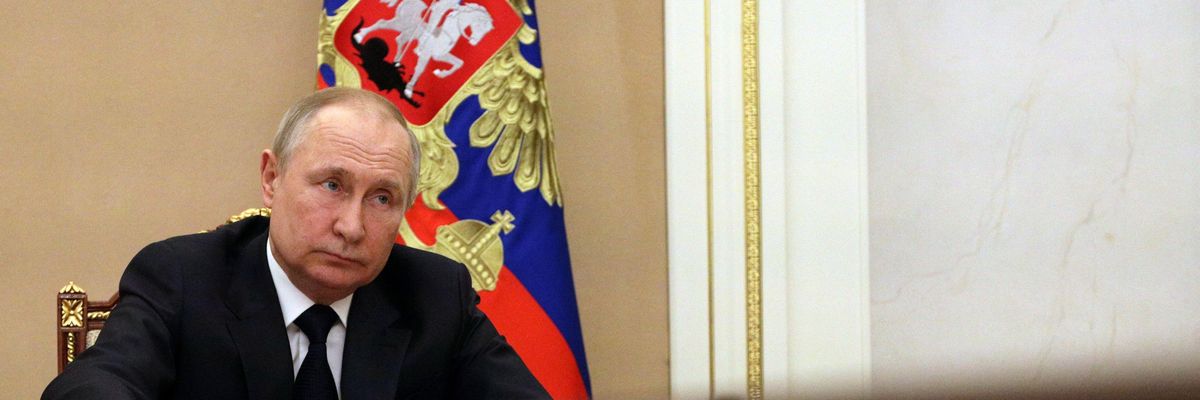
Russian President Vladimir Putin chairs a meeting with members of the Russian government via teleconference in Moscow on March 10, 2022. (Photo: Mikhail Klimentyev/SPUTNIK/AFP via Getty Images)
A number of things about Putin's invasion of Ukraine are not in doubt: that it was a deeply criminal act; that it has been accompanied by great brutality on the ground; that it was based on extremely faulty intelligence; and that in consequence it involved extremely serious political and strategic miscalculations.
The portrayal of adversaries as driven by insane compulsions to reckless aggression have been used again and again to block negotiations with those adversaries, and to argue not just for the most militarized U.S. responses, but also for confronting those adversaries everywhere.
It would be nice in some ways to think that this reflected insanity on Putin's part--but outright insanity in international affairs is, thank Heaven, rare. On the other hand, serious miscalculations based on what appeared at the time to be good evidence are rather common--though the mixture that led to Putin's serial miscalculations over Ukraine was an unusually toxic one, influenced by factors particular to the Russian-Ukrainian relationship.
The difference between miscalculation and lunacy is an extremely important distinction to draw. The portrayal of adversaries as driven by insane compulsions to reckless aggression have been used again and again to block negotiations with those adversaries, and to argue not just for the most militarized U.S. responses, but also for confronting those adversaries everywhere, regardless of the importance of the actual issues involved.
During the later years of the Cold War, this line was used, absurdly, about the elderly, grey bureaucrats of the Brezhnev leadership. But we should remember that when Soviet archives were opened after the end of the Cold War, it turned out that much of the time the Soviet leadership was at least as scared of us as we were of them--as indeed George Kennan had pointed out in his memo setting out the basis of "containment" strategy.
I strongly believe that in view of climate change, a century or so from now most of the basic preconceptions underlying the strategies of leading world powers will be seen by our descendants to have been profoundly irrational. Whether they will see the Russian regime's obsession with Ukraine as having been more irrational than the Chinese leadership's obsession with Taiwan or the U.S. Blob's obsession with global primacy is another matter.
Certainly the desire to keep a hostile military alliance away from Russia's borders should be understood by every American strategist--even if (like many U.S. analysts), Russians have exaggerated the concrete threats involved. Russia's motives for dominating Ukraine are nationalist as well as strategic, and to that extent emotional--but so too are Indian motives concerning Kashmir and Chinese motives concerning Taiwan, both of which we treat as geopolitical givens.
The Russian establishment's fear of the West contributed to a long series of miscalculations over Ukraine, to which historical preconceptions about the Ukrainian-Russian relationship and faulty intelligence about Ukrainian politics and society also contributed.
In terms of the sequence of events leading to the present war, the first mistake was made in 2013, when the Russian government persuaded President Yanukovych of Ukraine to join the Russian-dominated Eurasian Union. This set off the protests in Kiev that eventually led to the U.S.-backed revolution of 2014 that toppled Yanukovych and took most of Ukraine firmly into the Western camp.
This Russian policy was clearly a bad mistake that completely underestimated the depth and extent of the desire of many Ukrainians to move towards the West. I and many other analysts warned publicly back in the 1990s that any attempt to take Ukraine fully either into the Russian or the Western camp would split the country and lead to civil war.
It was not however a completely irrational mistake on the part of Putin. After all, not only had around half of Ukrainians (give or take a few percent either way) voted in every election since independence for good relations with Russia--including electing President Yanukovych--but until 2014, Russia's aid to Ukraine in the form of subsidized gas had vastly outweighed aid from the West. Moreover, Russian aid was upfront, whereas the European Union was only offering in competition a vague form of association with no promise of eventual membership.
When the Ukrainian revolution occurred, the Putin regime's response involved two very serious miscalculations--but one of them, oddly enough, was a miscalculation in the direction of restraint. On the one hand, Putin annexed Crimea (as opposed to simply occupying it in order to "defend the Russian population"), thereby putting Russia squarely in the wrong as regards international law and global public opinion.
On the other hand, instead of sending in the Russian army to occupy all that half of Ukraine that had elected President Yanukovych, and declaring him to be still the legal President of Ukraine, the Putin regime opted to give semi-covert backing to a limited separatist revolt in the Donbas region. Putin exercised this restraint despite the fact that in 2014 Ukrainian military resistance would have been minimal, and that incidents like the massacre of pro-Russian protestors in Odessa would have given Russia an excellent excuse to intervene.
To understand this year's invasion, it is important to understand that sections of the Russian security establishment have regretted ever since not seizing that chance then (and in private blamed Putin for this failure). If Putin did not launch what would have been a successful invasion back in 2014, key reasons seem to be firstly his belief that many Ukrainians would continue to permanently identify with Russia, and this disillusionment with the West, and the deep political and economic dysfunction of Ukraine, would eventually bring Ukraine back to friendship with Russia.
Secondly, Putin was unwilling to break completely with a hope that had shaped Russian strategy since the end of the Cold War: that France and Germany could be persuaded to distance themselves from the United States and reach compromises with Russia over European security. This hope turned out to be empty: but the German and French sponsorship of the Minsk II peace agreement over the Donbas in 2015 seemed to give it continued life, as did the tension between Europe and America resulting from the Trump presidency.
And although Russian frustration grew as Paris and Berlin did nothing to get Ukraine actually to implement the Minsk agreement, as late as January of this year Putin still appears to have believed that President Macron might veto further NATO enlargement, handing Russia a diplomatic victory and leading to a split between Paris and Washington. Comprehensive Russian disappointment with Paris and Berlin was a key factor in precipitating the Russian invasion.
As to the Russian invasion itself, this now looks unbelievably reckless, and was certainly based both on exaggeration of the Western threat to Russia and appallingly poor intelligence about Ukraine's ability and will to resist; but it should be remembered that most Western military analysts, too, expected Russia to win a relatively quick victory. One reason for the failure was obviously the vastly over-ambitious plan to try to capture Kiev and overthrow the Ukrainian government while simultaneously attacking on several other fronts --which meant that Russian forces were too weak everywhere.
Once again, however, this was not a completely irrational strategy. At the start of the war, the United States offered to evacuate President Zelensky. If he had in fact fled, the Ukrainian government would have fragmented and Ukrainian resistance would have been greatly weakened.
When the Russian army was fought to a standstill outside Kiev, Putin did not however continue to hurl Russian forces against the capital, after the irrational fashion of Hitler at Stalingrad or generals on the Western Front during the First World War. His response was a rational one. The Russian government withdrew its forces from northern Ukraine, regrouped them in the east, and drastically scaled down Russian political objectives.
This record indicates a Russian leader who is extremely ruthless, and indifferent both to international law and to the dreadful human suffering resulting from his actions. It can also be seen that the mistakes of his policies towards Ukraine have been influenced by emotional nationalist and cultural prejudices common among Russians in general. They do not however indicate a leader who is dedicated to blind universal aggression regardless of the risks or the real Russian interests involved. Nor is there any evidence that the emotional compulsions particular to Putin's, and Russians' attitudes to Ukraine extend to the rest of Europe.
Dear Common Dreams reader, It’s been nearly 30 years since I co-founded Common Dreams with my late wife, Lina Newhouser. We had the radical notion that journalism should serve the public good, not corporate profits. It was clear to us from the outset what it would take to build such a project. No paid advertisements. No corporate sponsors. No millionaire publisher telling us what to think or do. Many people said we wouldn't last a year, but we proved those doubters wrong. Together with a tremendous team of journalists and dedicated staff, we built an independent media outlet free from the constraints of profits and corporate control. Our mission has always been simple: To inform. To inspire. To ignite change for the common good. Building Common Dreams was not easy. Our survival was never guaranteed. When you take on the most powerful forces—Wall Street greed, fossil fuel industry destruction, Big Tech lobbyists, and uber-rich oligarchs who have spent billions upon billions rigging the economy and democracy in their favor—the only bulwark you have is supporters who believe in your work. But here’s the urgent message from me today. It's never been this bad out there. And it's never been this hard to keep us going. At the very moment Common Dreams is most needed, the threats we face are intensifying. We need your support now more than ever. We don't accept corporate advertising and never will. We don't have a paywall because we don't think people should be blocked from critical news based on their ability to pay. Everything we do is funded by the donations of readers like you. When everyone does the little they can afford, we are strong. But if that support retreats or dries up, so do we. Will you donate now to make sure Common Dreams not only survives but thrives? —Craig Brown, Co-founder |
A number of things about Putin's invasion of Ukraine are not in doubt: that it was a deeply criminal act; that it has been accompanied by great brutality on the ground; that it was based on extremely faulty intelligence; and that in consequence it involved extremely serious political and strategic miscalculations.
The portrayal of adversaries as driven by insane compulsions to reckless aggression have been used again and again to block negotiations with those adversaries, and to argue not just for the most militarized U.S. responses, but also for confronting those adversaries everywhere.
It would be nice in some ways to think that this reflected insanity on Putin's part--but outright insanity in international affairs is, thank Heaven, rare. On the other hand, serious miscalculations based on what appeared at the time to be good evidence are rather common--though the mixture that led to Putin's serial miscalculations over Ukraine was an unusually toxic one, influenced by factors particular to the Russian-Ukrainian relationship.
The difference between miscalculation and lunacy is an extremely important distinction to draw. The portrayal of adversaries as driven by insane compulsions to reckless aggression have been used again and again to block negotiations with those adversaries, and to argue not just for the most militarized U.S. responses, but also for confronting those adversaries everywhere, regardless of the importance of the actual issues involved.
During the later years of the Cold War, this line was used, absurdly, about the elderly, grey bureaucrats of the Brezhnev leadership. But we should remember that when Soviet archives were opened after the end of the Cold War, it turned out that much of the time the Soviet leadership was at least as scared of us as we were of them--as indeed George Kennan had pointed out in his memo setting out the basis of "containment" strategy.
I strongly believe that in view of climate change, a century or so from now most of the basic preconceptions underlying the strategies of leading world powers will be seen by our descendants to have been profoundly irrational. Whether they will see the Russian regime's obsession with Ukraine as having been more irrational than the Chinese leadership's obsession with Taiwan or the U.S. Blob's obsession with global primacy is another matter.
Certainly the desire to keep a hostile military alliance away from Russia's borders should be understood by every American strategist--even if (like many U.S. analysts), Russians have exaggerated the concrete threats involved. Russia's motives for dominating Ukraine are nationalist as well as strategic, and to that extent emotional--but so too are Indian motives concerning Kashmir and Chinese motives concerning Taiwan, both of which we treat as geopolitical givens.
The Russian establishment's fear of the West contributed to a long series of miscalculations over Ukraine, to which historical preconceptions about the Ukrainian-Russian relationship and faulty intelligence about Ukrainian politics and society also contributed.
In terms of the sequence of events leading to the present war, the first mistake was made in 2013, when the Russian government persuaded President Yanukovych of Ukraine to join the Russian-dominated Eurasian Union. This set off the protests in Kiev that eventually led to the U.S.-backed revolution of 2014 that toppled Yanukovych and took most of Ukraine firmly into the Western camp.
This Russian policy was clearly a bad mistake that completely underestimated the depth and extent of the desire of many Ukrainians to move towards the West. I and many other analysts warned publicly back in the 1990s that any attempt to take Ukraine fully either into the Russian or the Western camp would split the country and lead to civil war.
It was not however a completely irrational mistake on the part of Putin. After all, not only had around half of Ukrainians (give or take a few percent either way) voted in every election since independence for good relations with Russia--including electing President Yanukovych--but until 2014, Russia's aid to Ukraine in the form of subsidized gas had vastly outweighed aid from the West. Moreover, Russian aid was upfront, whereas the European Union was only offering in competition a vague form of association with no promise of eventual membership.
When the Ukrainian revolution occurred, the Putin regime's response involved two very serious miscalculations--but one of them, oddly enough, was a miscalculation in the direction of restraint. On the one hand, Putin annexed Crimea (as opposed to simply occupying it in order to "defend the Russian population"), thereby putting Russia squarely in the wrong as regards international law and global public opinion.
On the other hand, instead of sending in the Russian army to occupy all that half of Ukraine that had elected President Yanukovych, and declaring him to be still the legal President of Ukraine, the Putin regime opted to give semi-covert backing to a limited separatist revolt in the Donbas region. Putin exercised this restraint despite the fact that in 2014 Ukrainian military resistance would have been minimal, and that incidents like the massacre of pro-Russian protestors in Odessa would have given Russia an excellent excuse to intervene.
To understand this year's invasion, it is important to understand that sections of the Russian security establishment have regretted ever since not seizing that chance then (and in private blamed Putin for this failure). If Putin did not launch what would have been a successful invasion back in 2014, key reasons seem to be firstly his belief that many Ukrainians would continue to permanently identify with Russia, and this disillusionment with the West, and the deep political and economic dysfunction of Ukraine, would eventually bring Ukraine back to friendship with Russia.
Secondly, Putin was unwilling to break completely with a hope that had shaped Russian strategy since the end of the Cold War: that France and Germany could be persuaded to distance themselves from the United States and reach compromises with Russia over European security. This hope turned out to be empty: but the German and French sponsorship of the Minsk II peace agreement over the Donbas in 2015 seemed to give it continued life, as did the tension between Europe and America resulting from the Trump presidency.
And although Russian frustration grew as Paris and Berlin did nothing to get Ukraine actually to implement the Minsk agreement, as late as January of this year Putin still appears to have believed that President Macron might veto further NATO enlargement, handing Russia a diplomatic victory and leading to a split between Paris and Washington. Comprehensive Russian disappointment with Paris and Berlin was a key factor in precipitating the Russian invasion.
As to the Russian invasion itself, this now looks unbelievably reckless, and was certainly based both on exaggeration of the Western threat to Russia and appallingly poor intelligence about Ukraine's ability and will to resist; but it should be remembered that most Western military analysts, too, expected Russia to win a relatively quick victory. One reason for the failure was obviously the vastly over-ambitious plan to try to capture Kiev and overthrow the Ukrainian government while simultaneously attacking on several other fronts --which meant that Russian forces were too weak everywhere.
Once again, however, this was not a completely irrational strategy. At the start of the war, the United States offered to evacuate President Zelensky. If he had in fact fled, the Ukrainian government would have fragmented and Ukrainian resistance would have been greatly weakened.
When the Russian army was fought to a standstill outside Kiev, Putin did not however continue to hurl Russian forces against the capital, after the irrational fashion of Hitler at Stalingrad or generals on the Western Front during the First World War. His response was a rational one. The Russian government withdrew its forces from northern Ukraine, regrouped them in the east, and drastically scaled down Russian political objectives.
This record indicates a Russian leader who is extremely ruthless, and indifferent both to international law and to the dreadful human suffering resulting from his actions. It can also be seen that the mistakes of his policies towards Ukraine have been influenced by emotional nationalist and cultural prejudices common among Russians in general. They do not however indicate a leader who is dedicated to blind universal aggression regardless of the risks or the real Russian interests involved. Nor is there any evidence that the emotional compulsions particular to Putin's, and Russians' attitudes to Ukraine extend to the rest of Europe.
A number of things about Putin's invasion of Ukraine are not in doubt: that it was a deeply criminal act; that it has been accompanied by great brutality on the ground; that it was based on extremely faulty intelligence; and that in consequence it involved extremely serious political and strategic miscalculations.
The portrayal of adversaries as driven by insane compulsions to reckless aggression have been used again and again to block negotiations with those adversaries, and to argue not just for the most militarized U.S. responses, but also for confronting those adversaries everywhere.
It would be nice in some ways to think that this reflected insanity on Putin's part--but outright insanity in international affairs is, thank Heaven, rare. On the other hand, serious miscalculations based on what appeared at the time to be good evidence are rather common--though the mixture that led to Putin's serial miscalculations over Ukraine was an unusually toxic one, influenced by factors particular to the Russian-Ukrainian relationship.
The difference between miscalculation and lunacy is an extremely important distinction to draw. The portrayal of adversaries as driven by insane compulsions to reckless aggression have been used again and again to block negotiations with those adversaries, and to argue not just for the most militarized U.S. responses, but also for confronting those adversaries everywhere, regardless of the importance of the actual issues involved.
During the later years of the Cold War, this line was used, absurdly, about the elderly, grey bureaucrats of the Brezhnev leadership. But we should remember that when Soviet archives were opened after the end of the Cold War, it turned out that much of the time the Soviet leadership was at least as scared of us as we were of them--as indeed George Kennan had pointed out in his memo setting out the basis of "containment" strategy.
I strongly believe that in view of climate change, a century or so from now most of the basic preconceptions underlying the strategies of leading world powers will be seen by our descendants to have been profoundly irrational. Whether they will see the Russian regime's obsession with Ukraine as having been more irrational than the Chinese leadership's obsession with Taiwan or the U.S. Blob's obsession with global primacy is another matter.
Certainly the desire to keep a hostile military alliance away from Russia's borders should be understood by every American strategist--even if (like many U.S. analysts), Russians have exaggerated the concrete threats involved. Russia's motives for dominating Ukraine are nationalist as well as strategic, and to that extent emotional--but so too are Indian motives concerning Kashmir and Chinese motives concerning Taiwan, both of which we treat as geopolitical givens.
The Russian establishment's fear of the West contributed to a long series of miscalculations over Ukraine, to which historical preconceptions about the Ukrainian-Russian relationship and faulty intelligence about Ukrainian politics and society also contributed.
In terms of the sequence of events leading to the present war, the first mistake was made in 2013, when the Russian government persuaded President Yanukovych of Ukraine to join the Russian-dominated Eurasian Union. This set off the protests in Kiev that eventually led to the U.S.-backed revolution of 2014 that toppled Yanukovych and took most of Ukraine firmly into the Western camp.
This Russian policy was clearly a bad mistake that completely underestimated the depth and extent of the desire of many Ukrainians to move towards the West. I and many other analysts warned publicly back in the 1990s that any attempt to take Ukraine fully either into the Russian or the Western camp would split the country and lead to civil war.
It was not however a completely irrational mistake on the part of Putin. After all, not only had around half of Ukrainians (give or take a few percent either way) voted in every election since independence for good relations with Russia--including electing President Yanukovych--but until 2014, Russia's aid to Ukraine in the form of subsidized gas had vastly outweighed aid from the West. Moreover, Russian aid was upfront, whereas the European Union was only offering in competition a vague form of association with no promise of eventual membership.
When the Ukrainian revolution occurred, the Putin regime's response involved two very serious miscalculations--but one of them, oddly enough, was a miscalculation in the direction of restraint. On the one hand, Putin annexed Crimea (as opposed to simply occupying it in order to "defend the Russian population"), thereby putting Russia squarely in the wrong as regards international law and global public opinion.
On the other hand, instead of sending in the Russian army to occupy all that half of Ukraine that had elected President Yanukovych, and declaring him to be still the legal President of Ukraine, the Putin regime opted to give semi-covert backing to a limited separatist revolt in the Donbas region. Putin exercised this restraint despite the fact that in 2014 Ukrainian military resistance would have been minimal, and that incidents like the massacre of pro-Russian protestors in Odessa would have given Russia an excellent excuse to intervene.
To understand this year's invasion, it is important to understand that sections of the Russian security establishment have regretted ever since not seizing that chance then (and in private blamed Putin for this failure). If Putin did not launch what would have been a successful invasion back in 2014, key reasons seem to be firstly his belief that many Ukrainians would continue to permanently identify with Russia, and this disillusionment with the West, and the deep political and economic dysfunction of Ukraine, would eventually bring Ukraine back to friendship with Russia.
Secondly, Putin was unwilling to break completely with a hope that had shaped Russian strategy since the end of the Cold War: that France and Germany could be persuaded to distance themselves from the United States and reach compromises with Russia over European security. This hope turned out to be empty: but the German and French sponsorship of the Minsk II peace agreement over the Donbas in 2015 seemed to give it continued life, as did the tension between Europe and America resulting from the Trump presidency.
And although Russian frustration grew as Paris and Berlin did nothing to get Ukraine actually to implement the Minsk agreement, as late as January of this year Putin still appears to have believed that President Macron might veto further NATO enlargement, handing Russia a diplomatic victory and leading to a split between Paris and Washington. Comprehensive Russian disappointment with Paris and Berlin was a key factor in precipitating the Russian invasion.
As to the Russian invasion itself, this now looks unbelievably reckless, and was certainly based both on exaggeration of the Western threat to Russia and appallingly poor intelligence about Ukraine's ability and will to resist; but it should be remembered that most Western military analysts, too, expected Russia to win a relatively quick victory. One reason for the failure was obviously the vastly over-ambitious plan to try to capture Kiev and overthrow the Ukrainian government while simultaneously attacking on several other fronts --which meant that Russian forces were too weak everywhere.
Once again, however, this was not a completely irrational strategy. At the start of the war, the United States offered to evacuate President Zelensky. If he had in fact fled, the Ukrainian government would have fragmented and Ukrainian resistance would have been greatly weakened.
When the Russian army was fought to a standstill outside Kiev, Putin did not however continue to hurl Russian forces against the capital, after the irrational fashion of Hitler at Stalingrad or generals on the Western Front during the First World War. His response was a rational one. The Russian government withdrew its forces from northern Ukraine, regrouped them in the east, and drastically scaled down Russian political objectives.
This record indicates a Russian leader who is extremely ruthless, and indifferent both to international law and to the dreadful human suffering resulting from his actions. It can also be seen that the mistakes of his policies towards Ukraine have been influenced by emotional nationalist and cultural prejudices common among Russians in general. They do not however indicate a leader who is dedicated to blind universal aggression regardless of the risks or the real Russian interests involved. Nor is there any evidence that the emotional compulsions particular to Putin's, and Russians' attitudes to Ukraine extend to the rest of Europe.