SUBSCRIBE TO OUR FREE NEWSLETTER
Daily news & progressive opinion—funded by the people, not the corporations—delivered straight to your inbox.
5
#000000
#FFFFFF
To donate by check, phone, or other method, see our More Ways to Give page.
Daily news & progressive opinion—funded by the people, not the corporations—delivered straight to your inbox.
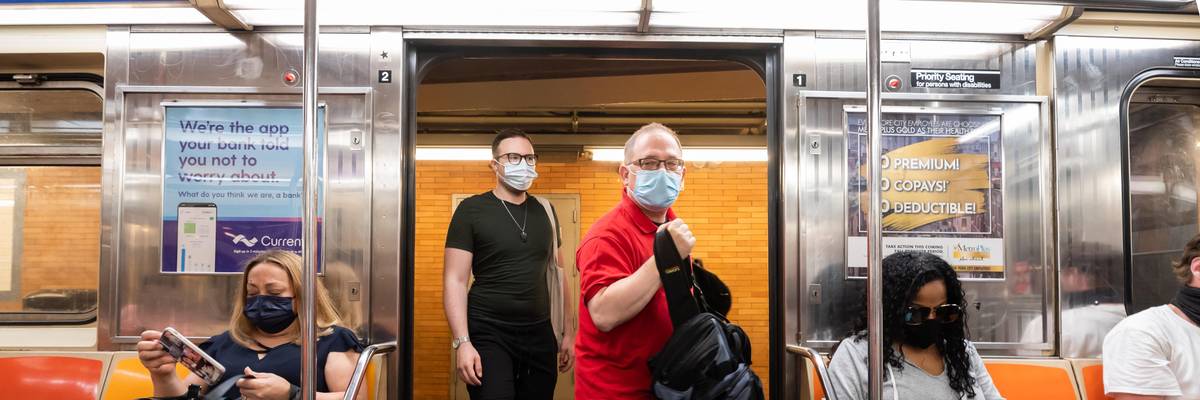
People ride the New York City subway on May 26, 2021. (Photo: Noam Galai/Getty Images)
Leave aside whether you like the result--ending the mask requirement on planes, trains, and other modes of mass transit--no one should support how the federal mandate came to be struck down this week.
Court packing was perhaps Trump's biggest legacy... Despite his defeat after a single term, and regardless of whether he wins the job back, Americans will feel Trump's impact for decades.
First, consider the order itself, from a federal district judge in Florida. It's 59 pages of rambling pseudoscience and conservative textualism-run-amok, delving into what a long-ago Congress meant by "sanitation" in the vast Public Health Service Act of 1944.
Judge Kathryn Kimball Mizelle gave the statute her own inane spin. "Wearing a mask cleans nothing," she concluded. "At most, it traps virus droplets. But it neither 'sanitizes' the person wearing the mask nor 'sanitizes' the conveyance."
I'd rather defer on that to the 21st century scientists at the Centers for Disease Control and Prevention, which is authorized by that law to make and enforce regulations "to prevent the introduction, transmission, or spread of communicable diseases"--like the highly contagious Covid-19.
Mizelle claims the CDC overstepped its power. At the agency's request, the Justice Department said Wednesday that the government would appeal her order.
More broadly, consider this: Mizelle should not even be on the federal bench.
She was put in the lifetime job 17 months ago--at 33, just eight years out of the University of Florida law school, having never tried a court case, rated "not qualified" by the American Bar Assn. Her confirmation exemplifies how completely former President Trump and a Senate then under Republican control, and led by Mitch McConnell, broke the judicial selection process in their drive to place conservative ideologues in the federal judiciary.
Court packing was perhaps Trump's biggest legacy. Certainly, it's his most enduring. Despite his defeat after a single term, and regardless of whether he wins the job back, Americans will feel Trump's impact for decades.
Today, it's mask-wearing. Previously, Trump judges have thwarted President Biden's agenda initiatives on public health, immigration, and climate change. And tomorrow--actually by July, when the Supreme Court ends its term--it will probably mean an end to the constitutional right to an abortion; expanded rights to carry firearms in public amid an epidemic of gun violence; and handcuffs on the Environmental Protection Agency in its labors to curb climate change.
As McConnell gloated at a 2018 gala of the Federalist Society, that feeder for Republican presidents' judicial candidates (Mizelle was a member, natch), Republicans' goal was "to do everything we can, for as long as we can, to transform the federal judiciary, because everything else we do is transitory."
Trump filled 226 seats on the federal judiciary in four years. His appointees now account for more than 25% of federal district judges, 30% of those on the 13 appeals courts (in one term, Trump appointed 54 appellate judges, just one fewer than President Obama appointed to appeals courts in two terms), and one-third of the Supreme Court, creating its 6-3 conservative supermajority.
The conservative RedState.com in 2019 approvingly wrote of "the bloody-mindedness" of Republicans "in ramming those nominees through the system."
Americans deserve better than federal judges who have little experience practicing law and have barely been inside a courtroom.
Even Trump's defeat in November 2020 didn't stop the norms-breaking juggernaut. McConnell, who'd vowed to "leave no vacancy behind," had the Senate continue to vote on Trump nominees right up to Joe Biden's inauguration--14 of them, including Mizelle.
Not since the election of 1896 had the Senate confirmed a judicial nominee of a president whose party had lost the White House, according to Russell Wheeler, a scholar at the Brookings Institution. And this was after McConnell had rammed Amy Coney Barrett's Supreme Court nomination through the Senate days before Biden's election, and after many millions of Americans had voted early.
So much for McConnell's "principle" back in 2016, when he blocked Obama's nomination of Merrick Garland to the Supreme Court for most of that election year, to "let the people decide" who should fill judicial seats.
Most of Trump's picks were unusually young--Mizelle was the youngest nominee of all--the better to ensure that these ideologues would be on the bench for many decades. That meant they were often less experienced than the traditional judicial nominee. Ten were confirmed despite ABA findings that they were "not qualified"--that was significantly more than in past administrations, which typically didn't go forward with nominees who got that rating.
Some Trump nominees were too sketchy even for Senate Republicans. Among those forced to withdraw from consideration was one who, like Mizelle, had never tried a civil or criminal case and couldn't answer a Republican senator's questions about basic judicial procedure. Another one had written sympathetically about the Ku Klux Klan, and a third had denigrated LGBTQ people in speeches (calling transgender kids proof of "Satan's plan," for example).
Yet Mizelle got through, though she could not meet the ABA's minimum standard of 12 years of legal experience for lifetime appointments to the federal bench.
Republicans have long claimed that the bar association is biased against conservatives in performing its exhaustive reviews of judicial nominees. But those complaints are baseless. Americans deserve better than federal judges who have little experience practicing law and have barely been inside a courtroom.
But, hey, Mizelle was a law clerk to Justice Clarence Thomas! With that credential and now permanently ensconced on the bench, don't be surprised if a Republican president elevates her to the Supreme Court before too long.
Dear Common Dreams reader, It’s been nearly 30 years since I co-founded Common Dreams with my late wife, Lina Newhouser. We had the radical notion that journalism should serve the public good, not corporate profits. It was clear to us from the outset what it would take to build such a project. No paid advertisements. No corporate sponsors. No millionaire publisher telling us what to think or do. Many people said we wouldn't last a year, but we proved those doubters wrong. Together with a tremendous team of journalists and dedicated staff, we built an independent media outlet free from the constraints of profits and corporate control. Our mission has always been simple: To inform. To inspire. To ignite change for the common good. Building Common Dreams was not easy. Our survival was never guaranteed. When you take on the most powerful forces—Wall Street greed, fossil fuel industry destruction, Big Tech lobbyists, and uber-rich oligarchs who have spent billions upon billions rigging the economy and democracy in their favor—the only bulwark you have is supporters who believe in your work. But here’s the urgent message from me today. It's never been this bad out there. And it's never been this hard to keep us going. At the very moment Common Dreams is most needed, the threats we face are intensifying. We need your support now more than ever. We don't accept corporate advertising and never will. We don't have a paywall because we don't think people should be blocked from critical news based on their ability to pay. Everything we do is funded by the donations of readers like you. When everyone does the little they can afford, we are strong. But if that support retreats or dries up, so do we. Will you donate now to make sure Common Dreams not only survives but thrives? —Craig Brown, Co-founder |
Leave aside whether you like the result--ending the mask requirement on planes, trains, and other modes of mass transit--no one should support how the federal mandate came to be struck down this week.
Court packing was perhaps Trump's biggest legacy... Despite his defeat after a single term, and regardless of whether he wins the job back, Americans will feel Trump's impact for decades.
First, consider the order itself, from a federal district judge in Florida. It's 59 pages of rambling pseudoscience and conservative textualism-run-amok, delving into what a long-ago Congress meant by "sanitation" in the vast Public Health Service Act of 1944.
Judge Kathryn Kimball Mizelle gave the statute her own inane spin. "Wearing a mask cleans nothing," she concluded. "At most, it traps virus droplets. But it neither 'sanitizes' the person wearing the mask nor 'sanitizes' the conveyance."
I'd rather defer on that to the 21st century scientists at the Centers for Disease Control and Prevention, which is authorized by that law to make and enforce regulations "to prevent the introduction, transmission, or spread of communicable diseases"--like the highly contagious Covid-19.
Mizelle claims the CDC overstepped its power. At the agency's request, the Justice Department said Wednesday that the government would appeal her order.
More broadly, consider this: Mizelle should not even be on the federal bench.
She was put in the lifetime job 17 months ago--at 33, just eight years out of the University of Florida law school, having never tried a court case, rated "not qualified" by the American Bar Assn. Her confirmation exemplifies how completely former President Trump and a Senate then under Republican control, and led by Mitch McConnell, broke the judicial selection process in their drive to place conservative ideologues in the federal judiciary.
Court packing was perhaps Trump's biggest legacy. Certainly, it's his most enduring. Despite his defeat after a single term, and regardless of whether he wins the job back, Americans will feel Trump's impact for decades.
Today, it's mask-wearing. Previously, Trump judges have thwarted President Biden's agenda initiatives on public health, immigration, and climate change. And tomorrow--actually by July, when the Supreme Court ends its term--it will probably mean an end to the constitutional right to an abortion; expanded rights to carry firearms in public amid an epidemic of gun violence; and handcuffs on the Environmental Protection Agency in its labors to curb climate change.
As McConnell gloated at a 2018 gala of the Federalist Society, that feeder for Republican presidents' judicial candidates (Mizelle was a member, natch), Republicans' goal was "to do everything we can, for as long as we can, to transform the federal judiciary, because everything else we do is transitory."
Trump filled 226 seats on the federal judiciary in four years. His appointees now account for more than 25% of federal district judges, 30% of those on the 13 appeals courts (in one term, Trump appointed 54 appellate judges, just one fewer than President Obama appointed to appeals courts in two terms), and one-third of the Supreme Court, creating its 6-3 conservative supermajority.
The conservative RedState.com in 2019 approvingly wrote of "the bloody-mindedness" of Republicans "in ramming those nominees through the system."
Americans deserve better than federal judges who have little experience practicing law and have barely been inside a courtroom.
Even Trump's defeat in November 2020 didn't stop the norms-breaking juggernaut. McConnell, who'd vowed to "leave no vacancy behind," had the Senate continue to vote on Trump nominees right up to Joe Biden's inauguration--14 of them, including Mizelle.
Not since the election of 1896 had the Senate confirmed a judicial nominee of a president whose party had lost the White House, according to Russell Wheeler, a scholar at the Brookings Institution. And this was after McConnell had rammed Amy Coney Barrett's Supreme Court nomination through the Senate days before Biden's election, and after many millions of Americans had voted early.
So much for McConnell's "principle" back in 2016, when he blocked Obama's nomination of Merrick Garland to the Supreme Court for most of that election year, to "let the people decide" who should fill judicial seats.
Most of Trump's picks were unusually young--Mizelle was the youngest nominee of all--the better to ensure that these ideologues would be on the bench for many decades. That meant they were often less experienced than the traditional judicial nominee. Ten were confirmed despite ABA findings that they were "not qualified"--that was significantly more than in past administrations, which typically didn't go forward with nominees who got that rating.
Some Trump nominees were too sketchy even for Senate Republicans. Among those forced to withdraw from consideration was one who, like Mizelle, had never tried a civil or criminal case and couldn't answer a Republican senator's questions about basic judicial procedure. Another one had written sympathetically about the Ku Klux Klan, and a third had denigrated LGBTQ people in speeches (calling transgender kids proof of "Satan's plan," for example).
Yet Mizelle got through, though she could not meet the ABA's minimum standard of 12 years of legal experience for lifetime appointments to the federal bench.
Republicans have long claimed that the bar association is biased against conservatives in performing its exhaustive reviews of judicial nominees. But those complaints are baseless. Americans deserve better than federal judges who have little experience practicing law and have barely been inside a courtroom.
But, hey, Mizelle was a law clerk to Justice Clarence Thomas! With that credential and now permanently ensconced on the bench, don't be surprised if a Republican president elevates her to the Supreme Court before too long.
Leave aside whether you like the result--ending the mask requirement on planes, trains, and other modes of mass transit--no one should support how the federal mandate came to be struck down this week.
Court packing was perhaps Trump's biggest legacy... Despite his defeat after a single term, and regardless of whether he wins the job back, Americans will feel Trump's impact for decades.
First, consider the order itself, from a federal district judge in Florida. It's 59 pages of rambling pseudoscience and conservative textualism-run-amok, delving into what a long-ago Congress meant by "sanitation" in the vast Public Health Service Act of 1944.
Judge Kathryn Kimball Mizelle gave the statute her own inane spin. "Wearing a mask cleans nothing," she concluded. "At most, it traps virus droplets. But it neither 'sanitizes' the person wearing the mask nor 'sanitizes' the conveyance."
I'd rather defer on that to the 21st century scientists at the Centers for Disease Control and Prevention, which is authorized by that law to make and enforce regulations "to prevent the introduction, transmission, or spread of communicable diseases"--like the highly contagious Covid-19.
Mizelle claims the CDC overstepped its power. At the agency's request, the Justice Department said Wednesday that the government would appeal her order.
More broadly, consider this: Mizelle should not even be on the federal bench.
She was put in the lifetime job 17 months ago--at 33, just eight years out of the University of Florida law school, having never tried a court case, rated "not qualified" by the American Bar Assn. Her confirmation exemplifies how completely former President Trump and a Senate then under Republican control, and led by Mitch McConnell, broke the judicial selection process in their drive to place conservative ideologues in the federal judiciary.
Court packing was perhaps Trump's biggest legacy. Certainly, it's his most enduring. Despite his defeat after a single term, and regardless of whether he wins the job back, Americans will feel Trump's impact for decades.
Today, it's mask-wearing. Previously, Trump judges have thwarted President Biden's agenda initiatives on public health, immigration, and climate change. And tomorrow--actually by July, when the Supreme Court ends its term--it will probably mean an end to the constitutional right to an abortion; expanded rights to carry firearms in public amid an epidemic of gun violence; and handcuffs on the Environmental Protection Agency in its labors to curb climate change.
As McConnell gloated at a 2018 gala of the Federalist Society, that feeder for Republican presidents' judicial candidates (Mizelle was a member, natch), Republicans' goal was "to do everything we can, for as long as we can, to transform the federal judiciary, because everything else we do is transitory."
Trump filled 226 seats on the federal judiciary in four years. His appointees now account for more than 25% of federal district judges, 30% of those on the 13 appeals courts (in one term, Trump appointed 54 appellate judges, just one fewer than President Obama appointed to appeals courts in two terms), and one-third of the Supreme Court, creating its 6-3 conservative supermajority.
The conservative RedState.com in 2019 approvingly wrote of "the bloody-mindedness" of Republicans "in ramming those nominees through the system."
Americans deserve better than federal judges who have little experience practicing law and have barely been inside a courtroom.
Even Trump's defeat in November 2020 didn't stop the norms-breaking juggernaut. McConnell, who'd vowed to "leave no vacancy behind," had the Senate continue to vote on Trump nominees right up to Joe Biden's inauguration--14 of them, including Mizelle.
Not since the election of 1896 had the Senate confirmed a judicial nominee of a president whose party had lost the White House, according to Russell Wheeler, a scholar at the Brookings Institution. And this was after McConnell had rammed Amy Coney Barrett's Supreme Court nomination through the Senate days before Biden's election, and after many millions of Americans had voted early.
So much for McConnell's "principle" back in 2016, when he blocked Obama's nomination of Merrick Garland to the Supreme Court for most of that election year, to "let the people decide" who should fill judicial seats.
Most of Trump's picks were unusually young--Mizelle was the youngest nominee of all--the better to ensure that these ideologues would be on the bench for many decades. That meant they were often less experienced than the traditional judicial nominee. Ten were confirmed despite ABA findings that they were "not qualified"--that was significantly more than in past administrations, which typically didn't go forward with nominees who got that rating.
Some Trump nominees were too sketchy even for Senate Republicans. Among those forced to withdraw from consideration was one who, like Mizelle, had never tried a civil or criminal case and couldn't answer a Republican senator's questions about basic judicial procedure. Another one had written sympathetically about the Ku Klux Klan, and a third had denigrated LGBTQ people in speeches (calling transgender kids proof of "Satan's plan," for example).
Yet Mizelle got through, though she could not meet the ABA's minimum standard of 12 years of legal experience for lifetime appointments to the federal bench.
Republicans have long claimed that the bar association is biased against conservatives in performing its exhaustive reviews of judicial nominees. But those complaints are baseless. Americans deserve better than federal judges who have little experience practicing law and have barely been inside a courtroom.
But, hey, Mizelle was a law clerk to Justice Clarence Thomas! With that credential and now permanently ensconced on the bench, don't be surprised if a Republican president elevates her to the Supreme Court before too long.