SUBSCRIBE TO OUR FREE NEWSLETTER
Daily news & progressive opinion—funded by the people, not the corporations—delivered straight to your inbox.
5
#000000
#FFFFFF
To donate by check, phone, or other method, see our More Ways to Give page.
Daily news & progressive opinion—funded by the people, not the corporations—delivered straight to your inbox.
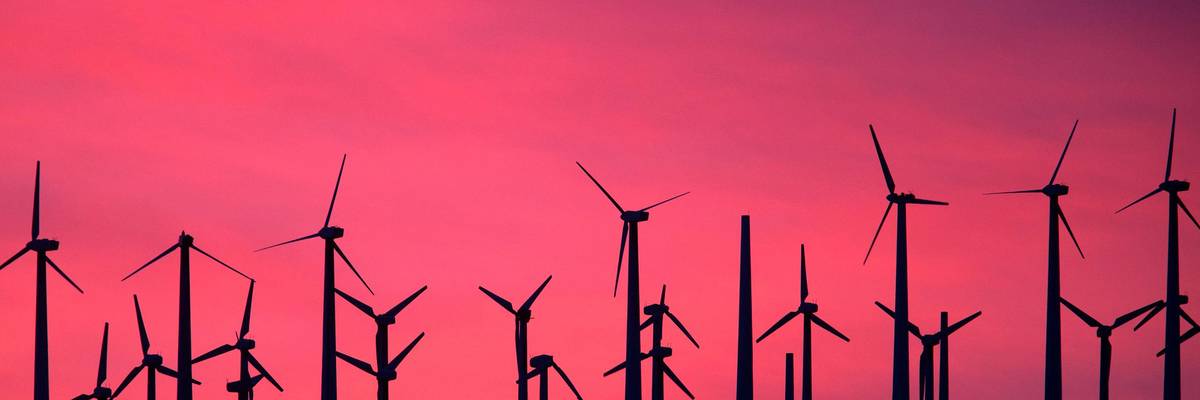
Electric energy generating wind turbines are seen on a wind farm in the San Gorgonio Pass area on Earth Day, April 22, 2016, near Palm Springs, California. San Gorgonio Pass is one of the largest wind farm areas in the United States. (Photo: David McNew/AFP via Getty Images)
California's energy mix was powered 97% by renewable energy on Sunday, April 3 at at 3:39 p.m., the highest contribution of renewables to the state's grid on record, according to David Knowles at Yahoo News.
Based on the performance of these energy sectors in 2019 and 2020, California now gets about 60% of its electricity from low-carbon, non-fossil fuel sources.
Although the milestone lasted only for a brief time, it points to a future in which California runs on 100% wind, solar, hydro and batteries, a future that will certainly arrive even faster than the state plans. As it is, California is ahead of its green energy goals.
The implication of these plans is that California intends to phase out methane gas as a source of power. The state is also trying to electrify transportation. A world of 100% green energy and electric cars is not only a healthier and more comfortable world, it is a world where oil and gas dictators like Vladimir Putin are defunded.
Based on the performance of these energy sectors in 2019 and 2020, California now gets about 60% of its electricity from low-carbon, non-fossil fuel sources.
Over a third of the state's electricity is generated by wind and solar, and between 14% and 17% by large hydro, depending on how severe the droughts are. Some 10 percent comes from nuclear plants.
The Golden State has also made enormous progress in garnering more battery power for back-up. By the beginning of this year it had 2.1 gigawatts in battery capacity, an 8-fold increase over the amount available in late 2019. Christian Roselund at PV Magazine points out that if we look at green energy projects in the pipeline, 533 of them are for batteries, aiming for 135 gigawatts. There are 282 projects that involve solar energy, aiming for 76 gigawatts. So battery generation is outstripping solar. Batteries are also key to providing electricity at night or when the wind falls off. Since they can scale up and down quickly, they are highly compatible with renewables.
A bill has been introduced in the California legislature by Henry Stern (D-LA) that would require the state to put in 6 new gigawatts of renewable energy annually, beginning in 2025. Sammy Roth reports at the LA Times that this is the pace necessary if the state is to get to 100% renewables by 2045. The state has only been averaging 1.5 new gigawatts of renewables annually for the past decade, so this measure, if adopted, would up Sacramento's game substantially.
Roth says there are 25 climate bills looking to pass in the state legislature. Some want to help fossil fuel workers transition to other jobs. Others want to help bury electrical wires, which cause wildfires or are knocked out by wildires when above ground. Others back the building of necessary new, high-desity transmission wires. Yet others aim to push utilities to develop geothermal, battery and hydrogen power to provide baseline energy generation when intermittent renewables fall off.
Other bills aim to cut out the permitting and paperwork burden for installing solar panels, or to provide ways for lower-income families to get them.
If anyone is listening, what we really need is national financial instruments allowing families to pay off solar panels over time. Few people just walk into a dealership and plunk down cash for a new car, but mostly consumers are expected to do that with solar installations for their homes. The big difference is that whereas a car loses 50% of its value when you drive it off the lot, solar panels will go on saving people loads of money on their electrical bills for 25 years and will also fuel their electric cars.
Dear Common Dreams reader, It’s been nearly 30 years since I co-founded Common Dreams with my late wife, Lina Newhouser. We had the radical notion that journalism should serve the public good, not corporate profits. It was clear to us from the outset what it would take to build such a project. No paid advertisements. No corporate sponsors. No millionaire publisher telling us what to think or do. Many people said we wouldn't last a year, but we proved those doubters wrong. Together with a tremendous team of journalists and dedicated staff, we built an independent media outlet free from the constraints of profits and corporate control. Our mission has always been simple: To inform. To inspire. To ignite change for the common good. Building Common Dreams was not easy. Our survival was never guaranteed. When you take on the most powerful forces—Wall Street greed, fossil fuel industry destruction, Big Tech lobbyists, and uber-rich oligarchs who have spent billions upon billions rigging the economy and democracy in their favor—the only bulwark you have is supporters who believe in your work. But here’s the urgent message from me today. It's never been this bad out there. And it's never been this hard to keep us going. At the very moment Common Dreams is most needed, the threats we face are intensifying. We need your support now more than ever. We don't accept corporate advertising and never will. We don't have a paywall because we don't think people should be blocked from critical news based on their ability to pay. Everything we do is funded by the donations of readers like you. When everyone does the little they can afford, we are strong. But if that support retreats or dries up, so do we. Will you donate now to make sure Common Dreams not only survives but thrives? —Craig Brown, Co-founder |
California's energy mix was powered 97% by renewable energy on Sunday, April 3 at at 3:39 p.m., the highest contribution of renewables to the state's grid on record, according to David Knowles at Yahoo News.
Based on the performance of these energy sectors in 2019 and 2020, California now gets about 60% of its electricity from low-carbon, non-fossil fuel sources.
Although the milestone lasted only for a brief time, it points to a future in which California runs on 100% wind, solar, hydro and batteries, a future that will certainly arrive even faster than the state plans. As it is, California is ahead of its green energy goals.
The implication of these plans is that California intends to phase out methane gas as a source of power. The state is also trying to electrify transportation. A world of 100% green energy and electric cars is not only a healthier and more comfortable world, it is a world where oil and gas dictators like Vladimir Putin are defunded.
Based on the performance of these energy sectors in 2019 and 2020, California now gets about 60% of its electricity from low-carbon, non-fossil fuel sources.
Over a third of the state's electricity is generated by wind and solar, and between 14% and 17% by large hydro, depending on how severe the droughts are. Some 10 percent comes from nuclear plants.
The Golden State has also made enormous progress in garnering more battery power for back-up. By the beginning of this year it had 2.1 gigawatts in battery capacity, an 8-fold increase over the amount available in late 2019. Christian Roselund at PV Magazine points out that if we look at green energy projects in the pipeline, 533 of them are for batteries, aiming for 135 gigawatts. There are 282 projects that involve solar energy, aiming for 76 gigawatts. So battery generation is outstripping solar. Batteries are also key to providing electricity at night or when the wind falls off. Since they can scale up and down quickly, they are highly compatible with renewables.
A bill has been introduced in the California legislature by Henry Stern (D-LA) that would require the state to put in 6 new gigawatts of renewable energy annually, beginning in 2025. Sammy Roth reports at the LA Times that this is the pace necessary if the state is to get to 100% renewables by 2045. The state has only been averaging 1.5 new gigawatts of renewables annually for the past decade, so this measure, if adopted, would up Sacramento's game substantially.
Roth says there are 25 climate bills looking to pass in the state legislature. Some want to help fossil fuel workers transition to other jobs. Others want to help bury electrical wires, which cause wildfires or are knocked out by wildires when above ground. Others back the building of necessary new, high-desity transmission wires. Yet others aim to push utilities to develop geothermal, battery and hydrogen power to provide baseline energy generation when intermittent renewables fall off.
Other bills aim to cut out the permitting and paperwork burden for installing solar panels, or to provide ways for lower-income families to get them.
If anyone is listening, what we really need is national financial instruments allowing families to pay off solar panels over time. Few people just walk into a dealership and plunk down cash for a new car, but mostly consumers are expected to do that with solar installations for their homes. The big difference is that whereas a car loses 50% of its value when you drive it off the lot, solar panels will go on saving people loads of money on their electrical bills for 25 years and will also fuel their electric cars.
California's energy mix was powered 97% by renewable energy on Sunday, April 3 at at 3:39 p.m., the highest contribution of renewables to the state's grid on record, according to David Knowles at Yahoo News.
Based on the performance of these energy sectors in 2019 and 2020, California now gets about 60% of its electricity from low-carbon, non-fossil fuel sources.
Although the milestone lasted only for a brief time, it points to a future in which California runs on 100% wind, solar, hydro and batteries, a future that will certainly arrive even faster than the state plans. As it is, California is ahead of its green energy goals.
The implication of these plans is that California intends to phase out methane gas as a source of power. The state is also trying to electrify transportation. A world of 100% green energy and electric cars is not only a healthier and more comfortable world, it is a world where oil and gas dictators like Vladimir Putin are defunded.
Based on the performance of these energy sectors in 2019 and 2020, California now gets about 60% of its electricity from low-carbon, non-fossil fuel sources.
Over a third of the state's electricity is generated by wind and solar, and between 14% and 17% by large hydro, depending on how severe the droughts are. Some 10 percent comes from nuclear plants.
The Golden State has also made enormous progress in garnering more battery power for back-up. By the beginning of this year it had 2.1 gigawatts in battery capacity, an 8-fold increase over the amount available in late 2019. Christian Roselund at PV Magazine points out that if we look at green energy projects in the pipeline, 533 of them are for batteries, aiming for 135 gigawatts. There are 282 projects that involve solar energy, aiming for 76 gigawatts. So battery generation is outstripping solar. Batteries are also key to providing electricity at night or when the wind falls off. Since they can scale up and down quickly, they are highly compatible with renewables.
A bill has been introduced in the California legislature by Henry Stern (D-LA) that would require the state to put in 6 new gigawatts of renewable energy annually, beginning in 2025. Sammy Roth reports at the LA Times that this is the pace necessary if the state is to get to 100% renewables by 2045. The state has only been averaging 1.5 new gigawatts of renewables annually for the past decade, so this measure, if adopted, would up Sacramento's game substantially.
Roth says there are 25 climate bills looking to pass in the state legislature. Some want to help fossil fuel workers transition to other jobs. Others want to help bury electrical wires, which cause wildfires or are knocked out by wildires when above ground. Others back the building of necessary new, high-desity transmission wires. Yet others aim to push utilities to develop geothermal, battery and hydrogen power to provide baseline energy generation when intermittent renewables fall off.
Other bills aim to cut out the permitting and paperwork burden for installing solar panels, or to provide ways for lower-income families to get them.
If anyone is listening, what we really need is national financial instruments allowing families to pay off solar panels over time. Few people just walk into a dealership and plunk down cash for a new car, but mostly consumers are expected to do that with solar installations for their homes. The big difference is that whereas a car loses 50% of its value when you drive it off the lot, solar panels will go on saving people loads of money on their electrical bills for 25 years and will also fuel their electric cars.