About 1,000 miles north in Marathon County, Wis., about a quarter of the people live under 200 percent of the poverty line, and death rates from covid-19 are almost the same as in Hinds County. Britnie Remer, who lives in the county and is only partially vaccinated because of an allergy, worries about the impact of industrial pollution, low wages and a lack of adequate health care in her Rust Belt community.

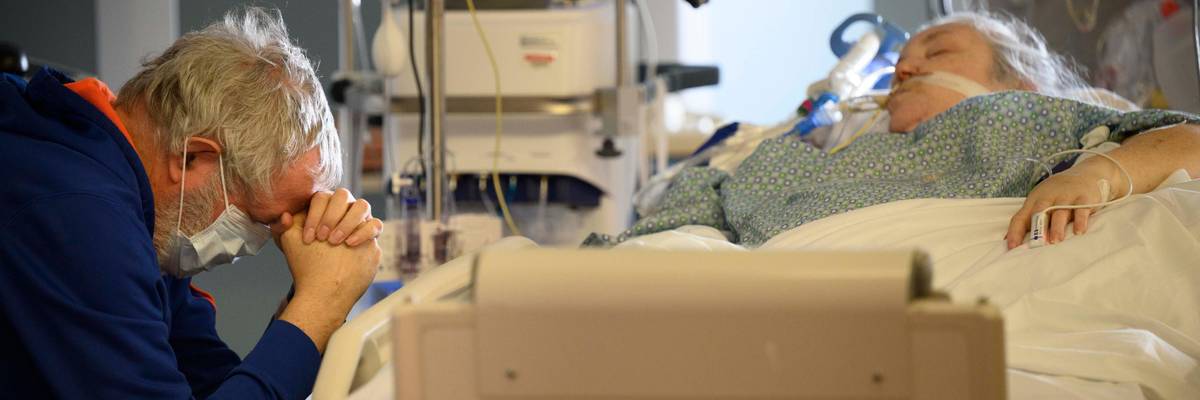
The husband of a Covid-19 patient prays at her bedside in the South Seven Intensive Care Unit on December 8, 2021 at North Memorial Health Hospital in Robbinsdale, Minnesota. (Photo: Aaron Lavinsky/Star Tribune via Getty Images)
Poverty: The Pre-Condition Underlying Covid-19 Mortality
If the nation had paid attention to the widespread poverty that preceded the pandemic, thousands of deaths might have been prevented.
In Hinds County, Miss., where nearly half of all residents are poor or low income, about 3 in 100 people have died of covid-19. Olivia Womack, a student at the University of Mississippi who grew up in Hinds County, has lost 20 members of her extended family to the coronavirus.
America's healing will not be complete until we address the poverty at the root of our covid catastrophe.

Womack and Remer live in communities often portrayed as polar opposites: Womack's county supported Joe Biden by a 3-to-1 margin over Donald Trump in 2020, while Remer's went almost 3 to 2 for Trump over Biden. But a new study released this week by the Poor People's Campaign and the U.N. Sustainable Development Network shows a disturbing link between the counties and covid-19 deaths.
"Mapping the Intersections of Poverty, Race and Covid-19" presents the first comprehensive county-level picture of how poverty has shaped both the spread of covid-19 and its devastating impact on the United States. It shows that death rates in the highest-income group are half the death rates in the lowest-income group. And, when we focus on the covid waves after vaccines were made available, the disparities are even more striking: During last fall's delta wave, death rates in the United States' poorest counties were five times those in the nation's wealthiest counties.
In almost every income group nationwide, county-by-county vaccine coverage ranges from high (85 percent and higher) to almost nonexistent (under 15 percent). Although average vaccination rates are generally higher in the highest-income counties, that doesn't fully explain the variation in death rates in the later waves of the pandemic.
To understand why some Americans have been so much more vulnerable to unnecessary death, we have to look at the consequences of poverty.
In Hinds County, where Womack lives, people are twice as likely to be uninsured as residents of the nation's wealthiest communities. In Remer's hometown of Wausau, Marathon's county seat, drinking wells in the municipal water system have higher levels of a pollutant than proposed state regulations allow. Like many low-income communities across America, Wausau is marked by the increased health risks that accompany industrial waste.
Since the start of the pandemic, public health officials have tried to understand why the covid death rate in the United States has been so much higher than in other nations with comparable resources and access to vaccines. Democrats have blamed Trump and other Republicans who failed to follow the advice of public health officials. Researchers also pointed to the role of systemic racism in health-care disparities. But race and partisan politics alone do not explain the disparity. Only when we focus on the impact of poverty can we see how uniquely vulnerable America is.
America will not be well until we invest in the communities where people like Womack and Remer live. And we will not find the political will to make that investment until poor and low-income people of every race and region unite. This is why we are organizing with poor people from every state to march in Washington on June 18 to demand equal access to health care, living wages, affordable housing, drinkable water, voting rights and a future where children in struggling communities share the promise of democracy rather than the curse of poverty.
When a public health crisis burns through a society, poverty fuels the fire. If the nation had paid attention to the widespread poverty that preceded the pandemic, thousands of deaths might have been prevented. As preachers, we know that no nation can thrive until it cares for its most marginalized members.
"If you spend yourselves on behalf of the hungry and satisfy the needs of the oppressed," the prophet Isaiah said, "your light will rise in the darkness, and your night will become like the noonday."
America's healing will not be complete until we address the poverty at the root of our covid catastrophe.
An Urgent Message From Our Co-Founder
Dear Common Dreams reader, The U.S. is on a fast track to authoritarianism like nothing I've ever seen. Meanwhile, corporate news outlets are utterly capitulating to Trump, twisting their coverage to avoid drawing his ire while lining up to stuff cash in his pockets. That's why I believe that Common Dreams is doing the best and most consequential reporting that we've ever done. Our small but mighty team is a progressive reporting powerhouse, covering the news every day that the corporate media never will. Our mission has always been simple: To inform. To inspire. And to ignite change for the common good. Now here's the key piece that I want all our readers to understand: None of this would be possible without your financial support. That's not just some fundraising cliche. It's the absolute and literal truth. We don't accept corporate advertising and never will. We don't have a paywall because we don't think people should be blocked from critical news based on their ability to pay. Everything we do is funded by the donations of readers like you. Will you donate now to help power the nonprofit, independent reporting of Common Dreams? Thank you for being a vital member of our community. Together, we can keep independent journalism alive when it’s needed most. - Craig Brown, Co-founder |
In Hinds County, Miss., where nearly half of all residents are poor or low income, about 3 in 100 people have died of covid-19. Olivia Womack, a student at the University of Mississippi who grew up in Hinds County, has lost 20 members of her extended family to the coronavirus.
America's healing will not be complete until we address the poverty at the root of our covid catastrophe.
About 1,000 miles north in Marathon County, Wis., about a quarter of the people live under 200 percent of the poverty line, and death rates from covid-19 are almost the same as in Hinds County. Britnie Remer, who lives in the county and is only partially vaccinated because of an allergy, worries about the impact of industrial pollution, low wages and a lack of adequate health care in her Rust Belt community.
Womack and Remer live in communities often portrayed as polar opposites: Womack's county supported Joe Biden by a 3-to-1 margin over Donald Trump in 2020, while Remer's went almost 3 to 2 for Trump over Biden. But a new study released this week by the Poor People's Campaign and the U.N. Sustainable Development Network shows a disturbing link between the counties and covid-19 deaths.
"Mapping the Intersections of Poverty, Race and Covid-19" presents the first comprehensive county-level picture of how poverty has shaped both the spread of covid-19 and its devastating impact on the United States. It shows that death rates in the highest-income group are half the death rates in the lowest-income group. And, when we focus on the covid waves after vaccines were made available, the disparities are even more striking: During last fall's delta wave, death rates in the United States' poorest counties were five times those in the nation's wealthiest counties.
In almost every income group nationwide, county-by-county vaccine coverage ranges from high (85 percent and higher) to almost nonexistent (under 15 percent). Although average vaccination rates are generally higher in the highest-income counties, that doesn't fully explain the variation in death rates in the later waves of the pandemic.
To understand why some Americans have been so much more vulnerable to unnecessary death, we have to look at the consequences of poverty.
In Hinds County, where Womack lives, people are twice as likely to be uninsured as residents of the nation's wealthiest communities. In Remer's hometown of Wausau, Marathon's county seat, drinking wells in the municipal water system have higher levels of a pollutant than proposed state regulations allow. Like many low-income communities across America, Wausau is marked by the increased health risks that accompany industrial waste.
Since the start of the pandemic, public health officials have tried to understand why the covid death rate in the United States has been so much higher than in other nations with comparable resources and access to vaccines. Democrats have blamed Trump and other Republicans who failed to follow the advice of public health officials. Researchers also pointed to the role of systemic racism in health-care disparities. But race and partisan politics alone do not explain the disparity. Only when we focus on the impact of poverty can we see how uniquely vulnerable America is.
America will not be well until we invest in the communities where people like Womack and Remer live. And we will not find the political will to make that investment until poor and low-income people of every race and region unite. This is why we are organizing with poor people from every state to march in Washington on June 18 to demand equal access to health care, living wages, affordable housing, drinkable water, voting rights and a future where children in struggling communities share the promise of democracy rather than the curse of poverty.
When a public health crisis burns through a society, poverty fuels the fire. If the nation had paid attention to the widespread poverty that preceded the pandemic, thousands of deaths might have been prevented. As preachers, we know that no nation can thrive until it cares for its most marginalized members.
"If you spend yourselves on behalf of the hungry and satisfy the needs of the oppressed," the prophet Isaiah said, "your light will rise in the darkness, and your night will become like the noonday."
America's healing will not be complete until we address the poverty at the root of our covid catastrophe.
In Hinds County, Miss., where nearly half of all residents are poor or low income, about 3 in 100 people have died of covid-19. Olivia Womack, a student at the University of Mississippi who grew up in Hinds County, has lost 20 members of her extended family to the coronavirus.
America's healing will not be complete until we address the poverty at the root of our covid catastrophe.
About 1,000 miles north in Marathon County, Wis., about a quarter of the people live under 200 percent of the poverty line, and death rates from covid-19 are almost the same as in Hinds County. Britnie Remer, who lives in the county and is only partially vaccinated because of an allergy, worries about the impact of industrial pollution, low wages and a lack of adequate health care in her Rust Belt community.
Womack and Remer live in communities often portrayed as polar opposites: Womack's county supported Joe Biden by a 3-to-1 margin over Donald Trump in 2020, while Remer's went almost 3 to 2 for Trump over Biden. But a new study released this week by the Poor People's Campaign and the U.N. Sustainable Development Network shows a disturbing link between the counties and covid-19 deaths.
"Mapping the Intersections of Poverty, Race and Covid-19" presents the first comprehensive county-level picture of how poverty has shaped both the spread of covid-19 and its devastating impact on the United States. It shows that death rates in the highest-income group are half the death rates in the lowest-income group. And, when we focus on the covid waves after vaccines were made available, the disparities are even more striking: During last fall's delta wave, death rates in the United States' poorest counties were five times those in the nation's wealthiest counties.
In almost every income group nationwide, county-by-county vaccine coverage ranges from high (85 percent and higher) to almost nonexistent (under 15 percent). Although average vaccination rates are generally higher in the highest-income counties, that doesn't fully explain the variation in death rates in the later waves of the pandemic.
To understand why some Americans have been so much more vulnerable to unnecessary death, we have to look at the consequences of poverty.
In Hinds County, where Womack lives, people are twice as likely to be uninsured as residents of the nation's wealthiest communities. In Remer's hometown of Wausau, Marathon's county seat, drinking wells in the municipal water system have higher levels of a pollutant than proposed state regulations allow. Like many low-income communities across America, Wausau is marked by the increased health risks that accompany industrial waste.
Since the start of the pandemic, public health officials have tried to understand why the covid death rate in the United States has been so much higher than in other nations with comparable resources and access to vaccines. Democrats have blamed Trump and other Republicans who failed to follow the advice of public health officials. Researchers also pointed to the role of systemic racism in health-care disparities. But race and partisan politics alone do not explain the disparity. Only when we focus on the impact of poverty can we see how uniquely vulnerable America is.
America will not be well until we invest in the communities where people like Womack and Remer live. And we will not find the political will to make that investment until poor and low-income people of every race and region unite. This is why we are organizing with poor people from every state to march in Washington on June 18 to demand equal access to health care, living wages, affordable housing, drinkable water, voting rights and a future where children in struggling communities share the promise of democracy rather than the curse of poverty.
When a public health crisis burns through a society, poverty fuels the fire. If the nation had paid attention to the widespread poverty that preceded the pandemic, thousands of deaths might have been prevented. As preachers, we know that no nation can thrive until it cares for its most marginalized members.
"If you spend yourselves on behalf of the hungry and satisfy the needs of the oppressed," the prophet Isaiah said, "your light will rise in the darkness, and your night will become like the noonday."
America's healing will not be complete until we address the poverty at the root of our covid catastrophe.