

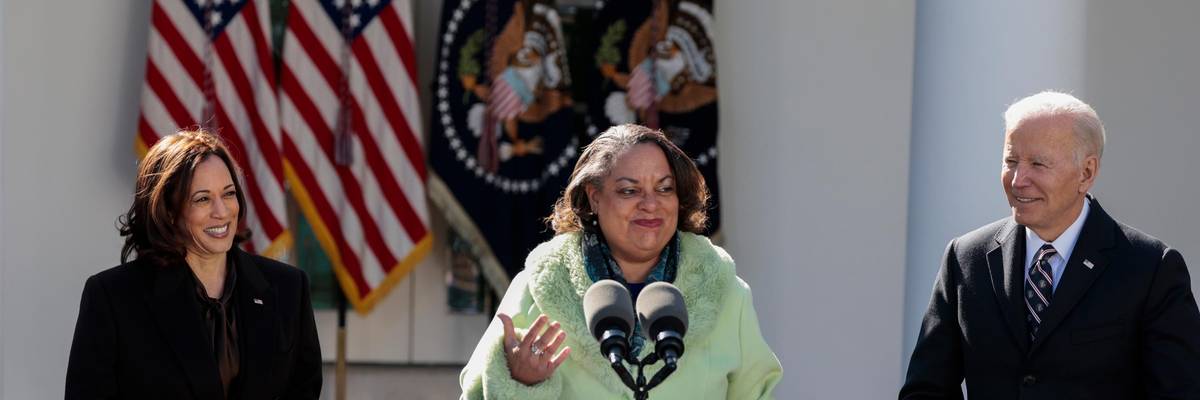
Michelle Duster, the great-granddaughter of Ida B. Wells delivers remarks alongside U.S. President Joe Biden and U.S Vice President Kamala Harris, after signing H.R. 55, the "Emmett Till Antilynching Act" in the Rose Garden of the White House on March 29, 2022 in Washington, DC. The bipartisan legislation labels lynching a federal hate crime. (Photo: Anna Moneymaker/Getty Images)
The Long-Overdue Emmett Till Antilynching Act Signed Into Law
Emmett Till's murder galvanized the civil rights movement.
President Biden signed The Emmett Till Antilynching Act into law on Tuesday, culminating efforts to make lynching a federal crime that started over a century ago. Michelle Duster, the great-granddaughter of Ida B. Wells, the legendary anti-lynching activist and pioneering African-American journalist, said at the signing ceremony,
"Since my great-grandmother's visit to the White House 124 years ago, there have been over 200 attempts to get legislation enacted. But we finally stand here today, generations later, to witness this historic moment."
The image went global and forced the people of the United States to witness the ravages of racism, the brutality of bigotry.
Emmett Till should be alive today. Born on July 25th, 1941, he would be eighty years old. Perhaps he would still be joking the way he did throughout his childhood. "For Emmett, life was laughter and laughter was life-giving," his mother, Mamie Till-Mobley wrote of him. "There was so much joy in his carefree world that he just wanted to share with everyone around him." Emmett Till, an African-American boy, was brutally murdered on August 28th, 1955, at the age of 14. He had been accused of "wolf whistling" at Carolyn Bryant, a white woman, then dragged out of his great-uncle's home in Money, Mississippi, where his mother had sent him from Chicago for the summer. Several days later, his brutally beaten, disfigured body, weighted down with a 75-pound cotton gin fan tied to his body with barbed wire, was pulled out of the Tallahatchie River.
The Leflore County sheriff attempted to force the immediate burial of Emmett Till, but Mamie intervened, and paid almost a year's salary for his body to be shipped back to Chicago. There, the funeral director refused to open the box for her to view her son's corpse. "Give me a hammer," she demanded. He relented, and allowed Mamie to view Emmett's mutilated remains. By then, the murder had sparked outrage across the nation. Mamie Till-Mobley insisted that Emmett receive an open-casket funeral. "Let the world see what I've seen," she said.
One hundred thousand mourners lined up to pay respects. Jet Magazine put a picture of Emmett in his casket, his head distended and deformed by violence, on the magazine's cover. The image went global and forced the people of the United States to witness the ravages of racism, the brutality of bigotry.
Two suspects, Roy Bryant, the husband of the woman who claimed she had been whistled at, and his half-brother J.W. Milam, were arrested for the kidnapping and murder of Emmett Till. Two brave activists from the Mississippi NAACP, Medgar Evers and Amzie Moore, had been involved since Till was reported missing, first looking for the lost boy then seeking eyewitnesses to the murder. Despite the eyewitnesses they produced, an all-white all-male jury acquitted the suspects. One member of the jury said that they had reached their decision within minutes, but waited an hour to appear as if they had actually deliberated. Medgar Evers himself was later assassinated, in the driveway of his home, on June 12, 1963.
After the acquittal, Bryant and Milam sold their story to Look Magazine for $4,000--about the same amount that Mamie Till-Mobley had paid to ship her son home, and equivalent to over $40,000 in 2022. Despite their confession to the magazine that they murdered Till, they couldn't be prosecuted due to constitutional "double jeopardy" protections. Had a federal anti-lynching law existed at the time, they could have been charged.
Emmett Till's murder galvanized the civil rights movement. Months later, Rosa Parks refused to give up her seat on the bus in Montgomery, Alabama. When asked why she refused to go to the rear of the bus, she said, "I thought of Emmett Till and I just couldn't go back."
A. Philip Randolph, the renowned African-American labor organizer and civil rights activist, chose the 8th anniversary of Till's death, August 28th, 1963, for the March on Washington, where Martin Luther King, Jr. delivered his famous "I Have a Dream" speech.
In 2004, the FBI reopened the Emmett Till case, and conducted interviews with surviving eyewitnesses, leading to the identification of several other still living suspects. In 2017, historian Timothy Tyson published a book on the case which included a 2007 interview he conducted with Carolyn Bryant. In it, Tyson reports, she recanted part of her 1955 court testimony that Till touched her and made lewd comments, a revelation that could have led to her being charged with lying to the FBI.
She denied Tyson's account. In December, 2021, the Department of Justice formally closed the Emmett Till case.
"The way to right wrongs is to turn the light of truth upon them," Ida B. Wells wrote. While Emmett Till's murderers escaped justice, his short life, and his mother Mamie Till-Mobley's tireless activism, charted the path forward for us all to permanently reject racist terror.
We are at a crossroads
This country and this world are at a monumental crossroads. In a few short weeks, US voters will have an opportunity to beat back the forces of fascism and confront the billionaires who are rigging the economy, our media system, and our democracy, making it increasingly impossible for ordinary people to get by. We’re not just talking about the election. We’re talking about what must be done once these fascist elements are vanquished from power. We need a bolder set of solutions than what either major party has so far been willing to offer and a working-class movement ready to fight like hell for it. Trump didn't emerge from nowhere. The conditions that fueled MAGA authoritarianism were created by decades of radical neoliberal economic policies and a corrupt political system dominated by corporate interests. They slashed taxes on the super-rich, promising that the benefits would trickle down. They said giveaways to the corporate titans would make life more affordable for the rest of us. It was all bullshit. And when a bitter, betrayed populace searches for someone to blame, right-wing demagogues have little trouble finding scapegoats. People know when they're being lied to, but you won't hear any of this from the corporate media. Only independent journalism—powered and funded by people who believe in building a better world—can deliver truly trustworthy daily news. Our Fall Campaign is underway, and we need your help. To power our newsroom through the rest of the year, we need to raise $125,000 by midnight on October 31. So if you share our vision, please contribute whatever you can to sustain our work. |
President Biden signed The Emmett Till Antilynching Act into law on Tuesday, culminating efforts to make lynching a federal crime that started over a century ago. Michelle Duster, the great-granddaughter of Ida B. Wells, the legendary anti-lynching activist and pioneering African-American journalist, said at the signing ceremony,
"Since my great-grandmother's visit to the White House 124 years ago, there have been over 200 attempts to get legislation enacted. But we finally stand here today, generations later, to witness this historic moment."
The image went global and forced the people of the United States to witness the ravages of racism, the brutality of bigotry.
Emmett Till should be alive today. Born on July 25th, 1941, he would be eighty years old. Perhaps he would still be joking the way he did throughout his childhood. "For Emmett, life was laughter and laughter was life-giving," his mother, Mamie Till-Mobley wrote of him. "There was so much joy in his carefree world that he just wanted to share with everyone around him." Emmett Till, an African-American boy, was brutally murdered on August 28th, 1955, at the age of 14. He had been accused of "wolf whistling" at Carolyn Bryant, a white woman, then dragged out of his great-uncle's home in Money, Mississippi, where his mother had sent him from Chicago for the summer. Several days later, his brutally beaten, disfigured body, weighted down with a 75-pound cotton gin fan tied to his body with barbed wire, was pulled out of the Tallahatchie River.
The Leflore County sheriff attempted to force the immediate burial of Emmett Till, but Mamie intervened, and paid almost a year's salary for his body to be shipped back to Chicago. There, the funeral director refused to open the box for her to view her son's corpse. "Give me a hammer," she demanded. He relented, and allowed Mamie to view Emmett's mutilated remains. By then, the murder had sparked outrage across the nation. Mamie Till-Mobley insisted that Emmett receive an open-casket funeral. "Let the world see what I've seen," she said.
One hundred thousand mourners lined up to pay respects. Jet Magazine put a picture of Emmett in his casket, his head distended and deformed by violence, on the magazine's cover. The image went global and forced the people of the United States to witness the ravages of racism, the brutality of bigotry.
Two suspects, Roy Bryant, the husband of the woman who claimed she had been whistled at, and his half-brother J.W. Milam, were arrested for the kidnapping and murder of Emmett Till. Two brave activists from the Mississippi NAACP, Medgar Evers and Amzie Moore, had been involved since Till was reported missing, first looking for the lost boy then seeking eyewitnesses to the murder. Despite the eyewitnesses they produced, an all-white all-male jury acquitted the suspects. One member of the jury said that they had reached their decision within minutes, but waited an hour to appear as if they had actually deliberated. Medgar Evers himself was later assassinated, in the driveway of his home, on June 12, 1963.
After the acquittal, Bryant and Milam sold their story to Look Magazine for $4,000--about the same amount that Mamie Till-Mobley had paid to ship her son home, and equivalent to over $40,000 in 2022. Despite their confession to the magazine that they murdered Till, they couldn't be prosecuted due to constitutional "double jeopardy" protections. Had a federal anti-lynching law existed at the time, they could have been charged.
Emmett Till's murder galvanized the civil rights movement. Months later, Rosa Parks refused to give up her seat on the bus in Montgomery, Alabama. When asked why she refused to go to the rear of the bus, she said, "I thought of Emmett Till and I just couldn't go back."
A. Philip Randolph, the renowned African-American labor organizer and civil rights activist, chose the 8th anniversary of Till's death, August 28th, 1963, for the March on Washington, where Martin Luther King, Jr. delivered his famous "I Have a Dream" speech.
In 2004, the FBI reopened the Emmett Till case, and conducted interviews with surviving eyewitnesses, leading to the identification of several other still living suspects. In 2017, historian Timothy Tyson published a book on the case which included a 2007 interview he conducted with Carolyn Bryant. In it, Tyson reports, she recanted part of her 1955 court testimony that Till touched her and made lewd comments, a revelation that could have led to her being charged with lying to the FBI.
She denied Tyson's account. In December, 2021, the Department of Justice formally closed the Emmett Till case.
"The way to right wrongs is to turn the light of truth upon them," Ida B. Wells wrote. While Emmett Till's murderers escaped justice, his short life, and his mother Mamie Till-Mobley's tireless activism, charted the path forward for us all to permanently reject racist terror.
President Biden signed The Emmett Till Antilynching Act into law on Tuesday, culminating efforts to make lynching a federal crime that started over a century ago. Michelle Duster, the great-granddaughter of Ida B. Wells, the legendary anti-lynching activist and pioneering African-American journalist, said at the signing ceremony,
"Since my great-grandmother's visit to the White House 124 years ago, there have been over 200 attempts to get legislation enacted. But we finally stand here today, generations later, to witness this historic moment."
The image went global and forced the people of the United States to witness the ravages of racism, the brutality of bigotry.
Emmett Till should be alive today. Born on July 25th, 1941, he would be eighty years old. Perhaps he would still be joking the way he did throughout his childhood. "For Emmett, life was laughter and laughter was life-giving," his mother, Mamie Till-Mobley wrote of him. "There was so much joy in his carefree world that he just wanted to share with everyone around him." Emmett Till, an African-American boy, was brutally murdered on August 28th, 1955, at the age of 14. He had been accused of "wolf whistling" at Carolyn Bryant, a white woman, then dragged out of his great-uncle's home in Money, Mississippi, where his mother had sent him from Chicago for the summer. Several days later, his brutally beaten, disfigured body, weighted down with a 75-pound cotton gin fan tied to his body with barbed wire, was pulled out of the Tallahatchie River.
The Leflore County sheriff attempted to force the immediate burial of Emmett Till, but Mamie intervened, and paid almost a year's salary for his body to be shipped back to Chicago. There, the funeral director refused to open the box for her to view her son's corpse. "Give me a hammer," she demanded. He relented, and allowed Mamie to view Emmett's mutilated remains. By then, the murder had sparked outrage across the nation. Mamie Till-Mobley insisted that Emmett receive an open-casket funeral. "Let the world see what I've seen," she said.
One hundred thousand mourners lined up to pay respects. Jet Magazine put a picture of Emmett in his casket, his head distended and deformed by violence, on the magazine's cover. The image went global and forced the people of the United States to witness the ravages of racism, the brutality of bigotry.
Two suspects, Roy Bryant, the husband of the woman who claimed she had been whistled at, and his half-brother J.W. Milam, were arrested for the kidnapping and murder of Emmett Till. Two brave activists from the Mississippi NAACP, Medgar Evers and Amzie Moore, had been involved since Till was reported missing, first looking for the lost boy then seeking eyewitnesses to the murder. Despite the eyewitnesses they produced, an all-white all-male jury acquitted the suspects. One member of the jury said that they had reached their decision within minutes, but waited an hour to appear as if they had actually deliberated. Medgar Evers himself was later assassinated, in the driveway of his home, on June 12, 1963.
After the acquittal, Bryant and Milam sold their story to Look Magazine for $4,000--about the same amount that Mamie Till-Mobley had paid to ship her son home, and equivalent to over $40,000 in 2022. Despite their confession to the magazine that they murdered Till, they couldn't be prosecuted due to constitutional "double jeopardy" protections. Had a federal anti-lynching law existed at the time, they could have been charged.
Emmett Till's murder galvanized the civil rights movement. Months later, Rosa Parks refused to give up her seat on the bus in Montgomery, Alabama. When asked why she refused to go to the rear of the bus, she said, "I thought of Emmett Till and I just couldn't go back."
A. Philip Randolph, the renowned African-American labor organizer and civil rights activist, chose the 8th anniversary of Till's death, August 28th, 1963, for the March on Washington, where Martin Luther King, Jr. delivered his famous "I Have a Dream" speech.
In 2004, the FBI reopened the Emmett Till case, and conducted interviews with surviving eyewitnesses, leading to the identification of several other still living suspects. In 2017, historian Timothy Tyson published a book on the case which included a 2007 interview he conducted with Carolyn Bryant. In it, Tyson reports, she recanted part of her 1955 court testimony that Till touched her and made lewd comments, a revelation that could have led to her being charged with lying to the FBI.
She denied Tyson's account. In December, 2021, the Department of Justice formally closed the Emmett Till case.
"The way to right wrongs is to turn the light of truth upon them," Ida B. Wells wrote. While Emmett Till's murderers escaped justice, his short life, and his mother Mamie Till-Mobley's tireless activism, charted the path forward for us all to permanently reject racist terror.