SUBSCRIBE TO OUR FREE NEWSLETTER
Daily news & progressive opinion—funded by the people, not the corporations—delivered straight to your inbox.
5
#000000
#FFFFFF
To donate by check, phone, or other method, see our More Ways to Give page.
Daily news & progressive opinion—funded by the people, not the corporations—delivered straight to your inbox.
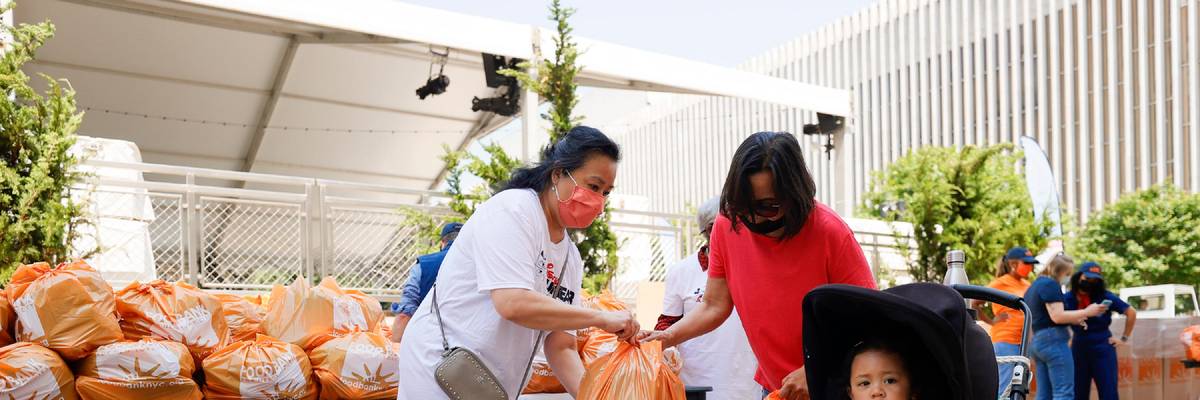
Local residents receive food during a food distribution event in New York City on May 26, 2021. (Photo: Michael Loccisano/Getty Images for Food Bank for New York City)
Two years ago I was panicking, making hundreds of phone calls to postpone my wedding that was a few days away. It was March 2020.
A global pandemic had reached the United States and changed each of our lives in ways we never imagined. Millions of Americans would lose jobs, friends, family, and even their lives to COVID-19, while billionaires would see record increases in their wealth.
Big corporations artificially raise the price of diapers, while also lobbying against extending the Child Tax Credit for people who buy them.
While the country ground to a halt, and I googled whether an imam would perform our marriage over Zoom, there was a glimmer of hope at the back of my mind. Surely, I thought, an event so monumental--one that laid bare every inequity of our economic system--would call for a change of equal measure.
There was a swell of recognition that working people were essential. Affordable child care--and well paid providers--were revealed as the backbone of a functioning economy. Free health care suddenly seemed like a great idea.
As a new administration took over, some short term changes in the American Rescue Plan kept people from falling off a steep cliff.
Vaccines were distributed freely and efficiently. Americans got bigger stimulus checks, while workers who lost jobs got more generous unemployment insurance. Families with kids started getting monthly direct payments through the expanded Child Tax Credit.
But when it came time to pass the more transformative, longer term changes we needed, the lessons of the past two years weren't enough for some politicians.
The Build Back Better Act would have reset the terms for how child care, housing, and income support operate in our country. It would have extended the Child Tax Credit, created green jobs, and much more.
But every one of the 263 Republicans in the House and Senate--plus Senate Democrat Joe Manchin--opposed it. For this, they were rewarded handsomely by corporate lobbyists. Oil giant Exxon, for example, donated $65,000 to Manchin's campaign and bragged about their access to the senator, who also owns stock in the company.
A good deal for Manchin. Not so much for the many Americans who can't fill up their tank for less than $100. We were so close to living in a country where higher gas prices, or an extra few dollars for ground beef, didn't mean someone going to bed without dinner.
Companies that monopolize these necessities deserve the blame for a lot of inflation, including the rising cost of gas and food. But they're also to blame for the fact that they don't pay their workers enough to meet those costs.
Big corporations artificially raise the price of diapers, while also lobbying against extending the Child Tax Credit for people who buy them. The credit has since expired, throwing millions of kids back into poverty.
Banks are benefiting from the Federal Reserve's decision to raise interest rates while also refusing Black people mortgage loans to buy a house and build up generational wealth.
Two years later, I can enjoy the photos from the in-person wedding I was finally able to have after my family and friends could get vaccinated. I'm grateful for that semblance of normalcy. But some things shouldn't go back to the status quo.
We can't fall back into a system where small unexpected expenses put entire families in poverty. We should be able to pay our bills and save some for the future, too. While that might sound "normal," it's been many decades since that's been the reality for the average American.
But that doesn't mean nothing at all has changed. As we grapple with another year of COVID-19, it's time we flex the power that comes with being essential and fight for a new economy that favors people, not just corporations.
Dear Common Dreams reader, It’s been nearly 30 years since I co-founded Common Dreams with my late wife, Lina Newhouser. We had the radical notion that journalism should serve the public good, not corporate profits. It was clear to us from the outset what it would take to build such a project. No paid advertisements. No corporate sponsors. No millionaire publisher telling us what to think or do. Many people said we wouldn't last a year, but we proved those doubters wrong. Together with a tremendous team of journalists and dedicated staff, we built an independent media outlet free from the constraints of profits and corporate control. Our mission has always been simple: To inform. To inspire. To ignite change for the common good. Building Common Dreams was not easy. Our survival was never guaranteed. When you take on the most powerful forces—Wall Street greed, fossil fuel industry destruction, Big Tech lobbyists, and uber-rich oligarchs who have spent billions upon billions rigging the economy and democracy in their favor—the only bulwark you have is supporters who believe in your work. But here’s the urgent message from me today. It's never been this bad out there. And it's never been this hard to keep us going. At the very moment Common Dreams is most needed, the threats we face are intensifying. We need your support now more than ever. We don't accept corporate advertising and never will. We don't have a paywall because we don't think people should be blocked from critical news based on their ability to pay. Everything we do is funded by the donations of readers like you. When everyone does the little they can afford, we are strong. But if that support retreats or dries up, so do we. Will you donate now to make sure Common Dreams not only survives but thrives? —Craig Brown, Co-founder |
Two years ago I was panicking, making hundreds of phone calls to postpone my wedding that was a few days away. It was March 2020.
A global pandemic had reached the United States and changed each of our lives in ways we never imagined. Millions of Americans would lose jobs, friends, family, and even their lives to COVID-19, while billionaires would see record increases in their wealth.
Big corporations artificially raise the price of diapers, while also lobbying against extending the Child Tax Credit for people who buy them.
While the country ground to a halt, and I googled whether an imam would perform our marriage over Zoom, there was a glimmer of hope at the back of my mind. Surely, I thought, an event so monumental--one that laid bare every inequity of our economic system--would call for a change of equal measure.
There was a swell of recognition that working people were essential. Affordable child care--and well paid providers--were revealed as the backbone of a functioning economy. Free health care suddenly seemed like a great idea.
As a new administration took over, some short term changes in the American Rescue Plan kept people from falling off a steep cliff.
Vaccines were distributed freely and efficiently. Americans got bigger stimulus checks, while workers who lost jobs got more generous unemployment insurance. Families with kids started getting monthly direct payments through the expanded Child Tax Credit.
But when it came time to pass the more transformative, longer term changes we needed, the lessons of the past two years weren't enough for some politicians.
The Build Back Better Act would have reset the terms for how child care, housing, and income support operate in our country. It would have extended the Child Tax Credit, created green jobs, and much more.
But every one of the 263 Republicans in the House and Senate--plus Senate Democrat Joe Manchin--opposed it. For this, they were rewarded handsomely by corporate lobbyists. Oil giant Exxon, for example, donated $65,000 to Manchin's campaign and bragged about their access to the senator, who also owns stock in the company.
A good deal for Manchin. Not so much for the many Americans who can't fill up their tank for less than $100. We were so close to living in a country where higher gas prices, or an extra few dollars for ground beef, didn't mean someone going to bed without dinner.
Companies that monopolize these necessities deserve the blame for a lot of inflation, including the rising cost of gas and food. But they're also to blame for the fact that they don't pay their workers enough to meet those costs.
Big corporations artificially raise the price of diapers, while also lobbying against extending the Child Tax Credit for people who buy them. The credit has since expired, throwing millions of kids back into poverty.
Banks are benefiting from the Federal Reserve's decision to raise interest rates while also refusing Black people mortgage loans to buy a house and build up generational wealth.
Two years later, I can enjoy the photos from the in-person wedding I was finally able to have after my family and friends could get vaccinated. I'm grateful for that semblance of normalcy. But some things shouldn't go back to the status quo.
We can't fall back into a system where small unexpected expenses put entire families in poverty. We should be able to pay our bills and save some for the future, too. While that might sound "normal," it's been many decades since that's been the reality for the average American.
But that doesn't mean nothing at all has changed. As we grapple with another year of COVID-19, it's time we flex the power that comes with being essential and fight for a new economy that favors people, not just corporations.
Two years ago I was panicking, making hundreds of phone calls to postpone my wedding that was a few days away. It was March 2020.
A global pandemic had reached the United States and changed each of our lives in ways we never imagined. Millions of Americans would lose jobs, friends, family, and even their lives to COVID-19, while billionaires would see record increases in their wealth.
Big corporations artificially raise the price of diapers, while also lobbying against extending the Child Tax Credit for people who buy them.
While the country ground to a halt, and I googled whether an imam would perform our marriage over Zoom, there was a glimmer of hope at the back of my mind. Surely, I thought, an event so monumental--one that laid bare every inequity of our economic system--would call for a change of equal measure.
There was a swell of recognition that working people were essential. Affordable child care--and well paid providers--were revealed as the backbone of a functioning economy. Free health care suddenly seemed like a great idea.
As a new administration took over, some short term changes in the American Rescue Plan kept people from falling off a steep cliff.
Vaccines were distributed freely and efficiently. Americans got bigger stimulus checks, while workers who lost jobs got more generous unemployment insurance. Families with kids started getting monthly direct payments through the expanded Child Tax Credit.
But when it came time to pass the more transformative, longer term changes we needed, the lessons of the past two years weren't enough for some politicians.
The Build Back Better Act would have reset the terms for how child care, housing, and income support operate in our country. It would have extended the Child Tax Credit, created green jobs, and much more.
But every one of the 263 Republicans in the House and Senate--plus Senate Democrat Joe Manchin--opposed it. For this, they were rewarded handsomely by corporate lobbyists. Oil giant Exxon, for example, donated $65,000 to Manchin's campaign and bragged about their access to the senator, who also owns stock in the company.
A good deal for Manchin. Not so much for the many Americans who can't fill up their tank for less than $100. We were so close to living in a country where higher gas prices, or an extra few dollars for ground beef, didn't mean someone going to bed without dinner.
Companies that monopolize these necessities deserve the blame for a lot of inflation, including the rising cost of gas and food. But they're also to blame for the fact that they don't pay their workers enough to meet those costs.
Big corporations artificially raise the price of diapers, while also lobbying against extending the Child Tax Credit for people who buy them. The credit has since expired, throwing millions of kids back into poverty.
Banks are benefiting from the Federal Reserve's decision to raise interest rates while also refusing Black people mortgage loans to buy a house and build up generational wealth.
Two years later, I can enjoy the photos from the in-person wedding I was finally able to have after my family and friends could get vaccinated. I'm grateful for that semblance of normalcy. But some things shouldn't go back to the status quo.
We can't fall back into a system where small unexpected expenses put entire families in poverty. We should be able to pay our bills and save some for the future, too. While that might sound "normal," it's been many decades since that's been the reality for the average American.
But that doesn't mean nothing at all has changed. As we grapple with another year of COVID-19, it's time we flex the power that comes with being essential and fight for a new economy that favors people, not just corporations.