SUBSCRIBE TO OUR FREE NEWSLETTER
Daily news & progressive opinion—funded by the people, not the corporations—delivered straight to your inbox.
5
#000000
#FFFFFF
To donate by check, phone, or other method, see our More Ways to Give page.
Daily news & progressive opinion—funded by the people, not the corporations—delivered straight to your inbox.
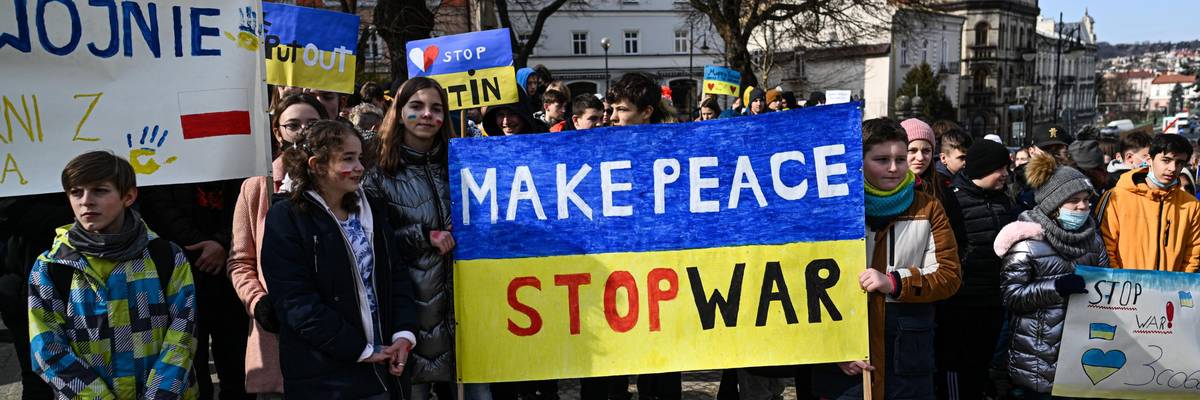
Children from primary and high schools hold banners and flags during a protest for Peace in Ukraine on March 01, 2022 in Przemysl, Poland. According to the United Nations, Poland has so far received at least 281,000 refugees from Ukraine since Russia invaded on February 24. Meanwhile, battles are raging across Ukraine between Ukrainian armed forces and the invading Russian army. (Photo: Omar Marques/Getty Images)
"When elephants fight, it is the grass that suffers," an old African proverb teaches. Sadly, we now witness its truth in the horrors visited upon Ukraine by Russia's invasion. The elephants--Russia and the U.S. with its NATO allies--fought over Ukraine, and now Ukrainians are paying a horrible price.
As in any modern war, civilians suffer the worst casualties.
As in any modern war, civilians suffer the worst casualties. Nearly 400,000 Ukrainians have already been forced from their country, refugees fleeing the violence. While sanctions may hit the Russian elites in their pocketbooks, it is young, often befuddled Russian soldiers whose lives are at risk in the face of the inspired and fierce Ukrainian resistance.
Although Ukrainians suffer the brunt of the violence and destruction, "the grass suffers" across the world. Home heating and gas prices are spiking, as the war and sanctions constrict Russian supply. Food prices will soar, particularly in the Middle East and northern Africa, as wheat exports from Ukraine and Russia are disrupted. Rising prices will hit the poor and the weak first and hardest.
The Russian invasion and the brave Ukrainian resistance have set off two separate currents. The U.S. and European governments are rushing to supply weapons to Ukraine. In Europe, Germany has announced a massive increase in military spending, and a commitment to rebuild its military forces, which surely will be followed by others. Calls for adding to the Pentagon's budget--already at levels that exceed in real dollars where it was under Ronald Reagan at the height of the Cold War--have already begun. Economic sanctions to isolate and punish Russia are ramping up. Russian President Vladimir Putin has responded by putting Russia's nuclear forces on high alert, moving a step closer to the unimaginable.
At the same time, across the world, citizens march to protest the Russian invasion and to call for peace. In Russia, protests against the war continue, despite over 1,500 arrests. The children of Russian elites call for peace. In Europe and the U.S., demonstrators march to protest the invasion of Ukraine. Across the world, religious leaders, artists and celebrities add their voices to condemn the invasion and to call for peace.
Once begun, war has its own momentum. Clearly surprised by the Ukrainian resistance, Putin is reinforcing the invading forces, with Belarus announcing that it will send soldiers into the fray. Russian soldiers are massed outside of Kyiv, preparing to attack the Ukrainian capital. Ukrainians gain more arms and aid with each passing day. Russia's presumed hope that it could topple the Ukrainian government quickly has been frustrated. The prospects of an extended, bloody and painful occupation have increased.
What's needed now is a push for peace. As this is written, government delegations from Ukraine and Russia meet for "unconditional discussions." At this stage, with troops in the field and blood on the ground, negotiations are difficult. To avoid the appearance of defeat, Putin will demand concessions. The justified rage of Ukrainians after the invasion will make any concession difficult. And in Europe and the U.S., hawks will argue against "rewarding" Putin for his invasion. But if there is no peace, then Ukrainians will continue to suffer.
It is vital that the voices for peace--the demonstrators, the voices of conscience, civic, religious, artistic and intellectual leaders--continue to grow in volume and urgency.
A cease fire is the first step. Negotiations that address both Putin's fears and Ukraine's independence are vital. And if the war can be stopped, new efforts will be needed to ensure that Europe seeks security not in a new arms race, but in a new effort to build the structures of peace. As we have learned repeatedly, wars too often end in ways that plant the seeds for the next war. We must find a way to end this war to ensure that the elephants learn to live together so that the grass can flourish.
Dear Common Dreams reader, It’s been nearly 30 years since I co-founded Common Dreams with my late wife, Lina Newhouser. We had the radical notion that journalism should serve the public good, not corporate profits. It was clear to us from the outset what it would take to build such a project. No paid advertisements. No corporate sponsors. No millionaire publisher telling us what to think or do. Many people said we wouldn't last a year, but we proved those doubters wrong. Together with a tremendous team of journalists and dedicated staff, we built an independent media outlet free from the constraints of profits and corporate control. Our mission has always been simple: To inform. To inspire. To ignite change for the common good. Building Common Dreams was not easy. Our survival was never guaranteed. When you take on the most powerful forces—Wall Street greed, fossil fuel industry destruction, Big Tech lobbyists, and uber-rich oligarchs who have spent billions upon billions rigging the economy and democracy in their favor—the only bulwark you have is supporters who believe in your work. But here’s the urgent message from me today. It's never been this bad out there. And it's never been this hard to keep us going. At the very moment Common Dreams is most needed, the threats we face are intensifying. We need your support now more than ever. We don't accept corporate advertising and never will. We don't have a paywall because we don't think people should be blocked from critical news based on their ability to pay. Everything we do is funded by the donations of readers like you. When everyone does the little they can afford, we are strong. But if that support retreats or dries up, so do we. Will you donate now to make sure Common Dreams not only survives but thrives? —Craig Brown, Co-founder |
"When elephants fight, it is the grass that suffers," an old African proverb teaches. Sadly, we now witness its truth in the horrors visited upon Ukraine by Russia's invasion. The elephants--Russia and the U.S. with its NATO allies--fought over Ukraine, and now Ukrainians are paying a horrible price.
As in any modern war, civilians suffer the worst casualties.
As in any modern war, civilians suffer the worst casualties. Nearly 400,000 Ukrainians have already been forced from their country, refugees fleeing the violence. While sanctions may hit the Russian elites in their pocketbooks, it is young, often befuddled Russian soldiers whose lives are at risk in the face of the inspired and fierce Ukrainian resistance.
Although Ukrainians suffer the brunt of the violence and destruction, "the grass suffers" across the world. Home heating and gas prices are spiking, as the war and sanctions constrict Russian supply. Food prices will soar, particularly in the Middle East and northern Africa, as wheat exports from Ukraine and Russia are disrupted. Rising prices will hit the poor and the weak first and hardest.
The Russian invasion and the brave Ukrainian resistance have set off two separate currents. The U.S. and European governments are rushing to supply weapons to Ukraine. In Europe, Germany has announced a massive increase in military spending, and a commitment to rebuild its military forces, which surely will be followed by others. Calls for adding to the Pentagon's budget--already at levels that exceed in real dollars where it was under Ronald Reagan at the height of the Cold War--have already begun. Economic sanctions to isolate and punish Russia are ramping up. Russian President Vladimir Putin has responded by putting Russia's nuclear forces on high alert, moving a step closer to the unimaginable.
At the same time, across the world, citizens march to protest the Russian invasion and to call for peace. In Russia, protests against the war continue, despite over 1,500 arrests. The children of Russian elites call for peace. In Europe and the U.S., demonstrators march to protest the invasion of Ukraine. Across the world, religious leaders, artists and celebrities add their voices to condemn the invasion and to call for peace.
Once begun, war has its own momentum. Clearly surprised by the Ukrainian resistance, Putin is reinforcing the invading forces, with Belarus announcing that it will send soldiers into the fray. Russian soldiers are massed outside of Kyiv, preparing to attack the Ukrainian capital. Ukrainians gain more arms and aid with each passing day. Russia's presumed hope that it could topple the Ukrainian government quickly has been frustrated. The prospects of an extended, bloody and painful occupation have increased.
What's needed now is a push for peace. As this is written, government delegations from Ukraine and Russia meet for "unconditional discussions." At this stage, with troops in the field and blood on the ground, negotiations are difficult. To avoid the appearance of defeat, Putin will demand concessions. The justified rage of Ukrainians after the invasion will make any concession difficult. And in Europe and the U.S., hawks will argue against "rewarding" Putin for his invasion. But if there is no peace, then Ukrainians will continue to suffer.
It is vital that the voices for peace--the demonstrators, the voices of conscience, civic, religious, artistic and intellectual leaders--continue to grow in volume and urgency.
A cease fire is the first step. Negotiations that address both Putin's fears and Ukraine's independence are vital. And if the war can be stopped, new efforts will be needed to ensure that Europe seeks security not in a new arms race, but in a new effort to build the structures of peace. As we have learned repeatedly, wars too often end in ways that plant the seeds for the next war. We must find a way to end this war to ensure that the elephants learn to live together so that the grass can flourish.
"When elephants fight, it is the grass that suffers," an old African proverb teaches. Sadly, we now witness its truth in the horrors visited upon Ukraine by Russia's invasion. The elephants--Russia and the U.S. with its NATO allies--fought over Ukraine, and now Ukrainians are paying a horrible price.
As in any modern war, civilians suffer the worst casualties.
As in any modern war, civilians suffer the worst casualties. Nearly 400,000 Ukrainians have already been forced from their country, refugees fleeing the violence. While sanctions may hit the Russian elites in their pocketbooks, it is young, often befuddled Russian soldiers whose lives are at risk in the face of the inspired and fierce Ukrainian resistance.
Although Ukrainians suffer the brunt of the violence and destruction, "the grass suffers" across the world. Home heating and gas prices are spiking, as the war and sanctions constrict Russian supply. Food prices will soar, particularly in the Middle East and northern Africa, as wheat exports from Ukraine and Russia are disrupted. Rising prices will hit the poor and the weak first and hardest.
The Russian invasion and the brave Ukrainian resistance have set off two separate currents. The U.S. and European governments are rushing to supply weapons to Ukraine. In Europe, Germany has announced a massive increase in military spending, and a commitment to rebuild its military forces, which surely will be followed by others. Calls for adding to the Pentagon's budget--already at levels that exceed in real dollars where it was under Ronald Reagan at the height of the Cold War--have already begun. Economic sanctions to isolate and punish Russia are ramping up. Russian President Vladimir Putin has responded by putting Russia's nuclear forces on high alert, moving a step closer to the unimaginable.
At the same time, across the world, citizens march to protest the Russian invasion and to call for peace. In Russia, protests against the war continue, despite over 1,500 arrests. The children of Russian elites call for peace. In Europe and the U.S., demonstrators march to protest the invasion of Ukraine. Across the world, religious leaders, artists and celebrities add their voices to condemn the invasion and to call for peace.
Once begun, war has its own momentum. Clearly surprised by the Ukrainian resistance, Putin is reinforcing the invading forces, with Belarus announcing that it will send soldiers into the fray. Russian soldiers are massed outside of Kyiv, preparing to attack the Ukrainian capital. Ukrainians gain more arms and aid with each passing day. Russia's presumed hope that it could topple the Ukrainian government quickly has been frustrated. The prospects of an extended, bloody and painful occupation have increased.
What's needed now is a push for peace. As this is written, government delegations from Ukraine and Russia meet for "unconditional discussions." At this stage, with troops in the field and blood on the ground, negotiations are difficult. To avoid the appearance of defeat, Putin will demand concessions. The justified rage of Ukrainians after the invasion will make any concession difficult. And in Europe and the U.S., hawks will argue against "rewarding" Putin for his invasion. But if there is no peace, then Ukrainians will continue to suffer.
It is vital that the voices for peace--the demonstrators, the voices of conscience, civic, religious, artistic and intellectual leaders--continue to grow in volume and urgency.
A cease fire is the first step. Negotiations that address both Putin's fears and Ukraine's independence are vital. And if the war can be stopped, new efforts will be needed to ensure that Europe seeks security not in a new arms race, but in a new effort to build the structures of peace. As we have learned repeatedly, wars too often end in ways that plant the seeds for the next war. We must find a way to end this war to ensure that the elephants learn to live together so that the grass can flourish.