

SUBSCRIBE TO OUR FREE NEWSLETTER
Daily news & progressive opinion—funded by the people, not the corporations—delivered straight to your inbox.
5
#000000
#FFFFFF
To donate by check, phone, or other method, see our More Ways to Give page.
Daily news & progressive opinion—funded by the people, not the corporations—delivered straight to your inbox.
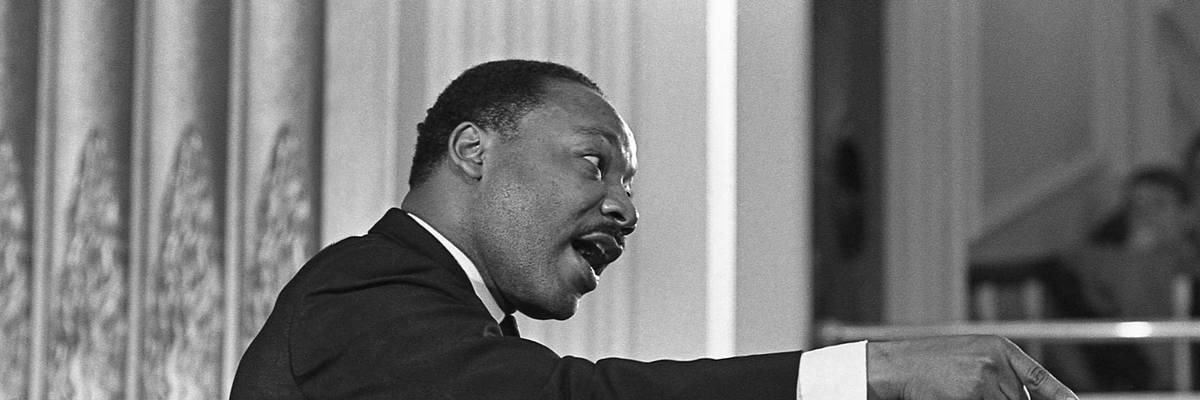
Profile view of American Civil Rights leader Dr. Martin Luther King Jr (1929 - 1968) as he speaks from a lecturn at the New York Avenue Presbyterian Church, Washington DC, February 6, 1968. Dr. King, invited to the church as the national co-chair for the 'Clergy and Laymen Concerned About Vietnam,' spoke about ending the war in Vietnam. (Photo: Joseph Klipple/Getty Images)
Today's anniversary of the birth of Dr. Martin Luther King Jr. calls for more than playing back a few lines from his "I Have a Dream" speech or showing a few pictures of the 1963 march on Washington, as historic as those were. It calls for a deeper reflection on his life, work, and teachings. One good place to start that reflection is with his April 4, 1967 speech against the Vietnam War, delivered at New York's Riverside Church a year to the day before he was assassinated.
If Dr. King were alive today, he would despair at the state of our foreign and domestic policies.
King began his speech by attempting to preempt the arguments of critics who claimed that he had no business wading into the debate over the war, asserting, in King's words, that "peace and civil rights don't mix." The criticisms came anyway. As historian David Garrow noted in a New York Times op-ed published on the 50th anniversary of the speech, it "drew widespread condemnation across the political spectrum," including in the Times. Criticisms aside, King was right then, and many of his arguments are sadly still relevant today.
King's first point in drawing the connection between ending racism at home and curbing militarism abroad had to do with the waste of precious resources:
"I knew that America would never invest the necessary funds or energies in rehabilitation of its poor so long as adventures like Vietnam continued to draw men and skills and money like some demonic destructive suction tube."
Note that King said, "adventures like Vietnam," underscoring his fear that the Vietnam War would not be the last example of a devastating and counterproductive U.S. military intervention.
He saw the temptation to intervene as being grounded in systemic flaws in the American system, which he described as the "giant triplets of racism, extreme materialism, and militarism." He stated that beyond Vietnam, "we will be marching for these and a dozen other names [of potential war zones] and attending rallies without end, unless there is a significant and profound change in American life and policy."
In short, until America attends to its problems at home, from pandemics to racial and economic injustice to the fires, floods and storms that are ravaging our country, it will be difficult if not impossible to pursue a less militarized foreign policy. And likewise, continuing to prosecute multiple wars abroad will undermine our capacity to solve our problems here. In our own time King's call has been taken up by the Poor People's Campaign, a social justice initiative co-chaired by Rev. William Barber and Rev. Liz Theoharis, which has added protecting us from environmental degradation and climate change to the list of priorities that must be addressed with what King described in his speech as "the fierce urgency of now."
Fifty-five years after King's Riverside Church speech, the obvious question is where we stand in combatting the problems he so eloquently and scathingly described. The short answer is that we have made far too little progress, to put it mildly. While President Biden deserves credit for ending America's 20-year war in Afghanistan, the Costs of War Project at Brown University estimates that the United States is militarily still engaged in 85 countries, enabling or prosecuting wars in Iraq, Syria, Somalia, Yemen and beyond; maintaining over 750 overseas military bases; and spending far more for military purposes than at the height of the Vietnam or Korean Wars.
Meanwhile, the Pentagon is spinning out scenarios for a war with China at a time when Washington needs to be cooperating with Beijing on pressing problems like climate change, preventing future pandemics, and controlling and reducing nuclear arsenals. This can be done without excusing China's repression of its Uyghur population, its crackdown on democracy in Hong Kong, or its military maneuvering in the South China Sea. But none of these problems will be solved by building more aircraft carriers or spending up to $2 trillion on a new generation of nuclear weapons. An arms race with China, much less a war between two nuclear-armed powers, could spur an unprecedented catastrophe that can and must be prevented.
If Dr. King were alive today, he would despair at the state of our foreign and domestic policies, but he would also hold out hope that people of goodwill can organize against and overcome the enduring obstacles to achieving peace, public health, and social, and economic justice. The time to act is now.
Dear Common Dreams reader, It’s been nearly 30 years since I co-founded Common Dreams with my late wife, Lina Newhouser. We had the radical notion that journalism should serve the public good, not corporate profits. It was clear to us from the outset what it would take to build such a project. No paid advertisements. No corporate sponsors. No millionaire publisher telling us what to think or do. Many people said we wouldn't last a year, but we proved those doubters wrong. Together with a tremendous team of journalists and dedicated staff, we built an independent media outlet free from the constraints of profits and corporate control. Our mission has always been simple: To inform. To inspire. To ignite change for the common good. Building Common Dreams was not easy. Our survival was never guaranteed. When you take on the most powerful forces—Wall Street greed, fossil fuel industry destruction, Big Tech lobbyists, and uber-rich oligarchs who have spent billions upon billions rigging the economy and democracy in their favor—the only bulwark you have is supporters who believe in your work. But here’s the urgent message from me today. It's never been this bad out there. And it's never been this hard to keep us going. At the very moment Common Dreams is most needed, the threats we face are intensifying. We need your support now more than ever. We don't accept corporate advertising and never will. We don't have a paywall because we don't think people should be blocked from critical news based on their ability to pay. Everything we do is funded by the donations of readers like you. When everyone does the little they can afford, we are strong. But if that support retreats or dries up, so do we. Will you donate now to make sure Common Dreams not only survives but thrives? —Craig Brown, Co-founder |
Today's anniversary of the birth of Dr. Martin Luther King Jr. calls for more than playing back a few lines from his "I Have a Dream" speech or showing a few pictures of the 1963 march on Washington, as historic as those were. It calls for a deeper reflection on his life, work, and teachings. One good place to start that reflection is with his April 4, 1967 speech against the Vietnam War, delivered at New York's Riverside Church a year to the day before he was assassinated.
If Dr. King were alive today, he would despair at the state of our foreign and domestic policies.
King began his speech by attempting to preempt the arguments of critics who claimed that he had no business wading into the debate over the war, asserting, in King's words, that "peace and civil rights don't mix." The criticisms came anyway. As historian David Garrow noted in a New York Times op-ed published on the 50th anniversary of the speech, it "drew widespread condemnation across the political spectrum," including in the Times. Criticisms aside, King was right then, and many of his arguments are sadly still relevant today.
King's first point in drawing the connection between ending racism at home and curbing militarism abroad had to do with the waste of precious resources:
"I knew that America would never invest the necessary funds or energies in rehabilitation of its poor so long as adventures like Vietnam continued to draw men and skills and money like some demonic destructive suction tube."
Note that King said, "adventures like Vietnam," underscoring his fear that the Vietnam War would not be the last example of a devastating and counterproductive U.S. military intervention.
He saw the temptation to intervene as being grounded in systemic flaws in the American system, which he described as the "giant triplets of racism, extreme materialism, and militarism." He stated that beyond Vietnam, "we will be marching for these and a dozen other names [of potential war zones] and attending rallies without end, unless there is a significant and profound change in American life and policy."
In short, until America attends to its problems at home, from pandemics to racial and economic injustice to the fires, floods and storms that are ravaging our country, it will be difficult if not impossible to pursue a less militarized foreign policy. And likewise, continuing to prosecute multiple wars abroad will undermine our capacity to solve our problems here. In our own time King's call has been taken up by the Poor People's Campaign, a social justice initiative co-chaired by Rev. William Barber and Rev. Liz Theoharis, which has added protecting us from environmental degradation and climate change to the list of priorities that must be addressed with what King described in his speech as "the fierce urgency of now."
Fifty-five years after King's Riverside Church speech, the obvious question is where we stand in combatting the problems he so eloquently and scathingly described. The short answer is that we have made far too little progress, to put it mildly. While President Biden deserves credit for ending America's 20-year war in Afghanistan, the Costs of War Project at Brown University estimates that the United States is militarily still engaged in 85 countries, enabling or prosecuting wars in Iraq, Syria, Somalia, Yemen and beyond; maintaining over 750 overseas military bases; and spending far more for military purposes than at the height of the Vietnam or Korean Wars.
Meanwhile, the Pentagon is spinning out scenarios for a war with China at a time when Washington needs to be cooperating with Beijing on pressing problems like climate change, preventing future pandemics, and controlling and reducing nuclear arsenals. This can be done without excusing China's repression of its Uyghur population, its crackdown on democracy in Hong Kong, or its military maneuvering in the South China Sea. But none of these problems will be solved by building more aircraft carriers or spending up to $2 trillion on a new generation of nuclear weapons. An arms race with China, much less a war between two nuclear-armed powers, could spur an unprecedented catastrophe that can and must be prevented.
If Dr. King were alive today, he would despair at the state of our foreign and domestic policies, but he would also hold out hope that people of goodwill can organize against and overcome the enduring obstacles to achieving peace, public health, and social, and economic justice. The time to act is now.
Today's anniversary of the birth of Dr. Martin Luther King Jr. calls for more than playing back a few lines from his "I Have a Dream" speech or showing a few pictures of the 1963 march on Washington, as historic as those were. It calls for a deeper reflection on his life, work, and teachings. One good place to start that reflection is with his April 4, 1967 speech against the Vietnam War, delivered at New York's Riverside Church a year to the day before he was assassinated.
If Dr. King were alive today, he would despair at the state of our foreign and domestic policies.
King began his speech by attempting to preempt the arguments of critics who claimed that he had no business wading into the debate over the war, asserting, in King's words, that "peace and civil rights don't mix." The criticisms came anyway. As historian David Garrow noted in a New York Times op-ed published on the 50th anniversary of the speech, it "drew widespread condemnation across the political spectrum," including in the Times. Criticisms aside, King was right then, and many of his arguments are sadly still relevant today.
King's first point in drawing the connection between ending racism at home and curbing militarism abroad had to do with the waste of precious resources:
"I knew that America would never invest the necessary funds or energies in rehabilitation of its poor so long as adventures like Vietnam continued to draw men and skills and money like some demonic destructive suction tube."
Note that King said, "adventures like Vietnam," underscoring his fear that the Vietnam War would not be the last example of a devastating and counterproductive U.S. military intervention.
He saw the temptation to intervene as being grounded in systemic flaws in the American system, which he described as the "giant triplets of racism, extreme materialism, and militarism." He stated that beyond Vietnam, "we will be marching for these and a dozen other names [of potential war zones] and attending rallies without end, unless there is a significant and profound change in American life and policy."
In short, until America attends to its problems at home, from pandemics to racial and economic injustice to the fires, floods and storms that are ravaging our country, it will be difficult if not impossible to pursue a less militarized foreign policy. And likewise, continuing to prosecute multiple wars abroad will undermine our capacity to solve our problems here. In our own time King's call has been taken up by the Poor People's Campaign, a social justice initiative co-chaired by Rev. William Barber and Rev. Liz Theoharis, which has added protecting us from environmental degradation and climate change to the list of priorities that must be addressed with what King described in his speech as "the fierce urgency of now."
Fifty-five years after King's Riverside Church speech, the obvious question is where we stand in combatting the problems he so eloquently and scathingly described. The short answer is that we have made far too little progress, to put it mildly. While President Biden deserves credit for ending America's 20-year war in Afghanistan, the Costs of War Project at Brown University estimates that the United States is militarily still engaged in 85 countries, enabling or prosecuting wars in Iraq, Syria, Somalia, Yemen and beyond; maintaining over 750 overseas military bases; and spending far more for military purposes than at the height of the Vietnam or Korean Wars.
Meanwhile, the Pentagon is spinning out scenarios for a war with China at a time when Washington needs to be cooperating with Beijing on pressing problems like climate change, preventing future pandemics, and controlling and reducing nuclear arsenals. This can be done without excusing China's repression of its Uyghur population, its crackdown on democracy in Hong Kong, or its military maneuvering in the South China Sea. But none of these problems will be solved by building more aircraft carriers or spending up to $2 trillion on a new generation of nuclear weapons. An arms race with China, much less a war between two nuclear-armed powers, could spur an unprecedented catastrophe that can and must be prevented.
If Dr. King were alive today, he would despair at the state of our foreign and domestic policies, but he would also hold out hope that people of goodwill can organize against and overcome the enduring obstacles to achieving peace, public health, and social, and economic justice. The time to act is now.

