SUBSCRIBE TO OUR FREE NEWSLETTER
Daily news & progressive opinion—funded by the people, not the corporations—delivered straight to your inbox.
5
#000000
#FFFFFF
To donate by check, phone, or other method, see our More Ways to Give page.

Sen. Kyrsten Sinema (D.-Arizona) is notorious for being inaccessible to the press--and to constituents--while threatening to tank the Democratic Party's key social spending bill. As Mother Jones (10/7/21) reported, Sinema has not held a single town hall since her election, doesn't hold press conferences, and refuses to speak to reporters and constituents alike when approached. So when CNN's Lauren Fox (12/2/21) landed a sit-down interview with Sinema, it presented a rare opportunity to do what journalists are supposed to do: hold power to account.
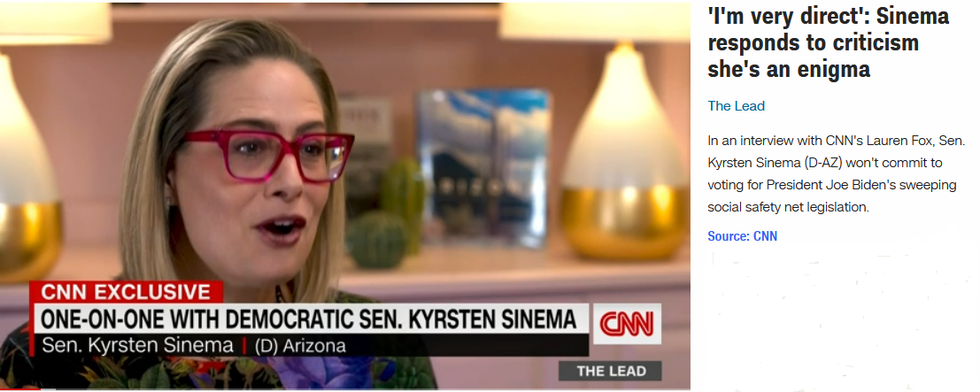
CNN's exclusive interview (12/2/21) with Sen. Kyrsten Sinema asked her no questions about her conflicts of interest.
Instead, Fox's questions primarily ranged from the inane ("Is it hard for you to tell the president, no, I can't do that?") to the flattering, casting Sinema as a straight-shooter stuck with bad party leaders:
One of the ways that you negotiate in talking with your colleagues is that you're pretty forthcoming about where you stand on something. We talked about the corporate tax rate. Why do you think it is that your leadership sometimes overpromises? Do you think that's a problem for voters and for the Democratic Party?
You wouldn't understand from Fox's question that Sinema's refusal to support the tax increases on corporations (and the rich) that would help fund the Biden-backed budget bill known as Build Back Better--a notable reversal from her opposition to the Trump tax cuts as a House rep in 2017--is strikingly unpopular, in both Arizona and the country as a whole. A better question would be whether Sinema's position is a problem for voters.
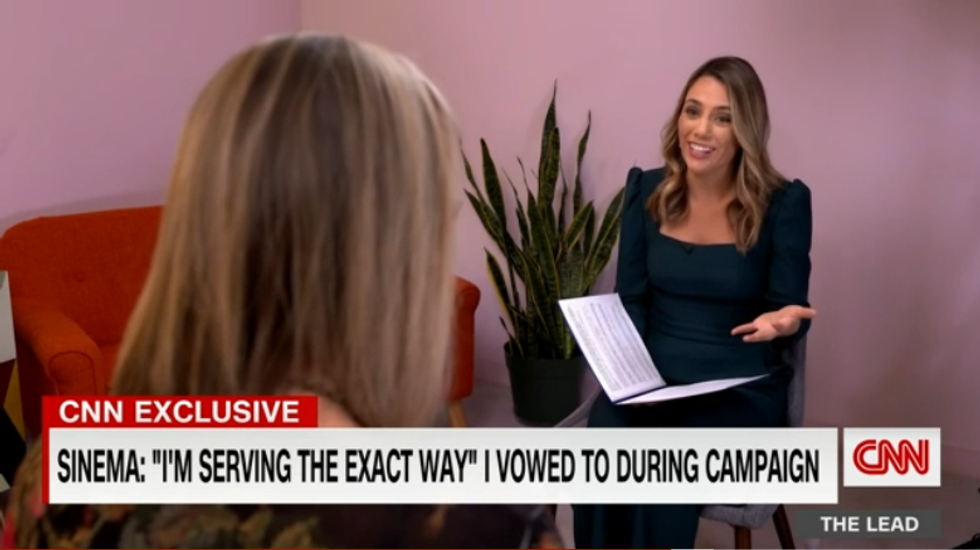
CNN's Lauren Fox (12/2/21) to Kyrsten Sinema: "You're pretty forthcoming about where you stand on something."
The only other question Fox asked that related to Sinema's position on taxes--one of the biggest sticking points for the bill--likewise gave Sinema a total pass:
I know one of the things that you made clear very early in the negotiation with the president and your majority leader was that you were not going to support raising the corporate tax rate a single point. Did you feel like at any point they weren't taking your comment seriously, given the fact that they were promising for a long time that this was going to be part of the bill?
Fox did ask two more substantive questions about Build Back Better; first whether Sinema would vote yes when it comes to the Senate floor, and then, after an evasive non-answer, what changes Sinema would make to the bill. When Sinema directly rebuffed her ("I don't negotiate in the press"), Fox simply let it drop.
Likewise, when Fox asked, "Would you be willing to vote with Democrats to hold up the president's mandates?" Sinema responded, "I'm not going to tell you those things." Fox asked no follow-up, at least in the portions of the interview that CNN ran.
Fox was tougher on Sinema's outraged constituents than she was on Sinema herself. Two months ago, immigrant youth activists from Arizona who had been stonewalled for months by Sinema followed her into a bathroom on their campus after she refused to engage them in the hallway, to express their concerns about her position on Build Back Better. Whatever you think about the protesters' tactics, the incident highlights how inaccessible Sinema is to those she represents, when her frequent exclusive big-money events with corporate lobbyists and wealthy PAC donors have been raising eyebrows in the press.
Instead of making an effort to hold Sinema's feet to the fire over this bigger-picture issue of whose interests the elected official represents, Fox only highlighted the behavior of the protesters: "I'm really curious what you think that means about the state of US politics right now, given the fact that they crossed a boundary by following you into the restroom?"
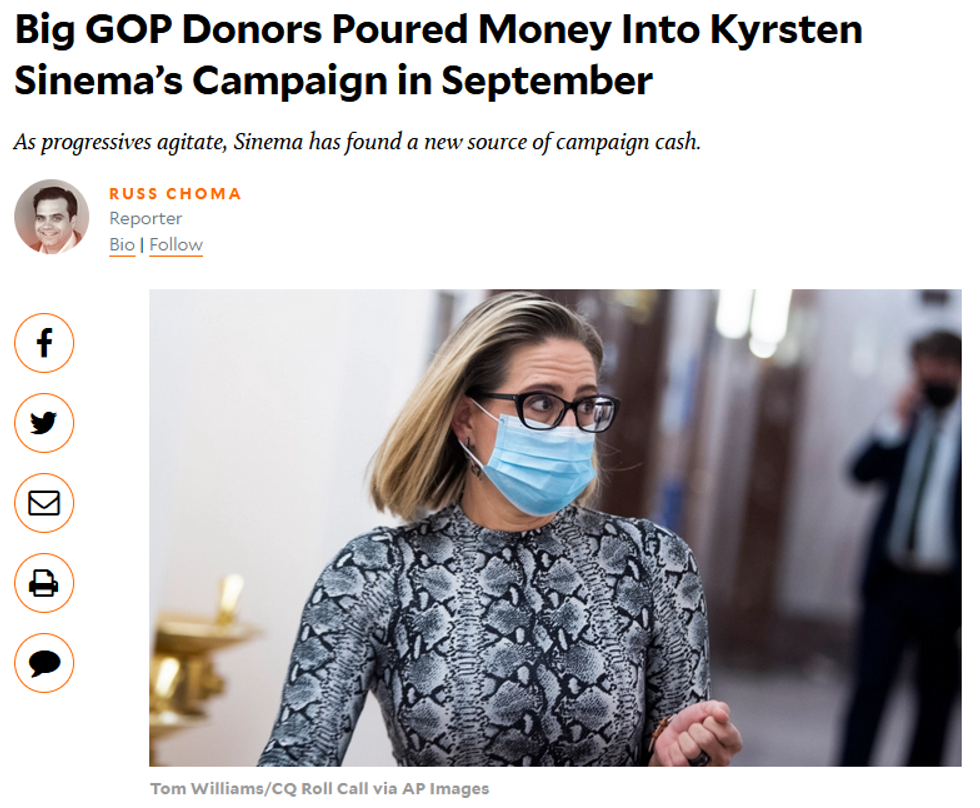
The words "donors" or "contributions" never come up in CNN's interview with Sinema, despite the flood of money coming to her from lobbies that benefit from her obstructionist stance (Mother Jones, 10/16/21).
In fact, Fox asked zero questions about Sinema's motives and conflicts, for which other journalists had provided plenty of fodder. No questions, for instance, about the fundraisers she held with opponents of Build Back Better during crucial moments of negotiation on the bill (New York Times, 9/27/21).
Or about how shockingly little of her third-quarter fundraising haul came from her constituents. While pharma and finance bigwigs and PACs lined up to write big checks, only 10% of her individual contributions came from Arizona (Politico, 10/15/21).
Or about reports in Mother Jones (10/16/21) and the New York Times (11/21/21) that Sinema's opposition to Build Back Better has made her (and fellow bill blocker Joe Manchin) particularly popular among Republican megadonors, who are maxing out their individual contributions to her.
Or about how Sinema and Manchin have received more lobbyist contributions this year than any other senator in their cohort--the group that's not up for re-election until 2024--and both are taking in three times the lobbying money of the average senator (Data for Progress, 10/27/21).
No doubt such questions would have irked Sinema, and perhaps even threatened CNN's access to her in the future. But if access is only used to polish the image of the powerful, that's propaganda, not journalism.
Sen. Kyrsten Sinema (D.-Arizona) is notorious for being inaccessible to the press--and to constituents--while threatening to tank the Democratic Party's key social spending bill. As Mother Jones (10/7/21) reported, Sinema has not held a single town hall since her election, doesn't hold press conferences, and refuses to speak to reporters and constituents alike when approached. So when CNN's Lauren Fox (12/2/21) landed a sit-down interview with Sinema, it presented a rare opportunity to do what journalists are supposed to do: hold power to account.
CNN's exclusive interview (12/2/21) with Sen. Kyrsten Sinema asked her no questions about her conflicts of interest.
Instead, Fox's questions primarily ranged from the inane ("Is it hard for you to tell the president, no, I can't do that?") to the flattering, casting Sinema as a straight-shooter stuck with bad party leaders:
One of the ways that you negotiate in talking with your colleagues is that you're pretty forthcoming about where you stand on something. We talked about the corporate tax rate. Why do you think it is that your leadership sometimes overpromises? Do you think that's a problem for voters and for the Democratic Party?
You wouldn't understand from Fox's question that Sinema's refusal to support the tax increases on corporations (and the rich) that would help fund the Biden-backed budget bill known as Build Back Better--a notable reversal from her opposition to the Trump tax cuts as a House rep in 2017--is strikingly unpopular, in both Arizona and the country as a whole. A better question would be whether Sinema's position is a problem for voters.
CNN's Lauren Fox (12/2/21) to Kyrsten Sinema: "You're pretty forthcoming about where you stand on something."
The only other question Fox asked that related to Sinema's position on taxes--one of the biggest sticking points for the bill--likewise gave Sinema a total pass:
I know one of the things that you made clear very early in the negotiation with the president and your majority leader was that you were not going to support raising the corporate tax rate a single point. Did you feel like at any point they weren't taking your comment seriously, given the fact that they were promising for a long time that this was going to be part of the bill?
Fox did ask two more substantive questions about Build Back Better; first whether Sinema would vote yes when it comes to the Senate floor, and then, after an evasive non-answer, what changes Sinema would make to the bill. When Sinema directly rebuffed her ("I don't negotiate in the press"), Fox simply let it drop.
Likewise, when Fox asked, "Would you be willing to vote with Democrats to hold up the president's mandates?" Sinema responded, "I'm not going to tell you those things." Fox asked no follow-up, at least in the portions of the interview that CNN ran.
Fox was tougher on Sinema's outraged constituents than she was on Sinema herself. Two months ago, immigrant youth activists from Arizona who had been stonewalled for months by Sinema followed her into a bathroom on their campus after she refused to engage them in the hallway, to express their concerns about her position on Build Back Better. Whatever you think about the protesters' tactics, the incident highlights how inaccessible Sinema is to those she represents, when her frequent exclusive big-money events with corporate lobbyists and wealthy PAC donors have been raising eyebrows in the press.
Instead of making an effort to hold Sinema's feet to the fire over this bigger-picture issue of whose interests the elected official represents, Fox only highlighted the behavior of the protesters: "I'm really curious what you think that means about the state of US politics right now, given the fact that they crossed a boundary by following you into the restroom?"
The words "donors" or "contributions" never come up in CNN's interview with Sinema, despite the flood of money coming to her from lobbies that benefit from her obstructionist stance (Mother Jones, 10/16/21).
In fact, Fox asked zero questions about Sinema's motives and conflicts, for which other journalists had provided plenty of fodder. No questions, for instance, about the fundraisers she held with opponents of Build Back Better during crucial moments of negotiation on the bill (New York Times, 9/27/21).
Or about how shockingly little of her third-quarter fundraising haul came from her constituents. While pharma and finance bigwigs and PACs lined up to write big checks, only 10% of her individual contributions came from Arizona (Politico, 10/15/21).
Or about reports in Mother Jones (10/16/21) and the New York Times (11/21/21) that Sinema's opposition to Build Back Better has made her (and fellow bill blocker Joe Manchin) particularly popular among Republican megadonors, who are maxing out their individual contributions to her.
Or about how Sinema and Manchin have received more lobbyist contributions this year than any other senator in their cohort--the group that's not up for re-election until 2024--and both are taking in three times the lobbying money of the average senator (Data for Progress, 10/27/21).
No doubt such questions would have irked Sinema, and perhaps even threatened CNN's access to her in the future. But if access is only used to polish the image of the powerful, that's propaganda, not journalism.
Sen. Kyrsten Sinema (D.-Arizona) is notorious for being inaccessible to the press--and to constituents--while threatening to tank the Democratic Party's key social spending bill. As Mother Jones (10/7/21) reported, Sinema has not held a single town hall since her election, doesn't hold press conferences, and refuses to speak to reporters and constituents alike when approached. So when CNN's Lauren Fox (12/2/21) landed a sit-down interview with Sinema, it presented a rare opportunity to do what journalists are supposed to do: hold power to account.
CNN's exclusive interview (12/2/21) with Sen. Kyrsten Sinema asked her no questions about her conflicts of interest.
Instead, Fox's questions primarily ranged from the inane ("Is it hard for you to tell the president, no, I can't do that?") to the flattering, casting Sinema as a straight-shooter stuck with bad party leaders:
One of the ways that you negotiate in talking with your colleagues is that you're pretty forthcoming about where you stand on something. We talked about the corporate tax rate. Why do you think it is that your leadership sometimes overpromises? Do you think that's a problem for voters and for the Democratic Party?
You wouldn't understand from Fox's question that Sinema's refusal to support the tax increases on corporations (and the rich) that would help fund the Biden-backed budget bill known as Build Back Better--a notable reversal from her opposition to the Trump tax cuts as a House rep in 2017--is strikingly unpopular, in both Arizona and the country as a whole. A better question would be whether Sinema's position is a problem for voters.
CNN's Lauren Fox (12/2/21) to Kyrsten Sinema: "You're pretty forthcoming about where you stand on something."
The only other question Fox asked that related to Sinema's position on taxes--one of the biggest sticking points for the bill--likewise gave Sinema a total pass:
I know one of the things that you made clear very early in the negotiation with the president and your majority leader was that you were not going to support raising the corporate tax rate a single point. Did you feel like at any point they weren't taking your comment seriously, given the fact that they were promising for a long time that this was going to be part of the bill?
Fox did ask two more substantive questions about Build Back Better; first whether Sinema would vote yes when it comes to the Senate floor, and then, after an evasive non-answer, what changes Sinema would make to the bill. When Sinema directly rebuffed her ("I don't negotiate in the press"), Fox simply let it drop.
Likewise, when Fox asked, "Would you be willing to vote with Democrats to hold up the president's mandates?" Sinema responded, "I'm not going to tell you those things." Fox asked no follow-up, at least in the portions of the interview that CNN ran.
Fox was tougher on Sinema's outraged constituents than she was on Sinema herself. Two months ago, immigrant youth activists from Arizona who had been stonewalled for months by Sinema followed her into a bathroom on their campus after she refused to engage them in the hallway, to express their concerns about her position on Build Back Better. Whatever you think about the protesters' tactics, the incident highlights how inaccessible Sinema is to those she represents, when her frequent exclusive big-money events with corporate lobbyists and wealthy PAC donors have been raising eyebrows in the press.
Instead of making an effort to hold Sinema's feet to the fire over this bigger-picture issue of whose interests the elected official represents, Fox only highlighted the behavior of the protesters: "I'm really curious what you think that means about the state of US politics right now, given the fact that they crossed a boundary by following you into the restroom?"
The words "donors" or "contributions" never come up in CNN's interview with Sinema, despite the flood of money coming to her from lobbies that benefit from her obstructionist stance (Mother Jones, 10/16/21).
In fact, Fox asked zero questions about Sinema's motives and conflicts, for which other journalists had provided plenty of fodder. No questions, for instance, about the fundraisers she held with opponents of Build Back Better during crucial moments of negotiation on the bill (New York Times, 9/27/21).
Or about how shockingly little of her third-quarter fundraising haul came from her constituents. While pharma and finance bigwigs and PACs lined up to write big checks, only 10% of her individual contributions came from Arizona (Politico, 10/15/21).
Or about reports in Mother Jones (10/16/21) and the New York Times (11/21/21) that Sinema's opposition to Build Back Better has made her (and fellow bill blocker Joe Manchin) particularly popular among Republican megadonors, who are maxing out their individual contributions to her.
Or about how Sinema and Manchin have received more lobbyist contributions this year than any other senator in their cohort--the group that's not up for re-election until 2024--and both are taking in three times the lobbying money of the average senator (Data for Progress, 10/27/21).
No doubt such questions would have irked Sinema, and perhaps even threatened CNN's access to her in the future. But if access is only used to polish the image of the powerful, that's propaganda, not journalism.