SUBSCRIBE TO OUR FREE NEWSLETTER
Daily news & progressive opinion—funded by the people, not the corporations—delivered straight to your inbox.
5
#000000
#FFFFFF
To donate by check, phone, or other method, see our More Ways to Give page.
Daily news & progressive opinion—funded by the people, not the corporations—delivered straight to your inbox.
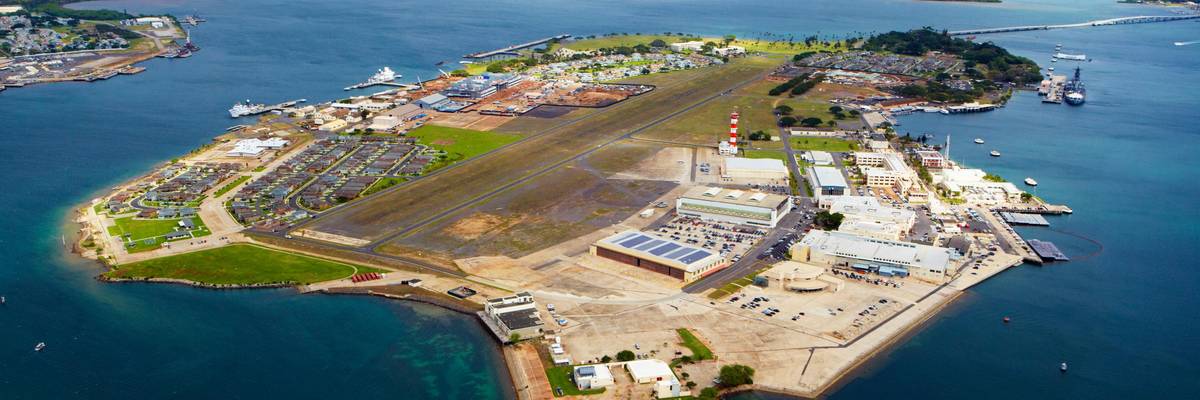
Three wells and water shafts serve the 93,000 military and family members around Pearl Harbor. Water samples have been sent for analysis to a laboratory in California to determine what type of contamination is in the water. (Photo: Aerial view of Pearl Harbor /Getty/Stock Photo)
The long citizen protest underscoring the dangers from the U.S. Navy's 80-year-old leaking 20 jet fuel tanks at Red Hill each tank 20 stories tall and holding a total of 225 million gallons of jet fuel came to a head over the weekend with Navy families around the large Pearl Harbor Naval Base being sickened by fuel in their home tap water. The Navy's huge jet fuel tank complex is only 100 feet above Honolulu's water supply and has been leaking with regularity.
The Navy command was slow to alert the community while the State of Hawai'i quickly issued a notice not to drink the water. Foster Village community members stated that they were smelling fuel after the November 20, 2021 release of 14,000 gallons of water and fuel from a fire suppression drain line a quarter-mile downhill from the fuel tank farm. The Navy has acknowledged that another pipeline fuel leak of more than 1,600 gallons of fuel had occurred on May 6 due to human error and that some of the fuel likely "reached the environment."
All hell broke loose at four military community town hall meetings on November 30, 2021 when the Navy told housing residents that they should flush the water out of home pipes, the smell and fuel sheen would go away and they could use the water. Residents yelled at military briefers that the State of Hawai'i Department of Health was warning resident not to drink or use the water.
Three wells and water shafts serve the 93,000 military and family members around Pearl Harbor. Water samples have been sent for analysis to a laboratory in California to determine what type of contamination is in the water.
Over 470 persons have made comments on the Joint Base Pearl Harbor Hickam community Facebook about a fuel smell coming from their water taps and a sheen on the water. Military families are reporting headaches, rashes and diarrhea in children and pets. Basic hygiene, showers and laundry are major concerns of residents.
Valerie Kaahanui, who lives in the Dorris Miller military housing community, said she and her three kids began noticing problems about a week ago. "My kids have been sick, respiratory issues, headaches. I've had a headache for the past week," she said. "My kids have had nosebleeds, rashes, we've been itchy after we get out of the shower. It feels like our skin is burning." Kaahanui added that on Saturday, a smell became noticeable in the shower, and on Sunday, it was "heavy" and a film was noticeable on top of the water.
Hawaii's 4-person Congressional delegation has finally begun challenging the safety of the U.S. Navy's Red Hill jet fuel tank complex and met with the Secretary of the Navy. Afterwards they issued a joint statement that read: "The Navy owes the community straightforward communications on all events that occur at Red Hill and a commitment to address concerns with the Red Hill infrastructure no matter the cost. Given the resources and engineering expertise available to the Navy, we made it clear that there is zero tolerance for endangering the health and safety of the public or the environment."
The Sierra Club has been warning for years about the dangers to Oahu's water supply from the leaking 80-year-old jet fuel tank complex. Citing threats to Honolulu's drinking water, the Sierra Club of Hawaii and the Oahu Water Protectors have called on President Biden, the Hawaii congressional delegation and the U.S. military to shut down the leaking fuel tanks.
A week before the water contamination crisis for US Navy families, at a rally and news conference on November 22, 2021, Wayne Tanaka, the director of the Sierra Club of Hawaii said "Enough is enough. We've lost all faith in the local Navy command."
On December 1, Tanaka stated, "We've locked horns with the Navy for the last several years. I'm just trying to get them to acknowledge the risk--existential risks--that this fuel facility poses to our drinking water supply. It's still unclear how and where fuel flow, if there is a massive leak, how quickly and whether it will actually migrate toward the Halawa shaft, which again would be pretty catastrophic. We all want to make sure that this doesn't become a harbinger of things to come of what may be impacting a much, much, much broader segment of the population here."
Dangers from the Underground Jet Fuel Storage Tanks
The facts presented in a lawsuit filed by the Sierra Club against the Navy presented the evidence of the dangers of the 80 year old tanks include:
1). Eight of the tanks, each containing millions of gallons of fuel, have not been inspected in over two decades; three of these have not been inspected in 38 years;
2). Leaked fuel and fuel components have already been found in the groundwater below the facility;
3). The thin steel tank walls are corroding faster than the Navy anticipated due to moisture in the gaps between the tanks and their concrete casing;
4). The Navy's system to test and monitor tanks for leaks cannot detect slow leaks that may indicate a heightened risk for larger, catastrophic leaks; cannot prevent human error that has led to large releases of fuel in the past; and cannot prevent an earthquake, like the one that spilled 1,100 barrels of fuel when the tanks were brand new.
The statement of the Oahu Water Protectors coalition provides even more information about the leaks from the storage tanks:
- In 2014, 27,000 gallons of jet fuel leaked from Tank 5;
- In March 2020, a pipeline connected to Red Hill leaked an unknown quantity of fuel into Pearl Harbor Hotel Pier. The leak, which had stopped, started again in June 2020. Approximately 7,100 gallons of fuel was collected from the surrounding environment;
- In January 2021, a pipeline that leads to the Hotel Pier area failed two leak detection tests. In February, a Navy contractor determined that there is an active leak at Hotel Pier. The Department of Health only found out in May 2021;
- In May 2021, over 1,600 gallons of fuel leaked from the facility due to human error after a control room operator failed to follow correct procedures;
- In July 2021, 100 gallons of fuel was released into Pearl Harbor, possibly from a source connected to the Red Hill facility;
- In November 2021, residents from the neighborhoods of Foster Village and Aliamanu called 911 to report the smell of fuel, later found likely to have come from a leak from a fire suppression drain line connected to Red Hill. -The Navy reported that about 14,000 gallons of a fuel-water mixture had leaked;
- The Navy's own risk assessment reports that there is a 96% chance that up to 30,000 gallons of fuel will leak into the aquifer over the next 10 years.
Is Human Security Also National Security?
The Navy has warned that the tanks are vital for U.S. national security. Citizen activists, including the newly formed Oahu Water Protectors coalition, have maintained that the real national security issue is the security of the water supply for 400,000 resident on an island 2300 miles from the closest continent and an island considered a key military location for projection of power. If the Honolulu aquifer is contaminated, water would have to be transported from the other aquifers on the island.
It is ironic that the major test of human security vs. national security centers on the drinking water contamination of the military families and military members that provide the human element of the US military strategy in the Pacific..and that the safety of the 400,000 who drink from the aquifer of 970,000 civilians who live on Oahu will be determined on how the State of Hawai'i and the federal government force the US Navy to eliminate the major catastrophic danger to the islands water supply by finally shutting down the Red Hill jet fuel tanks.
Dear Common Dreams reader, It’s been nearly 30 years since I co-founded Common Dreams with my late wife, Lina Newhouser. We had the radical notion that journalism should serve the public good, not corporate profits. It was clear to us from the outset what it would take to build such a project. No paid advertisements. No corporate sponsors. No millionaire publisher telling us what to think or do. Many people said we wouldn't last a year, but we proved those doubters wrong. Together with a tremendous team of journalists and dedicated staff, we built an independent media outlet free from the constraints of profits and corporate control. Our mission has always been simple: To inform. To inspire. To ignite change for the common good. Building Common Dreams was not easy. Our survival was never guaranteed. When you take on the most powerful forces—Wall Street greed, fossil fuel industry destruction, Big Tech lobbyists, and uber-rich oligarchs who have spent billions upon billions rigging the economy and democracy in their favor—the only bulwark you have is supporters who believe in your work. But here’s the urgent message from me today. It's never been this bad out there. And it's never been this hard to keep us going. At the very moment Common Dreams is most needed, the threats we face are intensifying. We need your support now more than ever. We don't accept corporate advertising and never will. We don't have a paywall because we don't think people should be blocked from critical news based on their ability to pay. Everything we do is funded by the donations of readers like you. When everyone does the little they can afford, we are strong. But if that support retreats or dries up, so do we. Will you donate now to make sure Common Dreams not only survives but thrives? —Craig Brown, Co-founder |
The long citizen protest underscoring the dangers from the U.S. Navy's 80-year-old leaking 20 jet fuel tanks at Red Hill each tank 20 stories tall and holding a total of 225 million gallons of jet fuel came to a head over the weekend with Navy families around the large Pearl Harbor Naval Base being sickened by fuel in their home tap water. The Navy's huge jet fuel tank complex is only 100 feet above Honolulu's water supply and has been leaking with regularity.
The Navy command was slow to alert the community while the State of Hawai'i quickly issued a notice not to drink the water. Foster Village community members stated that they were smelling fuel after the November 20, 2021 release of 14,000 gallons of water and fuel from a fire suppression drain line a quarter-mile downhill from the fuel tank farm. The Navy has acknowledged that another pipeline fuel leak of more than 1,600 gallons of fuel had occurred on May 6 due to human error and that some of the fuel likely "reached the environment."
All hell broke loose at four military community town hall meetings on November 30, 2021 when the Navy told housing residents that they should flush the water out of home pipes, the smell and fuel sheen would go away and they could use the water. Residents yelled at military briefers that the State of Hawai'i Department of Health was warning resident not to drink or use the water.
Three wells and water shafts serve the 93,000 military and family members around Pearl Harbor. Water samples have been sent for analysis to a laboratory in California to determine what type of contamination is in the water.
Over 470 persons have made comments on the Joint Base Pearl Harbor Hickam community Facebook about a fuel smell coming from their water taps and a sheen on the water. Military families are reporting headaches, rashes and diarrhea in children and pets. Basic hygiene, showers and laundry are major concerns of residents.
Valerie Kaahanui, who lives in the Dorris Miller military housing community, said she and her three kids began noticing problems about a week ago. "My kids have been sick, respiratory issues, headaches. I've had a headache for the past week," she said. "My kids have had nosebleeds, rashes, we've been itchy after we get out of the shower. It feels like our skin is burning." Kaahanui added that on Saturday, a smell became noticeable in the shower, and on Sunday, it was "heavy" and a film was noticeable on top of the water.
Hawaii's 4-person Congressional delegation has finally begun challenging the safety of the U.S. Navy's Red Hill jet fuel tank complex and met with the Secretary of the Navy. Afterwards they issued a joint statement that read: "The Navy owes the community straightforward communications on all events that occur at Red Hill and a commitment to address concerns with the Red Hill infrastructure no matter the cost. Given the resources and engineering expertise available to the Navy, we made it clear that there is zero tolerance for endangering the health and safety of the public or the environment."
The Sierra Club has been warning for years about the dangers to Oahu's water supply from the leaking 80-year-old jet fuel tank complex. Citing threats to Honolulu's drinking water, the Sierra Club of Hawaii and the Oahu Water Protectors have called on President Biden, the Hawaii congressional delegation and the U.S. military to shut down the leaking fuel tanks.
A week before the water contamination crisis for US Navy families, at a rally and news conference on November 22, 2021, Wayne Tanaka, the director of the Sierra Club of Hawaii said "Enough is enough. We've lost all faith in the local Navy command."
On December 1, Tanaka stated, "We've locked horns with the Navy for the last several years. I'm just trying to get them to acknowledge the risk--existential risks--that this fuel facility poses to our drinking water supply. It's still unclear how and where fuel flow, if there is a massive leak, how quickly and whether it will actually migrate toward the Halawa shaft, which again would be pretty catastrophic. We all want to make sure that this doesn't become a harbinger of things to come of what may be impacting a much, much, much broader segment of the population here."
Dangers from the Underground Jet Fuel Storage Tanks
The facts presented in a lawsuit filed by the Sierra Club against the Navy presented the evidence of the dangers of the 80 year old tanks include:
1). Eight of the tanks, each containing millions of gallons of fuel, have not been inspected in over two decades; three of these have not been inspected in 38 years;
2). Leaked fuel and fuel components have already been found in the groundwater below the facility;
3). The thin steel tank walls are corroding faster than the Navy anticipated due to moisture in the gaps between the tanks and their concrete casing;
4). The Navy's system to test and monitor tanks for leaks cannot detect slow leaks that may indicate a heightened risk for larger, catastrophic leaks; cannot prevent human error that has led to large releases of fuel in the past; and cannot prevent an earthquake, like the one that spilled 1,100 barrels of fuel when the tanks were brand new.
The statement of the Oahu Water Protectors coalition provides even more information about the leaks from the storage tanks:
- In 2014, 27,000 gallons of jet fuel leaked from Tank 5;
- In March 2020, a pipeline connected to Red Hill leaked an unknown quantity of fuel into Pearl Harbor Hotel Pier. The leak, which had stopped, started again in June 2020. Approximately 7,100 gallons of fuel was collected from the surrounding environment;
- In January 2021, a pipeline that leads to the Hotel Pier area failed two leak detection tests. In February, a Navy contractor determined that there is an active leak at Hotel Pier. The Department of Health only found out in May 2021;
- In May 2021, over 1,600 gallons of fuel leaked from the facility due to human error after a control room operator failed to follow correct procedures;
- In July 2021, 100 gallons of fuel was released into Pearl Harbor, possibly from a source connected to the Red Hill facility;
- In November 2021, residents from the neighborhoods of Foster Village and Aliamanu called 911 to report the smell of fuel, later found likely to have come from a leak from a fire suppression drain line connected to Red Hill. -The Navy reported that about 14,000 gallons of a fuel-water mixture had leaked;
- The Navy's own risk assessment reports that there is a 96% chance that up to 30,000 gallons of fuel will leak into the aquifer over the next 10 years.
Is Human Security Also National Security?
The Navy has warned that the tanks are vital for U.S. national security. Citizen activists, including the newly formed Oahu Water Protectors coalition, have maintained that the real national security issue is the security of the water supply for 400,000 resident on an island 2300 miles from the closest continent and an island considered a key military location for projection of power. If the Honolulu aquifer is contaminated, water would have to be transported from the other aquifers on the island.
It is ironic that the major test of human security vs. national security centers on the drinking water contamination of the military families and military members that provide the human element of the US military strategy in the Pacific..and that the safety of the 400,000 who drink from the aquifer of 970,000 civilians who live on Oahu will be determined on how the State of Hawai'i and the federal government force the US Navy to eliminate the major catastrophic danger to the islands water supply by finally shutting down the Red Hill jet fuel tanks.
The long citizen protest underscoring the dangers from the U.S. Navy's 80-year-old leaking 20 jet fuel tanks at Red Hill each tank 20 stories tall and holding a total of 225 million gallons of jet fuel came to a head over the weekend with Navy families around the large Pearl Harbor Naval Base being sickened by fuel in their home tap water. The Navy's huge jet fuel tank complex is only 100 feet above Honolulu's water supply and has been leaking with regularity.
The Navy command was slow to alert the community while the State of Hawai'i quickly issued a notice not to drink the water. Foster Village community members stated that they were smelling fuel after the November 20, 2021 release of 14,000 gallons of water and fuel from a fire suppression drain line a quarter-mile downhill from the fuel tank farm. The Navy has acknowledged that another pipeline fuel leak of more than 1,600 gallons of fuel had occurred on May 6 due to human error and that some of the fuel likely "reached the environment."
All hell broke loose at four military community town hall meetings on November 30, 2021 when the Navy told housing residents that they should flush the water out of home pipes, the smell and fuel sheen would go away and they could use the water. Residents yelled at military briefers that the State of Hawai'i Department of Health was warning resident not to drink or use the water.
Three wells and water shafts serve the 93,000 military and family members around Pearl Harbor. Water samples have been sent for analysis to a laboratory in California to determine what type of contamination is in the water.
Over 470 persons have made comments on the Joint Base Pearl Harbor Hickam community Facebook about a fuel smell coming from their water taps and a sheen on the water. Military families are reporting headaches, rashes and diarrhea in children and pets. Basic hygiene, showers and laundry are major concerns of residents.
Valerie Kaahanui, who lives in the Dorris Miller military housing community, said she and her three kids began noticing problems about a week ago. "My kids have been sick, respiratory issues, headaches. I've had a headache for the past week," she said. "My kids have had nosebleeds, rashes, we've been itchy after we get out of the shower. It feels like our skin is burning." Kaahanui added that on Saturday, a smell became noticeable in the shower, and on Sunday, it was "heavy" and a film was noticeable on top of the water.
Hawaii's 4-person Congressional delegation has finally begun challenging the safety of the U.S. Navy's Red Hill jet fuel tank complex and met with the Secretary of the Navy. Afterwards they issued a joint statement that read: "The Navy owes the community straightforward communications on all events that occur at Red Hill and a commitment to address concerns with the Red Hill infrastructure no matter the cost. Given the resources and engineering expertise available to the Navy, we made it clear that there is zero tolerance for endangering the health and safety of the public or the environment."
The Sierra Club has been warning for years about the dangers to Oahu's water supply from the leaking 80-year-old jet fuel tank complex. Citing threats to Honolulu's drinking water, the Sierra Club of Hawaii and the Oahu Water Protectors have called on President Biden, the Hawaii congressional delegation and the U.S. military to shut down the leaking fuel tanks.
A week before the water contamination crisis for US Navy families, at a rally and news conference on November 22, 2021, Wayne Tanaka, the director of the Sierra Club of Hawaii said "Enough is enough. We've lost all faith in the local Navy command."
On December 1, Tanaka stated, "We've locked horns with the Navy for the last several years. I'm just trying to get them to acknowledge the risk--existential risks--that this fuel facility poses to our drinking water supply. It's still unclear how and where fuel flow, if there is a massive leak, how quickly and whether it will actually migrate toward the Halawa shaft, which again would be pretty catastrophic. We all want to make sure that this doesn't become a harbinger of things to come of what may be impacting a much, much, much broader segment of the population here."
Dangers from the Underground Jet Fuel Storage Tanks
The facts presented in a lawsuit filed by the Sierra Club against the Navy presented the evidence of the dangers of the 80 year old tanks include:
1). Eight of the tanks, each containing millions of gallons of fuel, have not been inspected in over two decades; three of these have not been inspected in 38 years;
2). Leaked fuel and fuel components have already been found in the groundwater below the facility;
3). The thin steel tank walls are corroding faster than the Navy anticipated due to moisture in the gaps between the tanks and their concrete casing;
4). The Navy's system to test and monitor tanks for leaks cannot detect slow leaks that may indicate a heightened risk for larger, catastrophic leaks; cannot prevent human error that has led to large releases of fuel in the past; and cannot prevent an earthquake, like the one that spilled 1,100 barrels of fuel when the tanks were brand new.
The statement of the Oahu Water Protectors coalition provides even more information about the leaks from the storage tanks:
- In 2014, 27,000 gallons of jet fuel leaked from Tank 5;
- In March 2020, a pipeline connected to Red Hill leaked an unknown quantity of fuel into Pearl Harbor Hotel Pier. The leak, which had stopped, started again in June 2020. Approximately 7,100 gallons of fuel was collected from the surrounding environment;
- In January 2021, a pipeline that leads to the Hotel Pier area failed two leak detection tests. In February, a Navy contractor determined that there is an active leak at Hotel Pier. The Department of Health only found out in May 2021;
- In May 2021, over 1,600 gallons of fuel leaked from the facility due to human error after a control room operator failed to follow correct procedures;
- In July 2021, 100 gallons of fuel was released into Pearl Harbor, possibly from a source connected to the Red Hill facility;
- In November 2021, residents from the neighborhoods of Foster Village and Aliamanu called 911 to report the smell of fuel, later found likely to have come from a leak from a fire suppression drain line connected to Red Hill. -The Navy reported that about 14,000 gallons of a fuel-water mixture had leaked;
- The Navy's own risk assessment reports that there is a 96% chance that up to 30,000 gallons of fuel will leak into the aquifer over the next 10 years.
Is Human Security Also National Security?
The Navy has warned that the tanks are vital for U.S. national security. Citizen activists, including the newly formed Oahu Water Protectors coalition, have maintained that the real national security issue is the security of the water supply for 400,000 resident on an island 2300 miles from the closest continent and an island considered a key military location for projection of power. If the Honolulu aquifer is contaminated, water would have to be transported from the other aquifers on the island.
It is ironic that the major test of human security vs. national security centers on the drinking water contamination of the military families and military members that provide the human element of the US military strategy in the Pacific..and that the safety of the 400,000 who drink from the aquifer of 970,000 civilians who live on Oahu will be determined on how the State of Hawai'i and the federal government force the US Navy to eliminate the major catastrophic danger to the islands water supply by finally shutting down the Red Hill jet fuel tanks.