
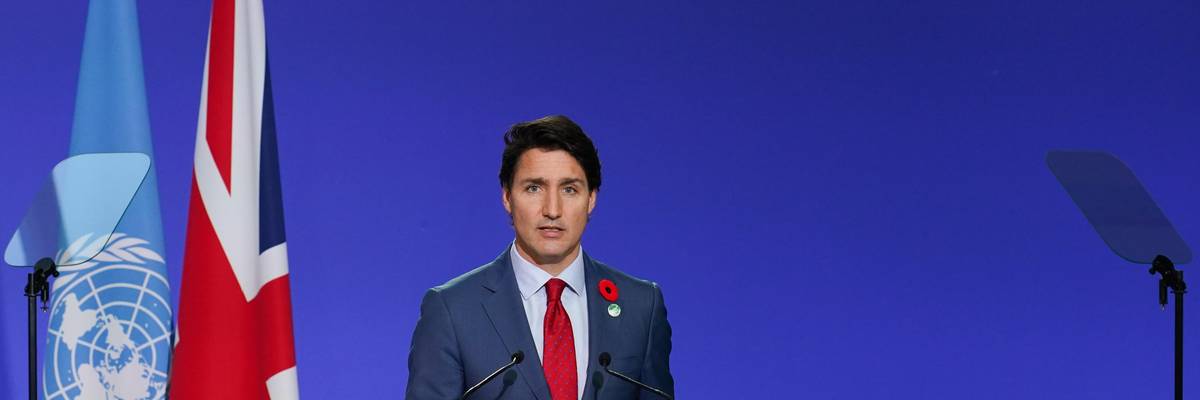
Canadian Prime Minister Justin Trudeau speaks as National Statements are delivered on day two of the COP 26 United Nations Climate Change Conference at SECC on November 01, 2021 in Glasgow, Scotland. (Photo: Ian Forsyth/Getty Images)
Big Oil, Lurking in Shadows, Continues to Call Shots on Climate
Let's be clear: Big Oil has no intention of leaving oil in the ground.
During the Second World War, no Canadian would have been satisfied to learn that, while the Allies were making progress, their efforts wouldn't be enough to stop Hitler. Any possibility of Hitler winning was unacceptable; accordingly, the Canadian government devoted itself unwaveringly to mobilizing a national war effort against him.
That's because--unlike children's sports--when it comes to war against an evil tyrant, it's not enough just to try hard. Winning matters.
Our prime minister is, at best, split in his loyalties, happy to run around dressed as a climate warrior while quietly doling out billions in subsidies to an industry hell-bent on developing every last ounce of climate-destroying oil.
Same with climate change, which poses a very different but also deadly threat, as B.C.'s flooding reminds us. And we're nowhere near the climate chaos currently locked in due to emissions we've already pumped into the air.
And yet, Justin Trudeau is waging a war on climate change that seems half-hearted--perhaps "deeply conflicted" describes it best.
Certainly, there's a huge disconnect between the Trudeau government loudly proclaiming its commitment to emission-reduction even as it quietly provides billions of dollars in subsidies to the fossil fuel industry and turns a blind eye to industry plans to greatly expand Canadian production.
This two-faced behaviour has led an international group of environmentalists to lump Canada in with the U.S., U.K., Norway and Australia as five rich nations whose refusal to rein in future fossil fuel production is jeopardizing the world's future.
There can be no heading off a climate catastrophe if we allow the fossil fuel industry to continue to expand production. It is the elephant in the room of the climate crisis--huge, quiet and heavy enough to crush anyone under it in a mudslide.
In fact, the industry was calling the shots, as it has for years. The fossil fuel industry is the richest set of corporate interests on earth, and its future depends on blocking climate action.
The industry has $27 trillion worth of oil, gas and coal deposits in the ground around the world. If these proven reserves were to stay in the ground--as most of them must to avoid climate disaster--the industry would "be writing off $20 trillion in assets," notes U.S. climate activist Bill McKibben.
So let's be clear: Big Oil has no intention of leaving that oil in the ground.
On the contrary, the eight major oil and gas producers in Canada have laid out plans to expand their production here in the coming decade--plans that will result in a devastating 25 per cent increase in Canada's annual carbon emissions, according to "Big Oil Reality Check" by Environmental Defence Canada.
Rather than curbing these plans, the Trudeau government is providing the companies nearly $18 billion in annual subsidies, including $3.28 billion through direct programs and $13.47 billion in public financing through Export Development Canada.
But Trudeau keeps the public's gaze away from these subsidies. "Hey, look over here at how low Canada's emissions will go--and not over there, at how we're subsidizing the production of more emissions!"
What makes this tricky performance so insidious is that the emission reductions are only promises (which Canada has so far not kept), while new investment and subsidies are real, and happening at a frightening pace inconsistent with limiting the global temperature rise to the accepted cut-off of 1.5 C.
The Canadian government certainly didn't give subsidies to the enemy during the Second World War.
Yet in today's climate battle, our prime minister is, at best, split in his loyalties, happy to run around dressed as a climate warrior while quietly doling out billions in subsidies to an industry hell-bent on developing every last ounce of climate-destroying oil.
An Urgent Message From Our Co-Founder
Dear Common Dreams reader, It’s been nearly 30 years since I co-founded Common Dreams with my late wife, Lina Newhouser. We had the radical notion that journalism should serve the public good, not corporate profits. It was clear to us from the outset what it would take to build such a project. No paid advertisements. No corporate sponsors. No millionaire publisher telling us what to think or do. Many people said we wouldn't last a year, but we proved those doubters wrong. Together with a tremendous team of journalists and dedicated staff, we built an independent media outlet free from the constraints of profits and corporate control. Our mission has always been simple: To inform. To inspire. To ignite change for the common good. Building Common Dreams was not easy. Our survival was never guaranteed. When you take on the most powerful forces—Wall Street greed, fossil fuel industry destruction, Big Tech lobbyists, and uber-rich oligarchs who have spent billions upon billions rigging the economy and democracy in their favor—the only bulwark you have is supporters who believe in your work. But here’s the urgent message from me today. It's never been this bad out there. And it's never been this hard to keep us going. At the very moment Common Dreams is most needed, the threats we face are intensifying. We need your support now more than ever. We don't accept corporate advertising and never will. We don't have a paywall because we don't think people should be blocked from critical news based on their ability to pay. Everything we do is funded by the donations of readers like you. When everyone does the little they can afford, we are strong. But if that support retreats or dries up, so do we. Will you donate now to make sure Common Dreams not only survives but thrives? —Craig Brown, Co-founder |
During the Second World War, no Canadian would have been satisfied to learn that, while the Allies were making progress, their efforts wouldn't be enough to stop Hitler. Any possibility of Hitler winning was unacceptable; accordingly, the Canadian government devoted itself unwaveringly to mobilizing a national war effort against him.
That's because--unlike children's sports--when it comes to war against an evil tyrant, it's not enough just to try hard. Winning matters.
Our prime minister is, at best, split in his loyalties, happy to run around dressed as a climate warrior while quietly doling out billions in subsidies to an industry hell-bent on developing every last ounce of climate-destroying oil.
Same with climate change, which poses a very different but also deadly threat, as B.C.'s flooding reminds us. And we're nowhere near the climate chaos currently locked in due to emissions we've already pumped into the air.
And yet, Justin Trudeau is waging a war on climate change that seems half-hearted--perhaps "deeply conflicted" describes it best.
Certainly, there's a huge disconnect between the Trudeau government loudly proclaiming its commitment to emission-reduction even as it quietly provides billions of dollars in subsidies to the fossil fuel industry and turns a blind eye to industry plans to greatly expand Canadian production.
This two-faced behaviour has led an international group of environmentalists to lump Canada in with the U.S., U.K., Norway and Australia as five rich nations whose refusal to rein in future fossil fuel production is jeopardizing the world's future.
There can be no heading off a climate catastrophe if we allow the fossil fuel industry to continue to expand production. It is the elephant in the room of the climate crisis--huge, quiet and heavy enough to crush anyone under it in a mudslide.
In fact, the industry was calling the shots, as it has for years. The fossil fuel industry is the richest set of corporate interests on earth, and its future depends on blocking climate action.
The industry has $27 trillion worth of oil, gas and coal deposits in the ground around the world. If these proven reserves were to stay in the ground--as most of them must to avoid climate disaster--the industry would "be writing off $20 trillion in assets," notes U.S. climate activist Bill McKibben.
So let's be clear: Big Oil has no intention of leaving that oil in the ground.
On the contrary, the eight major oil and gas producers in Canada have laid out plans to expand their production here in the coming decade--plans that will result in a devastating 25 per cent increase in Canada's annual carbon emissions, according to "Big Oil Reality Check" by Environmental Defence Canada.
Rather than curbing these plans, the Trudeau government is providing the companies nearly $18 billion in annual subsidies, including $3.28 billion through direct programs and $13.47 billion in public financing through Export Development Canada.
But Trudeau keeps the public's gaze away from these subsidies. "Hey, look over here at how low Canada's emissions will go--and not over there, at how we're subsidizing the production of more emissions!"
What makes this tricky performance so insidious is that the emission reductions are only promises (which Canada has so far not kept), while new investment and subsidies are real, and happening at a frightening pace inconsistent with limiting the global temperature rise to the accepted cut-off of 1.5 C.
The Canadian government certainly didn't give subsidies to the enemy during the Second World War.
Yet in today's climate battle, our prime minister is, at best, split in his loyalties, happy to run around dressed as a climate warrior while quietly doling out billions in subsidies to an industry hell-bent on developing every last ounce of climate-destroying oil.
During the Second World War, no Canadian would have been satisfied to learn that, while the Allies were making progress, their efforts wouldn't be enough to stop Hitler. Any possibility of Hitler winning was unacceptable; accordingly, the Canadian government devoted itself unwaveringly to mobilizing a national war effort against him.
That's because--unlike children's sports--when it comes to war against an evil tyrant, it's not enough just to try hard. Winning matters.
Our prime minister is, at best, split in his loyalties, happy to run around dressed as a climate warrior while quietly doling out billions in subsidies to an industry hell-bent on developing every last ounce of climate-destroying oil.
Same with climate change, which poses a very different but also deadly threat, as B.C.'s flooding reminds us. And we're nowhere near the climate chaos currently locked in due to emissions we've already pumped into the air.
And yet, Justin Trudeau is waging a war on climate change that seems half-hearted--perhaps "deeply conflicted" describes it best.
Certainly, there's a huge disconnect between the Trudeau government loudly proclaiming its commitment to emission-reduction even as it quietly provides billions of dollars in subsidies to the fossil fuel industry and turns a blind eye to industry plans to greatly expand Canadian production.
This two-faced behaviour has led an international group of environmentalists to lump Canada in with the U.S., U.K., Norway and Australia as five rich nations whose refusal to rein in future fossil fuel production is jeopardizing the world's future.
There can be no heading off a climate catastrophe if we allow the fossil fuel industry to continue to expand production. It is the elephant in the room of the climate crisis--huge, quiet and heavy enough to crush anyone under it in a mudslide.
In fact, the industry was calling the shots, as it has for years. The fossil fuel industry is the richest set of corporate interests on earth, and its future depends on blocking climate action.
The industry has $27 trillion worth of oil, gas and coal deposits in the ground around the world. If these proven reserves were to stay in the ground--as most of them must to avoid climate disaster--the industry would "be writing off $20 trillion in assets," notes U.S. climate activist Bill McKibben.
So let's be clear: Big Oil has no intention of leaving that oil in the ground.
On the contrary, the eight major oil and gas producers in Canada have laid out plans to expand their production here in the coming decade--plans that will result in a devastating 25 per cent increase in Canada's annual carbon emissions, according to "Big Oil Reality Check" by Environmental Defence Canada.
Rather than curbing these plans, the Trudeau government is providing the companies nearly $18 billion in annual subsidies, including $3.28 billion through direct programs and $13.47 billion in public financing through Export Development Canada.
But Trudeau keeps the public's gaze away from these subsidies. "Hey, look over here at how low Canada's emissions will go--and not over there, at how we're subsidizing the production of more emissions!"
What makes this tricky performance so insidious is that the emission reductions are only promises (which Canada has so far not kept), while new investment and subsidies are real, and happening at a frightening pace inconsistent with limiting the global temperature rise to the accepted cut-off of 1.5 C.
The Canadian government certainly didn't give subsidies to the enemy during the Second World War.
Yet in today's climate battle, our prime minister is, at best, split in his loyalties, happy to run around dressed as a climate warrior while quietly doling out billions in subsidies to an industry hell-bent on developing every last ounce of climate-destroying oil.