SUBSCRIBE TO OUR FREE NEWSLETTER
Daily news & progressive opinion—funded by the people, not the corporations—delivered straight to your inbox.
5
#000000
#FFFFFF
To donate by check, phone, or other method, see our More Ways to Give page.
Daily news & progressive opinion—funded by the people, not the corporations—delivered straight to your inbox.
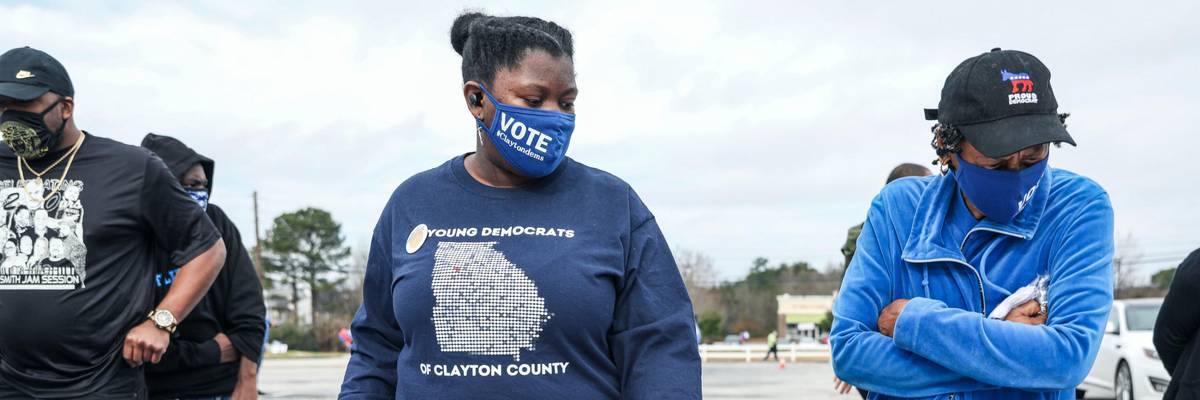
Supporters of Democratic Senate candidates Jon Ossoff and Raphael Warnock (D-GA) attend a get out to vote rally in Hampton, Georgia on January 2, 2021.(Photo: Sandy Huffaker/AFP via Getty Images)
"I got a call from Bill Clinton!" my grandmother informed me one day many years ago, thrilled that the president of the United States had taken time out of his busy schedule to call her. But he hadn't. Instead, it was her first encounter with an exciting new technology--robocalls--which were used to remind voters to get out and cast a ballot. Wow, did she kvell about this experience and tell all her friends to go vote for her friend Bill.
Now is the time to find new ways to reach larger audiences and modernize our strategies for engaging everyone from young voters to grandmas.
And just like that, political consultants had a new tool in their arsenal. Several campaigns innovated these pre-recorded calls. But eventually, they became a commodity that every local candidate abused until voters rarely answer their phones on Election Day.
I have faced these diminishing returns on every campaign in my career. As Barack Obama's social media strategist in 2008, I pushed his leadership to spend more resources on MySpace, BlackPlanet, and MiGente. During the 2016 cycle, I advised Sen.Bernie Sanders' (I-Vt.) presidential campaign to spend more advertising dollars on Twitter Cards and Snapchat Filters. While each of these platforms helped campaigns reach more African Americans, Latinx, and young voters, it would have been a giant mistake to recommend spending the same amount of scarce resources on them a cycle later.
Campaigns need to keep evolving their communications tactics to match the constant shifts in where base voters receive news. Unfortunately, all the reports about the proliferation of fake news that may negatively affect young voters on Facebook seem a bit ill-informed since this key demographic barely uses the platform anymore. They have long since moved to Snapchat, TikTok, Instagram, and Twitch. As my nephew told me, "Facebook is for Boomers."
We are all watching history repeat itself with those unsolicited peer-to-peer text messages that campaigns first used in 2016. This spammy innovation to traditional SMS programs was added to skirt FCC rules around blasting illegal unsubscribed text, something that people had never seen on their cell phones before. And by this past election cycle, this tactic was adopted by hundreds of campaigns even as their engagement rates plummet. If Democrats don't evolve their strategies, imagine what these spam text campaigns are going to look like by 2022?
Not only are technology platforms becoming less and less effective each day, but traditional news sources are suffering hits to both their viewership and credibility. Gallup recently found that Americans' trust in traditional news outlets has declined to the second-lowest rating in recorded history.
There are consequences for failing to develop new communications strategies for key constituents that have clearly shifted. According to Targetsmart, early numbers in this year's gubernatorial election in New Jersey for 18- to 29-year-olds were down by 6.9 percent from 2020 voting tallies; and Virginia's numbers among the same demographic were down by 6.3 percent. Remember, these 18- to 29-year-olds tend to vote overwhelmingly Democratic when they are inspired to vote.
For Democrats, the problem is larger than just finding the next social media trend. It's about finding better ways to engage consistently with base voters. In Virginia alone, the Latinx/Hispanic population is almost 10 percent of the population. Terry McAuliffe, who just lost his race for governor, had a fully translated Spanish-language homepage on his website, but it did not provide a quality user experience. While the homepage offered directions on how to contribute in Spanish, it sent Spanish-speaking voters immediately to an English-only contribution page.
The campaign did the same with Spanish language social media efforts--which clicked through to their English-only Facebook and Twitter pages. These tactics of creating a translated section on a website or a Spanish-language mailer for appearance's sake in 2021 are political malfeasance and must be retired.
It's time that the Democratic Party starts truly communicating early and often with its key constituents in authentic ways for the critical 2022 election.
Democrats must fix their technology infrastructure to better engage with their base voters. It's time to finally have a payment gateway that works in multiple languages. They must evolve mobile communication beyond peer-to-peer text messaging and be honest that these are not personal messages or interactive conversations anymore, but spam announcements.
Democrats must also experiment with how to talk with key audiences in new ways. Why not try regular political Twitch events, run social media in multiple languages, evolve Instagram Live events or experiment with original video content on TikTok?
McAuliffe's campaign challenged the law of diminishing returns on email fundraising and sent upwards of 15 emails a day to squeeze every last dime out of donors. How much longer do we think this strategy will work before voters unsubscribe?
Now is the time to find new ways to reach larger audiences and modernize our strategies for engaging everyone from young voters to grandmas.
Dear Common Dreams reader, It’s been nearly 30 years since I co-founded Common Dreams with my late wife, Lina Newhouser. We had the radical notion that journalism should serve the public good, not corporate profits. It was clear to us from the outset what it would take to build such a project. No paid advertisements. No corporate sponsors. No millionaire publisher telling us what to think or do. Many people said we wouldn't last a year, but we proved those doubters wrong. Together with a tremendous team of journalists and dedicated staff, we built an independent media outlet free from the constraints of profits and corporate control. Our mission has always been simple: To inform. To inspire. To ignite change for the common good. Building Common Dreams was not easy. Our survival was never guaranteed. When you take on the most powerful forces—Wall Street greed, fossil fuel industry destruction, Big Tech lobbyists, and uber-rich oligarchs who have spent billions upon billions rigging the economy and democracy in their favor—the only bulwark you have is supporters who believe in your work. But here’s the urgent message from me today. It's never been this bad out there. And it's never been this hard to keep us going. At the very moment Common Dreams is most needed, the threats we face are intensifying. We need your support now more than ever. We don't accept corporate advertising and never will. We don't have a paywall because we don't think people should be blocked from critical news based on their ability to pay. Everything we do is funded by the donations of readers like you. When everyone does the little they can afford, we are strong. But if that support retreats or dries up, so do we. Will you donate now to make sure Common Dreams not only survives but thrives? —Craig Brown, Co-founder |
"I got a call from Bill Clinton!" my grandmother informed me one day many years ago, thrilled that the president of the United States had taken time out of his busy schedule to call her. But he hadn't. Instead, it was her first encounter with an exciting new technology--robocalls--which were used to remind voters to get out and cast a ballot. Wow, did she kvell about this experience and tell all her friends to go vote for her friend Bill.
Now is the time to find new ways to reach larger audiences and modernize our strategies for engaging everyone from young voters to grandmas.
And just like that, political consultants had a new tool in their arsenal. Several campaigns innovated these pre-recorded calls. But eventually, they became a commodity that every local candidate abused until voters rarely answer their phones on Election Day.
I have faced these diminishing returns on every campaign in my career. As Barack Obama's social media strategist in 2008, I pushed his leadership to spend more resources on MySpace, BlackPlanet, and MiGente. During the 2016 cycle, I advised Sen.Bernie Sanders' (I-Vt.) presidential campaign to spend more advertising dollars on Twitter Cards and Snapchat Filters. While each of these platforms helped campaigns reach more African Americans, Latinx, and young voters, it would have been a giant mistake to recommend spending the same amount of scarce resources on them a cycle later.
Campaigns need to keep evolving their communications tactics to match the constant shifts in where base voters receive news. Unfortunately, all the reports about the proliferation of fake news that may negatively affect young voters on Facebook seem a bit ill-informed since this key demographic barely uses the platform anymore. They have long since moved to Snapchat, TikTok, Instagram, and Twitch. As my nephew told me, "Facebook is for Boomers."
We are all watching history repeat itself with those unsolicited peer-to-peer text messages that campaigns first used in 2016. This spammy innovation to traditional SMS programs was added to skirt FCC rules around blasting illegal unsubscribed text, something that people had never seen on their cell phones before. And by this past election cycle, this tactic was adopted by hundreds of campaigns even as their engagement rates plummet. If Democrats don't evolve their strategies, imagine what these spam text campaigns are going to look like by 2022?
Not only are technology platforms becoming less and less effective each day, but traditional news sources are suffering hits to both their viewership and credibility. Gallup recently found that Americans' trust in traditional news outlets has declined to the second-lowest rating in recorded history.
There are consequences for failing to develop new communications strategies for key constituents that have clearly shifted. According to Targetsmart, early numbers in this year's gubernatorial election in New Jersey for 18- to 29-year-olds were down by 6.9 percent from 2020 voting tallies; and Virginia's numbers among the same demographic were down by 6.3 percent. Remember, these 18- to 29-year-olds tend to vote overwhelmingly Democratic when they are inspired to vote.
For Democrats, the problem is larger than just finding the next social media trend. It's about finding better ways to engage consistently with base voters. In Virginia alone, the Latinx/Hispanic population is almost 10 percent of the population. Terry McAuliffe, who just lost his race for governor, had a fully translated Spanish-language homepage on his website, but it did not provide a quality user experience. While the homepage offered directions on how to contribute in Spanish, it sent Spanish-speaking voters immediately to an English-only contribution page.
The campaign did the same with Spanish language social media efforts--which clicked through to their English-only Facebook and Twitter pages. These tactics of creating a translated section on a website or a Spanish-language mailer for appearance's sake in 2021 are political malfeasance and must be retired.
It's time that the Democratic Party starts truly communicating early and often with its key constituents in authentic ways for the critical 2022 election.
Democrats must fix their technology infrastructure to better engage with their base voters. It's time to finally have a payment gateway that works in multiple languages. They must evolve mobile communication beyond peer-to-peer text messaging and be honest that these are not personal messages or interactive conversations anymore, but spam announcements.
Democrats must also experiment with how to talk with key audiences in new ways. Why not try regular political Twitch events, run social media in multiple languages, evolve Instagram Live events or experiment with original video content on TikTok?
McAuliffe's campaign challenged the law of diminishing returns on email fundraising and sent upwards of 15 emails a day to squeeze every last dime out of donors. How much longer do we think this strategy will work before voters unsubscribe?
Now is the time to find new ways to reach larger audiences and modernize our strategies for engaging everyone from young voters to grandmas.
"I got a call from Bill Clinton!" my grandmother informed me one day many years ago, thrilled that the president of the United States had taken time out of his busy schedule to call her. But he hadn't. Instead, it was her first encounter with an exciting new technology--robocalls--which were used to remind voters to get out and cast a ballot. Wow, did she kvell about this experience and tell all her friends to go vote for her friend Bill.
Now is the time to find new ways to reach larger audiences and modernize our strategies for engaging everyone from young voters to grandmas.
And just like that, political consultants had a new tool in their arsenal. Several campaigns innovated these pre-recorded calls. But eventually, they became a commodity that every local candidate abused until voters rarely answer their phones on Election Day.
I have faced these diminishing returns on every campaign in my career. As Barack Obama's social media strategist in 2008, I pushed his leadership to spend more resources on MySpace, BlackPlanet, and MiGente. During the 2016 cycle, I advised Sen.Bernie Sanders' (I-Vt.) presidential campaign to spend more advertising dollars on Twitter Cards and Snapchat Filters. While each of these platforms helped campaigns reach more African Americans, Latinx, and young voters, it would have been a giant mistake to recommend spending the same amount of scarce resources on them a cycle later.
Campaigns need to keep evolving their communications tactics to match the constant shifts in where base voters receive news. Unfortunately, all the reports about the proliferation of fake news that may negatively affect young voters on Facebook seem a bit ill-informed since this key demographic barely uses the platform anymore. They have long since moved to Snapchat, TikTok, Instagram, and Twitch. As my nephew told me, "Facebook is for Boomers."
We are all watching history repeat itself with those unsolicited peer-to-peer text messages that campaigns first used in 2016. This spammy innovation to traditional SMS programs was added to skirt FCC rules around blasting illegal unsubscribed text, something that people had never seen on their cell phones before. And by this past election cycle, this tactic was adopted by hundreds of campaigns even as their engagement rates plummet. If Democrats don't evolve their strategies, imagine what these spam text campaigns are going to look like by 2022?
Not only are technology platforms becoming less and less effective each day, but traditional news sources are suffering hits to both their viewership and credibility. Gallup recently found that Americans' trust in traditional news outlets has declined to the second-lowest rating in recorded history.
There are consequences for failing to develop new communications strategies for key constituents that have clearly shifted. According to Targetsmart, early numbers in this year's gubernatorial election in New Jersey for 18- to 29-year-olds were down by 6.9 percent from 2020 voting tallies; and Virginia's numbers among the same demographic were down by 6.3 percent. Remember, these 18- to 29-year-olds tend to vote overwhelmingly Democratic when they are inspired to vote.
For Democrats, the problem is larger than just finding the next social media trend. It's about finding better ways to engage consistently with base voters. In Virginia alone, the Latinx/Hispanic population is almost 10 percent of the population. Terry McAuliffe, who just lost his race for governor, had a fully translated Spanish-language homepage on his website, but it did not provide a quality user experience. While the homepage offered directions on how to contribute in Spanish, it sent Spanish-speaking voters immediately to an English-only contribution page.
The campaign did the same with Spanish language social media efforts--which clicked through to their English-only Facebook and Twitter pages. These tactics of creating a translated section on a website or a Spanish-language mailer for appearance's sake in 2021 are political malfeasance and must be retired.
It's time that the Democratic Party starts truly communicating early and often with its key constituents in authentic ways for the critical 2022 election.
Democrats must fix their technology infrastructure to better engage with their base voters. It's time to finally have a payment gateway that works in multiple languages. They must evolve mobile communication beyond peer-to-peer text messaging and be honest that these are not personal messages or interactive conversations anymore, but spam announcements.
Democrats must also experiment with how to talk with key audiences in new ways. Why not try regular political Twitch events, run social media in multiple languages, evolve Instagram Live events or experiment with original video content on TikTok?
McAuliffe's campaign challenged the law of diminishing returns on email fundraising and sent upwards of 15 emails a day to squeeze every last dime out of donors. How much longer do we think this strategy will work before voters unsubscribe?
Now is the time to find new ways to reach larger audiences and modernize our strategies for engaging everyone from young voters to grandmas.