SUBSCRIBE TO OUR FREE NEWSLETTER
Daily news & progressive opinion—funded by the people, not the corporations—delivered straight to your inbox.
5
#000000
#FFFFFF
To donate by check, phone, or other method, see our More Ways to Give page.
Daily news & progressive opinion—funded by the people, not the corporations—delivered straight to your inbox.
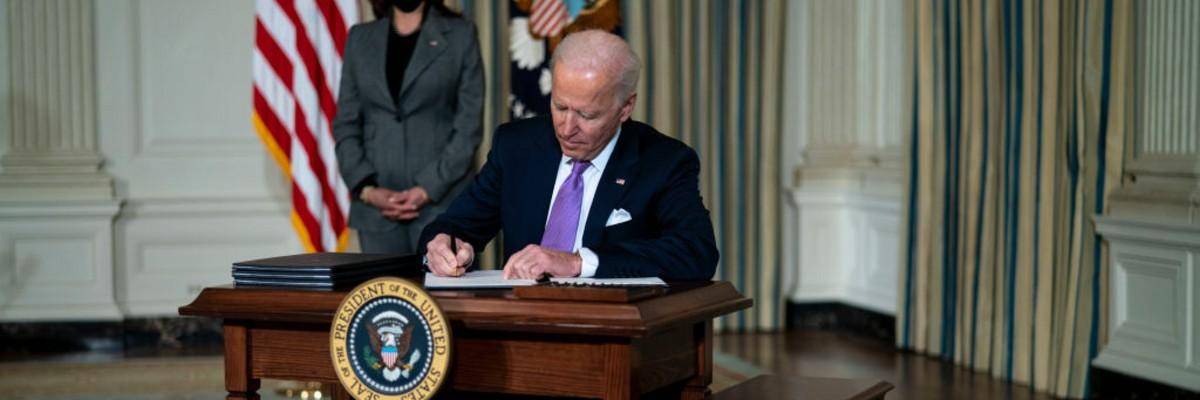
U.S. President Joe Biden signs executives orders related to his racial equity agenda in the State Dining Room of the White House on January 26, 2021 in Washington, DC. President Biden signed executive actions Tuesday on housing and justice reforms, including a directive to the Department of Justice to end its use of private prisons. (Photo by Doug Mills-Pool/Getty Images)
Over the last three decades, the federal government has largely outsourced immigration detention to private prison companies. Today, private prison corporations like the GEO Group, CoreCivic, LaSalle Corrections, and the Management and Training Corporation (MTC) own or operate facilities that hold the overwhelming majority of detained people for Immigration and Customs Enforcement (ICE).
It must begin by dramatically reducing detention rates, and investing in proven alternatives to detention, instead of wasting billions of dollars to support the coffers of private prison companies.
During the Trump administration, ICE expanded the immigration detention system by over 50 percent, signing contracts to open over 40 new detention facilities. This expansion overwhelmingly benefitted private prison companies, which housed 91 percent of all people held in detention centers that opened during those years. In a review of these new contracts, the Government Accountability Office (GAO) found that ICE failed to adhere to its own process for signing these agreements, concluding that ICE did not have documentation to justify the need for the space. The GAO also found that ICE disregarded the input of staff who advised against the use of several new facilities because of safety issues, understaffing, and poor conditions. In some instances, the Department of Justice (DOJ) had cancelled its contracts to house prisoners at the same facilities due to abuse and poor conditions.
Today, the Biden administration has the opportunity to reverse these trends. But closer examination shows that little has changed. In January 2021, President Biden issued an executive order directing the Department of Justice to phase out its contracts with private prison companies. The executive order instructed DOJ not to renew contracts with privately operated criminal detention facilities, including for Bureau of Prison (BOP) and U.S. Marshals Service (USMS) sites. But the executive order did not apply to ICE detention facilities.
Today, the Biden administration is filling private prison beds emptied out by its own executive order with detained immigrants.
Four Out of Five People in ICE Detention Remain Held in Privately-Run Facilities
Under the Trump administration, 81 percent of people detained each day in January 2020 were held in facilities owned or operated by private prison corporations.
This number remains virtually unchanged under the Biden administration. As of September 2021, 79 percent of people detained each day in ICE custody are detained in private detention facilities.
Private Prison Corporations Continue to Profit from ICE Detention Contracts
In the past several years, contracts for ICE detention made up approximately 25 percent of total revenue for both CoreCivic and the GEO Group. These corporations earned approximately the same amount of revenue from ICE detention contracts as they earned from Department of Justice (Bureau of Prisons and U.S. Marshals Service) contracts combined.
Even in spite of significant population reductions in 2020 due to the COVID-19 pandemic, revenues from ICE contracts remained relatively constant for these private prison companies. In 2019, 29 percent of CoreCivic's revenue came from ICE detention contracts, at a total of $574 million. In 2020, 28 percent of CoreCivic's revenue came from ICE detention contracts, at a total of $533 million. Twenty-eight percent of GEO's revenue came from ICE detention contracts in both 2019 and 2020, at a total of $708 million in 2019 and $662 million in 2020.
The Biden Administration is Helping Private Prison Companies Fill Jail Cells Emptied by its Own Executive Order with Immigrant Detainees
As criminal justice reforms have reduced the number of incarcerated people held nationwide, private prison corporations have found themselves with empty beds to fill. Under the Trump administration, private prison corporations found a new source of income: detained immigrants. For example, after Louisiana enacted sentencing reform measures in 2019, the state's incarceration dropped by almost 9,000 people in less than two years. Faced with the prospect of empty cells, private prison companies in Louisiana secured new contracts to detain over 6,000 more immigrants under the Trump administration. Private prison corporations in Texas also benefited from the boom. In many instances, these ICE detention contracts guaranteed minimum provisions that the GAO has concluded lacked "a strategic approach," paying private prison corporations millions of dollars a month on unused detention beds. Today, ICE detains 42 percent of all immigrant detainees in Texas and Louisiana alone. At least 11 of these facilities have shifted operations entirely to detaining immigrants.
Even detention facilities that had lost their contracts with the federal government due to poor conditions won new ICE detention contracts--even over the objections of local ICE officials. In 2019, the Bureau of Prisons discontinued its use of the Adams County Detention Center in Natchez, Mississippi after understaffing, lack of medical care, and poor conditions led to deadly riots. Local ICE officers objected to the use of the Adams County facility as an immigration detention facility, but were overridden by ICE headquarters. Soon after, CoreCivic announced that it won a new contract to hold ICE detainees, noting that "more favorable contract terms . . . mitigated the impact of lower occupancy at this facility."
In January 2021, GEO announced that the Bureau of Prisons had declined to renew its contract for the Moshannon Valley Correctional Facility in Pennsylvania, which was expected to generate $42 million in annualized revenue. GEO then informed its investors that it expected to market the facility "to other federal and state agencies."
In September 2021, the GEO Group announced that it would reopen the facility as an ICE detention facility. Another federal contract with the Leavenworth Detention Center in Kansas, run by CoreCivic, is set to expire in December, and may also be in line to become another ICE detention facility. CoreCivic is actively attempting to replace its U.S. Marshals Service contract with an ICE detention contract at the West Tennessee Detention Facility in Mason, Tennessee.
This must change. The Biden administration must truly reverse course on immigration detention. It must begin by dramatically reducing detention rates, and investing in proven alternatives to detention, instead of wasting billions of dollars to support the coffers of private prison companies.
This country and this world are at a monumental crossroads. US voters have an opportunity to beat back the forces of fascism and confront the billionaires who are rigging the economy, our media system, and our democracy, making it increasingly impossible for ordinary people to get by. We’re not just talking about the election. We’re talking about what must be done once these fascist elements are vanquished from power. We need a bolder set of solutions than what either major party has so far been willing to offer and a working-class movement ready to fight like hell for it. Trump didn't emerge from nowhere. The conditions that fueled MAGA authoritarianism were created by decades of radical neoliberal economic policies and a corrupt political system dominated by corporate interests. They slashed taxes on the super-rich, promising that the benefits would trickle down. They said giveaways to the corporate titans would make life more affordable for the rest of us. It was all bullshit. And when a bitter, betrayed populace searches for someone to blame, right-wing demagogues have little trouble finding scapegoats. People know when they're being lied to, but you won't hear any of this from the corporate media. Only independent journalism—powered and funded by people who believe in building a better world—can deliver truly trustworthy daily news. If you share our vision, please contribute whatever you can to sustain our work. |
Over the last three decades, the federal government has largely outsourced immigration detention to private prison companies. Today, private prison corporations like the GEO Group, CoreCivic, LaSalle Corrections, and the Management and Training Corporation (MTC) own or operate facilities that hold the overwhelming majority of detained people for Immigration and Customs Enforcement (ICE).
It must begin by dramatically reducing detention rates, and investing in proven alternatives to detention, instead of wasting billions of dollars to support the coffers of private prison companies.
During the Trump administration, ICE expanded the immigration detention system by over 50 percent, signing contracts to open over 40 new detention facilities. This expansion overwhelmingly benefitted private prison companies, which housed 91 percent of all people held in detention centers that opened during those years. In a review of these new contracts, the Government Accountability Office (GAO) found that ICE failed to adhere to its own process for signing these agreements, concluding that ICE did not have documentation to justify the need for the space. The GAO also found that ICE disregarded the input of staff who advised against the use of several new facilities because of safety issues, understaffing, and poor conditions. In some instances, the Department of Justice (DOJ) had cancelled its contracts to house prisoners at the same facilities due to abuse and poor conditions.
Today, the Biden administration has the opportunity to reverse these trends. But closer examination shows that little has changed. In January 2021, President Biden issued an executive order directing the Department of Justice to phase out its contracts with private prison companies. The executive order instructed DOJ not to renew contracts with privately operated criminal detention facilities, including for Bureau of Prison (BOP) and U.S. Marshals Service (USMS) sites. But the executive order did not apply to ICE detention facilities.
Today, the Biden administration is filling private prison beds emptied out by its own executive order with detained immigrants.
Four Out of Five People in ICE Detention Remain Held in Privately-Run Facilities
Under the Trump administration, 81 percent of people detained each day in January 2020 were held in facilities owned or operated by private prison corporations.
This number remains virtually unchanged under the Biden administration. As of September 2021, 79 percent of people detained each day in ICE custody are detained in private detention facilities.
Private Prison Corporations Continue to Profit from ICE Detention Contracts
In the past several years, contracts for ICE detention made up approximately 25 percent of total revenue for both CoreCivic and the GEO Group. These corporations earned approximately the same amount of revenue from ICE detention contracts as they earned from Department of Justice (Bureau of Prisons and U.S. Marshals Service) contracts combined.
Even in spite of significant population reductions in 2020 due to the COVID-19 pandemic, revenues from ICE contracts remained relatively constant for these private prison companies. In 2019, 29 percent of CoreCivic's revenue came from ICE detention contracts, at a total of $574 million. In 2020, 28 percent of CoreCivic's revenue came from ICE detention contracts, at a total of $533 million. Twenty-eight percent of GEO's revenue came from ICE detention contracts in both 2019 and 2020, at a total of $708 million in 2019 and $662 million in 2020.
The Biden Administration is Helping Private Prison Companies Fill Jail Cells Emptied by its Own Executive Order with Immigrant Detainees
As criminal justice reforms have reduced the number of incarcerated people held nationwide, private prison corporations have found themselves with empty beds to fill. Under the Trump administration, private prison corporations found a new source of income: detained immigrants. For example, after Louisiana enacted sentencing reform measures in 2019, the state's incarceration dropped by almost 9,000 people in less than two years. Faced with the prospect of empty cells, private prison companies in Louisiana secured new contracts to detain over 6,000 more immigrants under the Trump administration. Private prison corporations in Texas also benefited from the boom. In many instances, these ICE detention contracts guaranteed minimum provisions that the GAO has concluded lacked "a strategic approach," paying private prison corporations millions of dollars a month on unused detention beds. Today, ICE detains 42 percent of all immigrant detainees in Texas and Louisiana alone. At least 11 of these facilities have shifted operations entirely to detaining immigrants.
Even detention facilities that had lost their contracts with the federal government due to poor conditions won new ICE detention contracts--even over the objections of local ICE officials. In 2019, the Bureau of Prisons discontinued its use of the Adams County Detention Center in Natchez, Mississippi after understaffing, lack of medical care, and poor conditions led to deadly riots. Local ICE officers objected to the use of the Adams County facility as an immigration detention facility, but were overridden by ICE headquarters. Soon after, CoreCivic announced that it won a new contract to hold ICE detainees, noting that "more favorable contract terms . . . mitigated the impact of lower occupancy at this facility."
In January 2021, GEO announced that the Bureau of Prisons had declined to renew its contract for the Moshannon Valley Correctional Facility in Pennsylvania, which was expected to generate $42 million in annualized revenue. GEO then informed its investors that it expected to market the facility "to other federal and state agencies."
In September 2021, the GEO Group announced that it would reopen the facility as an ICE detention facility. Another federal contract with the Leavenworth Detention Center in Kansas, run by CoreCivic, is set to expire in December, and may also be in line to become another ICE detention facility. CoreCivic is actively attempting to replace its U.S. Marshals Service contract with an ICE detention contract at the West Tennessee Detention Facility in Mason, Tennessee.
This must change. The Biden administration must truly reverse course on immigration detention. It must begin by dramatically reducing detention rates, and investing in proven alternatives to detention, instead of wasting billions of dollars to support the coffers of private prison companies.