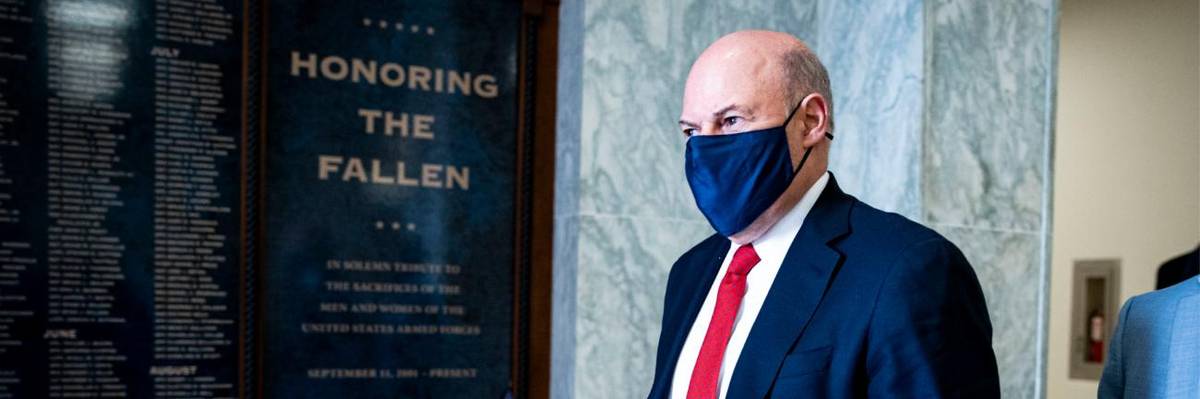
United States Postal Service Postmaster General Louis DeJoy departs following a House Oversight and Reform Committee hearing on Legislative Proposals to Put the Postal Service on Sustainable Financial Footing on Capitol Hill on February 24, 2021 in Washington, D.C. (Photo: Al Drago/Getty Images)
Don't Abandon First-Class Postal Service
Now more than ever the agency requires leaders who can adjust to new challenges in innovative ways while maintaining the agency's essential commitment to operating a democratic public service.
Starting with Benjamin Franklin, one postmaster general after another endeavored to speed up the U.S. Mail. In this ongoing quest to move mail faster, a series of transportation advances were eagerly adopted, from stagecoaches to steamships to railroads to airplanes. But the current postmaster general, Louis DeJoy, is pursuing a course of action that departs from the goals and aspirations of his predecessors. While previous postmasters generals sought faster mail delivery, DeJoy stands out for his wish to make it slower. Beginning this October 1, many Americans can expect permanently slower mail, especially if they live on the West Coast.
Unfortunately, after more than one year as postmaster general, the tenure of DeJoy remains unimaginative at best and destructive at worst.
DeJoy claims that lowering service standards offers an outstanding opportunity to cut costs because hauling mail overland on trucks will prove cheaper than using air transportation. Lost in this short-term calculus is the cost to American citizens and to the health of the Postal Service in the long run. Degrading standards of service and discarding competitive advantages is not a formula for long-term relevance.
While DeJoy's actions will curtail air transportation of first-class mail, airmail as a separate class of mail actually ended back in 1977. By that point, advances in service standards had made the category itself superfluous, since most first-class mail was being transported on airplanes. The postal system had come a long way since the pioneer transcontinental airmail service was inaugurated between New York City and San Francisco in 1920. Back then it took three and a half days for a letter to travel from coast to coast, but this was almost a day faster than the speeds that express railroads offered. Generations of Americans had witnessed a remarkable and continual improvement of the postal system. At that time, there were older citizens who could still remember the Pony Express. President Abraham Lincoln's 1861 inaugural address had established a record when copies completed the journey from St. Joseph, Missouri, to Sacramento, California, in a little over a week.
By the 1950s, the Post Office has established a goal of "next-day delivery for all first-class mail in the United States." How unlike today, when DeJoy wants to reduce the existing service standard of one to three days for first-class mail delivery to one to five days. While delivery times for a majority of the U.S. Mail will remain unchanged, DeJoy acknowledges that "some uncomfortable changes" are forthcoming, since approximately two in five pieces of mail will take longer to reach their destinations.
In response, businesses are already pushing to shift more of their communications online. Wells Fargo bank has notified its customers that "this may delay your receipt of mail from us and our receipt of mail from you," and consequently urged them to consider "switching to online statements" and other alternatives to the Postal Service. Ordinary citizens and small businesses are particularly reliant on single-piece mail, so such delays will fall heaviest on these groups. As more bills arrive late, increasing late fees for consumers will result, not to mention the damage to credit scores. Postal officials opted to reduce delivery standards without even studying the harmful impact on millions of Americans who lack access to broadband internet.
Although the Postal Service exists to serve everyone equally, the coming changes in delivery standards will hit certain areas of the country hardest, notably the Pacific coast. Yet westerners deserve the same first-class mail service as the rest of the nation, not second-class treatment. The Postal Service faces serious challenges arising from unique financial burdens mandated by Congress, technological changes, and decades of underinvestment in its infrastructure. Reducing service will only discourage use of the U.S. Mail. Such a course of action does not offer a sustainable path forward for the Postal Service. Unfortunately, after more than one year as postmaster general, the tenure of DeJoy remains unimaginative at best and destructive at worst. Now more than ever the agency requires leaders who can adjust to new challenges in innovative ways while maintaining the agency's essential commitment to operating a democratic public service.
Read more about this issue here.
An Urgent Message From Our Co-Founder
Dear Common Dreams reader, It’s been nearly 30 years since I co-founded Common Dreams with my late wife, Lina Newhouser. We had the radical notion that journalism should serve the public good, not corporate profits. It was clear to us from the outset what it would take to build such a project. No paid advertisements. No corporate sponsors. No millionaire publisher telling us what to think or do. Many people said we wouldn't last a year, but we proved those doubters wrong. Together with a tremendous team of journalists and dedicated staff, we built an independent media outlet free from the constraints of profits and corporate control. Our mission has always been simple: To inform. To inspire. To ignite change for the common good. Building Common Dreams was not easy. Our survival was never guaranteed. When you take on the most powerful forces—Wall Street greed, fossil fuel industry destruction, Big Tech lobbyists, and uber-rich oligarchs who have spent billions upon billions rigging the economy and democracy in their favor—the only bulwark you have is supporters who believe in your work. But here’s the urgent message from me today. It's never been this bad out there. And it's never been this hard to keep us going. At the very moment Common Dreams is most needed, the threats we face are intensifying. We need your support now more than ever. We don't accept corporate advertising and never will. We don't have a paywall because we don't think people should be blocked from critical news based on their ability to pay. Everything we do is funded by the donations of readers like you. When everyone does the little they can afford, we are strong. But if that support retreats or dries up, so do we. Will you donate now to make sure Common Dreams not only survives but thrives? —Craig Brown, Co-founder |
Starting with Benjamin Franklin, one postmaster general after another endeavored to speed up the U.S. Mail. In this ongoing quest to move mail faster, a series of transportation advances were eagerly adopted, from stagecoaches to steamships to railroads to airplanes. But the current postmaster general, Louis DeJoy, is pursuing a course of action that departs from the goals and aspirations of his predecessors. While previous postmasters generals sought faster mail delivery, DeJoy stands out for his wish to make it slower. Beginning this October 1, many Americans can expect permanently slower mail, especially if they live on the West Coast.
Unfortunately, after more than one year as postmaster general, the tenure of DeJoy remains unimaginative at best and destructive at worst.
DeJoy claims that lowering service standards offers an outstanding opportunity to cut costs because hauling mail overland on trucks will prove cheaper than using air transportation. Lost in this short-term calculus is the cost to American citizens and to the health of the Postal Service in the long run. Degrading standards of service and discarding competitive advantages is not a formula for long-term relevance.
While DeJoy's actions will curtail air transportation of first-class mail, airmail as a separate class of mail actually ended back in 1977. By that point, advances in service standards had made the category itself superfluous, since most first-class mail was being transported on airplanes. The postal system had come a long way since the pioneer transcontinental airmail service was inaugurated between New York City and San Francisco in 1920. Back then it took three and a half days for a letter to travel from coast to coast, but this was almost a day faster than the speeds that express railroads offered. Generations of Americans had witnessed a remarkable and continual improvement of the postal system. At that time, there were older citizens who could still remember the Pony Express. President Abraham Lincoln's 1861 inaugural address had established a record when copies completed the journey from St. Joseph, Missouri, to Sacramento, California, in a little over a week.
By the 1950s, the Post Office has established a goal of "next-day delivery for all first-class mail in the United States." How unlike today, when DeJoy wants to reduce the existing service standard of one to three days for first-class mail delivery to one to five days. While delivery times for a majority of the U.S. Mail will remain unchanged, DeJoy acknowledges that "some uncomfortable changes" are forthcoming, since approximately two in five pieces of mail will take longer to reach their destinations.
In response, businesses are already pushing to shift more of their communications online. Wells Fargo bank has notified its customers that "this may delay your receipt of mail from us and our receipt of mail from you," and consequently urged them to consider "switching to online statements" and other alternatives to the Postal Service. Ordinary citizens and small businesses are particularly reliant on single-piece mail, so such delays will fall heaviest on these groups. As more bills arrive late, increasing late fees for consumers will result, not to mention the damage to credit scores. Postal officials opted to reduce delivery standards without even studying the harmful impact on millions of Americans who lack access to broadband internet.
Although the Postal Service exists to serve everyone equally, the coming changes in delivery standards will hit certain areas of the country hardest, notably the Pacific coast. Yet westerners deserve the same first-class mail service as the rest of the nation, not second-class treatment. The Postal Service faces serious challenges arising from unique financial burdens mandated by Congress, technological changes, and decades of underinvestment in its infrastructure. Reducing service will only discourage use of the U.S. Mail. Such a course of action does not offer a sustainable path forward for the Postal Service. Unfortunately, after more than one year as postmaster general, the tenure of DeJoy remains unimaginative at best and destructive at worst. Now more than ever the agency requires leaders who can adjust to new challenges in innovative ways while maintaining the agency's essential commitment to operating a democratic public service.
Read more about this issue here.
Starting with Benjamin Franklin, one postmaster general after another endeavored to speed up the U.S. Mail. In this ongoing quest to move mail faster, a series of transportation advances were eagerly adopted, from stagecoaches to steamships to railroads to airplanes. But the current postmaster general, Louis DeJoy, is pursuing a course of action that departs from the goals and aspirations of his predecessors. While previous postmasters generals sought faster mail delivery, DeJoy stands out for his wish to make it slower. Beginning this October 1, many Americans can expect permanently slower mail, especially if they live on the West Coast.
Unfortunately, after more than one year as postmaster general, the tenure of DeJoy remains unimaginative at best and destructive at worst.
DeJoy claims that lowering service standards offers an outstanding opportunity to cut costs because hauling mail overland on trucks will prove cheaper than using air transportation. Lost in this short-term calculus is the cost to American citizens and to the health of the Postal Service in the long run. Degrading standards of service and discarding competitive advantages is not a formula for long-term relevance.
While DeJoy's actions will curtail air transportation of first-class mail, airmail as a separate class of mail actually ended back in 1977. By that point, advances in service standards had made the category itself superfluous, since most first-class mail was being transported on airplanes. The postal system had come a long way since the pioneer transcontinental airmail service was inaugurated between New York City and San Francisco in 1920. Back then it took three and a half days for a letter to travel from coast to coast, but this was almost a day faster than the speeds that express railroads offered. Generations of Americans had witnessed a remarkable and continual improvement of the postal system. At that time, there were older citizens who could still remember the Pony Express. President Abraham Lincoln's 1861 inaugural address had established a record when copies completed the journey from St. Joseph, Missouri, to Sacramento, California, in a little over a week.
By the 1950s, the Post Office has established a goal of "next-day delivery for all first-class mail in the United States." How unlike today, when DeJoy wants to reduce the existing service standard of one to three days for first-class mail delivery to one to five days. While delivery times for a majority of the U.S. Mail will remain unchanged, DeJoy acknowledges that "some uncomfortable changes" are forthcoming, since approximately two in five pieces of mail will take longer to reach their destinations.
In response, businesses are already pushing to shift more of their communications online. Wells Fargo bank has notified its customers that "this may delay your receipt of mail from us and our receipt of mail from you," and consequently urged them to consider "switching to online statements" and other alternatives to the Postal Service. Ordinary citizens and small businesses are particularly reliant on single-piece mail, so such delays will fall heaviest on these groups. As more bills arrive late, increasing late fees for consumers will result, not to mention the damage to credit scores. Postal officials opted to reduce delivery standards without even studying the harmful impact on millions of Americans who lack access to broadband internet.
Although the Postal Service exists to serve everyone equally, the coming changes in delivery standards will hit certain areas of the country hardest, notably the Pacific coast. Yet westerners deserve the same first-class mail service as the rest of the nation, not second-class treatment. The Postal Service faces serious challenges arising from unique financial burdens mandated by Congress, technological changes, and decades of underinvestment in its infrastructure. Reducing service will only discourage use of the U.S. Mail. Such a course of action does not offer a sustainable path forward for the Postal Service. Unfortunately, after more than one year as postmaster general, the tenure of DeJoy remains unimaginative at best and destructive at worst. Now more than ever the agency requires leaders who can adjust to new challenges in innovative ways while maintaining the agency's essential commitment to operating a democratic public service.
Read more about this issue here.