SUBSCRIBE TO OUR FREE NEWSLETTER
Daily news & progressive opinion—funded by the people, not the corporations—delivered straight to your inbox.
5
#000000
#FFFFFF
To donate by check, phone, or other method, see our More Ways to Give page.
Daily news & progressive opinion—funded by the people, not the corporations—delivered straight to your inbox.
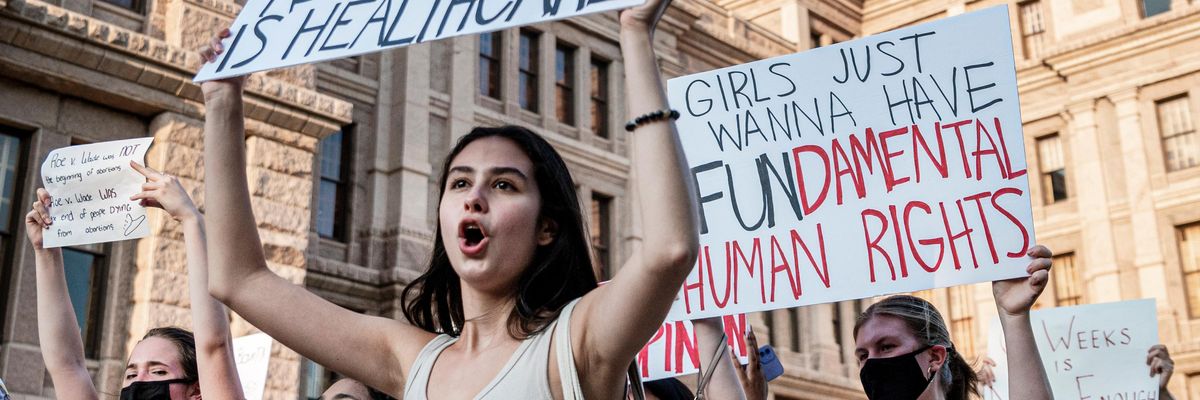
Pro-choice protesters march outside the Texas State Capitol on Wednesday, Sept. 1, 2021 in Austin, TX. Texas passed SB8 which effectively bans nearly all abortions and it went into effect Sept. 1. (Photo: Sergio Flores For The Washington Post via Getty Images)
The new ban in Texas on abortions after the detection of cardiac activity--usually around six weeks, when many women don't even know they're pregnant--is rightfully dominating headlines around the world.
It is an extreme and cruel ban. And it includes clauses that effectively turn private citizens into bounty hunters, with 'prizes' of up to $10,000 for catching doctors who break the law (or anyone who helps a woman end a pregnancy after this point).
It is also a reflection of how Trump's legacy is still shaping American lives--it is the Supreme Court he created that enabled the ban to go through earlier this week.
But, don't be fooled: it will not end abortions in the third-most populous US state. And if other states follow suit, such bans won't end abortion there either.
If you thought otherwise, did a little bird tell you that women are all obedient and law-abiding, and always do what they're told? If so, it's time to shoot that bird.
The truth is that women around the world end pregnancies, regardless of what the law in their country says. Even where abortion is criminalised. Even where they could face severe prison sentences if they are caught.
Women in the US have been preparing for the end of Roe vs Wade for many years.
In the US, women have already had to struggle in many places, for many years, to access legal abortion services. Some travel long distances to find a clinic. Others opt for self-managed abortion care, accessing medical abortion pills online.
Women have also been preparing for the end of Roe vs Wade--the 1973 Supreme Court judgement that legalised abortion across the US--for many years.
In 2019, journalist and reproductive rights advocate Robin Marty published a Handbook for a Post-Roe America. This week--because of the news from Texas--its publisher has made e-copies of the book free to download.
"This is exactly the scenario we always feared," Marty said about the Texas law: "Strangers deputised as an anti-abortion crime watch, creating a massive surveillance system to ensure every pregnant person gives birth [...] or goes to jail."
Her book is written as a user-friendly manual, including step-by-step lists, on how to access abortion--even in situations like Texas. The aim is for women to get "the healthcare you need - by any means necessary".
This includes "how to acquire financial support, how to use existing networks and create new ones, and how to, when required, work outside existing legal systems."
Let that sink in. Even outside the law. By any means necessary. This is the spirit of today's women--and the women who came before us--around the world. You cannot take away our freedoms that easily. You cannot expect us to obey.
The cruelty of the Texas ban will fall hardest on the impoverished and vulnerable--those without access to resources (for example, to travel) or information (to treat and protect themselves). It is draconian, for sure. But it will not work as intended.
Women, and feminist movements, will without a doubt step up and work long hours to help those who need it, as they have done around the world.
Look at Poland. A whole country of nearly 38 million people, compared to 29 mllion in Texas, is under an almost-total ban on abortion after a constitutional court ruling last October (in which Trump-linked US lawyers intervened to support restrictions). This ruling made abortion illegal even in cases of fatal foetal anomalies.
Within six months, Abortion Without Borders--a network of rights activists across Europe--said it had already helped more than 17,000 Polish women with information and, in some cases, support to travel for abortions abroad.
This is hard work that shouldn't have to happen. Restrictions on legal abortions are cruel because they make accessing healthcare a much harder task--particularly for people who are already disadvantaged by class, race or other issues.
The bottom line is: bans like the one just passed in Texas only 'work' if the goal is to punish poor women in particular. But they do not end abortions. Women are tougher than conservative legislators would like. We don't always follow rules.
Dear Common Dreams reader, It’s been nearly 30 years since I co-founded Common Dreams with my late wife, Lina Newhouser. We had the radical notion that journalism should serve the public good, not corporate profits. It was clear to us from the outset what it would take to build such a project. No paid advertisements. No corporate sponsors. No millionaire publisher telling us what to think or do. Many people said we wouldn't last a year, but we proved those doubters wrong. Together with a tremendous team of journalists and dedicated staff, we built an independent media outlet free from the constraints of profits and corporate control. Our mission has always been simple: To inform. To inspire. To ignite change for the common good. Building Common Dreams was not easy. Our survival was never guaranteed. When you take on the most powerful forces—Wall Street greed, fossil fuel industry destruction, Big Tech lobbyists, and uber-rich oligarchs who have spent billions upon billions rigging the economy and democracy in their favor—the only bulwark you have is supporters who believe in your work. But here’s the urgent message from me today. It's never been this bad out there. And it's never been this hard to keep us going. At the very moment Common Dreams is most needed, the threats we face are intensifying. We need your support now more than ever. We don't accept corporate advertising and never will. We don't have a paywall because we don't think people should be blocked from critical news based on their ability to pay. Everything we do is funded by the donations of readers like you. When everyone does the little they can afford, we are strong. But if that support retreats or dries up, so do we. Will you donate now to make sure Common Dreams not only survives but thrives? —Craig Brown, Co-founder |
The new ban in Texas on abortions after the detection of cardiac activity--usually around six weeks, when many women don't even know they're pregnant--is rightfully dominating headlines around the world.
It is an extreme and cruel ban. And it includes clauses that effectively turn private citizens into bounty hunters, with 'prizes' of up to $10,000 for catching doctors who break the law (or anyone who helps a woman end a pregnancy after this point).
It is also a reflection of how Trump's legacy is still shaping American lives--it is the Supreme Court he created that enabled the ban to go through earlier this week.
But, don't be fooled: it will not end abortions in the third-most populous US state. And if other states follow suit, such bans won't end abortion there either.
If you thought otherwise, did a little bird tell you that women are all obedient and law-abiding, and always do what they're told? If so, it's time to shoot that bird.
The truth is that women around the world end pregnancies, regardless of what the law in their country says. Even where abortion is criminalised. Even where they could face severe prison sentences if they are caught.
Women in the US have been preparing for the end of Roe vs Wade for many years.
In the US, women have already had to struggle in many places, for many years, to access legal abortion services. Some travel long distances to find a clinic. Others opt for self-managed abortion care, accessing medical abortion pills online.
Women have also been preparing for the end of Roe vs Wade--the 1973 Supreme Court judgement that legalised abortion across the US--for many years.
In 2019, journalist and reproductive rights advocate Robin Marty published a Handbook for a Post-Roe America. This week--because of the news from Texas--its publisher has made e-copies of the book free to download.
"This is exactly the scenario we always feared," Marty said about the Texas law: "Strangers deputised as an anti-abortion crime watch, creating a massive surveillance system to ensure every pregnant person gives birth [...] or goes to jail."
Her book is written as a user-friendly manual, including step-by-step lists, on how to access abortion--even in situations like Texas. The aim is for women to get "the healthcare you need - by any means necessary".
This includes "how to acquire financial support, how to use existing networks and create new ones, and how to, when required, work outside existing legal systems."
Let that sink in. Even outside the law. By any means necessary. This is the spirit of today's women--and the women who came before us--around the world. You cannot take away our freedoms that easily. You cannot expect us to obey.
The cruelty of the Texas ban will fall hardest on the impoverished and vulnerable--those without access to resources (for example, to travel) or information (to treat and protect themselves). It is draconian, for sure. But it will not work as intended.
Women, and feminist movements, will without a doubt step up and work long hours to help those who need it, as they have done around the world.
Look at Poland. A whole country of nearly 38 million people, compared to 29 mllion in Texas, is under an almost-total ban on abortion after a constitutional court ruling last October (in which Trump-linked US lawyers intervened to support restrictions). This ruling made abortion illegal even in cases of fatal foetal anomalies.
Within six months, Abortion Without Borders--a network of rights activists across Europe--said it had already helped more than 17,000 Polish women with information and, in some cases, support to travel for abortions abroad.
This is hard work that shouldn't have to happen. Restrictions on legal abortions are cruel because they make accessing healthcare a much harder task--particularly for people who are already disadvantaged by class, race or other issues.
The bottom line is: bans like the one just passed in Texas only 'work' if the goal is to punish poor women in particular. But they do not end abortions. Women are tougher than conservative legislators would like. We don't always follow rules.
The new ban in Texas on abortions after the detection of cardiac activity--usually around six weeks, when many women don't even know they're pregnant--is rightfully dominating headlines around the world.
It is an extreme and cruel ban. And it includes clauses that effectively turn private citizens into bounty hunters, with 'prizes' of up to $10,000 for catching doctors who break the law (or anyone who helps a woman end a pregnancy after this point).
It is also a reflection of how Trump's legacy is still shaping American lives--it is the Supreme Court he created that enabled the ban to go through earlier this week.
But, don't be fooled: it will not end abortions in the third-most populous US state. And if other states follow suit, such bans won't end abortion there either.
If you thought otherwise, did a little bird tell you that women are all obedient and law-abiding, and always do what they're told? If so, it's time to shoot that bird.
The truth is that women around the world end pregnancies, regardless of what the law in their country says. Even where abortion is criminalised. Even where they could face severe prison sentences if they are caught.
Women in the US have been preparing for the end of Roe vs Wade for many years.
In the US, women have already had to struggle in many places, for many years, to access legal abortion services. Some travel long distances to find a clinic. Others opt for self-managed abortion care, accessing medical abortion pills online.
Women have also been preparing for the end of Roe vs Wade--the 1973 Supreme Court judgement that legalised abortion across the US--for many years.
In 2019, journalist and reproductive rights advocate Robin Marty published a Handbook for a Post-Roe America. This week--because of the news from Texas--its publisher has made e-copies of the book free to download.
"This is exactly the scenario we always feared," Marty said about the Texas law: "Strangers deputised as an anti-abortion crime watch, creating a massive surveillance system to ensure every pregnant person gives birth [...] or goes to jail."
Her book is written as a user-friendly manual, including step-by-step lists, on how to access abortion--even in situations like Texas. The aim is for women to get "the healthcare you need - by any means necessary".
This includes "how to acquire financial support, how to use existing networks and create new ones, and how to, when required, work outside existing legal systems."
Let that sink in. Even outside the law. By any means necessary. This is the spirit of today's women--and the women who came before us--around the world. You cannot take away our freedoms that easily. You cannot expect us to obey.
The cruelty of the Texas ban will fall hardest on the impoverished and vulnerable--those without access to resources (for example, to travel) or information (to treat and protect themselves). It is draconian, for sure. But it will not work as intended.
Women, and feminist movements, will without a doubt step up and work long hours to help those who need it, as they have done around the world.
Look at Poland. A whole country of nearly 38 million people, compared to 29 mllion in Texas, is under an almost-total ban on abortion after a constitutional court ruling last October (in which Trump-linked US lawyers intervened to support restrictions). This ruling made abortion illegal even in cases of fatal foetal anomalies.
Within six months, Abortion Without Borders--a network of rights activists across Europe--said it had already helped more than 17,000 Polish women with information and, in some cases, support to travel for abortions abroad.
This is hard work that shouldn't have to happen. Restrictions on legal abortions are cruel because they make accessing healthcare a much harder task--particularly for people who are already disadvantaged by class, race or other issues.
The bottom line is: bans like the one just passed in Texas only 'work' if the goal is to punish poor women in particular. But they do not end abortions. Women are tougher than conservative legislators would like. We don't always follow rules.