SUBSCRIBE TO OUR FREE NEWSLETTER
Daily news & progressive opinion—funded by the people, not the corporations—delivered straight to your inbox.
5
#000000
#FFFFFF
To donate by check, phone, or other method, see our More Ways to Give page.
Daily news & progressive opinion—funded by the people, not the corporations—delivered straight to your inbox.
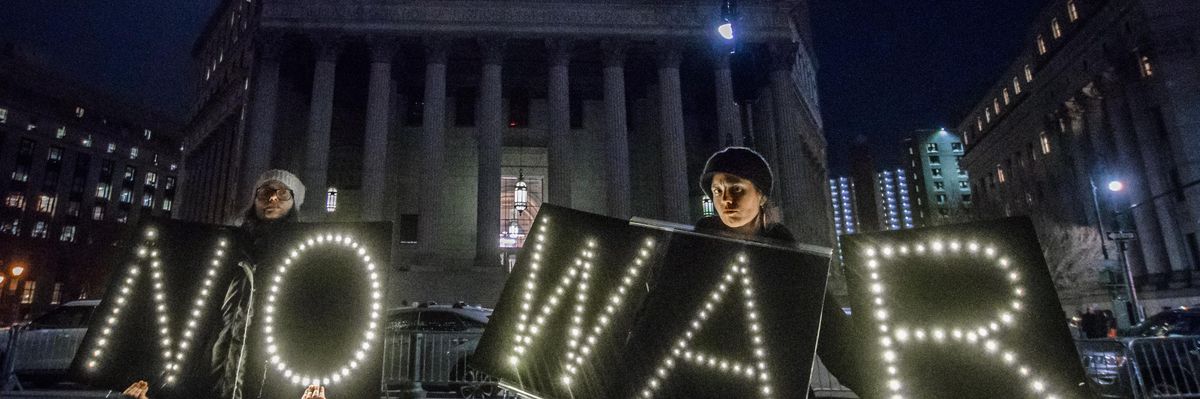
Hundreds of anti-war activists joined Iranian-Americans, Muslims, and communities of color in a rally at Foley Square to send a clear message: New York stand against endless wars, going to war with Iran and sanctions; demanding de-escalation and peace. (Photo by Erik McGregor/LightRocket via Getty Images)
During the past 60 years, the United States has suffered a series of failed wars in Indochina, Central America, the Middle East, and Afghanistan. Each of these wars produced mayhem and suffering, followed by an American retreat. While the American right wing has always argued that success needed just one more surge or bombing spree, the truth has been simpler and sadder. Ours have been wars of hatred, not logic, and doomed to fail--at a mind-boggling human and financial cost.
America has never cared to help those we have pretended to "save" by these wars. For that reason alone, America has never had the broad support of local populations that would have been essential for any kind of success in these misguided wars.
For the past 60 years, the United States has waged war after war for America's narrow interests alone, and has created havoc, destruction, and death in its wake.
Americans didn't want to save the Vietnamese, Cambodians, and Laotians, who were despised in US popular culture; America wanted to stop communism and the supposed "falling dominoes" across Southeast Asia. America didn't want to save Salvadorans, Nicaraguans, and others in poverty-stricken Central America; it wanted to stop leftist radicals who threatened American investments in the region. America didn't want to save the Iraqis, Libyans, and Syrians; it wanted to topple regimes and replace them with US-backed regimes.
And America cared not a whit about Afghanistan, a point confirmed repeatedly by President Biden in recent days. Biden has noted, approvingly, that the United States went to Afghanistan for one reason and one reason only: to get Osama bin Laden and Al Qaeda after 9/11, not to help the people of Afghanistan.
Tellingly, Biden has not been truthful about the real origin of US intervention in Afghanistan, following a pattern set by his predecessors. America's intervention in Afghanistan goes back to 1979, more than 20 years before 9/11, when the CIA secretly trained, armed, and funded Islamic jihadists in Afghanistan to fight the Soviet Union. The US-created fighting force morphed into Al Qaeda and the Taliban, but no president, including Biden, has honestly explained the basic facts to the American people.
America's right-wing culture has often been hostile toward the non-European world--the "shithole countries" in Donald Trump's disgusting yet telling phrase. For the past 60 years, the United States has waged war after war for America's narrow interests alone, and has created havoc, destruction, and death in its wake.
I have worked for decades in countries that all too many Americans find contemptible due to their poverty, religion, skin color, desire to migrate from hunger and violence, and insolence for trying to claim control over their own oil, uranium, and other minerals that America craves. Begrudging development assistance to these countries is a congressional pastime. People in those countries know all too well about American power, and its destructive potential. They try their best to stay out of harm's way.
In pulling the United States out of Afghanistan, Biden showed scant sympathy for the Afghan people. He mocked the idea of "nation-building," an American phrase of scorn that seems to mean being naive enough to try to help another country. Is it any surprise that the regime in Afghanistan propped up by American power crumbled so rapidly just as America departed?
Lest any American mistakenly think that much of the roughly $1 trillion the US spent in Afghanistan for war and reconstruction went towards nation-building, it did not. Perhaps 2 percent of the total US spending went for purposes such as health, education, and civilian infrastructure. Almost all the money went for military and security purposes--troops, armaments, Afghan security forces, and the like. After 20 years, we left behind a country where 38 percent of the children are stunted due to chronic undernutrition.
In explaining America's exit, Biden played the typical American foreign policy tune, that the world is very dangerous place filled with foes of America. The job of the president, Biden emphasized, is to protect America from those enemies, just no longer in Afghanistan. Here is how Biden summarized the global scene:
"This is a new world. The terror threat has metastasized across the world, well beyond Afghanistan. We face threats from Al Shabab in Somalia; Al Qaeda affiliates in Syria in and the Arabian Peninsula; and ISIS attempting to create a caliphate in Syria and Iraq, and establishing affiliates across Africa and Asia ... And here's a critical thing to understand: The world is changing. We're engaged in a serious competition with China. We're dealing with the challenges on multiple fronts with Russia. We're confronted with cyberattacks and nuclear proliferation. We have to shore up America's competitive[ness] to meet these new challenges in the competition for the 21st century."
Here is what he should have said instead: All countries--including the United States, members of the European Union, Russia, China, Iran, and, yes, Afghanistan--are destabilized by the COVID-19 pandemic; the effects of the climate crisis (floods, droughts, hurricanes, forest fires, heatwaves); widening income inequality further dividing the haves and have nots; the upheavals of digital technologies; and the dangerous political influence of plutocrats. All of these are shared problems across the globe, and all require intensive global cooperation rather than confrontation.
Biden was right to pull out of Afghanistan, yet wrong on the larger picture.
America's mortal enemies are not China, Iran, and Russia. Our real enemies are the common scourges facing humanity today. Global problems cannot be solved by individual nations alone.
It is uncertain whether America will change its relentless aggressive foreign policy for our own good, and the world's. Our nation has been at war for centuries. Our repeated failures have led the political right to double down, calling with increasing fervor for more weapons, and further escalation with China, Iran, Russia, and other alleged foes. Yes, we have pulled out of Afghanistan--42 years too late--and that is good. But will the United States adopt a new foreign policy based on peace and problem-solving? That's the real question.
Dear Common Dreams reader, It’s been nearly 30 years since I co-founded Common Dreams with my late wife, Lina Newhouser. We had the radical notion that journalism should serve the public good, not corporate profits. It was clear to us from the outset what it would take to build such a project. No paid advertisements. No corporate sponsors. No millionaire publisher telling us what to think or do. Many people said we wouldn't last a year, but we proved those doubters wrong. Together with a tremendous team of journalists and dedicated staff, we built an independent media outlet free from the constraints of profits and corporate control. Our mission has always been simple: To inform. To inspire. To ignite change for the common good. Building Common Dreams was not easy. Our survival was never guaranteed. When you take on the most powerful forces—Wall Street greed, fossil fuel industry destruction, Big Tech lobbyists, and uber-rich oligarchs who have spent billions upon billions rigging the economy and democracy in their favor—the only bulwark you have is supporters who believe in your work. But here’s the urgent message from me today. It's never been this bad out there. And it's never been this hard to keep us going. At the very moment Common Dreams is most needed, the threats we face are intensifying. We need your support now more than ever. We don't accept corporate advertising and never will. We don't have a paywall because we don't think people should be blocked from critical news based on their ability to pay. Everything we do is funded by the donations of readers like you. When everyone does the little they can afford, we are strong. But if that support retreats or dries up, so do we. Will you donate now to make sure Common Dreams not only survives but thrives? —Craig Brown, Co-founder |
During the past 60 years, the United States has suffered a series of failed wars in Indochina, Central America, the Middle East, and Afghanistan. Each of these wars produced mayhem and suffering, followed by an American retreat. While the American right wing has always argued that success needed just one more surge or bombing spree, the truth has been simpler and sadder. Ours have been wars of hatred, not logic, and doomed to fail--at a mind-boggling human and financial cost.
America has never cared to help those we have pretended to "save" by these wars. For that reason alone, America has never had the broad support of local populations that would have been essential for any kind of success in these misguided wars.
For the past 60 years, the United States has waged war after war for America's narrow interests alone, and has created havoc, destruction, and death in its wake.
Americans didn't want to save the Vietnamese, Cambodians, and Laotians, who were despised in US popular culture; America wanted to stop communism and the supposed "falling dominoes" across Southeast Asia. America didn't want to save Salvadorans, Nicaraguans, and others in poverty-stricken Central America; it wanted to stop leftist radicals who threatened American investments in the region. America didn't want to save the Iraqis, Libyans, and Syrians; it wanted to topple regimes and replace them with US-backed regimes.
And America cared not a whit about Afghanistan, a point confirmed repeatedly by President Biden in recent days. Biden has noted, approvingly, that the United States went to Afghanistan for one reason and one reason only: to get Osama bin Laden and Al Qaeda after 9/11, not to help the people of Afghanistan.
Tellingly, Biden has not been truthful about the real origin of US intervention in Afghanistan, following a pattern set by his predecessors. America's intervention in Afghanistan goes back to 1979, more than 20 years before 9/11, when the CIA secretly trained, armed, and funded Islamic jihadists in Afghanistan to fight the Soviet Union. The US-created fighting force morphed into Al Qaeda and the Taliban, but no president, including Biden, has honestly explained the basic facts to the American people.
America's right-wing culture has often been hostile toward the non-European world--the "shithole countries" in Donald Trump's disgusting yet telling phrase. For the past 60 years, the United States has waged war after war for America's narrow interests alone, and has created havoc, destruction, and death in its wake.
I have worked for decades in countries that all too many Americans find contemptible due to their poverty, religion, skin color, desire to migrate from hunger and violence, and insolence for trying to claim control over their own oil, uranium, and other minerals that America craves. Begrudging development assistance to these countries is a congressional pastime. People in those countries know all too well about American power, and its destructive potential. They try their best to stay out of harm's way.
In pulling the United States out of Afghanistan, Biden showed scant sympathy for the Afghan people. He mocked the idea of "nation-building," an American phrase of scorn that seems to mean being naive enough to try to help another country. Is it any surprise that the regime in Afghanistan propped up by American power crumbled so rapidly just as America departed?
Lest any American mistakenly think that much of the roughly $1 trillion the US spent in Afghanistan for war and reconstruction went towards nation-building, it did not. Perhaps 2 percent of the total US spending went for purposes such as health, education, and civilian infrastructure. Almost all the money went for military and security purposes--troops, armaments, Afghan security forces, and the like. After 20 years, we left behind a country where 38 percent of the children are stunted due to chronic undernutrition.
In explaining America's exit, Biden played the typical American foreign policy tune, that the world is very dangerous place filled with foes of America. The job of the president, Biden emphasized, is to protect America from those enemies, just no longer in Afghanistan. Here is how Biden summarized the global scene:
"This is a new world. The terror threat has metastasized across the world, well beyond Afghanistan. We face threats from Al Shabab in Somalia; Al Qaeda affiliates in Syria in and the Arabian Peninsula; and ISIS attempting to create a caliphate in Syria and Iraq, and establishing affiliates across Africa and Asia ... And here's a critical thing to understand: The world is changing. We're engaged in a serious competition with China. We're dealing with the challenges on multiple fronts with Russia. We're confronted with cyberattacks and nuclear proliferation. We have to shore up America's competitive[ness] to meet these new challenges in the competition for the 21st century."
Here is what he should have said instead: All countries--including the United States, members of the European Union, Russia, China, Iran, and, yes, Afghanistan--are destabilized by the COVID-19 pandemic; the effects of the climate crisis (floods, droughts, hurricanes, forest fires, heatwaves); widening income inequality further dividing the haves and have nots; the upheavals of digital technologies; and the dangerous political influence of plutocrats. All of these are shared problems across the globe, and all require intensive global cooperation rather than confrontation.
Biden was right to pull out of Afghanistan, yet wrong on the larger picture.
America's mortal enemies are not China, Iran, and Russia. Our real enemies are the common scourges facing humanity today. Global problems cannot be solved by individual nations alone.
It is uncertain whether America will change its relentless aggressive foreign policy for our own good, and the world's. Our nation has been at war for centuries. Our repeated failures have led the political right to double down, calling with increasing fervor for more weapons, and further escalation with China, Iran, Russia, and other alleged foes. Yes, we have pulled out of Afghanistan--42 years too late--and that is good. But will the United States adopt a new foreign policy based on peace and problem-solving? That's the real question.
During the past 60 years, the United States has suffered a series of failed wars in Indochina, Central America, the Middle East, and Afghanistan. Each of these wars produced mayhem and suffering, followed by an American retreat. While the American right wing has always argued that success needed just one more surge or bombing spree, the truth has been simpler and sadder. Ours have been wars of hatred, not logic, and doomed to fail--at a mind-boggling human and financial cost.
America has never cared to help those we have pretended to "save" by these wars. For that reason alone, America has never had the broad support of local populations that would have been essential for any kind of success in these misguided wars.
For the past 60 years, the United States has waged war after war for America's narrow interests alone, and has created havoc, destruction, and death in its wake.
Americans didn't want to save the Vietnamese, Cambodians, and Laotians, who were despised in US popular culture; America wanted to stop communism and the supposed "falling dominoes" across Southeast Asia. America didn't want to save Salvadorans, Nicaraguans, and others in poverty-stricken Central America; it wanted to stop leftist radicals who threatened American investments in the region. America didn't want to save the Iraqis, Libyans, and Syrians; it wanted to topple regimes and replace them with US-backed regimes.
And America cared not a whit about Afghanistan, a point confirmed repeatedly by President Biden in recent days. Biden has noted, approvingly, that the United States went to Afghanistan for one reason and one reason only: to get Osama bin Laden and Al Qaeda after 9/11, not to help the people of Afghanistan.
Tellingly, Biden has not been truthful about the real origin of US intervention in Afghanistan, following a pattern set by his predecessors. America's intervention in Afghanistan goes back to 1979, more than 20 years before 9/11, when the CIA secretly trained, armed, and funded Islamic jihadists in Afghanistan to fight the Soviet Union. The US-created fighting force morphed into Al Qaeda and the Taliban, but no president, including Biden, has honestly explained the basic facts to the American people.
America's right-wing culture has often been hostile toward the non-European world--the "shithole countries" in Donald Trump's disgusting yet telling phrase. For the past 60 years, the United States has waged war after war for America's narrow interests alone, and has created havoc, destruction, and death in its wake.
I have worked for decades in countries that all too many Americans find contemptible due to their poverty, religion, skin color, desire to migrate from hunger and violence, and insolence for trying to claim control over their own oil, uranium, and other minerals that America craves. Begrudging development assistance to these countries is a congressional pastime. People in those countries know all too well about American power, and its destructive potential. They try their best to stay out of harm's way.
In pulling the United States out of Afghanistan, Biden showed scant sympathy for the Afghan people. He mocked the idea of "nation-building," an American phrase of scorn that seems to mean being naive enough to try to help another country. Is it any surprise that the regime in Afghanistan propped up by American power crumbled so rapidly just as America departed?
Lest any American mistakenly think that much of the roughly $1 trillion the US spent in Afghanistan for war and reconstruction went towards nation-building, it did not. Perhaps 2 percent of the total US spending went for purposes such as health, education, and civilian infrastructure. Almost all the money went for military and security purposes--troops, armaments, Afghan security forces, and the like. After 20 years, we left behind a country where 38 percent of the children are stunted due to chronic undernutrition.
In explaining America's exit, Biden played the typical American foreign policy tune, that the world is very dangerous place filled with foes of America. The job of the president, Biden emphasized, is to protect America from those enemies, just no longer in Afghanistan. Here is how Biden summarized the global scene:
"This is a new world. The terror threat has metastasized across the world, well beyond Afghanistan. We face threats from Al Shabab in Somalia; Al Qaeda affiliates in Syria in and the Arabian Peninsula; and ISIS attempting to create a caliphate in Syria and Iraq, and establishing affiliates across Africa and Asia ... And here's a critical thing to understand: The world is changing. We're engaged in a serious competition with China. We're dealing with the challenges on multiple fronts with Russia. We're confronted with cyberattacks and nuclear proliferation. We have to shore up America's competitive[ness] to meet these new challenges in the competition for the 21st century."
Here is what he should have said instead: All countries--including the United States, members of the European Union, Russia, China, Iran, and, yes, Afghanistan--are destabilized by the COVID-19 pandemic; the effects of the climate crisis (floods, droughts, hurricanes, forest fires, heatwaves); widening income inequality further dividing the haves and have nots; the upheavals of digital technologies; and the dangerous political influence of plutocrats. All of these are shared problems across the globe, and all require intensive global cooperation rather than confrontation.
Biden was right to pull out of Afghanistan, yet wrong on the larger picture.
America's mortal enemies are not China, Iran, and Russia. Our real enemies are the common scourges facing humanity today. Global problems cannot be solved by individual nations alone.
It is uncertain whether America will change its relentless aggressive foreign policy for our own good, and the world's. Our nation has been at war for centuries. Our repeated failures have led the political right to double down, calling with increasing fervor for more weapons, and further escalation with China, Iran, Russia, and other alleged foes. Yes, we have pulled out of Afghanistan--42 years too late--and that is good. But will the United States adopt a new foreign policy based on peace and problem-solving? That's the real question.