

SUBSCRIBE TO OUR FREE NEWSLETTER
Daily news & progressive opinion—funded by the people, not the corporations—delivered straight to your inbox.
5
#000000
#FFFFFF
To donate by check, phone, or other method, see our More Ways to Give page.
Daily news & progressive opinion—funded by the people, not the corporations—delivered straight to your inbox.
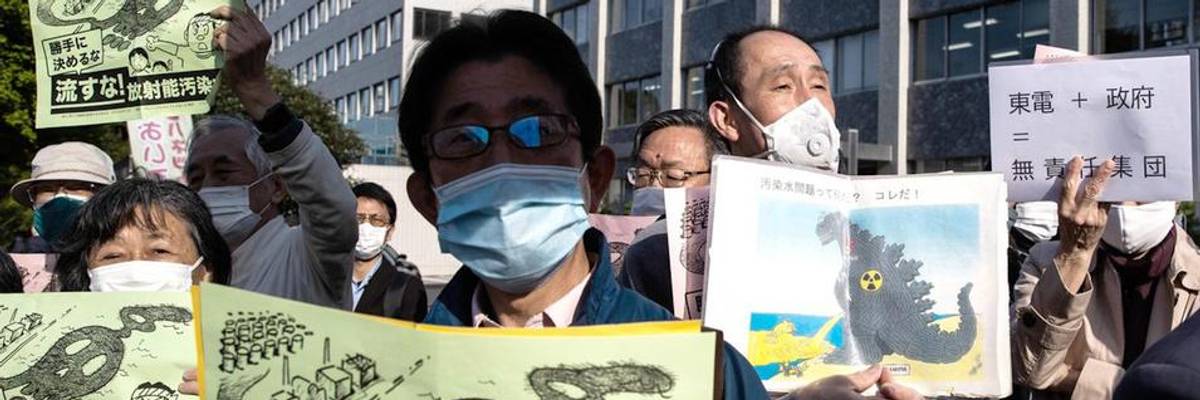
Anti-nuclear demonstrators protest outside the home of Japanese Prime Minister Suga Yoshihide on April 12, 2021 ahead of the government's announced decision to dump 1.25 million tonnes of radioactive wastewater from the damaged Fukushima Daiichi nuclear power plant into the Pacific Ocean. (Photo: Takashi Aoyama/Getty Images)
Then
In 2011 the Great East Japan Earthquake and ensuing tsunami devastated northeast Japan, taking the lives of more than 18,000 people and triggering one of the worst industrial accidents in history: the crippling breakdown of the Fukushima Dai'ichi nuclear power plant. Three of the plant's six reactors suffered perilous nuclear core meltdowns and hydrogen gas explosions, releasing radionuclides into the air, water and soil. More than 160,000 people were evacuated-nuclear power refugees, many of whom have lost trust in their government's pronouncements about "safe to return."
Five Years Later
Considered the most complex industrial cleanup, not even robots were able to enter the main radioactive fuel-debris areas by 2016. The regional farming and the fishing industries suffered collapse and financial ruin. Permissible levels of radiation for children were raised in a callous move to keep schools open. Debates over canceling the 2020 Tokyo Olympics ensued because of the geographic spread of radioactive pollution-an issue all but forgotten as more recent debates rose over canceling the subsequent 2021 Olympics because of Covid-19 and Japan's low vaccination rate.
Three hundred tons per day of groundwater containing large amounts of radioactive material, including cesium, strontium, iodine, and other substances, poured into the Pacific Ocean from 2010 until the Tokyo Electric Power Company (TEPCO), the plant's owner, decreased it to one-tenth that volume by 2015. On site over 1,000 mammoth storage tanks hold wastewater treated by a filter process TEPCO devised to remove more than 60 radioactive chemicals to so-called safe internationally regulated levels. Only the treatment has left 70% of the filtered wastewater still contaminated above regulatory levels. Nor can it remove tritium, a radioactive form of hydrogen.
In September 2015, ocean surges from Typhoon Etau overwhelmed the site's drainage pumps; hundreds of tons of radioactive water leaked from the reactors site and ultimately into the ocean. What, then, of more severe typhoons, undersea earthquakes, and the reality of sea level rise for the oceanside plant? How will an onsite drainage system survive natural disasters worsened by climate change if they failed in 2015?
Now
On April 13, 2021, the Japanese government announced that TEPCO has the government's permission to release 1.38 million US tons of its filtered radioactive wastewater into the Pacific Ocean, beginning in 2023. The company states that its storage capacity will run out in two years, a claim that critics dispute. Critics also deem the treatment filtration system that TEPCO invented, the Advanced Liquid Processing System (ALPS), subpar and not capable of thorough removal of radioactive waste.
Ultimately, the discharge will rely on dilution with ocean water as the solution to radioactive pollution-in denial of the food chain phenomenon in which plankton absorb the released radioactive elements in sea water, fish eat the plankton, bigger fish eat smaller fish, and humans and marine animals eat both big and small fish.
One week after Japan's announcement on April 13 of this year, fish caught off Fukushima waters were found to contain high levels of radioactive cesium many times above permissible levels. Referring to the announcement, Takeshi Komatsu, an oyster farmer in Miyagi prefecture, north of Tokyo responded despondently about the permission for TEPCO to discharge radioactive wastewater in two years: "The (Japanese) government's decision is outrageous, I feel more helpless than angry when I think that all the efforts I've made to rebuild my life over the past decade have come to nothing," as reported by the China Daily Global.
Nearby countries that share the seas and ocean with Japan are irate and extremely critical of Japan's decision, with some planning international legal action. Professor Choi SK Kunsan of South Korea National University warned, "Through the sea's currents, it can affect fishes near the Korean Peninsula, East Asia, and even the entire world..." Japan retorts that they plan to re-filter and dilute the water before releasing it, until the contaminated water is "safe to drink." If that is the case, "Then please drink it," countered Chinese Foreign Ministry spokesman Zhoa Lijian at a news briefing. "The ocean is not Japan's trash can."
An observer of this verbal chess match pointed out, with some irony, that Japan has about 100,000 dams for flood control, water supply, crop irrigation and hydroelectric power with more than enough capacity to dilute TEPCO's oversupply of radioactive wastewater to drinking water acceptability by Japan's standard. Re-filter the contaminated wastewater using ALPS and dilute it in the mammoth dams until it is "safe enough" to drink, he proposes. Then use it for the country's drinking water supply and crop irrigation. Problem solved. No angry neighbors.
With the back and forth about "permissible" levels of exposure in drinking water, the ocean and so on, let us keep this fact in mind. Decades of research have shown that there is no safe level of radiation, according to the National Academy of Sciences. Any exposure to radiation increases an individual's risk of developing cancer.
The two major supporters for Japan's decision to contaminate the Pacific Ocean with its oversupply of radioactive wastewater are the International Atomic Energy Agency (IAEA) and the United States. The IAEA's mission is "to promote the safe, secure and peaceful use of nuclear technologies," in other words, to sustain the illusion-despite Three Mile Island, Chernobyl, Fukushima and concern about Iran-that nuclear power can be safe and secure and its waste never at risk of being processed for nuclear weapons. The United States, the largest owner of nuclear power plants, promotes nuclear power as "safe and clean energy," a wolf in sheep's clothing.
Dear Common Dreams reader, It’s been nearly 30 years since I co-founded Common Dreams with my late wife, Lina Newhouser. We had the radical notion that journalism should serve the public good, not corporate profits. It was clear to us from the outset what it would take to build such a project. No paid advertisements. No corporate sponsors. No millionaire publisher telling us what to think or do. Many people said we wouldn't last a year, but we proved those doubters wrong. Together with a tremendous team of journalists and dedicated staff, we built an independent media outlet free from the constraints of profits and corporate control. Our mission has always been simple: To inform. To inspire. To ignite change for the common good. Building Common Dreams was not easy. Our survival was never guaranteed. When you take on the most powerful forces—Wall Street greed, fossil fuel industry destruction, Big Tech lobbyists, and uber-rich oligarchs who have spent billions upon billions rigging the economy and democracy in their favor—the only bulwark you have is supporters who believe in your work. But here’s the urgent message from me today. It's never been this bad out there. And it's never been this hard to keep us going. At the very moment Common Dreams is most needed, the threats we face are intensifying. We need your support now more than ever. We don't accept corporate advertising and never will. We don't have a paywall because we don't think people should be blocked from critical news based on their ability to pay. Everything we do is funded by the donations of readers like you. When everyone does the little they can afford, we are strong. But if that support retreats or dries up, so do we. Will you donate now to make sure Common Dreams not only survives but thrives? —Craig Brown, Co-founder |
Then
In 2011 the Great East Japan Earthquake and ensuing tsunami devastated northeast Japan, taking the lives of more than 18,000 people and triggering one of the worst industrial accidents in history: the crippling breakdown of the Fukushima Dai'ichi nuclear power plant. Three of the plant's six reactors suffered perilous nuclear core meltdowns and hydrogen gas explosions, releasing radionuclides into the air, water and soil. More than 160,000 people were evacuated-nuclear power refugees, many of whom have lost trust in their government's pronouncements about "safe to return."
Five Years Later
Considered the most complex industrial cleanup, not even robots were able to enter the main radioactive fuel-debris areas by 2016. The regional farming and the fishing industries suffered collapse and financial ruin. Permissible levels of radiation for children were raised in a callous move to keep schools open. Debates over canceling the 2020 Tokyo Olympics ensued because of the geographic spread of radioactive pollution-an issue all but forgotten as more recent debates rose over canceling the subsequent 2021 Olympics because of Covid-19 and Japan's low vaccination rate.
Three hundred tons per day of groundwater containing large amounts of radioactive material, including cesium, strontium, iodine, and other substances, poured into the Pacific Ocean from 2010 until the Tokyo Electric Power Company (TEPCO), the plant's owner, decreased it to one-tenth that volume by 2015. On site over 1,000 mammoth storage tanks hold wastewater treated by a filter process TEPCO devised to remove more than 60 radioactive chemicals to so-called safe internationally regulated levels. Only the treatment has left 70% of the filtered wastewater still contaminated above regulatory levels. Nor can it remove tritium, a radioactive form of hydrogen.
In September 2015, ocean surges from Typhoon Etau overwhelmed the site's drainage pumps; hundreds of tons of radioactive water leaked from the reactors site and ultimately into the ocean. What, then, of more severe typhoons, undersea earthquakes, and the reality of sea level rise for the oceanside plant? How will an onsite drainage system survive natural disasters worsened by climate change if they failed in 2015?
Now
On April 13, 2021, the Japanese government announced that TEPCO has the government's permission to release 1.38 million US tons of its filtered radioactive wastewater into the Pacific Ocean, beginning in 2023. The company states that its storage capacity will run out in two years, a claim that critics dispute. Critics also deem the treatment filtration system that TEPCO invented, the Advanced Liquid Processing System (ALPS), subpar and not capable of thorough removal of radioactive waste.
Ultimately, the discharge will rely on dilution with ocean water as the solution to radioactive pollution-in denial of the food chain phenomenon in which plankton absorb the released radioactive elements in sea water, fish eat the plankton, bigger fish eat smaller fish, and humans and marine animals eat both big and small fish.
One week after Japan's announcement on April 13 of this year, fish caught off Fukushima waters were found to contain high levels of radioactive cesium many times above permissible levels. Referring to the announcement, Takeshi Komatsu, an oyster farmer in Miyagi prefecture, north of Tokyo responded despondently about the permission for TEPCO to discharge radioactive wastewater in two years: "The (Japanese) government's decision is outrageous, I feel more helpless than angry when I think that all the efforts I've made to rebuild my life over the past decade have come to nothing," as reported by the China Daily Global.
Nearby countries that share the seas and ocean with Japan are irate and extremely critical of Japan's decision, with some planning international legal action. Professor Choi SK Kunsan of South Korea National University warned, "Through the sea's currents, it can affect fishes near the Korean Peninsula, East Asia, and even the entire world..." Japan retorts that they plan to re-filter and dilute the water before releasing it, until the contaminated water is "safe to drink." If that is the case, "Then please drink it," countered Chinese Foreign Ministry spokesman Zhoa Lijian at a news briefing. "The ocean is not Japan's trash can."
An observer of this verbal chess match pointed out, with some irony, that Japan has about 100,000 dams for flood control, water supply, crop irrigation and hydroelectric power with more than enough capacity to dilute TEPCO's oversupply of radioactive wastewater to drinking water acceptability by Japan's standard. Re-filter the contaminated wastewater using ALPS and dilute it in the mammoth dams until it is "safe enough" to drink, he proposes. Then use it for the country's drinking water supply and crop irrigation. Problem solved. No angry neighbors.
With the back and forth about "permissible" levels of exposure in drinking water, the ocean and so on, let us keep this fact in mind. Decades of research have shown that there is no safe level of radiation, according to the National Academy of Sciences. Any exposure to radiation increases an individual's risk of developing cancer.
The two major supporters for Japan's decision to contaminate the Pacific Ocean with its oversupply of radioactive wastewater are the International Atomic Energy Agency (IAEA) and the United States. The IAEA's mission is "to promote the safe, secure and peaceful use of nuclear technologies," in other words, to sustain the illusion-despite Three Mile Island, Chernobyl, Fukushima and concern about Iran-that nuclear power can be safe and secure and its waste never at risk of being processed for nuclear weapons. The United States, the largest owner of nuclear power plants, promotes nuclear power as "safe and clean energy," a wolf in sheep's clothing.
Then
In 2011 the Great East Japan Earthquake and ensuing tsunami devastated northeast Japan, taking the lives of more than 18,000 people and triggering one of the worst industrial accidents in history: the crippling breakdown of the Fukushima Dai'ichi nuclear power plant. Three of the plant's six reactors suffered perilous nuclear core meltdowns and hydrogen gas explosions, releasing radionuclides into the air, water and soil. More than 160,000 people were evacuated-nuclear power refugees, many of whom have lost trust in their government's pronouncements about "safe to return."
Five Years Later
Considered the most complex industrial cleanup, not even robots were able to enter the main radioactive fuel-debris areas by 2016. The regional farming and the fishing industries suffered collapse and financial ruin. Permissible levels of radiation for children were raised in a callous move to keep schools open. Debates over canceling the 2020 Tokyo Olympics ensued because of the geographic spread of radioactive pollution-an issue all but forgotten as more recent debates rose over canceling the subsequent 2021 Olympics because of Covid-19 and Japan's low vaccination rate.
Three hundred tons per day of groundwater containing large amounts of radioactive material, including cesium, strontium, iodine, and other substances, poured into the Pacific Ocean from 2010 until the Tokyo Electric Power Company (TEPCO), the plant's owner, decreased it to one-tenth that volume by 2015. On site over 1,000 mammoth storage tanks hold wastewater treated by a filter process TEPCO devised to remove more than 60 radioactive chemicals to so-called safe internationally regulated levels. Only the treatment has left 70% of the filtered wastewater still contaminated above regulatory levels. Nor can it remove tritium, a radioactive form of hydrogen.
In September 2015, ocean surges from Typhoon Etau overwhelmed the site's drainage pumps; hundreds of tons of radioactive water leaked from the reactors site and ultimately into the ocean. What, then, of more severe typhoons, undersea earthquakes, and the reality of sea level rise for the oceanside plant? How will an onsite drainage system survive natural disasters worsened by climate change if they failed in 2015?
Now
On April 13, 2021, the Japanese government announced that TEPCO has the government's permission to release 1.38 million US tons of its filtered radioactive wastewater into the Pacific Ocean, beginning in 2023. The company states that its storage capacity will run out in two years, a claim that critics dispute. Critics also deem the treatment filtration system that TEPCO invented, the Advanced Liquid Processing System (ALPS), subpar and not capable of thorough removal of radioactive waste.
Ultimately, the discharge will rely on dilution with ocean water as the solution to radioactive pollution-in denial of the food chain phenomenon in which plankton absorb the released radioactive elements in sea water, fish eat the plankton, bigger fish eat smaller fish, and humans and marine animals eat both big and small fish.
One week after Japan's announcement on April 13 of this year, fish caught off Fukushima waters were found to contain high levels of radioactive cesium many times above permissible levels. Referring to the announcement, Takeshi Komatsu, an oyster farmer in Miyagi prefecture, north of Tokyo responded despondently about the permission for TEPCO to discharge radioactive wastewater in two years: "The (Japanese) government's decision is outrageous, I feel more helpless than angry when I think that all the efforts I've made to rebuild my life over the past decade have come to nothing," as reported by the China Daily Global.
Nearby countries that share the seas and ocean with Japan are irate and extremely critical of Japan's decision, with some planning international legal action. Professor Choi SK Kunsan of South Korea National University warned, "Through the sea's currents, it can affect fishes near the Korean Peninsula, East Asia, and even the entire world..." Japan retorts that they plan to re-filter and dilute the water before releasing it, until the contaminated water is "safe to drink." If that is the case, "Then please drink it," countered Chinese Foreign Ministry spokesman Zhoa Lijian at a news briefing. "The ocean is not Japan's trash can."
An observer of this verbal chess match pointed out, with some irony, that Japan has about 100,000 dams for flood control, water supply, crop irrigation and hydroelectric power with more than enough capacity to dilute TEPCO's oversupply of radioactive wastewater to drinking water acceptability by Japan's standard. Re-filter the contaminated wastewater using ALPS and dilute it in the mammoth dams until it is "safe enough" to drink, he proposes. Then use it for the country's drinking water supply and crop irrigation. Problem solved. No angry neighbors.
With the back and forth about "permissible" levels of exposure in drinking water, the ocean and so on, let us keep this fact in mind. Decades of research have shown that there is no safe level of radiation, according to the National Academy of Sciences. Any exposure to radiation increases an individual's risk of developing cancer.
The two major supporters for Japan's decision to contaminate the Pacific Ocean with its oversupply of radioactive wastewater are the International Atomic Energy Agency (IAEA) and the United States. The IAEA's mission is "to promote the safe, secure and peaceful use of nuclear technologies," in other words, to sustain the illusion-despite Three Mile Island, Chernobyl, Fukushima and concern about Iran-that nuclear power can be safe and secure and its waste never at risk of being processed for nuclear weapons. The United States, the largest owner of nuclear power plants, promotes nuclear power as "safe and clean energy," a wolf in sheep's clothing.

