SUBSCRIBE TO OUR FREE NEWSLETTER
Daily news & progressive opinion—funded by the people, not the corporations—delivered straight to your inbox.
5
#000000
#FFFFFF
To donate by check, phone, or other method, see our More Ways to Give page.
Daily news & progressive opinion—funded by the people, not the corporations—delivered straight to your inbox.
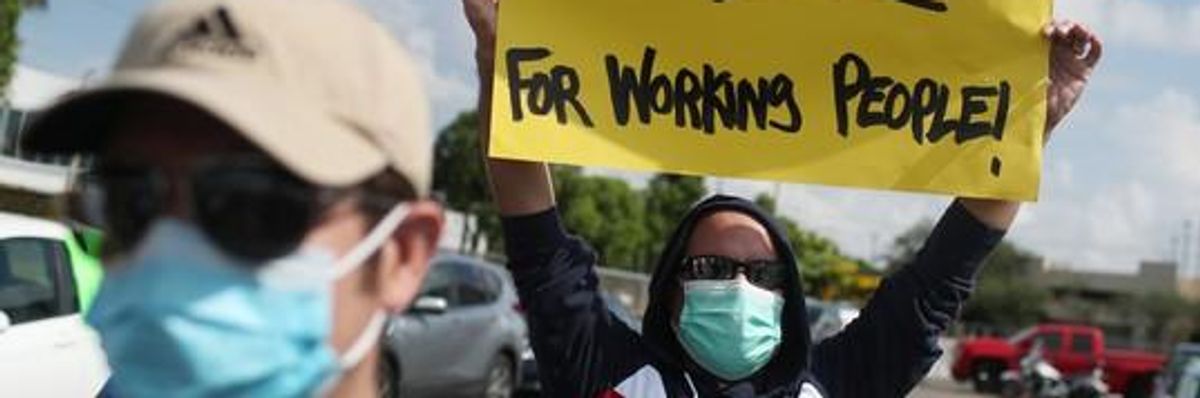
Carlos Ponce joins other demonstrators at a protest demanding an extension of unemployment benefits on July 16, 2020 in Miami Springs, Florida. (Photo: Joe Raedle/Getty Images)
Ending enhanced unemployment benefits has become the signature economic agenda for the GOP, a party with little else to promote. Unfortunately the largely low- key response of the President on this issue has been disappointing. The failure to mount a vigorous defense of these benefits is bad ethics, bad policy, and bad politics. As for ethics, let us assume for the minute that some workers lie around idle at home while enjoying the extra $300 from the government. Should economic leaders cut off any additional assistance to all workers who currently cannot find any job at all, in order to incentivize the return to the workplace of the few who could?
As the Economic Policy Institute's David Cooper pointed out:
"Nearly all the states cutting UI still have significantly fewer jobs than before the pandemic. Those that are still relying on these programs are likely those that need them most--the people having the hardest time finding suitable work or facing significant constraints on their ability to resume working due to care responsibilities, health concerns, or other factors," Cooper noted. "Cutting off adequate supports to these workers to try to force them to take whatever job might be available--even if it is low-paying, high-risk, not suited to their skills, or incompatible with their responsibilities at home--is cruel and not in the long-term best interest of any state's workers or businesses."
This reduction in federal assistance at a time when full recovery is far from certain carries the macro economic risk of stalling recovery and initiating another round of secular stagnation. And who would be blamed? From this point on Joe Biden and the tenuous Democratic majority probably owns the economy. And once the 300 dollar enhanced UI becomes a Blue state benefit it opens up new ways to divide the working class electorate. Democrats, and Biden especially, need to preempt this strategy.
Some workers have had to choose between their safety and their wallets. This choice, however, reflects on the power dynamics of the US workplace and the breadth and depth of the safety net. Business interests maintain their goal is merely to fill the slots with qualified candidates, but in fact they aim to fashion a cadre of workers who will accept, even actively seek, any job, no matter how demeaning or dangerous.
Employers will be the judge as to the risks workers must accept. OSHA -several months late- issued its new Covid 19 workplace safety guidelines. These are binding only for healthcare workers. For other workplaces they are only voluntary. There are many reasons for concern regarding workplace practices of businesses unregulated by government and/or strong rank and file labor union presence. In other words most US businesses.
How this works out in practice has been illustrated in a recent California case. Labor Notes staff writer Marc Norton cites the case of a poultry processing plant fined $181,000 for failing to protect 8 workers from Covid 19. Massive as the fine seemed to corporate media, a reflection of their naivete regarding corporate America,
"Foster Farms is paying a fine of about $22,700 per body. If more than eight workers died, those lives are costing Foster Farms even less per body. Is that all that a worker's life is worth in California?"
In fact the real gain to Foster Farms is probably at least an order of magnitude greater. It is likely that these rules are violated in many places, thereby yielding substantial profits and rendering the fine a minor cost of doing business. Marc Norton puts it:
"But for most of the corporate media [the many Covid ] deaths are just background noise now, an inconvenient fact that the media wants us to forget, so as not to distract us from the reopening and from getting our profit-driven economy back on track. Nothing much to scream home about--unless of course one of those deaths is in your home"
Are policies that force employees back into such workplaces the best way to fill vacant slots and get the economy moving again? Safety is not the enemy of efficiency. Greater worker input into the design of the productive process advances safety. And efficiency. Corporate control of the workplace stands in the way of both.
Whether it is safe to reopen schools, restaurants, gyms, and bars is a function not merely of the level and trends of Covid but also of the institutions and practices that protect workers and consumers.
Dear Common Dreams reader, It’s been nearly 30 years since I co-founded Common Dreams with my late wife, Lina Newhouser. We had the radical notion that journalism should serve the public good, not corporate profits. It was clear to us from the outset what it would take to build such a project. No paid advertisements. No corporate sponsors. No millionaire publisher telling us what to think or do. Many people said we wouldn't last a year, but we proved those doubters wrong. Together with a tremendous team of journalists and dedicated staff, we built an independent media outlet free from the constraints of profits and corporate control. Our mission has always been simple: To inform. To inspire. To ignite change for the common good. Building Common Dreams was not easy. Our survival was never guaranteed. When you take on the most powerful forces—Wall Street greed, fossil fuel industry destruction, Big Tech lobbyists, and uber-rich oligarchs who have spent billions upon billions rigging the economy and democracy in their favor—the only bulwark you have is supporters who believe in your work. But here’s the urgent message from me today. It's never been this bad out there. And it's never been this hard to keep us going. At the very moment Common Dreams is most needed, the threats we face are intensifying. We need your support now more than ever. We don't accept corporate advertising and never will. We don't have a paywall because we don't think people should be blocked from critical news based on their ability to pay. Everything we do is funded by the donations of readers like you. When everyone does the little they can afford, we are strong. But if that support retreats or dries up, so do we. Will you donate now to make sure Common Dreams not only survives but thrives? —Craig Brown, Co-founder |
Ending enhanced unemployment benefits has become the signature economic agenda for the GOP, a party with little else to promote. Unfortunately the largely low- key response of the President on this issue has been disappointing. The failure to mount a vigorous defense of these benefits is bad ethics, bad policy, and bad politics. As for ethics, let us assume for the minute that some workers lie around idle at home while enjoying the extra $300 from the government. Should economic leaders cut off any additional assistance to all workers who currently cannot find any job at all, in order to incentivize the return to the workplace of the few who could?
As the Economic Policy Institute's David Cooper pointed out:
"Nearly all the states cutting UI still have significantly fewer jobs than before the pandemic. Those that are still relying on these programs are likely those that need them most--the people having the hardest time finding suitable work or facing significant constraints on their ability to resume working due to care responsibilities, health concerns, or other factors," Cooper noted. "Cutting off adequate supports to these workers to try to force them to take whatever job might be available--even if it is low-paying, high-risk, not suited to their skills, or incompatible with their responsibilities at home--is cruel and not in the long-term best interest of any state's workers or businesses."
This reduction in federal assistance at a time when full recovery is far from certain carries the macro economic risk of stalling recovery and initiating another round of secular stagnation. And who would be blamed? From this point on Joe Biden and the tenuous Democratic majority probably owns the economy. And once the 300 dollar enhanced UI becomes a Blue state benefit it opens up new ways to divide the working class electorate. Democrats, and Biden especially, need to preempt this strategy.
Some workers have had to choose between their safety and their wallets. This choice, however, reflects on the power dynamics of the US workplace and the breadth and depth of the safety net. Business interests maintain their goal is merely to fill the slots with qualified candidates, but in fact they aim to fashion a cadre of workers who will accept, even actively seek, any job, no matter how demeaning or dangerous.
Employers will be the judge as to the risks workers must accept. OSHA -several months late- issued its new Covid 19 workplace safety guidelines. These are binding only for healthcare workers. For other workplaces they are only voluntary. There are many reasons for concern regarding workplace practices of businesses unregulated by government and/or strong rank and file labor union presence. In other words most US businesses.
How this works out in practice has been illustrated in a recent California case. Labor Notes staff writer Marc Norton cites the case of a poultry processing plant fined $181,000 for failing to protect 8 workers from Covid 19. Massive as the fine seemed to corporate media, a reflection of their naivete regarding corporate America,
"Foster Farms is paying a fine of about $22,700 per body. If more than eight workers died, those lives are costing Foster Farms even less per body. Is that all that a worker's life is worth in California?"
In fact the real gain to Foster Farms is probably at least an order of magnitude greater. It is likely that these rules are violated in many places, thereby yielding substantial profits and rendering the fine a minor cost of doing business. Marc Norton puts it:
"But for most of the corporate media [the many Covid ] deaths are just background noise now, an inconvenient fact that the media wants us to forget, so as not to distract us from the reopening and from getting our profit-driven economy back on track. Nothing much to scream home about--unless of course one of those deaths is in your home"
Are policies that force employees back into such workplaces the best way to fill vacant slots and get the economy moving again? Safety is not the enemy of efficiency. Greater worker input into the design of the productive process advances safety. And efficiency. Corporate control of the workplace stands in the way of both.
Whether it is safe to reopen schools, restaurants, gyms, and bars is a function not merely of the level and trends of Covid but also of the institutions and practices that protect workers and consumers.
Ending enhanced unemployment benefits has become the signature economic agenda for the GOP, a party with little else to promote. Unfortunately the largely low- key response of the President on this issue has been disappointing. The failure to mount a vigorous defense of these benefits is bad ethics, bad policy, and bad politics. As for ethics, let us assume for the minute that some workers lie around idle at home while enjoying the extra $300 from the government. Should economic leaders cut off any additional assistance to all workers who currently cannot find any job at all, in order to incentivize the return to the workplace of the few who could?
As the Economic Policy Institute's David Cooper pointed out:
"Nearly all the states cutting UI still have significantly fewer jobs than before the pandemic. Those that are still relying on these programs are likely those that need them most--the people having the hardest time finding suitable work or facing significant constraints on their ability to resume working due to care responsibilities, health concerns, or other factors," Cooper noted. "Cutting off adequate supports to these workers to try to force them to take whatever job might be available--even if it is low-paying, high-risk, not suited to their skills, or incompatible with their responsibilities at home--is cruel and not in the long-term best interest of any state's workers or businesses."
This reduction in federal assistance at a time when full recovery is far from certain carries the macro economic risk of stalling recovery and initiating another round of secular stagnation. And who would be blamed? From this point on Joe Biden and the tenuous Democratic majority probably owns the economy. And once the 300 dollar enhanced UI becomes a Blue state benefit it opens up new ways to divide the working class electorate. Democrats, and Biden especially, need to preempt this strategy.
Some workers have had to choose between their safety and their wallets. This choice, however, reflects on the power dynamics of the US workplace and the breadth and depth of the safety net. Business interests maintain their goal is merely to fill the slots with qualified candidates, but in fact they aim to fashion a cadre of workers who will accept, even actively seek, any job, no matter how demeaning or dangerous.
Employers will be the judge as to the risks workers must accept. OSHA -several months late- issued its new Covid 19 workplace safety guidelines. These are binding only for healthcare workers. For other workplaces they are only voluntary. There are many reasons for concern regarding workplace practices of businesses unregulated by government and/or strong rank and file labor union presence. In other words most US businesses.
How this works out in practice has been illustrated in a recent California case. Labor Notes staff writer Marc Norton cites the case of a poultry processing plant fined $181,000 for failing to protect 8 workers from Covid 19. Massive as the fine seemed to corporate media, a reflection of their naivete regarding corporate America,
"Foster Farms is paying a fine of about $22,700 per body. If more than eight workers died, those lives are costing Foster Farms even less per body. Is that all that a worker's life is worth in California?"
In fact the real gain to Foster Farms is probably at least an order of magnitude greater. It is likely that these rules are violated in many places, thereby yielding substantial profits and rendering the fine a minor cost of doing business. Marc Norton puts it:
"But for most of the corporate media [the many Covid ] deaths are just background noise now, an inconvenient fact that the media wants us to forget, so as not to distract us from the reopening and from getting our profit-driven economy back on track. Nothing much to scream home about--unless of course one of those deaths is in your home"
Are policies that force employees back into such workplaces the best way to fill vacant slots and get the economy moving again? Safety is not the enemy of efficiency. Greater worker input into the design of the productive process advances safety. And efficiency. Corporate control of the workplace stands in the way of both.
Whether it is safe to reopen schools, restaurants, gyms, and bars is a function not merely of the level and trends of Covid but also of the institutions and practices that protect workers and consumers.