SUBSCRIBE TO OUR FREE NEWSLETTER
Daily news & progressive opinion—funded by the people, not the corporations—delivered straight to your inbox.
5
#000000
#FFFFFF
To donate by check, phone, or other method, see our More Ways to Give page.
Daily news & progressive opinion—funded by the people, not the corporations—delivered straight to your inbox.
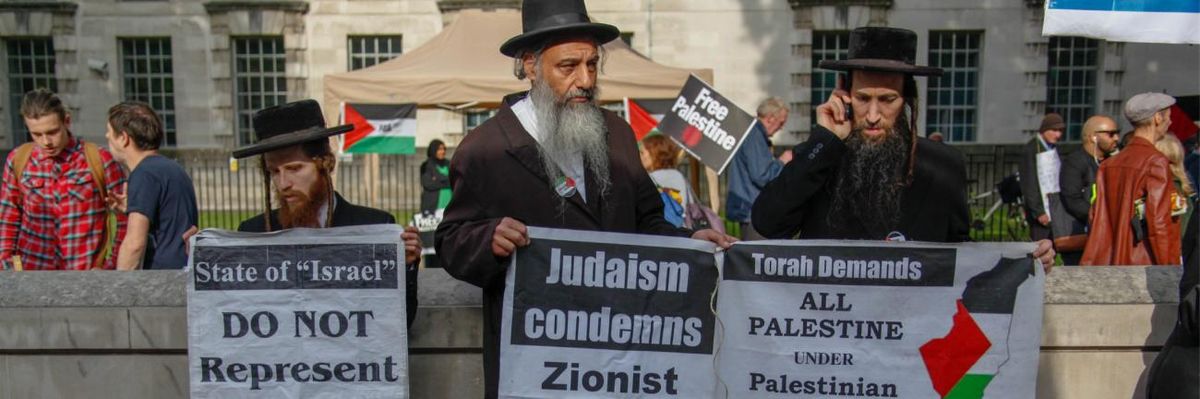
Hasidic Jews protest against Israeli oppression in Palestine. Palestinians and those that support Palestine protested in London, U.K., on June 5, 2018 condemning the recent killings in the Gaza Strip. (Photo: Alex Cavendish/NurPhoto via Getty Images)
The violent events in Israel/Palestine over the past month have elicited a rare display of unity and solidarity among Palestinians across the country and around the world, from the occupied West Bank and Gaza, to '48 Palestinians who carry Israeli citizenship, to the diaspora.
In contrast, Jewish-Israeli society is more divided than ever - and despite the clear advantage that Israeli forces have in terms of weaponry over Palestinian resistance groups, they have been acting in an uncoordinated manner. The Israeli "divide and conquer" strategy is failing.
Israelis have been sharing on social media and blogs an old interview with Sara Netanyahu, Prime Minister Benjamin Netanyahu's wife, recorded two decades ago, after her husband failed to maintain leadership of the Likud Party.
His successor, Ariel Sharon, provocatively entered al-Aqsa Mosque in 2000, one of the main triggers of the Second Intifada. The violence and the collapse of peace negotiations toppled the Ehud Barak government and propelled Sharon to the prime minister's office. In the interview from 2002, Sarah Netanyahu said Israel could not survive without her husband, and without him the "country would burn".
Once again, a right-wing Israeli politician has sparked a provocation at al-Aqsa Mosque in his quest for the prime ministerial seat - but the difference is that this time, the ploy is obvious.
Even as Israelis are fully aware of Netanyahu's gambit, the populism, racism and panic gripping Israeli society are too strong. Opposition politicians are terrified of being tagged as "leftists", so they prefer to surrender power rather than to speak out against the violence. Netanyahu got his wish: his opponents will not form a coalition without him, and in the meantime, the country is burning.
Deteriorating into an angry mob
The chief editor of Haaretz, Aluf Benn, has called Israel's current offensive against the besieged Gaza Strip the worst Israeli military operation ever, in terms of bad planning and preparation. Coverage in the Israeli media obsesses about achieving a "picture of victory" and reaching a ceasefire while saving face, because the notion that Hamas could claim victory is unthinkable.
But when Israeli officials initially hinted at their willingness to reach a ceasefire, suggesting that the military has already destroyed everything in its "target bank", senior officers have undermined these statements, telling the media that they have asked the government's approval to bomb additional targets.
Cracks have also emerged between the government and police. As Israel's police commissioner called for calm and coexistence between Jews and Arabs, noting that recent events had revealed "terrorists on both sides", Public Security Minister Amir Ohana immediately condemned these remarks, and a column in the pro-Netanyahu Israel Hayom newspaper called the police chief a "lefty".
The Israeli army is in the process of deteriorating into an angry mob. Ever since Israeli soldier Elor Azaria received overwhelming popular support for executing a Palestinian, Abdel Fattah al-Sharif, in Hebron in 2016, and served only nine months in prison, soldiers know that they can act with impunity and will not be held accountable for using deadly force.
In addition to the war machine being deployed in the massive bombardments of Gaza, military units have been deployed to enforce martial law in the so-called "mixed cities" of Israel to quell uprisings. Units have also been sent to crush protests in the occupied West Bank and along the border with Lebanon, killing dozens.
Lack of discipline
With Israeli security forces stretched thin, military discipline is more crucial than ever - but the Israeli military has never been as undisciplined as it is now, nor has the Israeli government ever needed to rely so heavily on the Palestinian Authority in Ramallah to help keep the Palestinian population in check. It remains to be seen whether President Mahmoud Abbas can continue to restrain Palestinian uprisings, after cancelling the upcoming elections and disappointing millions of Palestinians.
Although most of the violence in Israel/Palestine is directed towards Palestinians, and Palestinian casualties far outnumber Jewish Israeli casualties, the rifts within Israeli society have also turned violent against Jews. It has not just been the riots of '48 Palestinians, which claimed the life of one Jewish Israeli, but also out-of-control right-wing Jewish mobs, who have threatened the lives of Jewish politicians and journalists.
Demonstrations by Israelis against the bombardment of the Gaza Strip have been sporadic, with right-wing mobs prepared to attack them and police either unable or unwilling to protect protesters. A token message of solidarity with Arab victims by the Israeli mobile-phone company Cellcom triggered boycott calls from the far right, and the company's stock plunged.
Many are calling the collapse of Israel's pseudo-democratic institutions (police, media, courts and civil society) signs of fascism - but in fact, this disintegration is not a sign of a state that has become too powerful, but of a state that has lost its ability to govern without brute force. When the government encourages vigilante mobs to enforce apartheid, it opens a Pandora's box that can't be easily closed again.
As politicians and journalists incite against their own citizens (as Netanyahu has been doing for more than a decade), encourage vigilante violence and even murder; and when journalists neglect their obligation to ask critical questions and attempt to humiliate Palestinian guests during interviews, there is a price to pay. This creates an angry and divided society, one that is also cynical and individualistic.
The years during which a populist government in Israel has used hate as currency to gain political power have not increased the willingness of Jewish Israelis to make personal sacrifices to keep Palestinians pacified. When the time comes to pay an economic price, a personal security price, it becomes apparent that the apartheid system is unsustainable.
Dear Common Dreams reader, It’s been nearly 30 years since I co-founded Common Dreams with my late wife, Lina Newhouser. We had the radical notion that journalism should serve the public good, not corporate profits. It was clear to us from the outset what it would take to build such a project. No paid advertisements. No corporate sponsors. No millionaire publisher telling us what to think or do. Many people said we wouldn't last a year, but we proved those doubters wrong. Together with a tremendous team of journalists and dedicated staff, we built an independent media outlet free from the constraints of profits and corporate control. Our mission has always been simple: To inform. To inspire. To ignite change for the common good. Building Common Dreams was not easy. Our survival was never guaranteed. When you take on the most powerful forces—Wall Street greed, fossil fuel industry destruction, Big Tech lobbyists, and uber-rich oligarchs who have spent billions upon billions rigging the economy and democracy in their favor—the only bulwark you have is supporters who believe in your work. But here’s the urgent message from me today. It's never been this bad out there. And it's never been this hard to keep us going. At the very moment Common Dreams is most needed, the threats we face are intensifying. We need your support now more than ever. We don't accept corporate advertising and never will. We don't have a paywall because we don't think people should be blocked from critical news based on their ability to pay. Everything we do is funded by the donations of readers like you. When everyone does the little they can afford, we are strong. But if that support retreats or dries up, so do we. Will you donate now to make sure Common Dreams not only survives but thrives? —Craig Brown, Co-founder |
The violent events in Israel/Palestine over the past month have elicited a rare display of unity and solidarity among Palestinians across the country and around the world, from the occupied West Bank and Gaza, to '48 Palestinians who carry Israeli citizenship, to the diaspora.
In contrast, Jewish-Israeli society is more divided than ever - and despite the clear advantage that Israeli forces have in terms of weaponry over Palestinian resistance groups, they have been acting in an uncoordinated manner. The Israeli "divide and conquer" strategy is failing.
Israelis have been sharing on social media and blogs an old interview with Sara Netanyahu, Prime Minister Benjamin Netanyahu's wife, recorded two decades ago, after her husband failed to maintain leadership of the Likud Party.
His successor, Ariel Sharon, provocatively entered al-Aqsa Mosque in 2000, one of the main triggers of the Second Intifada. The violence and the collapse of peace negotiations toppled the Ehud Barak government and propelled Sharon to the prime minister's office. In the interview from 2002, Sarah Netanyahu said Israel could not survive without her husband, and without him the "country would burn".
Once again, a right-wing Israeli politician has sparked a provocation at al-Aqsa Mosque in his quest for the prime ministerial seat - but the difference is that this time, the ploy is obvious.
Even as Israelis are fully aware of Netanyahu's gambit, the populism, racism and panic gripping Israeli society are too strong. Opposition politicians are terrified of being tagged as "leftists", so they prefer to surrender power rather than to speak out against the violence. Netanyahu got his wish: his opponents will not form a coalition without him, and in the meantime, the country is burning.
Deteriorating into an angry mob
The chief editor of Haaretz, Aluf Benn, has called Israel's current offensive against the besieged Gaza Strip the worst Israeli military operation ever, in terms of bad planning and preparation. Coverage in the Israeli media obsesses about achieving a "picture of victory" and reaching a ceasefire while saving face, because the notion that Hamas could claim victory is unthinkable.
But when Israeli officials initially hinted at their willingness to reach a ceasefire, suggesting that the military has already destroyed everything in its "target bank", senior officers have undermined these statements, telling the media that they have asked the government's approval to bomb additional targets.
Cracks have also emerged between the government and police. As Israel's police commissioner called for calm and coexistence between Jews and Arabs, noting that recent events had revealed "terrorists on both sides", Public Security Minister Amir Ohana immediately condemned these remarks, and a column in the pro-Netanyahu Israel Hayom newspaper called the police chief a "lefty".
The Israeli army is in the process of deteriorating into an angry mob. Ever since Israeli soldier Elor Azaria received overwhelming popular support for executing a Palestinian, Abdel Fattah al-Sharif, in Hebron in 2016, and served only nine months in prison, soldiers know that they can act with impunity and will not be held accountable for using deadly force.
In addition to the war machine being deployed in the massive bombardments of Gaza, military units have been deployed to enforce martial law in the so-called "mixed cities" of Israel to quell uprisings. Units have also been sent to crush protests in the occupied West Bank and along the border with Lebanon, killing dozens.
Lack of discipline
With Israeli security forces stretched thin, military discipline is more crucial than ever - but the Israeli military has never been as undisciplined as it is now, nor has the Israeli government ever needed to rely so heavily on the Palestinian Authority in Ramallah to help keep the Palestinian population in check. It remains to be seen whether President Mahmoud Abbas can continue to restrain Palestinian uprisings, after cancelling the upcoming elections and disappointing millions of Palestinians.
Although most of the violence in Israel/Palestine is directed towards Palestinians, and Palestinian casualties far outnumber Jewish Israeli casualties, the rifts within Israeli society have also turned violent against Jews. It has not just been the riots of '48 Palestinians, which claimed the life of one Jewish Israeli, but also out-of-control right-wing Jewish mobs, who have threatened the lives of Jewish politicians and journalists.
Demonstrations by Israelis against the bombardment of the Gaza Strip have been sporadic, with right-wing mobs prepared to attack them and police either unable or unwilling to protect protesters. A token message of solidarity with Arab victims by the Israeli mobile-phone company Cellcom triggered boycott calls from the far right, and the company's stock plunged.
Many are calling the collapse of Israel's pseudo-democratic institutions (police, media, courts and civil society) signs of fascism - but in fact, this disintegration is not a sign of a state that has become too powerful, but of a state that has lost its ability to govern without brute force. When the government encourages vigilante mobs to enforce apartheid, it opens a Pandora's box that can't be easily closed again.
As politicians and journalists incite against their own citizens (as Netanyahu has been doing for more than a decade), encourage vigilante violence and even murder; and when journalists neglect their obligation to ask critical questions and attempt to humiliate Palestinian guests during interviews, there is a price to pay. This creates an angry and divided society, one that is also cynical and individualistic.
The years during which a populist government in Israel has used hate as currency to gain political power have not increased the willingness of Jewish Israelis to make personal sacrifices to keep Palestinians pacified. When the time comes to pay an economic price, a personal security price, it becomes apparent that the apartheid system is unsustainable.
The violent events in Israel/Palestine over the past month have elicited a rare display of unity and solidarity among Palestinians across the country and around the world, from the occupied West Bank and Gaza, to '48 Palestinians who carry Israeli citizenship, to the diaspora.
In contrast, Jewish-Israeli society is more divided than ever - and despite the clear advantage that Israeli forces have in terms of weaponry over Palestinian resistance groups, they have been acting in an uncoordinated manner. The Israeli "divide and conquer" strategy is failing.
Israelis have been sharing on social media and blogs an old interview with Sara Netanyahu, Prime Minister Benjamin Netanyahu's wife, recorded two decades ago, after her husband failed to maintain leadership of the Likud Party.
His successor, Ariel Sharon, provocatively entered al-Aqsa Mosque in 2000, one of the main triggers of the Second Intifada. The violence and the collapse of peace negotiations toppled the Ehud Barak government and propelled Sharon to the prime minister's office. In the interview from 2002, Sarah Netanyahu said Israel could not survive without her husband, and without him the "country would burn".
Once again, a right-wing Israeli politician has sparked a provocation at al-Aqsa Mosque in his quest for the prime ministerial seat - but the difference is that this time, the ploy is obvious.
Even as Israelis are fully aware of Netanyahu's gambit, the populism, racism and panic gripping Israeli society are too strong. Opposition politicians are terrified of being tagged as "leftists", so they prefer to surrender power rather than to speak out against the violence. Netanyahu got his wish: his opponents will not form a coalition without him, and in the meantime, the country is burning.
Deteriorating into an angry mob
The chief editor of Haaretz, Aluf Benn, has called Israel's current offensive against the besieged Gaza Strip the worst Israeli military operation ever, in terms of bad planning and preparation. Coverage in the Israeli media obsesses about achieving a "picture of victory" and reaching a ceasefire while saving face, because the notion that Hamas could claim victory is unthinkable.
But when Israeli officials initially hinted at their willingness to reach a ceasefire, suggesting that the military has already destroyed everything in its "target bank", senior officers have undermined these statements, telling the media that they have asked the government's approval to bomb additional targets.
Cracks have also emerged between the government and police. As Israel's police commissioner called for calm and coexistence between Jews and Arabs, noting that recent events had revealed "terrorists on both sides", Public Security Minister Amir Ohana immediately condemned these remarks, and a column in the pro-Netanyahu Israel Hayom newspaper called the police chief a "lefty".
The Israeli army is in the process of deteriorating into an angry mob. Ever since Israeli soldier Elor Azaria received overwhelming popular support for executing a Palestinian, Abdel Fattah al-Sharif, in Hebron in 2016, and served only nine months in prison, soldiers know that they can act with impunity and will not be held accountable for using deadly force.
In addition to the war machine being deployed in the massive bombardments of Gaza, military units have been deployed to enforce martial law in the so-called "mixed cities" of Israel to quell uprisings. Units have also been sent to crush protests in the occupied West Bank and along the border with Lebanon, killing dozens.
Lack of discipline
With Israeli security forces stretched thin, military discipline is more crucial than ever - but the Israeli military has never been as undisciplined as it is now, nor has the Israeli government ever needed to rely so heavily on the Palestinian Authority in Ramallah to help keep the Palestinian population in check. It remains to be seen whether President Mahmoud Abbas can continue to restrain Palestinian uprisings, after cancelling the upcoming elections and disappointing millions of Palestinians.
Although most of the violence in Israel/Palestine is directed towards Palestinians, and Palestinian casualties far outnumber Jewish Israeli casualties, the rifts within Israeli society have also turned violent against Jews. It has not just been the riots of '48 Palestinians, which claimed the life of one Jewish Israeli, but also out-of-control right-wing Jewish mobs, who have threatened the lives of Jewish politicians and journalists.
Demonstrations by Israelis against the bombardment of the Gaza Strip have been sporadic, with right-wing mobs prepared to attack them and police either unable or unwilling to protect protesters. A token message of solidarity with Arab victims by the Israeli mobile-phone company Cellcom triggered boycott calls from the far right, and the company's stock plunged.
Many are calling the collapse of Israel's pseudo-democratic institutions (police, media, courts and civil society) signs of fascism - but in fact, this disintegration is not a sign of a state that has become too powerful, but of a state that has lost its ability to govern without brute force. When the government encourages vigilante mobs to enforce apartheid, it opens a Pandora's box that can't be easily closed again.
As politicians and journalists incite against their own citizens (as Netanyahu has been doing for more than a decade), encourage vigilante violence and even murder; and when journalists neglect their obligation to ask critical questions and attempt to humiliate Palestinian guests during interviews, there is a price to pay. This creates an angry and divided society, one that is also cynical and individualistic.
The years during which a populist government in Israel has used hate as currency to gain political power have not increased the willingness of Jewish Israelis to make personal sacrifices to keep Palestinians pacified. When the time comes to pay an economic price, a personal security price, it becomes apparent that the apartheid system is unsustainable.