SUBSCRIBE TO OUR FREE NEWSLETTER
Daily news & progressive opinion—funded by the people, not the corporations—delivered straight to your inbox.
5
#000000
#FFFFFF
To donate by check, phone, or other method, see our More Ways to Give page.
Daily news & progressive opinion—funded by the people, not the corporations—delivered straight to your inbox.
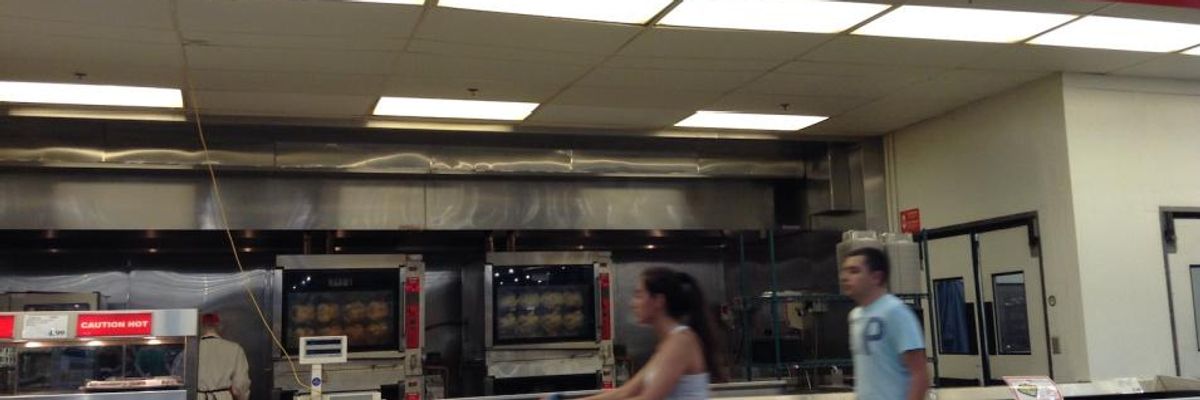
"Approximately 9 billion chickens are raised for food every year in the US, making ours the largest broiler chicken industry in the world," writes Coman-Hidy. (Photo: Mike Mozart/Flickr)
Imagine a food so filthy that it requires chemical disinfection prior to packaging and sale. Now imagine that the average American eats almost 100 pounds of it every year. Sadly, that product is not imaginary. It's chicken, and few US consumers know the grisly truth about how it's produced.
The industrialized methods used to farm our chicken result in meat so slick with pathogens, it risks sickening and even killing us if not for the chlorine cocktail used in processing. Equally disturbing is that European consumers and food retailers are so averse to American chicken farming practices that US chicken is not sold in the EU. Why should we settle for less than our European counterparts? Why don't our retailers insist on higher standards?
"American meat suppliers and the supermarkets that purchase from them have fallen far behind retailers in other countries on animal welfare and food quality."
Approximately 9 billion chickens are raised for food every year in the US, making ours the largest broiler chicken industry in the world. Such vast numbers can only be achieved through intensive confinement methods and rampant antibiotic use to mitigate disease and the growth-inhibiting effects of stress. The ensuing welfare standards are predictably dismal.
The horrific conditions that chickens raised for meat are forced to live in were made evident in the investigation into a Costco chicken farm that was released last week. Bred to grow unnaturally fast, chickens live in constant pain, their juvenile frames overwhelmed by their sheer size. These intelligent, highly social creatures never see the sun or breathe fresh air. Incarcerated in cramped, ammonia-filled sheds containing tens of thousands of birds, they live out their short, painful lives in intensely stressful, unhygienic, disease-inducing conditions. The baby birds who survive to the slaughter age of approximately 7 weeks grow up afflicted--and infected--by their own waste. It's no wonder that the final product is crawling with contaminants.
Rather than address the root causes of the problem, the US Department of Agriculture (USDA) has approved various chemicals that poultry producers can use to try to kill toxic organisms like E. coli, salmonella, and campylobacter, which flourish on the surfaces of US-produced chicken and sicken thousands of Americans every year. These chemicals include chlorine dioxide, acidified sodium chlorite, trisodium phosphate, and peroxyacids. Yet a 2018 UK study found that bacteria such as salmonella and listeria can survive even chlorine washing, which only serves to emphasize the futility of trying to whitewash a rotten system.
Imports of chlorinated chicken have been banned in the EU for over 20 years. In anticipation of a post-Brexit trade deal, however, the American chicken industry is angling to flood the British market with cheap, chlorinated chicken meat. That prospect has been met with fierce opposition in the UK, not only from farmers, but from retailers and consumers as well. Eighty percent of Britons oppose allowing chlorinated chicken imports, while major UK retailers have vowed not to sell it even if US chicken producers get their way. What is it that British consumers know that Americans don't?
In the UK, as in the EU, chicken farmers do not rely on chemical disinfectants to ensure a safe end-product. Instead they achieve this through higher animal welfare in food production (including lower flock densities), along with farming practices that fight bacteria at each step. By contrast, the factory farming of chickens in the U.S. is largely unregulated. Its high-density and high-yield industrial practices are geared toward rapid growth and profit maximization at the cost of animal welfare and food safety. Viewed as "backward" in Britain, American animal agriculture dooms chickens to lives of intense suffering, and saddles consumers with a product so contaminated with fecal matter that it requires chemical baths.
British retailers are of the view that if American chicken producers must rely on flawed, drastic measures to avoid sickening consumers, then their products should not be welcome in the UK French retailers agree. In fact, every major retailer in France has already signed on to the European Chicken Commitment, an animal welfare policy that sets strict standards aimed at minimizing the suffering of broiler chickens. It's long past time for US grocery stores to follow suit.
Aldi, one of the largest and fastest-growing grocery chains in America, recently committed to improve the conditions for chickens raised for its locations in Germany and Spain. Their standards now include lower stocking densities, more humane slaughter methods, and the use of slower-growing breeds. Tens of millions of chickens sold by Aldi in these countries will no longer be subject to torments like live-shackle slaughter and the painful crippling injuries sustained by fast-growing breeds. Why, then, don't more Americans, insist on these same standards in the US, given that animal welfare tops the list of causes they are most likely to support?
More than three-quarters of Americans are concerned about how chickens are raised, and data show their preference for higher-welfare meat influences their purchasing choices. We know people are willing to pay more for more ethical products, including poultry. More than 200 major US food companies, including Denny's and Subway, have taken notice, pledging to enact higher animal welfare standards in their supply chains by adopting the Better Chicken Commitment (BCC).
American meat suppliers and the supermarkets that purchase from them have fallen far behind retailers in other countries on animal welfare and food quality. They're cheating U.S. consumers who don't want dirty meat that's been raised in torturous conditions, pumped full of antibiotics, and chlorinated.
Grocery chains like Costco in the US need to commit to making substantial changes that improve the welfare of chickens in their supply chains here at home. Failure to do so amounts to endorsing the most extreme forms of animal cruelty, and to endangering American lives. Conversely, adopting standards consistent with the BCC demonstrates respect for consumers' health and wishes, as well as higher regard for chickens.
It's time to stop trying to clean up filthy meat, and to start cleaning up the foul system that's churning it out. American consumers, and the billions of birds, deserve at least that much.
Dear Common Dreams reader, It’s been nearly 30 years since I co-founded Common Dreams with my late wife, Lina Newhouser. We had the radical notion that journalism should serve the public good, not corporate profits. It was clear to us from the outset what it would take to build such a project. No paid advertisements. No corporate sponsors. No millionaire publisher telling us what to think or do. Many people said we wouldn't last a year, but we proved those doubters wrong. Together with a tremendous team of journalists and dedicated staff, we built an independent media outlet free from the constraints of profits and corporate control. Our mission has always been simple: To inform. To inspire. To ignite change for the common good. Building Common Dreams was not easy. Our survival was never guaranteed. When you take on the most powerful forces—Wall Street greed, fossil fuel industry destruction, Big Tech lobbyists, and uber-rich oligarchs who have spent billions upon billions rigging the economy and democracy in their favor—the only bulwark you have is supporters who believe in your work. But here’s the urgent message from me today. It's never been this bad out there. And it's never been this hard to keep us going. At the very moment Common Dreams is most needed, the threats we face are intensifying. We need your support now more than ever. We don't accept corporate advertising and never will. We don't have a paywall because we don't think people should be blocked from critical news based on their ability to pay. Everything we do is funded by the donations of readers like you. When everyone does the little they can afford, we are strong. But if that support retreats or dries up, so do we. Will you donate now to make sure Common Dreams not only survives but thrives? —Craig Brown, Co-founder |
Imagine a food so filthy that it requires chemical disinfection prior to packaging and sale. Now imagine that the average American eats almost 100 pounds of it every year. Sadly, that product is not imaginary. It's chicken, and few US consumers know the grisly truth about how it's produced.
The industrialized methods used to farm our chicken result in meat so slick with pathogens, it risks sickening and even killing us if not for the chlorine cocktail used in processing. Equally disturbing is that European consumers and food retailers are so averse to American chicken farming practices that US chicken is not sold in the EU. Why should we settle for less than our European counterparts? Why don't our retailers insist on higher standards?
"American meat suppliers and the supermarkets that purchase from them have fallen far behind retailers in other countries on animal welfare and food quality."
Approximately 9 billion chickens are raised for food every year in the US, making ours the largest broiler chicken industry in the world. Such vast numbers can only be achieved through intensive confinement methods and rampant antibiotic use to mitigate disease and the growth-inhibiting effects of stress. The ensuing welfare standards are predictably dismal.
The horrific conditions that chickens raised for meat are forced to live in were made evident in the investigation into a Costco chicken farm that was released last week. Bred to grow unnaturally fast, chickens live in constant pain, their juvenile frames overwhelmed by their sheer size. These intelligent, highly social creatures never see the sun or breathe fresh air. Incarcerated in cramped, ammonia-filled sheds containing tens of thousands of birds, they live out their short, painful lives in intensely stressful, unhygienic, disease-inducing conditions. The baby birds who survive to the slaughter age of approximately 7 weeks grow up afflicted--and infected--by their own waste. It's no wonder that the final product is crawling with contaminants.
Rather than address the root causes of the problem, the US Department of Agriculture (USDA) has approved various chemicals that poultry producers can use to try to kill toxic organisms like E. coli, salmonella, and campylobacter, which flourish on the surfaces of US-produced chicken and sicken thousands of Americans every year. These chemicals include chlorine dioxide, acidified sodium chlorite, trisodium phosphate, and peroxyacids. Yet a 2018 UK study found that bacteria such as salmonella and listeria can survive even chlorine washing, which only serves to emphasize the futility of trying to whitewash a rotten system.
Imports of chlorinated chicken have been banned in the EU for over 20 years. In anticipation of a post-Brexit trade deal, however, the American chicken industry is angling to flood the British market with cheap, chlorinated chicken meat. That prospect has been met with fierce opposition in the UK, not only from farmers, but from retailers and consumers as well. Eighty percent of Britons oppose allowing chlorinated chicken imports, while major UK retailers have vowed not to sell it even if US chicken producers get their way. What is it that British consumers know that Americans don't?
In the UK, as in the EU, chicken farmers do not rely on chemical disinfectants to ensure a safe end-product. Instead they achieve this through higher animal welfare in food production (including lower flock densities), along with farming practices that fight bacteria at each step. By contrast, the factory farming of chickens in the U.S. is largely unregulated. Its high-density and high-yield industrial practices are geared toward rapid growth and profit maximization at the cost of animal welfare and food safety. Viewed as "backward" in Britain, American animal agriculture dooms chickens to lives of intense suffering, and saddles consumers with a product so contaminated with fecal matter that it requires chemical baths.
British retailers are of the view that if American chicken producers must rely on flawed, drastic measures to avoid sickening consumers, then their products should not be welcome in the UK French retailers agree. In fact, every major retailer in France has already signed on to the European Chicken Commitment, an animal welfare policy that sets strict standards aimed at minimizing the suffering of broiler chickens. It's long past time for US grocery stores to follow suit.
Aldi, one of the largest and fastest-growing grocery chains in America, recently committed to improve the conditions for chickens raised for its locations in Germany and Spain. Their standards now include lower stocking densities, more humane slaughter methods, and the use of slower-growing breeds. Tens of millions of chickens sold by Aldi in these countries will no longer be subject to torments like live-shackle slaughter and the painful crippling injuries sustained by fast-growing breeds. Why, then, don't more Americans, insist on these same standards in the US, given that animal welfare tops the list of causes they are most likely to support?
More than three-quarters of Americans are concerned about how chickens are raised, and data show their preference for higher-welfare meat influences their purchasing choices. We know people are willing to pay more for more ethical products, including poultry. More than 200 major US food companies, including Denny's and Subway, have taken notice, pledging to enact higher animal welfare standards in their supply chains by adopting the Better Chicken Commitment (BCC).
American meat suppliers and the supermarkets that purchase from them have fallen far behind retailers in other countries on animal welfare and food quality. They're cheating U.S. consumers who don't want dirty meat that's been raised in torturous conditions, pumped full of antibiotics, and chlorinated.
Grocery chains like Costco in the US need to commit to making substantial changes that improve the welfare of chickens in their supply chains here at home. Failure to do so amounts to endorsing the most extreme forms of animal cruelty, and to endangering American lives. Conversely, adopting standards consistent with the BCC demonstrates respect for consumers' health and wishes, as well as higher regard for chickens.
It's time to stop trying to clean up filthy meat, and to start cleaning up the foul system that's churning it out. American consumers, and the billions of birds, deserve at least that much.
Imagine a food so filthy that it requires chemical disinfection prior to packaging and sale. Now imagine that the average American eats almost 100 pounds of it every year. Sadly, that product is not imaginary. It's chicken, and few US consumers know the grisly truth about how it's produced.
The industrialized methods used to farm our chicken result in meat so slick with pathogens, it risks sickening and even killing us if not for the chlorine cocktail used in processing. Equally disturbing is that European consumers and food retailers are so averse to American chicken farming practices that US chicken is not sold in the EU. Why should we settle for less than our European counterparts? Why don't our retailers insist on higher standards?
"American meat suppliers and the supermarkets that purchase from them have fallen far behind retailers in other countries on animal welfare and food quality."
Approximately 9 billion chickens are raised for food every year in the US, making ours the largest broiler chicken industry in the world. Such vast numbers can only be achieved through intensive confinement methods and rampant antibiotic use to mitigate disease and the growth-inhibiting effects of stress. The ensuing welfare standards are predictably dismal.
The horrific conditions that chickens raised for meat are forced to live in were made evident in the investigation into a Costco chicken farm that was released last week. Bred to grow unnaturally fast, chickens live in constant pain, their juvenile frames overwhelmed by their sheer size. These intelligent, highly social creatures never see the sun or breathe fresh air. Incarcerated in cramped, ammonia-filled sheds containing tens of thousands of birds, they live out their short, painful lives in intensely stressful, unhygienic, disease-inducing conditions. The baby birds who survive to the slaughter age of approximately 7 weeks grow up afflicted--and infected--by their own waste. It's no wonder that the final product is crawling with contaminants.
Rather than address the root causes of the problem, the US Department of Agriculture (USDA) has approved various chemicals that poultry producers can use to try to kill toxic organisms like E. coli, salmonella, and campylobacter, which flourish on the surfaces of US-produced chicken and sicken thousands of Americans every year. These chemicals include chlorine dioxide, acidified sodium chlorite, trisodium phosphate, and peroxyacids. Yet a 2018 UK study found that bacteria such as salmonella and listeria can survive even chlorine washing, which only serves to emphasize the futility of trying to whitewash a rotten system.
Imports of chlorinated chicken have been banned in the EU for over 20 years. In anticipation of a post-Brexit trade deal, however, the American chicken industry is angling to flood the British market with cheap, chlorinated chicken meat. That prospect has been met with fierce opposition in the UK, not only from farmers, but from retailers and consumers as well. Eighty percent of Britons oppose allowing chlorinated chicken imports, while major UK retailers have vowed not to sell it even if US chicken producers get their way. What is it that British consumers know that Americans don't?
In the UK, as in the EU, chicken farmers do not rely on chemical disinfectants to ensure a safe end-product. Instead they achieve this through higher animal welfare in food production (including lower flock densities), along with farming practices that fight bacteria at each step. By contrast, the factory farming of chickens in the U.S. is largely unregulated. Its high-density and high-yield industrial practices are geared toward rapid growth and profit maximization at the cost of animal welfare and food safety. Viewed as "backward" in Britain, American animal agriculture dooms chickens to lives of intense suffering, and saddles consumers with a product so contaminated with fecal matter that it requires chemical baths.
British retailers are of the view that if American chicken producers must rely on flawed, drastic measures to avoid sickening consumers, then their products should not be welcome in the UK French retailers agree. In fact, every major retailer in France has already signed on to the European Chicken Commitment, an animal welfare policy that sets strict standards aimed at minimizing the suffering of broiler chickens. It's long past time for US grocery stores to follow suit.
Aldi, one of the largest and fastest-growing grocery chains in America, recently committed to improve the conditions for chickens raised for its locations in Germany and Spain. Their standards now include lower stocking densities, more humane slaughter methods, and the use of slower-growing breeds. Tens of millions of chickens sold by Aldi in these countries will no longer be subject to torments like live-shackle slaughter and the painful crippling injuries sustained by fast-growing breeds. Why, then, don't more Americans, insist on these same standards in the US, given that animal welfare tops the list of causes they are most likely to support?
More than three-quarters of Americans are concerned about how chickens are raised, and data show their preference for higher-welfare meat influences their purchasing choices. We know people are willing to pay more for more ethical products, including poultry. More than 200 major US food companies, including Denny's and Subway, have taken notice, pledging to enact higher animal welfare standards in their supply chains by adopting the Better Chicken Commitment (BCC).
American meat suppliers and the supermarkets that purchase from them have fallen far behind retailers in other countries on animal welfare and food quality. They're cheating U.S. consumers who don't want dirty meat that's been raised in torturous conditions, pumped full of antibiotics, and chlorinated.
Grocery chains like Costco in the US need to commit to making substantial changes that improve the welfare of chickens in their supply chains here at home. Failure to do so amounts to endorsing the most extreme forms of animal cruelty, and to endangering American lives. Conversely, adopting standards consistent with the BCC demonstrates respect for consumers' health and wishes, as well as higher regard for chickens.
It's time to stop trying to clean up filthy meat, and to start cleaning up the foul system that's churning it out. American consumers, and the billions of birds, deserve at least that much.