

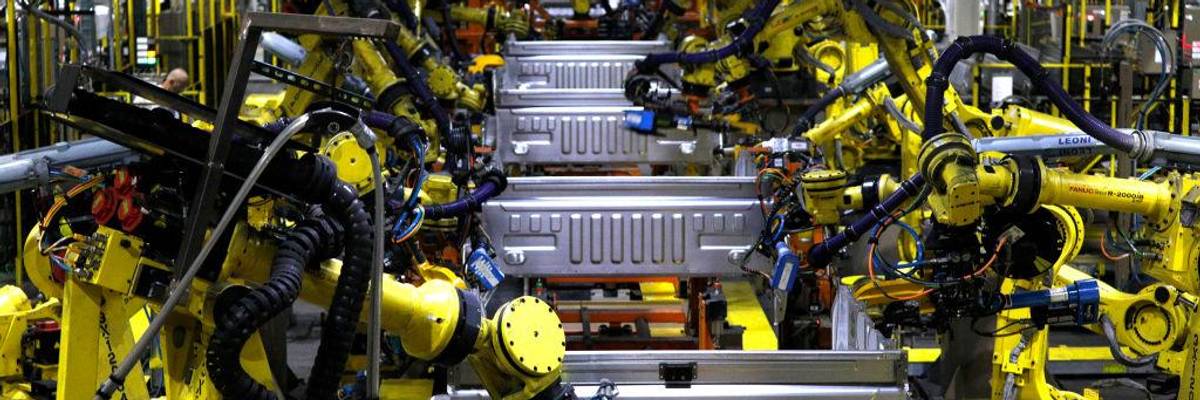
Ford F150 trucks go through robots on the assembly line at the Ford Dearborn Truck Plant on September 27, 2018 in Dearborn, Michigan. (Photo by Bill Pugliano/Getty Images)
Robots Are Coming for Millions of Blue-Collar Jobs
CEOs urgently need euphemisms to soften the image of their constant hunt for ways to kill jobs and funnel more money to themselves and top investors.
Some people find hunting for sport to be abhorrent, so hunters have come up with euphemisms to make what they do sound gentler on the ears of the nonhunting public. For example, animals aren't killed; they're "harvested." And dead prey is not gutted but "processed."
Corporate America has taken note of this verbal ploy and is now adopting it, for CEOs urgently need euphemisms to soften the image of their constant hunt for ways to kill jobs and funnel more money to themselves and top investors. Their urgency is that they're now pushing a huge new surge in job cuts--this time targeting college-educated, white-collar professionals! Their weapon is the same sort of neutron bomb they've used to dispatch millions of blue-collar workers: robots.
But that term has a very bad reputation, so robots have been relabeled with a nondescript acronym: RPA, "robotic process automation." These are not your grandfather's old bots merely doing repetitive mechanical tasks. Sophisticated automatons armed with artificial intelligence have quietly moved up the corporate ladder to take over cognitive work that had been the niche of such highly paid humans as financial analysts, lawyers, engineers, managers and doctors.
McKinsey, the world's biggest corporate strategy consultancy, calculated in 2019 that the emerging revolution of thinking robotics would displace 37 million U.S. workers by 2030. Now, seeing the current corporate stampede to impose RPAs on U.S. workplaces, McKinsey analysts have upped their projection to 45 million job losses by 2030.
This is more than just an incremental extension of a long, slow automation process. It's a transformative Big Bang, presently ripping through America's workforce at warp speed with no public or political attention, and most of the vulnerable employees have no idea of what's coming.
Corporate executives, boards and investors do know, however, for they've been rushing furtively in the past year or so to implement RPA initiatives. The New York Times reports that a survey of executives last year found that nearly 80% of them have already put some forms of RPA in place, with an additional 16% planning to do so within three years. Yes, that's 96% of corporate employers. Sales of the new-age automation software are booming, turning little-known providers like UiPath and Automation Anywhere into multibillion-dollar behemoths intent on radically shrinking the job market here and elsewhere. McKinsey, the world's biggest corporate strategy consultancy, calculated in 2019 that the emerging revolution of thinking robotics would displace 37 million U.S. workers by 2030. Now, seeing the current corporate stampede to impose RPAs on U.S. workplaces, McKinsey analysts have upped their projection to 45 million job losses by 2030.
Returning to the hunting analogy, professional jobs requiring human-level judgement have been presumed to be beyond the range of robotic firepower. But, as one economist who studies labor now notes, with the mass deployment of RPA technology, "that type of work is much more in the kill path."
The corporate vocabulary does not include the phrase "job cuts." Rather, such unpleasantness is blandly referred to as "employment adjustment." Moreover, terminations are hailed as universally beneficial--they're said to "streamline" operations and "liberate" the workforce from tedious tasks.
Now, though, corporate wordsmiths are going to need a new thesaurus of euphemisms to try glossing over the masses of job cuts coming for those in the higher echelons of the corporate structure. Don't look now, but an unanticipated result of the ongoing pandemic is that it has given cover for CEOs to speed up the adoption of highly advanced RPAs to replace employees once assumed to be immune from displacement. As one analyst told a New York Times reporter, "With R.P.A., you can build a bot that costs $10,000 a year and take out two to four humans."
Prior to the COVID-19 crisis, many top executives feared a public backlash if they pushed automation too far too fast. But, ironically, the economic collapse caused by the pandemic has so discombobulated the workplace and diverted public attention that corporate bosses have been emboldened to rush ahead, declaring, "I don't really care. I'm just going to do what's right for my business." While the nationwide shutdown of offices and furloughing of employees has caused misery for millions, one purveyor of RPA systems approvingly notes that it has "'massively raised awareness' among executives about the variety of work that no longer requires human involvement," The New York Times says. He cheerfully declares, "We think any business process can be automated," and his firm advises corporate bosses that half to two-thirds of all the tasks being done at their companies can be done by machines.
Conventional corporate wisdom blithely preaches that all new technologies create more jobs than they kill, but even those Pollyannaish preachers are now conceding that this robotic automation of white-collar jobs is being imposed so suddenly, widely and stealthily that losses will crush any gains. "We haven't hit the exponential point of this stuff yet," warns an alarmed analyst. "And when we do, it's going to be dramatic."
An Urgent Message From Our Co-Founder
Dear Common Dreams reader, It’s been nearly 30 years since I co-founded Common Dreams with my late wife, Lina Newhouser. We had the radical notion that journalism should serve the public good, not corporate profits. It was clear to us from the outset what it would take to build such a project. No paid advertisements. No corporate sponsors. No millionaire publisher telling us what to think or do. Many people said we wouldn't last a year, but we proved those doubters wrong. Together with a tremendous team of journalists and dedicated staff, we built an independent media outlet free from the constraints of profits and corporate control. Our mission has always been simple: To inform. To inspire. To ignite change for the common good. Building Common Dreams was not easy. Our survival was never guaranteed. When you take on the most powerful forces—Wall Street greed, fossil fuel industry destruction, Big Tech lobbyists, and uber-rich oligarchs who have spent billions upon billions rigging the economy and democracy in their favor—the only bulwark you have is supporters who believe in your work. But here’s the urgent message from me today. It's never been this bad out there. And it's never been this hard to keep us going. At the very moment Common Dreams is most needed, the threats we face are intensifying. We need your support now more than ever. We don't accept corporate advertising and never will. We don't have a paywall because we don't think people should be blocked from critical news based on their ability to pay. Everything we do is funded by the donations of readers like you. When everyone does the little they can afford, we are strong. But if that support retreats or dries up, so do we. Will you donate now to make sure Common Dreams not only survives but thrives? —Craig Brown, Co-founder |
Some people find hunting for sport to be abhorrent, so hunters have come up with euphemisms to make what they do sound gentler on the ears of the nonhunting public. For example, animals aren't killed; they're "harvested." And dead prey is not gutted but "processed."
Corporate America has taken note of this verbal ploy and is now adopting it, for CEOs urgently need euphemisms to soften the image of their constant hunt for ways to kill jobs and funnel more money to themselves and top investors. Their urgency is that they're now pushing a huge new surge in job cuts--this time targeting college-educated, white-collar professionals! Their weapon is the same sort of neutron bomb they've used to dispatch millions of blue-collar workers: robots.
But that term has a very bad reputation, so robots have been relabeled with a nondescript acronym: RPA, "robotic process automation." These are not your grandfather's old bots merely doing repetitive mechanical tasks. Sophisticated automatons armed with artificial intelligence have quietly moved up the corporate ladder to take over cognitive work that had been the niche of such highly paid humans as financial analysts, lawyers, engineers, managers and doctors.
McKinsey, the world's biggest corporate strategy consultancy, calculated in 2019 that the emerging revolution of thinking robotics would displace 37 million U.S. workers by 2030. Now, seeing the current corporate stampede to impose RPAs on U.S. workplaces, McKinsey analysts have upped their projection to 45 million job losses by 2030.
This is more than just an incremental extension of a long, slow automation process. It's a transformative Big Bang, presently ripping through America's workforce at warp speed with no public or political attention, and most of the vulnerable employees have no idea of what's coming.
Corporate executives, boards and investors do know, however, for they've been rushing furtively in the past year or so to implement RPA initiatives. The New York Times reports that a survey of executives last year found that nearly 80% of them have already put some forms of RPA in place, with an additional 16% planning to do so within three years. Yes, that's 96% of corporate employers. Sales of the new-age automation software are booming, turning little-known providers like UiPath and Automation Anywhere into multibillion-dollar behemoths intent on radically shrinking the job market here and elsewhere. McKinsey, the world's biggest corporate strategy consultancy, calculated in 2019 that the emerging revolution of thinking robotics would displace 37 million U.S. workers by 2030. Now, seeing the current corporate stampede to impose RPAs on U.S. workplaces, McKinsey analysts have upped their projection to 45 million job losses by 2030.
Returning to the hunting analogy, professional jobs requiring human-level judgement have been presumed to be beyond the range of robotic firepower. But, as one economist who studies labor now notes, with the mass deployment of RPA technology, "that type of work is much more in the kill path."
The corporate vocabulary does not include the phrase "job cuts." Rather, such unpleasantness is blandly referred to as "employment adjustment." Moreover, terminations are hailed as universally beneficial--they're said to "streamline" operations and "liberate" the workforce from tedious tasks.
Now, though, corporate wordsmiths are going to need a new thesaurus of euphemisms to try glossing over the masses of job cuts coming for those in the higher echelons of the corporate structure. Don't look now, but an unanticipated result of the ongoing pandemic is that it has given cover for CEOs to speed up the adoption of highly advanced RPAs to replace employees once assumed to be immune from displacement. As one analyst told a New York Times reporter, "With R.P.A., you can build a bot that costs $10,000 a year and take out two to four humans."
Prior to the COVID-19 crisis, many top executives feared a public backlash if they pushed automation too far too fast. But, ironically, the economic collapse caused by the pandemic has so discombobulated the workplace and diverted public attention that corporate bosses have been emboldened to rush ahead, declaring, "I don't really care. I'm just going to do what's right for my business." While the nationwide shutdown of offices and furloughing of employees has caused misery for millions, one purveyor of RPA systems approvingly notes that it has "'massively raised awareness' among executives about the variety of work that no longer requires human involvement," The New York Times says. He cheerfully declares, "We think any business process can be automated," and his firm advises corporate bosses that half to two-thirds of all the tasks being done at their companies can be done by machines.
Conventional corporate wisdom blithely preaches that all new technologies create more jobs than they kill, but even those Pollyannaish preachers are now conceding that this robotic automation of white-collar jobs is being imposed so suddenly, widely and stealthily that losses will crush any gains. "We haven't hit the exponential point of this stuff yet," warns an alarmed analyst. "And when we do, it's going to be dramatic."
Some people find hunting for sport to be abhorrent, so hunters have come up with euphemisms to make what they do sound gentler on the ears of the nonhunting public. For example, animals aren't killed; they're "harvested." And dead prey is not gutted but "processed."
Corporate America has taken note of this verbal ploy and is now adopting it, for CEOs urgently need euphemisms to soften the image of their constant hunt for ways to kill jobs and funnel more money to themselves and top investors. Their urgency is that they're now pushing a huge new surge in job cuts--this time targeting college-educated, white-collar professionals! Their weapon is the same sort of neutron bomb they've used to dispatch millions of blue-collar workers: robots.
But that term has a very bad reputation, so robots have been relabeled with a nondescript acronym: RPA, "robotic process automation." These are not your grandfather's old bots merely doing repetitive mechanical tasks. Sophisticated automatons armed with artificial intelligence have quietly moved up the corporate ladder to take over cognitive work that had been the niche of such highly paid humans as financial analysts, lawyers, engineers, managers and doctors.
McKinsey, the world's biggest corporate strategy consultancy, calculated in 2019 that the emerging revolution of thinking robotics would displace 37 million U.S. workers by 2030. Now, seeing the current corporate stampede to impose RPAs on U.S. workplaces, McKinsey analysts have upped their projection to 45 million job losses by 2030.
This is more than just an incremental extension of a long, slow automation process. It's a transformative Big Bang, presently ripping through America's workforce at warp speed with no public or political attention, and most of the vulnerable employees have no idea of what's coming.
Corporate executives, boards and investors do know, however, for they've been rushing furtively in the past year or so to implement RPA initiatives. The New York Times reports that a survey of executives last year found that nearly 80% of them have already put some forms of RPA in place, with an additional 16% planning to do so within three years. Yes, that's 96% of corporate employers. Sales of the new-age automation software are booming, turning little-known providers like UiPath and Automation Anywhere into multibillion-dollar behemoths intent on radically shrinking the job market here and elsewhere. McKinsey, the world's biggest corporate strategy consultancy, calculated in 2019 that the emerging revolution of thinking robotics would displace 37 million U.S. workers by 2030. Now, seeing the current corporate stampede to impose RPAs on U.S. workplaces, McKinsey analysts have upped their projection to 45 million job losses by 2030.
Returning to the hunting analogy, professional jobs requiring human-level judgement have been presumed to be beyond the range of robotic firepower. But, as one economist who studies labor now notes, with the mass deployment of RPA technology, "that type of work is much more in the kill path."
The corporate vocabulary does not include the phrase "job cuts." Rather, such unpleasantness is blandly referred to as "employment adjustment." Moreover, terminations are hailed as universally beneficial--they're said to "streamline" operations and "liberate" the workforce from tedious tasks.
Now, though, corporate wordsmiths are going to need a new thesaurus of euphemisms to try glossing over the masses of job cuts coming for those in the higher echelons of the corporate structure. Don't look now, but an unanticipated result of the ongoing pandemic is that it has given cover for CEOs to speed up the adoption of highly advanced RPAs to replace employees once assumed to be immune from displacement. As one analyst told a New York Times reporter, "With R.P.A., you can build a bot that costs $10,000 a year and take out two to four humans."
Prior to the COVID-19 crisis, many top executives feared a public backlash if they pushed automation too far too fast. But, ironically, the economic collapse caused by the pandemic has so discombobulated the workplace and diverted public attention that corporate bosses have been emboldened to rush ahead, declaring, "I don't really care. I'm just going to do what's right for my business." While the nationwide shutdown of offices and furloughing of employees has caused misery for millions, one purveyor of RPA systems approvingly notes that it has "'massively raised awareness' among executives about the variety of work that no longer requires human involvement," The New York Times says. He cheerfully declares, "We think any business process can be automated," and his firm advises corporate bosses that half to two-thirds of all the tasks being done at their companies can be done by machines.
Conventional corporate wisdom blithely preaches that all new technologies create more jobs than they kill, but even those Pollyannaish preachers are now conceding that this robotic automation of white-collar jobs is being imposed so suddenly, widely and stealthily that losses will crush any gains. "We haven't hit the exponential point of this stuff yet," warns an alarmed analyst. "And when we do, it's going to be dramatic."