SUBSCRIBE TO OUR FREE NEWSLETTER
Daily news & progressive opinion—funded by the people, not the corporations—delivered straight to your inbox.
5
#000000
#FFFFFF
To donate by check, phone, or other method, see our More Ways to Give page.
Daily news & progressive opinion—funded by the people, not the corporations—delivered straight to your inbox.
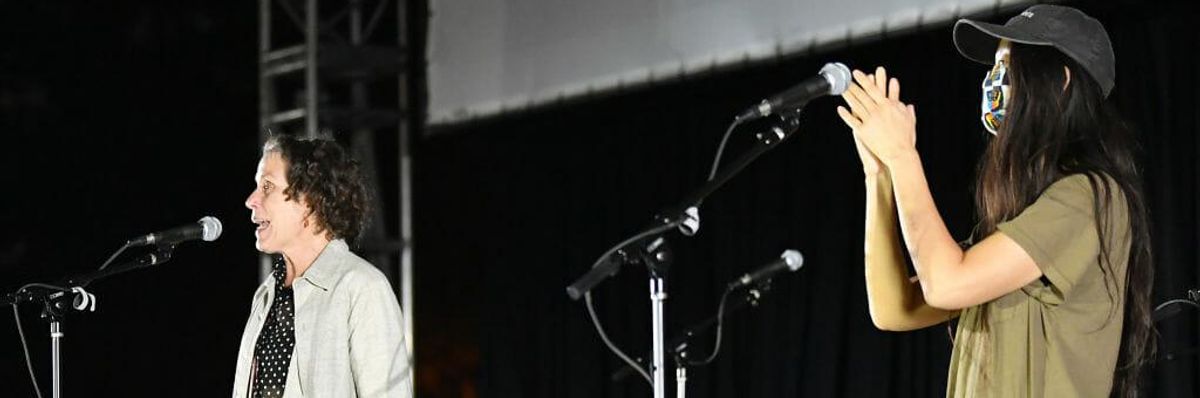
Frances McDormand and Chloe Zhao speak onstage at the drive-in premiere of Nomadland in Pasadena, California. (Photo by Amy Sussman/Getty Images)
If you grew up agitated that "women earn 59 cents on the dollar," for the same work as men, there's a movie for you.
At the beginning of the new film, Nomadland, one of the characters tells Fern, the lead character played beautifully by Frances McDormand: "My social security check is $550. How am I supposed to survive?"
In a film that is destined to win many accolades for McDormand and director Chloe Zhao, it's important to appreciate the context of the individual stories--and the deep reporting that brought it to light.
When I first read Jessica Bruder's work of non-fiction narrative, Nomadland: Surviving America in the Twenty-First Century, I told everyone I knew to read it.
As a work of nonfiction reporting, it opened up a whole world of people who described themselves as "houseless, but not homeless." Like Matthew Desmond's book Evicted, Bruder brought human faces to the statistics that sociologists puzzle over. What is the real impact of a life-time of unequal wages for women--and therefore lower Social Security payouts? How do elders, especially women, economically survive losing a home, a spouse, a community?
Nomadland powerfully depicts both emotional loss and the economic upheaval--and the skills people bring to survival.
It is true that the gender wage gap has slowly narrowed over the decades. The gap is still an unacceptable 82 cents on the dollar. But what about the women who earned 59 cents on the dollar for much of their work careers--and are now retired or approaching retirement? Or the women who took time away from the workforce to have and raise children, a job that is both uncompensated and, still, overwhelmingly held by moms, not dads?
As I wrote for the blog at Project Twist-It -about "reimagining how we talk about poverty":
For example, why do women retire with significantly lower Social Security benefits, after a lifetime of gender prejudiced earnings? I just read Jessicah Bruder's terrific book Nomadland, about elders who lose or give up their housing and live in mobile homes and vans and do seasonable as "workampers" at national parks, Amazon warehouses and beet harvests. Many of them are women with monthly social security checks of less than $700. If these women had been paid the same amount over their lifetimes as their male cohorts, they wouldn't be in the same circumstances.
A friend of mine from Arizona said that after reading Nomadland, she never looked at another van or mobile home camp the same. "I always thought these were snowbird retirees looking for some sunshine," she told me. "I didn't appreciate that for some of them, these were their homes."
Bruder spent three-years living with the nomads in her own van, documenting their vibrant community of the road, including the mutual aid and kinship networks--alongside the loneliness and precariousness. She accompanied her subjects as they worked the seasonal jobs--campground hosting at national and state parks, the beet harvest, seasonal gigs at Amazon warehouses, working 12 hour shifts in 70-year old bodies.
Many of these people would say they made a choice, that they choose the mobile life over the settled life. Most probably knew some aspect of a middle class life, but have the experience of being castaway, disposable workers in the Great Recession. Most but not all are white, taking advantage of the fact that they can travel the blue line highways and Walmart parking lots without the fear of racial terror.
Bruder was an advisor on the film--and without her insights, there would be no Nomadland. Common advice is you should read the book before the movie. But in this case the movie is so good, maybe it opens hearts and minds to another set of often invisible stories of people struggling in an unjust economic system.
Watch the movie. Then read the book.
Dear Common Dreams reader, It’s been nearly 30 years since I co-founded Common Dreams with my late wife, Lina Newhouser. We had the radical notion that journalism should serve the public good, not corporate profits. It was clear to us from the outset what it would take to build such a project. No paid advertisements. No corporate sponsors. No millionaire publisher telling us what to think or do. Many people said we wouldn't last a year, but we proved those doubters wrong. Together with a tremendous team of journalists and dedicated staff, we built an independent media outlet free from the constraints of profits and corporate control. Our mission has always been simple: To inform. To inspire. To ignite change for the common good. Building Common Dreams was not easy. Our survival was never guaranteed. When you take on the most powerful forces—Wall Street greed, fossil fuel industry destruction, Big Tech lobbyists, and uber-rich oligarchs who have spent billions upon billions rigging the economy and democracy in their favor—the only bulwark you have is supporters who believe in your work. But here’s the urgent message from me today. It's never been this bad out there. And it's never been this hard to keep us going. At the very moment Common Dreams is most needed, the threats we face are intensifying. We need your support now more than ever. We don't accept corporate advertising and never will. We don't have a paywall because we don't think people should be blocked from critical news based on their ability to pay. Everything we do is funded by the donations of readers like you. When everyone does the little they can afford, we are strong. But if that support retreats or dries up, so do we. Will you donate now to make sure Common Dreams not only survives but thrives? —Craig Brown, Co-founder |
If you grew up agitated that "women earn 59 cents on the dollar," for the same work as men, there's a movie for you.
At the beginning of the new film, Nomadland, one of the characters tells Fern, the lead character played beautifully by Frances McDormand: "My social security check is $550. How am I supposed to survive?"
In a film that is destined to win many accolades for McDormand and director Chloe Zhao, it's important to appreciate the context of the individual stories--and the deep reporting that brought it to light.
When I first read Jessica Bruder's work of non-fiction narrative, Nomadland: Surviving America in the Twenty-First Century, I told everyone I knew to read it.
As a work of nonfiction reporting, it opened up a whole world of people who described themselves as "houseless, but not homeless." Like Matthew Desmond's book Evicted, Bruder brought human faces to the statistics that sociologists puzzle over. What is the real impact of a life-time of unequal wages for women--and therefore lower Social Security payouts? How do elders, especially women, economically survive losing a home, a spouse, a community?
Nomadland powerfully depicts both emotional loss and the economic upheaval--and the skills people bring to survival.
It is true that the gender wage gap has slowly narrowed over the decades. The gap is still an unacceptable 82 cents on the dollar. But what about the women who earned 59 cents on the dollar for much of their work careers--and are now retired or approaching retirement? Or the women who took time away from the workforce to have and raise children, a job that is both uncompensated and, still, overwhelmingly held by moms, not dads?
As I wrote for the blog at Project Twist-It -about "reimagining how we talk about poverty":
For example, why do women retire with significantly lower Social Security benefits, after a lifetime of gender prejudiced earnings? I just read Jessicah Bruder's terrific book Nomadland, about elders who lose or give up their housing and live in mobile homes and vans and do seasonable as "workampers" at national parks, Amazon warehouses and beet harvests. Many of them are women with monthly social security checks of less than $700. If these women had been paid the same amount over their lifetimes as their male cohorts, they wouldn't be in the same circumstances.
A friend of mine from Arizona said that after reading Nomadland, she never looked at another van or mobile home camp the same. "I always thought these were snowbird retirees looking for some sunshine," she told me. "I didn't appreciate that for some of them, these were their homes."
Bruder spent three-years living with the nomads in her own van, documenting their vibrant community of the road, including the mutual aid and kinship networks--alongside the loneliness and precariousness. She accompanied her subjects as they worked the seasonal jobs--campground hosting at national and state parks, the beet harvest, seasonal gigs at Amazon warehouses, working 12 hour shifts in 70-year old bodies.
Many of these people would say they made a choice, that they choose the mobile life over the settled life. Most probably knew some aspect of a middle class life, but have the experience of being castaway, disposable workers in the Great Recession. Most but not all are white, taking advantage of the fact that they can travel the blue line highways and Walmart parking lots without the fear of racial terror.
Bruder was an advisor on the film--and without her insights, there would be no Nomadland. Common advice is you should read the book before the movie. But in this case the movie is so good, maybe it opens hearts and minds to another set of often invisible stories of people struggling in an unjust economic system.
Watch the movie. Then read the book.
If you grew up agitated that "women earn 59 cents on the dollar," for the same work as men, there's a movie for you.
At the beginning of the new film, Nomadland, one of the characters tells Fern, the lead character played beautifully by Frances McDormand: "My social security check is $550. How am I supposed to survive?"
In a film that is destined to win many accolades for McDormand and director Chloe Zhao, it's important to appreciate the context of the individual stories--and the deep reporting that brought it to light.
When I first read Jessica Bruder's work of non-fiction narrative, Nomadland: Surviving America in the Twenty-First Century, I told everyone I knew to read it.
As a work of nonfiction reporting, it opened up a whole world of people who described themselves as "houseless, but not homeless." Like Matthew Desmond's book Evicted, Bruder brought human faces to the statistics that sociologists puzzle over. What is the real impact of a life-time of unequal wages for women--and therefore lower Social Security payouts? How do elders, especially women, economically survive losing a home, a spouse, a community?
Nomadland powerfully depicts both emotional loss and the economic upheaval--and the skills people bring to survival.
It is true that the gender wage gap has slowly narrowed over the decades. The gap is still an unacceptable 82 cents on the dollar. But what about the women who earned 59 cents on the dollar for much of their work careers--and are now retired or approaching retirement? Or the women who took time away from the workforce to have and raise children, a job that is both uncompensated and, still, overwhelmingly held by moms, not dads?
As I wrote for the blog at Project Twist-It -about "reimagining how we talk about poverty":
For example, why do women retire with significantly lower Social Security benefits, after a lifetime of gender prejudiced earnings? I just read Jessicah Bruder's terrific book Nomadland, about elders who lose or give up their housing and live in mobile homes and vans and do seasonable as "workampers" at national parks, Amazon warehouses and beet harvests. Many of them are women with monthly social security checks of less than $700. If these women had been paid the same amount over their lifetimes as their male cohorts, they wouldn't be in the same circumstances.
A friend of mine from Arizona said that after reading Nomadland, she never looked at another van or mobile home camp the same. "I always thought these were snowbird retirees looking for some sunshine," she told me. "I didn't appreciate that for some of them, these were their homes."
Bruder spent three-years living with the nomads in her own van, documenting their vibrant community of the road, including the mutual aid and kinship networks--alongside the loneliness and precariousness. She accompanied her subjects as they worked the seasonal jobs--campground hosting at national and state parks, the beet harvest, seasonal gigs at Amazon warehouses, working 12 hour shifts in 70-year old bodies.
Many of these people would say they made a choice, that they choose the mobile life over the settled life. Most probably knew some aspect of a middle class life, but have the experience of being castaway, disposable workers in the Great Recession. Most but not all are white, taking advantage of the fact that they can travel the blue line highways and Walmart parking lots without the fear of racial terror.
Bruder was an advisor on the film--and without her insights, there would be no Nomadland. Common advice is you should read the book before the movie. But in this case the movie is so good, maybe it opens hearts and minds to another set of often invisible stories of people struggling in an unjust economic system.
Watch the movie. Then read the book.