SUBSCRIBE TO OUR FREE NEWSLETTER
Daily news & progressive opinion—funded by the people, not the corporations—delivered straight to your inbox.
5
#000000
#FFFFFF
To donate by check, phone, or other method, see our More Ways to Give page.
Daily news & progressive opinion—funded by the people, not the corporations—delivered straight to your inbox.
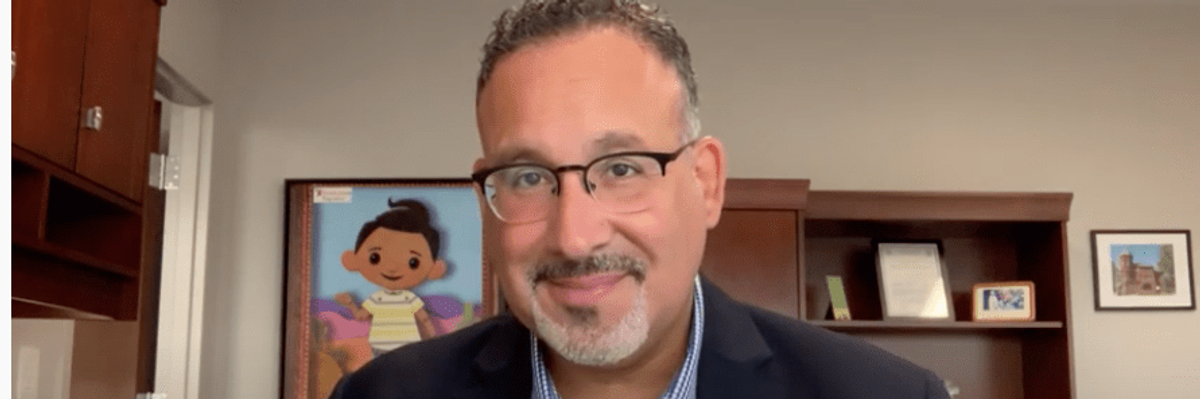
Miguel Cardona, whom President-elect Joe Biden has chosen to be his education secretary, speaks to educators earlier this year. (Photo: YouTube/State Education Resource Center)
President Elect Joe Biden on Tuesday announced his intention to nominate Miguel Cardona, a former public school principal who is Connecticut's education commissioner, for education secretary. The role is crucial, as Cardona would assume the top position at the Education Department as debates swirl about when and how to safely reopen schools and address inequalities aggravated by the Covid-19 pandemic.
Assuming he is confirmed by the Senate and takes office, Cardona will face a number of difficult decisions. But here's an easy one: He should do everything in his power to keep facial recognition technology out of our schools.
Surveillance breeds conformity and obedience, which hurts our kids' ability to learn and be creative.
We've only begun to see the potential harms associated with facial recognition and algorithmic decision-making; deploying these technologies in the classroom amounts to unethical experimentation on children. And while we don't yet know the full long-term impact, the current effects of these technologies are -- or should be -- setting off human rights alarm bells.
Today's facial recognition algorithms exhibit systemic racial and gender bias, making them more likely to misidentify or incorrectly flag people with darker skin, women and anyone who doesn't conform to gender stereotypes. It is even less accurate on children. In practice, this would mean Black and brown students and LGBTQ students -- as well as parents, faculty members and staff members who are Black, brown and/or LGBTQ -- could be stopped and harassed by school police because of false matches or marked absent from distance learning by automated attendance systems that fail to recognize their humanity. A transgender college student could be locked out of their dorm by a camera that can't identify them. A student activist group could be tracked and punished for organizing a protest.
Surveillance breeds conformity and obedience, which hurts our kids' ability to learn and be creative. Even if the accuracy of facial recognition algorithms improves, the technology is still fundamentally flawed. Experts have suggested that it is so harmful that the risks far outweigh any potential benefits, comparing it to nuclear weapons or lead paint.
It's no surprise, then, that schools that have dabbled in using facial recognition have faced massive backlash from students and civil rights groups. A student-led campaign last year prompted more than 60 of the most prominent colleges and universities in the U.S. to say they won't use facial recognition on their campuses. In perhaps the starkest turnaround, UCLA reversed its plan to implement facial recognition surveillance on campus, instead instituting a policy that bans it entirely.
Deploying these technologies in the classroom amounts to unethical experimentation on children.
But despite the overwhelming backlash and evidence of harm, facial recognition is still creeping into our schools. Surveillance tech vendors have shamelessly exploited the Covid-19 pandemic to promote their ineffective and discriminatory technology, and school officials who are desperate to calm anxious parents and frustrated teachers are increasingly enticed by the promise of technologies that won't actually make schools safer.
An investigation by Wired found that dozens of school districts had purchased temperature monitoring devices that were also equipped with facial recognition. A district in Georgia even purchased thermal imaging cameras from Hikvision, a company that has since been barred from selling its products in the U.S. because of its complicity in human rights violations targeting the Uighur people in China.
Privacy-violating technology has been spreading in districts where students have been learning remotely during the pandemic. Horror stories about monitoring apps that use facial detection, like Proctorio and Honorlock, have gone viral on social media. Students of color taking the bar exam remotely were forced to shine a bright, headache-inducing light into their faces for the entire two-day test, while data about hundreds of thousands of students who used ProctorU leaked this summer.
The use of facial recognition in schools should be banned -- full stop -- which is a job for legislators. We've seen increasing bipartisan interest in Congress, and several prominent lawmakers have proposed a federal ban on law enforcement use of the tech. But passing legislation will take time; facial recognition companies have already been aggressively pushing their software on schools, and kids are being monitored by this technology right now.
It's only going to get worse.
Dear Common Dreams reader, It’s been nearly 30 years since I co-founded Common Dreams with my late wife, Lina Newhouser. We had the radical notion that journalism should serve the public good, not corporate profits. It was clear to us from the outset what it would take to build such a project. No paid advertisements. No corporate sponsors. No millionaire publisher telling us what to think or do. Many people said we wouldn't last a year, but we proved those doubters wrong. Together with a tremendous team of journalists and dedicated staff, we built an independent media outlet free from the constraints of profits and corporate control. Our mission has always been simple: To inform. To inspire. To ignite change for the common good. Building Common Dreams was not easy. Our survival was never guaranteed. When you take on the most powerful forces—Wall Street greed, fossil fuel industry destruction, Big Tech lobbyists, and uber-rich oligarchs who have spent billions upon billions rigging the economy and democracy in their favor—the only bulwark you have is supporters who believe in your work. But here’s the urgent message from me today. It's never been this bad out there. And it's never been this hard to keep us going. At the very moment Common Dreams is most needed, the threats we face are intensifying. We need your support now more than ever. We don't accept corporate advertising and never will. We don't have a paywall because we don't think people should be blocked from critical news based on their ability to pay. Everything we do is funded by the donations of readers like you. When everyone does the little they can afford, we are strong. But if that support retreats or dries up, so do we. Will you donate now to make sure Common Dreams not only survives but thrives? —Craig Brown, Co-founder |
President Elect Joe Biden on Tuesday announced his intention to nominate Miguel Cardona, a former public school principal who is Connecticut's education commissioner, for education secretary. The role is crucial, as Cardona would assume the top position at the Education Department as debates swirl about when and how to safely reopen schools and address inequalities aggravated by the Covid-19 pandemic.
Assuming he is confirmed by the Senate and takes office, Cardona will face a number of difficult decisions. But here's an easy one: He should do everything in his power to keep facial recognition technology out of our schools.
Surveillance breeds conformity and obedience, which hurts our kids' ability to learn and be creative.
We've only begun to see the potential harms associated with facial recognition and algorithmic decision-making; deploying these technologies in the classroom amounts to unethical experimentation on children. And while we don't yet know the full long-term impact, the current effects of these technologies are -- or should be -- setting off human rights alarm bells.
Today's facial recognition algorithms exhibit systemic racial and gender bias, making them more likely to misidentify or incorrectly flag people with darker skin, women and anyone who doesn't conform to gender stereotypes. It is even less accurate on children. In practice, this would mean Black and brown students and LGBTQ students -- as well as parents, faculty members and staff members who are Black, brown and/or LGBTQ -- could be stopped and harassed by school police because of false matches or marked absent from distance learning by automated attendance systems that fail to recognize their humanity. A transgender college student could be locked out of their dorm by a camera that can't identify them. A student activist group could be tracked and punished for organizing a protest.
Surveillance breeds conformity and obedience, which hurts our kids' ability to learn and be creative. Even if the accuracy of facial recognition algorithms improves, the technology is still fundamentally flawed. Experts have suggested that it is so harmful that the risks far outweigh any potential benefits, comparing it to nuclear weapons or lead paint.
It's no surprise, then, that schools that have dabbled in using facial recognition have faced massive backlash from students and civil rights groups. A student-led campaign last year prompted more than 60 of the most prominent colleges and universities in the U.S. to say they won't use facial recognition on their campuses. In perhaps the starkest turnaround, UCLA reversed its plan to implement facial recognition surveillance on campus, instead instituting a policy that bans it entirely.
Deploying these technologies in the classroom amounts to unethical experimentation on children.
But despite the overwhelming backlash and evidence of harm, facial recognition is still creeping into our schools. Surveillance tech vendors have shamelessly exploited the Covid-19 pandemic to promote their ineffective and discriminatory technology, and school officials who are desperate to calm anxious parents and frustrated teachers are increasingly enticed by the promise of technologies that won't actually make schools safer.
An investigation by Wired found that dozens of school districts had purchased temperature monitoring devices that were also equipped with facial recognition. A district in Georgia even purchased thermal imaging cameras from Hikvision, a company that has since been barred from selling its products in the U.S. because of its complicity in human rights violations targeting the Uighur people in China.
Privacy-violating technology has been spreading in districts where students have been learning remotely during the pandemic. Horror stories about monitoring apps that use facial detection, like Proctorio and Honorlock, have gone viral on social media. Students of color taking the bar exam remotely were forced to shine a bright, headache-inducing light into their faces for the entire two-day test, while data about hundreds of thousands of students who used ProctorU leaked this summer.
The use of facial recognition in schools should be banned -- full stop -- which is a job for legislators. We've seen increasing bipartisan interest in Congress, and several prominent lawmakers have proposed a federal ban on law enforcement use of the tech. But passing legislation will take time; facial recognition companies have already been aggressively pushing their software on schools, and kids are being monitored by this technology right now.
It's only going to get worse.
President Elect Joe Biden on Tuesday announced his intention to nominate Miguel Cardona, a former public school principal who is Connecticut's education commissioner, for education secretary. The role is crucial, as Cardona would assume the top position at the Education Department as debates swirl about when and how to safely reopen schools and address inequalities aggravated by the Covid-19 pandemic.
Assuming he is confirmed by the Senate and takes office, Cardona will face a number of difficult decisions. But here's an easy one: He should do everything in his power to keep facial recognition technology out of our schools.
Surveillance breeds conformity and obedience, which hurts our kids' ability to learn and be creative.
We've only begun to see the potential harms associated with facial recognition and algorithmic decision-making; deploying these technologies in the classroom amounts to unethical experimentation on children. And while we don't yet know the full long-term impact, the current effects of these technologies are -- or should be -- setting off human rights alarm bells.
Today's facial recognition algorithms exhibit systemic racial and gender bias, making them more likely to misidentify or incorrectly flag people with darker skin, women and anyone who doesn't conform to gender stereotypes. It is even less accurate on children. In practice, this would mean Black and brown students and LGBTQ students -- as well as parents, faculty members and staff members who are Black, brown and/or LGBTQ -- could be stopped and harassed by school police because of false matches or marked absent from distance learning by automated attendance systems that fail to recognize their humanity. A transgender college student could be locked out of their dorm by a camera that can't identify them. A student activist group could be tracked and punished for organizing a protest.
Surveillance breeds conformity and obedience, which hurts our kids' ability to learn and be creative. Even if the accuracy of facial recognition algorithms improves, the technology is still fundamentally flawed. Experts have suggested that it is so harmful that the risks far outweigh any potential benefits, comparing it to nuclear weapons or lead paint.
It's no surprise, then, that schools that have dabbled in using facial recognition have faced massive backlash from students and civil rights groups. A student-led campaign last year prompted more than 60 of the most prominent colleges and universities in the U.S. to say they won't use facial recognition on their campuses. In perhaps the starkest turnaround, UCLA reversed its plan to implement facial recognition surveillance on campus, instead instituting a policy that bans it entirely.
Deploying these technologies in the classroom amounts to unethical experimentation on children.
But despite the overwhelming backlash and evidence of harm, facial recognition is still creeping into our schools. Surveillance tech vendors have shamelessly exploited the Covid-19 pandemic to promote their ineffective and discriminatory technology, and school officials who are desperate to calm anxious parents and frustrated teachers are increasingly enticed by the promise of technologies that won't actually make schools safer.
An investigation by Wired found that dozens of school districts had purchased temperature monitoring devices that were also equipped with facial recognition. A district in Georgia even purchased thermal imaging cameras from Hikvision, a company that has since been barred from selling its products in the U.S. because of its complicity in human rights violations targeting the Uighur people in China.
Privacy-violating technology has been spreading in districts where students have been learning remotely during the pandemic. Horror stories about monitoring apps that use facial detection, like Proctorio and Honorlock, have gone viral on social media. Students of color taking the bar exam remotely were forced to shine a bright, headache-inducing light into their faces for the entire two-day test, while data about hundreds of thousands of students who used ProctorU leaked this summer.
The use of facial recognition in schools should be banned -- full stop -- which is a job for legislators. We've seen increasing bipartisan interest in Congress, and several prominent lawmakers have proposed a federal ban on law enforcement use of the tech. But passing legislation will take time; facial recognition companies have already been aggressively pushing their software on schools, and kids are being monitored by this technology right now.
It's only going to get worse.