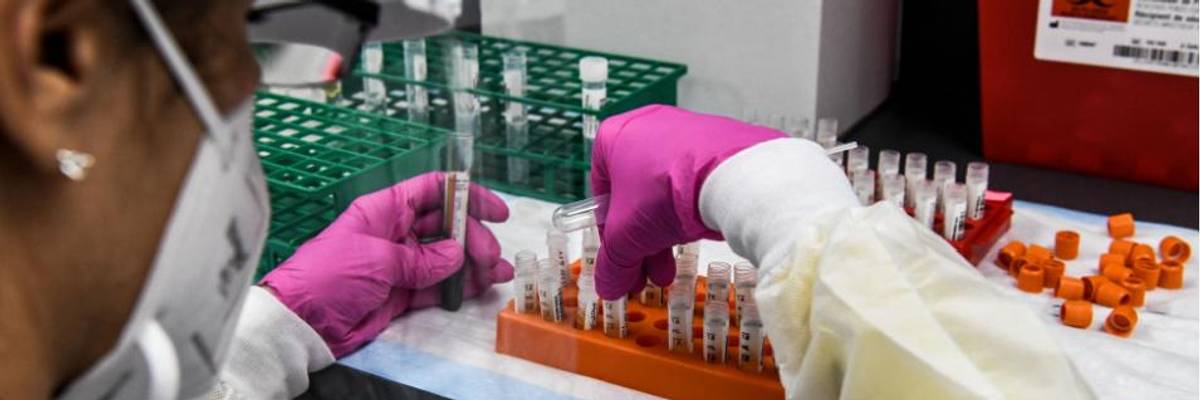
A lab technician sorts blood samples inside a lab for a Covid-19 vaccine study at the Research Centers of America (RCA) in Hollywood, Florida, on August 13, 2020. (Photo: Chandan Khanna/AFP via Getty Images)
The Rain on Our Yes-We-Now-Have-a-Vaccine! Parade
What could be better than a drug that can stop Covid? A society that doesn’t let some make billions off a drug millions can’t access
Who doesn't like a race? A grand global race, like the competition to run the first mile under four minutes. Or the race to scale the world's highest mountain. Or be the first to walk on the moon.
Now we find ourselves in a race of much greater import: the dash to develop an effective vaccine for Covid-19. The world now watches with that fabled bated breath. Pfizer, a Big Pharma behemoth, is running neck-in-neck with Moderna, a lavishly funded corporate upstart.
Pfizer, first to announce trial results, reports 90 percent effectiveness rates for its pandemic-stopper. Moderna, not to be outdone, reports 95 percent success rates. We actually hit that brass ring, too, retorts Pfizer. And ours even works with older people!
What a race! How exciting! More to the point: How lucrative!
This race is minting billionaires. The founder of Pfizer's partner company, BioNTech, achieved billionaire status earlier this year. Earlier this month, that founder and his two top investors saw their personal fortunes leap a combined $2 billion. At Moderna, three top players, including the CEO Stephane Bancel, have become billionaires so far this year.
Various other pharmaceutical industry movers and shakers -- like the hedge fund behind Vaxart, a San Francisco concern -- have made hundreds of millions.
"Every day, Americans wake up and make sacrifices during this pandemic," says Ben Wakana, the executive director at Patients for Affordable Drugs. "Drug companies see this as a payday."
The headlines that trumpet coronavirus boondoggles have become, in effect, the rain on our yes-we-now-have-a-vaccine! parade. How could some be making billions off the horror that's killing millions?
The biggest tragedy of all: Things don't have to be this way. Over a half-century ago, we conquered polio, and no one became fabulously rich in the process. We could have done the same with Covid-19.
We could have brought the world's nations all together, funneled resources into multiple beat-corona approaches, and pledged to share -- with researchers everywhere -- the latest medical breakthroughs in real-time. The Trump crew had no interest in that approach, and Democrats in Congress made no big push for an alternative. A lost opportunity.
"The Trump administration opted to pursue a route of patent monopoly research, as opposed to open-source collaborative research," explains Center for Economic and Policy Research economist Dean Baker. "Instead of paying for the research costs of a company like Moderna, and then telling them they could get a patent monopoly so that they could charge whatever they want, we could have made the condition of the funding that all its findings would be fully public and patents would be in the public domain."
With patents for Covid-19 vaccines under private control, adds Global Justice Now policy advisor Heidi Chow, Big Pharma's power players get to decide "who gets the vaccine and at what price."
And so we now have some promising vaccines but no global gameplan for assuring every person on Earth ready and timely access to a future sans Covid. Millions more of us will suffer while a fortunate few of us make multiple billions. We can do better, and advocacy groups like Global Justice Now are organizing to make that better happen.
Some 78 percent of Moderna's vaccine doses, Global Justice Now points out, has already been sold to rich nations with only 12 percent of the world's population.
"In this global health emergency, vaccines should be available to all, everywhere, free of charge," says a new Global Justice Now campaign for Covid-19 justice. "Manufacturers should be working together to produce enough doses for everyone, distributed in order of need. And companies and governments should be cooperating through the World Health Organization to make this happen."
We are at a crossroads
This country and this world are at a monumental crossroads. In a few short weeks, US voters will have an opportunity to beat back the forces of fascism and confront the billionaires who are rigging the economy, our media system, and our democracy, making it increasingly impossible for ordinary people to get by. We’re not just talking about the election. We’re talking about what must be done once these fascist elements are vanquished from power. We need a bolder set of solutions than what either major party has so far been willing to offer and a working-class movement ready to fight like hell for it. Trump didn't emerge from nowhere. The conditions that fueled MAGA authoritarianism were created by decades of radical neoliberal economic policies and a corrupt political system dominated by corporate interests. They slashed taxes on the super-rich, promising that the benefits would trickle down. They said giveaways to the corporate titans would make life more affordable for the rest of us. It was all bullshit. And when a bitter, betrayed populace searches for someone to blame, right-wing demagogues have little trouble finding scapegoats. People know when they're being lied to, but you won't hear any of this from the corporate media. Only independent journalism—powered and funded by people who believe in building a better world—can deliver truly trustworthy daily news. Our Fall Campaign is underway, and we need your help. To power our newsroom through the rest of the year, we need to raise $125,000 by midnight on October 31. So if you share our vision, please contribute whatever you can to sustain our work. |
Who doesn't like a race? A grand global race, like the competition to run the first mile under four minutes. Or the race to scale the world's highest mountain. Or be the first to walk on the moon.
Now we find ourselves in a race of much greater import: the dash to develop an effective vaccine for Covid-19. The world now watches with that fabled bated breath. Pfizer, a Big Pharma behemoth, is running neck-in-neck with Moderna, a lavishly funded corporate upstart.
Pfizer, first to announce trial results, reports 90 percent effectiveness rates for its pandemic-stopper. Moderna, not to be outdone, reports 95 percent success rates. We actually hit that brass ring, too, retorts Pfizer. And ours even works with older people!
What a race! How exciting! More to the point: How lucrative!
This race is minting billionaires. The founder of Pfizer's partner company, BioNTech, achieved billionaire status earlier this year. Earlier this month, that founder and his two top investors saw their personal fortunes leap a combined $2 billion. At Moderna, three top players, including the CEO Stephane Bancel, have become billionaires so far this year.
Various other pharmaceutical industry movers and shakers -- like the hedge fund behind Vaxart, a San Francisco concern -- have made hundreds of millions.
"Every day, Americans wake up and make sacrifices during this pandemic," says Ben Wakana, the executive director at Patients for Affordable Drugs. "Drug companies see this as a payday."
The headlines that trumpet coronavirus boondoggles have become, in effect, the rain on our yes-we-now-have-a-vaccine! parade. How could some be making billions off the horror that's killing millions?
The biggest tragedy of all: Things don't have to be this way. Over a half-century ago, we conquered polio, and no one became fabulously rich in the process. We could have done the same with Covid-19.
We could have brought the world's nations all together, funneled resources into multiple beat-corona approaches, and pledged to share -- with researchers everywhere -- the latest medical breakthroughs in real-time. The Trump crew had no interest in that approach, and Democrats in Congress made no big push for an alternative. A lost opportunity.
"The Trump administration opted to pursue a route of patent monopoly research, as opposed to open-source collaborative research," explains Center for Economic and Policy Research economist Dean Baker. "Instead of paying for the research costs of a company like Moderna, and then telling them they could get a patent monopoly so that they could charge whatever they want, we could have made the condition of the funding that all its findings would be fully public and patents would be in the public domain."
With patents for Covid-19 vaccines under private control, adds Global Justice Now policy advisor Heidi Chow, Big Pharma's power players get to decide "who gets the vaccine and at what price."
And so we now have some promising vaccines but no global gameplan for assuring every person on Earth ready and timely access to a future sans Covid. Millions more of us will suffer while a fortunate few of us make multiple billions. We can do better, and advocacy groups like Global Justice Now are organizing to make that better happen.
Some 78 percent of Moderna's vaccine doses, Global Justice Now points out, has already been sold to rich nations with only 12 percent of the world's population.
"In this global health emergency, vaccines should be available to all, everywhere, free of charge," says a new Global Justice Now campaign for Covid-19 justice. "Manufacturers should be working together to produce enough doses for everyone, distributed in order of need. And companies and governments should be cooperating through the World Health Organization to make this happen."
Who doesn't like a race? A grand global race, like the competition to run the first mile under four minutes. Or the race to scale the world's highest mountain. Or be the first to walk on the moon.
Now we find ourselves in a race of much greater import: the dash to develop an effective vaccine for Covid-19. The world now watches with that fabled bated breath. Pfizer, a Big Pharma behemoth, is running neck-in-neck with Moderna, a lavishly funded corporate upstart.
Pfizer, first to announce trial results, reports 90 percent effectiveness rates for its pandemic-stopper. Moderna, not to be outdone, reports 95 percent success rates. We actually hit that brass ring, too, retorts Pfizer. And ours even works with older people!
What a race! How exciting! More to the point: How lucrative!
This race is minting billionaires. The founder of Pfizer's partner company, BioNTech, achieved billionaire status earlier this year. Earlier this month, that founder and his two top investors saw their personal fortunes leap a combined $2 billion. At Moderna, three top players, including the CEO Stephane Bancel, have become billionaires so far this year.
Various other pharmaceutical industry movers and shakers -- like the hedge fund behind Vaxart, a San Francisco concern -- have made hundreds of millions.
"Every day, Americans wake up and make sacrifices during this pandemic," says Ben Wakana, the executive director at Patients for Affordable Drugs. "Drug companies see this as a payday."
The headlines that trumpet coronavirus boondoggles have become, in effect, the rain on our yes-we-now-have-a-vaccine! parade. How could some be making billions off the horror that's killing millions?
The biggest tragedy of all: Things don't have to be this way. Over a half-century ago, we conquered polio, and no one became fabulously rich in the process. We could have done the same with Covid-19.
We could have brought the world's nations all together, funneled resources into multiple beat-corona approaches, and pledged to share -- with researchers everywhere -- the latest medical breakthroughs in real-time. The Trump crew had no interest in that approach, and Democrats in Congress made no big push for an alternative. A lost opportunity.
"The Trump administration opted to pursue a route of patent monopoly research, as opposed to open-source collaborative research," explains Center for Economic and Policy Research economist Dean Baker. "Instead of paying for the research costs of a company like Moderna, and then telling them they could get a patent monopoly so that they could charge whatever they want, we could have made the condition of the funding that all its findings would be fully public and patents would be in the public domain."
With patents for Covid-19 vaccines under private control, adds Global Justice Now policy advisor Heidi Chow, Big Pharma's power players get to decide "who gets the vaccine and at what price."
And so we now have some promising vaccines but no global gameplan for assuring every person on Earth ready and timely access to a future sans Covid. Millions more of us will suffer while a fortunate few of us make multiple billions. We can do better, and advocacy groups like Global Justice Now are organizing to make that better happen.
Some 78 percent of Moderna's vaccine doses, Global Justice Now points out, has already been sold to rich nations with only 12 percent of the world's population.
"In this global health emergency, vaccines should be available to all, everywhere, free of charge," says a new Global Justice Now campaign for Covid-19 justice. "Manufacturers should be working together to produce enough doses for everyone, distributed in order of need. And companies and governments should be cooperating through the World Health Organization to make this happen."