SUBSCRIBE TO OUR FREE NEWSLETTER
Daily news & progressive opinion—funded by the people, not the corporations—delivered straight to your inbox.
5
#000000
#FFFFFF
To donate by check, phone, or other method, see our More Ways to Give page.
Daily news & progressive opinion—funded by the people, not the corporations—delivered straight to your inbox.
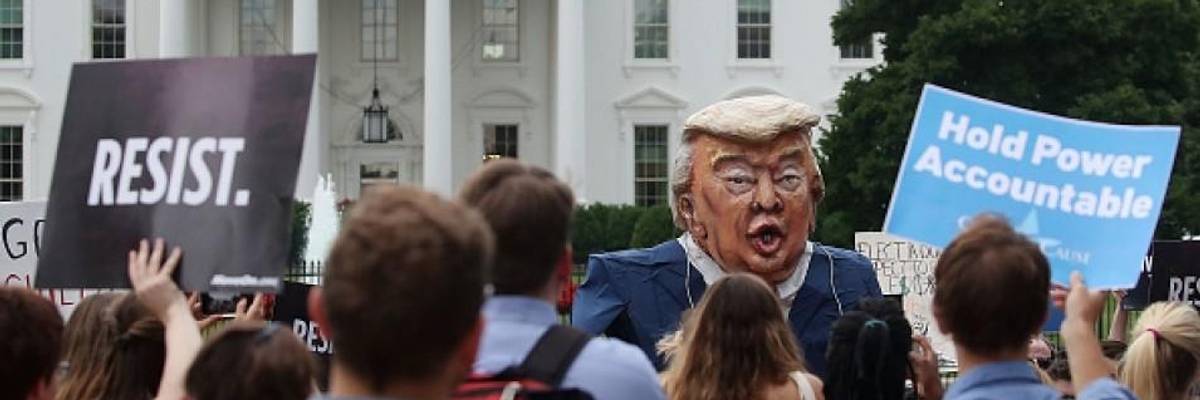
People protest against U.S. President Donald Trump in front of the White House on July 11, 2017 in Washington, D.C. (Photo: Mark Wilson/Getty Images)
Disturbing as it is to see politicians and pundits advising a Biden administration to vehemently reject progressive policy goals, there's more. As Eoin Higgins notes in a piece for Business Insider (10/30/20), a concurrent strain of argument is that Trump himself should face no real public reckoning. Higgins cites a column by historian Jill Lepore in the Washington Post (10/16/20)--heralded as "eloquent" by the New York Times' Nicholas Kristof (Twitter, 10/18/20): "Let History, Not Partisans, Prosecute Trump."
Lepore, a Harvard professor, says it would be inappropriate to have a reconciliation commission like other countries have had; Trump's "wrongdoing" instead "should be investigated by journalists, chronicled by historians and, in some instances, tried in ordinary courts." How those courts can adequately address such "wrongdoing" as allowing, through corruption and mismanagement, the deaths of hundreds of thousands of people is unclear. Her moral point is, though: "Many Trump critics will find this suggestion maddeningly insufficient," Lepore notes, but chides "the appetite for vengeance is a symptom of the same poison."
The call to coddle Trump--like the same outlets' insistence that it would be mean to send bankers whose fraud derailed the economy to jail--is evidence of the total divorce between real people's lives and experiences, and the puppets and caricatures in media's narrative. There is no accountability to the millions of people who lost their lives, their loved ones, their homes, their jobs. Then as now, protecting the status quo involves marginalizing calls for justice, by portraying them as an "emotional" desire for "vengeance," better tempered by cooler heads.
"Higher capital requirements may not satisfy blood lust the way a CEO in chains would," wrote the Washington Post (9/12/13) in 2013, "but they're going to do a lot more." At the New York Times (2/25/11), it was: "You're entitled to wonder whether any of the highly paid executives who helped kindle the disaster will ever see jail time. The harder question, though, is whether anybody should."
The call to let Trump go gently also evokes the call not to prosecute those who committed acts of torture for the US--purporting to be some sort of healing gesture about "looking forward, not back," while in fact preserving the conditions that led to the horrors. Now as then, doing what we're told is the dry-eyed, grown-up thing to do involves erasing the real harms done to real people. That's not "politic," or "pragmatic"--it's perverse.
Dear Common Dreams reader, It’s been nearly 30 years since I co-founded Common Dreams with my late wife, Lina Newhouser. We had the radical notion that journalism should serve the public good, not corporate profits. It was clear to us from the outset what it would take to build such a project. No paid advertisements. No corporate sponsors. No millionaire publisher telling us what to think or do. Many people said we wouldn't last a year, but we proved those doubters wrong. Together with a tremendous team of journalists and dedicated staff, we built an independent media outlet free from the constraints of profits and corporate control. Our mission has always been simple: To inform. To inspire. To ignite change for the common good. Building Common Dreams was not easy. Our survival was never guaranteed. When you take on the most powerful forces—Wall Street greed, fossil fuel industry destruction, Big Tech lobbyists, and uber-rich oligarchs who have spent billions upon billions rigging the economy and democracy in their favor—the only bulwark you have is supporters who believe in your work. But here’s the urgent message from me today. It's never been this bad out there. And it's never been this hard to keep us going. At the very moment Common Dreams is most needed, the threats we face are intensifying. We need your support now more than ever. We don't accept corporate advertising and never will. We don't have a paywall because we don't think people should be blocked from critical news based on their ability to pay. Everything we do is funded by the donations of readers like you. When everyone does the little they can afford, we are strong. But if that support retreats or dries up, so do we. Will you donate now to make sure Common Dreams not only survives but thrives? —Craig Brown, Co-founder |
Disturbing as it is to see politicians and pundits advising a Biden administration to vehemently reject progressive policy goals, there's more. As Eoin Higgins notes in a piece for Business Insider (10/30/20), a concurrent strain of argument is that Trump himself should face no real public reckoning. Higgins cites a column by historian Jill Lepore in the Washington Post (10/16/20)--heralded as "eloquent" by the New York Times' Nicholas Kristof (Twitter, 10/18/20): "Let History, Not Partisans, Prosecute Trump."
Lepore, a Harvard professor, says it would be inappropriate to have a reconciliation commission like other countries have had; Trump's "wrongdoing" instead "should be investigated by journalists, chronicled by historians and, in some instances, tried in ordinary courts." How those courts can adequately address such "wrongdoing" as allowing, through corruption and mismanagement, the deaths of hundreds of thousands of people is unclear. Her moral point is, though: "Many Trump critics will find this suggestion maddeningly insufficient," Lepore notes, but chides "the appetite for vengeance is a symptom of the same poison."
The call to coddle Trump--like the same outlets' insistence that it would be mean to send bankers whose fraud derailed the economy to jail--is evidence of the total divorce between real people's lives and experiences, and the puppets and caricatures in media's narrative. There is no accountability to the millions of people who lost their lives, their loved ones, their homes, their jobs. Then as now, protecting the status quo involves marginalizing calls for justice, by portraying them as an "emotional" desire for "vengeance," better tempered by cooler heads.
"Higher capital requirements may not satisfy blood lust the way a CEO in chains would," wrote the Washington Post (9/12/13) in 2013, "but they're going to do a lot more." At the New York Times (2/25/11), it was: "You're entitled to wonder whether any of the highly paid executives who helped kindle the disaster will ever see jail time. The harder question, though, is whether anybody should."
The call to let Trump go gently also evokes the call not to prosecute those who committed acts of torture for the US--purporting to be some sort of healing gesture about "looking forward, not back," while in fact preserving the conditions that led to the horrors. Now as then, doing what we're told is the dry-eyed, grown-up thing to do involves erasing the real harms done to real people. That's not "politic," or "pragmatic"--it's perverse.
Disturbing as it is to see politicians and pundits advising a Biden administration to vehemently reject progressive policy goals, there's more. As Eoin Higgins notes in a piece for Business Insider (10/30/20), a concurrent strain of argument is that Trump himself should face no real public reckoning. Higgins cites a column by historian Jill Lepore in the Washington Post (10/16/20)--heralded as "eloquent" by the New York Times' Nicholas Kristof (Twitter, 10/18/20): "Let History, Not Partisans, Prosecute Trump."
Lepore, a Harvard professor, says it would be inappropriate to have a reconciliation commission like other countries have had; Trump's "wrongdoing" instead "should be investigated by journalists, chronicled by historians and, in some instances, tried in ordinary courts." How those courts can adequately address such "wrongdoing" as allowing, through corruption and mismanagement, the deaths of hundreds of thousands of people is unclear. Her moral point is, though: "Many Trump critics will find this suggestion maddeningly insufficient," Lepore notes, but chides "the appetite for vengeance is a symptom of the same poison."
The call to coddle Trump--like the same outlets' insistence that it would be mean to send bankers whose fraud derailed the economy to jail--is evidence of the total divorce between real people's lives and experiences, and the puppets and caricatures in media's narrative. There is no accountability to the millions of people who lost their lives, their loved ones, their homes, their jobs. Then as now, protecting the status quo involves marginalizing calls for justice, by portraying them as an "emotional" desire for "vengeance," better tempered by cooler heads.
"Higher capital requirements may not satisfy blood lust the way a CEO in chains would," wrote the Washington Post (9/12/13) in 2013, "but they're going to do a lot more." At the New York Times (2/25/11), it was: "You're entitled to wonder whether any of the highly paid executives who helped kindle the disaster will ever see jail time. The harder question, though, is whether anybody should."
The call to let Trump go gently also evokes the call not to prosecute those who committed acts of torture for the US--purporting to be some sort of healing gesture about "looking forward, not back," while in fact preserving the conditions that led to the horrors. Now as then, doing what we're told is the dry-eyed, grown-up thing to do involves erasing the real harms done to real people. That's not "politic," or "pragmatic"--it's perverse.