SUBSCRIBE TO OUR FREE NEWSLETTER
Daily news & progressive opinion—funded by the people, not the corporations—delivered straight to your inbox.
5
#000000
#FFFFFF
To donate by check, phone, or other method, see our More Ways to Give page.
Daily news & progressive opinion—funded by the people, not the corporations—delivered straight to your inbox.
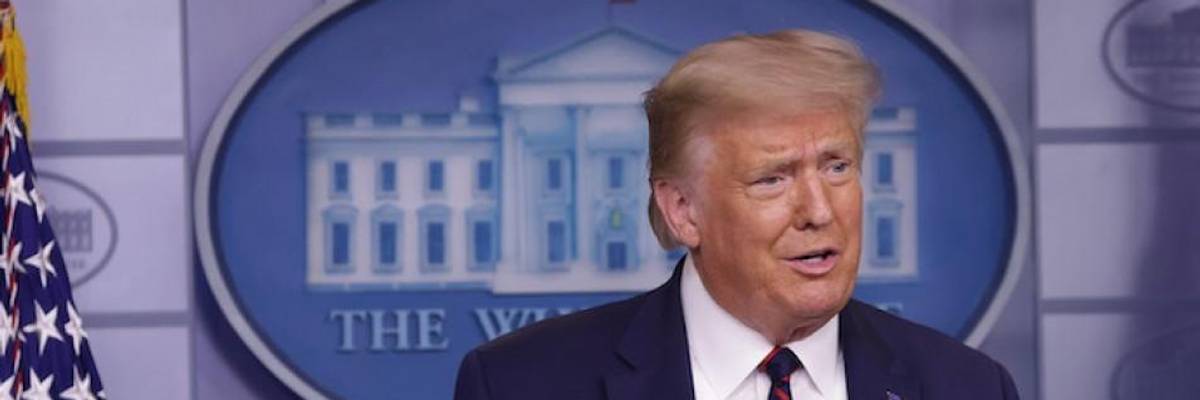
There are still hundreds of thousands of votes left to be counted, with outstanding gaps in key battleground states like Wisconsin, Pennsylvania, and North Carolina. (Photo: Alex Wong/Getty Images)
It's amazing how a mantra can fail you. Generally, if you need to really, truly believe something, you're advised to repeat it to yourself over and over until you internalize it. And so, pundits and Democratic politicians spent days and weeks and months repeatedly warning Americans that there would almost certainly be no winner of the presidential election on Nov. 3, the long-awaited Election Day in the longest year ever, 2020. No matter how badly we wanted the resolution to come, it simply would not. Such is the nature of a pandemic-year election.
Unfortunately, knowing something to be true doesn't always ease the anxiety it brings. And waking up on Nov. 4 to the reality that both President Trump and Joe Biden could still win the White House is unsettling. It begins to feel like an outright emergency when you factor in Trump's declaration, made around 2:30 a.m. Wednesday, that he'd in fact won the election--alongside, somehow, the claim that the election is being stolen away from him.
Neither of those statements are true. Trump has not won the election now, nearly seven hours later, and he was not the victor then. There are still hundreds of thousands of votes left to be counted, with outstanding gaps in key battleground states like Wisconsin, Pennsylvania, and North Carolina. The glut of early voting, both in person and by mail, to avoid coronavirus-spreading crowds meant the count would be slower this year, nevermind the fact that virtually no state certifies its results on Election Day even in normal times. Wanting a result immediately doesn't make one appear. Such is the nature of a pandemic-year election.
Trump, who's never seemed particularly aware that this is a pandemic year to begin with, maliciously disregarded these truisms. "We will win this. And as far as I'm concerned, we already have," he said, alleging falsely that the routine counting of valid ballots constitutes "major fraud in our nation." He vowed to stop those votes from being counted in most crucial battleground states that have yet to be called by the major networks--except for Arizona, a state which several outlets agree Biden has won, and which, golly-gee, Trump wants to keep tallying every ballot just in case.
Early votes, cast either in person or by mail, are thought to lean heavily Democratic, and the major networks were not always clear what tallies they were referring to as the results started coming in Tuesday night. It led to a lot of uncertainty and confusion, as reputable outlets were showing wildly different projections of the same state. It's hard enough to count millions of votes in just a few hours; now triple the sources of those votes, between early votes cast in-person, mail-in ballots, and day-of votes and ballot drops, and things get infinitely more complicated. Such is the nature of a pandemic-year election.
"We're going to the Supreme Court," Trump vowed, while CNN noted in a perfect chyron that it's "unclear why." Biden, for his part, spoke about two hours before Trump did and urged "patience" in his Election Day remarks. But he did project confidence, too. "We believe we're on track to win this election," he said, but he repeated that the result won't be known until "every ballot is counted."
Ballots are still being counted all the while. It looks like the results are tilting in Biden's favor, but it's absolutely not certain. No one can truthfully declare victory yet -- which, by the way, is in no small part due to efforts by the president's own party to suppress votes and make the night a lot more difficult.
In the meantime, we're left with an alternate truth: It's outright dangerous to have a leader who refuses to acknowledge a sound democratic process. Some might call it Trump's final slide into full-on authoritarianism. Others have been warning about this for a long, long, long time. You might even call it a mantra.
Dear Common Dreams reader, It’s been nearly 30 years since I co-founded Common Dreams with my late wife, Lina Newhouser. We had the radical notion that journalism should serve the public good, not corporate profits. It was clear to us from the outset what it would take to build such a project. No paid advertisements. No corporate sponsors. No millionaire publisher telling us what to think or do. Many people said we wouldn't last a year, but we proved those doubters wrong. Together with a tremendous team of journalists and dedicated staff, we built an independent media outlet free from the constraints of profits and corporate control. Our mission has always been simple: To inform. To inspire. To ignite change for the common good. Building Common Dreams was not easy. Our survival was never guaranteed. When you take on the most powerful forces—Wall Street greed, fossil fuel industry destruction, Big Tech lobbyists, and uber-rich oligarchs who have spent billions upon billions rigging the economy and democracy in their favor—the only bulwark you have is supporters who believe in your work. But here’s the urgent message from me today. It's never been this bad out there. And it's never been this hard to keep us going. At the very moment Common Dreams is most needed, the threats we face are intensifying. We need your support now more than ever. We don't accept corporate advertising and never will. We don't have a paywall because we don't think people should be blocked from critical news based on their ability to pay. Everything we do is funded by the donations of readers like you. When everyone does the little they can afford, we are strong. But if that support retreats or dries up, so do we. Will you donate now to make sure Common Dreams not only survives but thrives? —Craig Brown, Co-founder |
It's amazing how a mantra can fail you. Generally, if you need to really, truly believe something, you're advised to repeat it to yourself over and over until you internalize it. And so, pundits and Democratic politicians spent days and weeks and months repeatedly warning Americans that there would almost certainly be no winner of the presidential election on Nov. 3, the long-awaited Election Day in the longest year ever, 2020. No matter how badly we wanted the resolution to come, it simply would not. Such is the nature of a pandemic-year election.
Unfortunately, knowing something to be true doesn't always ease the anxiety it brings. And waking up on Nov. 4 to the reality that both President Trump and Joe Biden could still win the White House is unsettling. It begins to feel like an outright emergency when you factor in Trump's declaration, made around 2:30 a.m. Wednesday, that he'd in fact won the election--alongside, somehow, the claim that the election is being stolen away from him.
Neither of those statements are true. Trump has not won the election now, nearly seven hours later, and he was not the victor then. There are still hundreds of thousands of votes left to be counted, with outstanding gaps in key battleground states like Wisconsin, Pennsylvania, and North Carolina. The glut of early voting, both in person and by mail, to avoid coronavirus-spreading crowds meant the count would be slower this year, nevermind the fact that virtually no state certifies its results on Election Day even in normal times. Wanting a result immediately doesn't make one appear. Such is the nature of a pandemic-year election.
Trump, who's never seemed particularly aware that this is a pandemic year to begin with, maliciously disregarded these truisms. "We will win this. And as far as I'm concerned, we already have," he said, alleging falsely that the routine counting of valid ballots constitutes "major fraud in our nation." He vowed to stop those votes from being counted in most crucial battleground states that have yet to be called by the major networks--except for Arizona, a state which several outlets agree Biden has won, and which, golly-gee, Trump wants to keep tallying every ballot just in case.
Early votes, cast either in person or by mail, are thought to lean heavily Democratic, and the major networks were not always clear what tallies they were referring to as the results started coming in Tuesday night. It led to a lot of uncertainty and confusion, as reputable outlets were showing wildly different projections of the same state. It's hard enough to count millions of votes in just a few hours; now triple the sources of those votes, between early votes cast in-person, mail-in ballots, and day-of votes and ballot drops, and things get infinitely more complicated. Such is the nature of a pandemic-year election.
"We're going to the Supreme Court," Trump vowed, while CNN noted in a perfect chyron that it's "unclear why." Biden, for his part, spoke about two hours before Trump did and urged "patience" in his Election Day remarks. But he did project confidence, too. "We believe we're on track to win this election," he said, but he repeated that the result won't be known until "every ballot is counted."
Ballots are still being counted all the while. It looks like the results are tilting in Biden's favor, but it's absolutely not certain. No one can truthfully declare victory yet -- which, by the way, is in no small part due to efforts by the president's own party to suppress votes and make the night a lot more difficult.
In the meantime, we're left with an alternate truth: It's outright dangerous to have a leader who refuses to acknowledge a sound democratic process. Some might call it Trump's final slide into full-on authoritarianism. Others have been warning about this for a long, long, long time. You might even call it a mantra.
It's amazing how a mantra can fail you. Generally, if you need to really, truly believe something, you're advised to repeat it to yourself over and over until you internalize it. And so, pundits and Democratic politicians spent days and weeks and months repeatedly warning Americans that there would almost certainly be no winner of the presidential election on Nov. 3, the long-awaited Election Day in the longest year ever, 2020. No matter how badly we wanted the resolution to come, it simply would not. Such is the nature of a pandemic-year election.
Unfortunately, knowing something to be true doesn't always ease the anxiety it brings. And waking up on Nov. 4 to the reality that both President Trump and Joe Biden could still win the White House is unsettling. It begins to feel like an outright emergency when you factor in Trump's declaration, made around 2:30 a.m. Wednesday, that he'd in fact won the election--alongside, somehow, the claim that the election is being stolen away from him.
Neither of those statements are true. Trump has not won the election now, nearly seven hours later, and he was not the victor then. There are still hundreds of thousands of votes left to be counted, with outstanding gaps in key battleground states like Wisconsin, Pennsylvania, and North Carolina. The glut of early voting, both in person and by mail, to avoid coronavirus-spreading crowds meant the count would be slower this year, nevermind the fact that virtually no state certifies its results on Election Day even in normal times. Wanting a result immediately doesn't make one appear. Such is the nature of a pandemic-year election.
Trump, who's never seemed particularly aware that this is a pandemic year to begin with, maliciously disregarded these truisms. "We will win this. And as far as I'm concerned, we already have," he said, alleging falsely that the routine counting of valid ballots constitutes "major fraud in our nation." He vowed to stop those votes from being counted in most crucial battleground states that have yet to be called by the major networks--except for Arizona, a state which several outlets agree Biden has won, and which, golly-gee, Trump wants to keep tallying every ballot just in case.
Early votes, cast either in person or by mail, are thought to lean heavily Democratic, and the major networks were not always clear what tallies they were referring to as the results started coming in Tuesday night. It led to a lot of uncertainty and confusion, as reputable outlets were showing wildly different projections of the same state. It's hard enough to count millions of votes in just a few hours; now triple the sources of those votes, between early votes cast in-person, mail-in ballots, and day-of votes and ballot drops, and things get infinitely more complicated. Such is the nature of a pandemic-year election.
"We're going to the Supreme Court," Trump vowed, while CNN noted in a perfect chyron that it's "unclear why." Biden, for his part, spoke about two hours before Trump did and urged "patience" in his Election Day remarks. But he did project confidence, too. "We believe we're on track to win this election," he said, but he repeated that the result won't be known until "every ballot is counted."
Ballots are still being counted all the while. It looks like the results are tilting in Biden's favor, but it's absolutely not certain. No one can truthfully declare victory yet -- which, by the way, is in no small part due to efforts by the president's own party to suppress votes and make the night a lot more difficult.
In the meantime, we're left with an alternate truth: It's outright dangerous to have a leader who refuses to acknowledge a sound democratic process. Some might call it Trump's final slide into full-on authoritarianism. Others have been warning about this for a long, long, long time. You might even call it a mantra.