SUBSCRIBE TO OUR FREE NEWSLETTER
Daily news & progressive opinion—funded by the people, not the corporations—delivered straight to your inbox.
5
#000000
#FFFFFF
To donate by check, phone, or other method, see our More Ways to Give page.
Daily news & progressive opinion—funded by the people, not the corporations—delivered straight to your inbox.
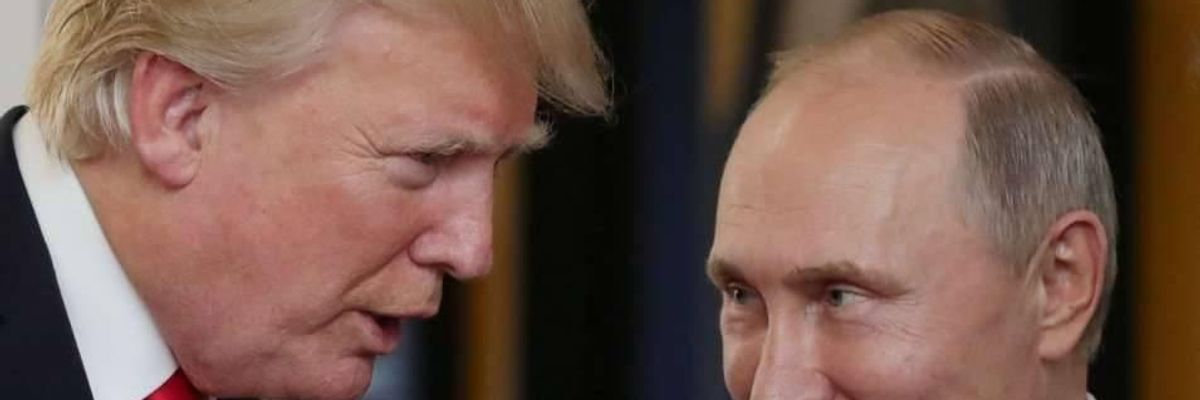
"Several weeks ago, he announced that he would like to host Putin in the United States before the November election," writes Gerson, "Was that just one more of our political clown's outrageous statements? Or, might it have been a negotiating signal?" (Photo: Mikhail Klimentyev/Getty Images)
Last night I had the strangest dream. I'm hoping it was just a fevered nightmare.
For the last several months, U.S. and Russian negotiators have been meeting intermittently, reportedly to explore possible extension of the New START Treaty. That treaty set the limit of 1,550 strategic (and omnicidal) nuclear warheads. More importantly, its verification provisions for intrusive inspections ensuring a degree of transparency and thus mutual trust. It Is scheduled to expire in February 2021. Should Trump refuse to extend the Treaty, we face the increased dangers of the unstrained nuclear arms race that he seems to want.
My dream wasn't about New START. It was more frightening.
Even as the Russians have pressed for the Treaty extension, the Trump administration has been making the unrealistic demand it will not concur unless China joins the negotiations. This is unrealistic because China's nuclear arsenal is 1/5 the size of that of the United States'. What's more, the U.S. is in the process of spending up to $ 2 trillion to upgrade all of its nuclear warheads and nuclear weapons delivery systems. It is also reinforcing its first-strike nuclear warfighting doctrine and potential by deploying so-called "missile defenses" within striking distance of China. In addition to their ostensible role in protecting the hundreds of U.S. military bases and forward deployments on China's periphery in Japan, South Korea, the Philippines, and Australia, missile defenses may be able to prevent a Chinese retaliatory strike by destroying Beijing's missiles that manage to survive a U.S. first strike. Consequently, Beijing is debating the possibility of augmenting its nuclear forces in order to retain a second-strike retaliator capability.
But my dream wasn't about first-strike, retaliatory missile defense weaponry. It was about November's election.
The widespread assumption in the U.S. arms control community is that the U.S.-Russian negotiations are primarily for show, a means to further isolate China. Until my nightmare, I didn't take that too seriously, given the very dangerous military U.S.-Chinese confrontations in the South China Sea. The possibility of an incident there that could escalate to the unthinkable on the eve of the election is a nightmare that many share.
My nightmare was rooted in my memories of the 1972 presidential election, even before Watergate. My imagination led me to wonder if the negotiations are really only political theater many in the arms control community have assumed.
With next to zero information leaking out from the negotiations being held in Vienna, and even as our news is understandably focused on the pandemic and conventions, it seems worth inquiring if Trump's reelection campaign might also remember Kissinger's and Nixon's opening to China months before the 1972 election. Nixon's trip to China cemented a tacit U.S.-Chinese alliance that served to further isolate the Soviet Union. Its related pageantry and news coverage paved the resulting broad avenue that led to Nixon's landslide reelection despite the Vietnam War.
Putin has long connived to keep the fatuous Trump, who has accelerated U.S. decline, in office. Might he be playing Trump and the U.S. people for patsies yet again, this time to consolidate the political, economic and thus military implosion of its primary enemy? There is a natural neo-fascist alignment between the two autocrats and their bases. In addition to seeking to restore past national glories, their political bases are each committed to related white Christian supremacy despite their Orthodox/Protestant fundamentalist sectional differences.
A nugget from a Trump throwaway line fuels my fears. Several weeks ago, he announced that he would like to host Putin in the United States before the November election. Was that just one more of our political clown's outrageous statements? Or, might it have been a negotiating signal?
Surprises happen. If history rhymes rather than repeats, we should revisit the parallels between this moment and the months that proceeded the 1914 guns of August, when a terrorist's bullets in remote Sarajevo triggered the First World War (which in turn set the stage for the Second World War). In addition to that era's dangerous nationalisms, complex alliance structures, arms races with new technologies, intertwined but competitive economies, and wild card actors, a very few monarchs--today's autocrats-- held the fate of the world in their hands and failed humanity.
Certainly, there is much to be criticized about China's repressive domestic political system and its increasingly aggressive foreign and military policies that mirror those of Trump World. That said, allying with the corrupt, racist, Christian supremist and murderous Russian autocracy is certainly not in the interest of the U.S. people. Common Security diplomacy, like that which contributed to the end of the cold war, would be a far more rational and life-affirming approach to U.S. tensions with both China and Russia.
Geography dictates that Russia will lie astride China until the tectonic plates engage in their own revolution. With Russia's post-Cold War economic, military and diplomatic integration with increasingly powerful China, breaking with Beijing seems most unlikely.
I'm hoping I've just had a fevered nightmare, and that you'll say it ain't so.
But, the cautious voice within me also fears that the preservation of constitutional democracy in the United States could depend on our preparing for a possible--if very unlikely--October Surprise.
Dear Common Dreams reader, It’s been nearly 30 years since I co-founded Common Dreams with my late wife, Lina Newhouser. We had the radical notion that journalism should serve the public good, not corporate profits. It was clear to us from the outset what it would take to build such a project. No paid advertisements. No corporate sponsors. No millionaire publisher telling us what to think or do. Many people said we wouldn't last a year, but we proved those doubters wrong. Together with a tremendous team of journalists and dedicated staff, we built an independent media outlet free from the constraints of profits and corporate control. Our mission has always been simple: To inform. To inspire. To ignite change for the common good. Building Common Dreams was not easy. Our survival was never guaranteed. When you take on the most powerful forces—Wall Street greed, fossil fuel industry destruction, Big Tech lobbyists, and uber-rich oligarchs who have spent billions upon billions rigging the economy and democracy in their favor—the only bulwark you have is supporters who believe in your work. But here’s the urgent message from me today. It's never been this bad out there. And it's never been this hard to keep us going. At the very moment Common Dreams is most needed, the threats we face are intensifying. We need your support now more than ever. We don't accept corporate advertising and never will. We don't have a paywall because we don't think people should be blocked from critical news based on their ability to pay. Everything we do is funded by the donations of readers like you. When everyone does the little they can afford, we are strong. But if that support retreats or dries up, so do we. Will you donate now to make sure Common Dreams not only survives but thrives? —Craig Brown, Co-founder |
Last night I had the strangest dream. I'm hoping it was just a fevered nightmare.
For the last several months, U.S. and Russian negotiators have been meeting intermittently, reportedly to explore possible extension of the New START Treaty. That treaty set the limit of 1,550 strategic (and omnicidal) nuclear warheads. More importantly, its verification provisions for intrusive inspections ensuring a degree of transparency and thus mutual trust. It Is scheduled to expire in February 2021. Should Trump refuse to extend the Treaty, we face the increased dangers of the unstrained nuclear arms race that he seems to want.
My dream wasn't about New START. It was more frightening.
Even as the Russians have pressed for the Treaty extension, the Trump administration has been making the unrealistic demand it will not concur unless China joins the negotiations. This is unrealistic because China's nuclear arsenal is 1/5 the size of that of the United States'. What's more, the U.S. is in the process of spending up to $ 2 trillion to upgrade all of its nuclear warheads and nuclear weapons delivery systems. It is also reinforcing its first-strike nuclear warfighting doctrine and potential by deploying so-called "missile defenses" within striking distance of China. In addition to their ostensible role in protecting the hundreds of U.S. military bases and forward deployments on China's periphery in Japan, South Korea, the Philippines, and Australia, missile defenses may be able to prevent a Chinese retaliatory strike by destroying Beijing's missiles that manage to survive a U.S. first strike. Consequently, Beijing is debating the possibility of augmenting its nuclear forces in order to retain a second-strike retaliator capability.
But my dream wasn't about first-strike, retaliatory missile defense weaponry. It was about November's election.
The widespread assumption in the U.S. arms control community is that the U.S.-Russian negotiations are primarily for show, a means to further isolate China. Until my nightmare, I didn't take that too seriously, given the very dangerous military U.S.-Chinese confrontations in the South China Sea. The possibility of an incident there that could escalate to the unthinkable on the eve of the election is a nightmare that many share.
My nightmare was rooted in my memories of the 1972 presidential election, even before Watergate. My imagination led me to wonder if the negotiations are really only political theater many in the arms control community have assumed.
With next to zero information leaking out from the negotiations being held in Vienna, and even as our news is understandably focused on the pandemic and conventions, it seems worth inquiring if Trump's reelection campaign might also remember Kissinger's and Nixon's opening to China months before the 1972 election. Nixon's trip to China cemented a tacit U.S.-Chinese alliance that served to further isolate the Soviet Union. Its related pageantry and news coverage paved the resulting broad avenue that led to Nixon's landslide reelection despite the Vietnam War.
Putin has long connived to keep the fatuous Trump, who has accelerated U.S. decline, in office. Might he be playing Trump and the U.S. people for patsies yet again, this time to consolidate the political, economic and thus military implosion of its primary enemy? There is a natural neo-fascist alignment between the two autocrats and their bases. In addition to seeking to restore past national glories, their political bases are each committed to related white Christian supremacy despite their Orthodox/Protestant fundamentalist sectional differences.
A nugget from a Trump throwaway line fuels my fears. Several weeks ago, he announced that he would like to host Putin in the United States before the November election. Was that just one more of our political clown's outrageous statements? Or, might it have been a negotiating signal?
Surprises happen. If history rhymes rather than repeats, we should revisit the parallels between this moment and the months that proceeded the 1914 guns of August, when a terrorist's bullets in remote Sarajevo triggered the First World War (which in turn set the stage for the Second World War). In addition to that era's dangerous nationalisms, complex alliance structures, arms races with new technologies, intertwined but competitive economies, and wild card actors, a very few monarchs--today's autocrats-- held the fate of the world in their hands and failed humanity.
Certainly, there is much to be criticized about China's repressive domestic political system and its increasingly aggressive foreign and military policies that mirror those of Trump World. That said, allying with the corrupt, racist, Christian supremist and murderous Russian autocracy is certainly not in the interest of the U.S. people. Common Security diplomacy, like that which contributed to the end of the cold war, would be a far more rational and life-affirming approach to U.S. tensions with both China and Russia.
Geography dictates that Russia will lie astride China until the tectonic plates engage in their own revolution. With Russia's post-Cold War economic, military and diplomatic integration with increasingly powerful China, breaking with Beijing seems most unlikely.
I'm hoping I've just had a fevered nightmare, and that you'll say it ain't so.
But, the cautious voice within me also fears that the preservation of constitutional democracy in the United States could depend on our preparing for a possible--if very unlikely--October Surprise.
Last night I had the strangest dream. I'm hoping it was just a fevered nightmare.
For the last several months, U.S. and Russian negotiators have been meeting intermittently, reportedly to explore possible extension of the New START Treaty. That treaty set the limit of 1,550 strategic (and omnicidal) nuclear warheads. More importantly, its verification provisions for intrusive inspections ensuring a degree of transparency and thus mutual trust. It Is scheduled to expire in February 2021. Should Trump refuse to extend the Treaty, we face the increased dangers of the unstrained nuclear arms race that he seems to want.
My dream wasn't about New START. It was more frightening.
Even as the Russians have pressed for the Treaty extension, the Trump administration has been making the unrealistic demand it will not concur unless China joins the negotiations. This is unrealistic because China's nuclear arsenal is 1/5 the size of that of the United States'. What's more, the U.S. is in the process of spending up to $ 2 trillion to upgrade all of its nuclear warheads and nuclear weapons delivery systems. It is also reinforcing its first-strike nuclear warfighting doctrine and potential by deploying so-called "missile defenses" within striking distance of China. In addition to their ostensible role in protecting the hundreds of U.S. military bases and forward deployments on China's periphery in Japan, South Korea, the Philippines, and Australia, missile defenses may be able to prevent a Chinese retaliatory strike by destroying Beijing's missiles that manage to survive a U.S. first strike. Consequently, Beijing is debating the possibility of augmenting its nuclear forces in order to retain a second-strike retaliator capability.
But my dream wasn't about first-strike, retaliatory missile defense weaponry. It was about November's election.
The widespread assumption in the U.S. arms control community is that the U.S.-Russian negotiations are primarily for show, a means to further isolate China. Until my nightmare, I didn't take that too seriously, given the very dangerous military U.S.-Chinese confrontations in the South China Sea. The possibility of an incident there that could escalate to the unthinkable on the eve of the election is a nightmare that many share.
My nightmare was rooted in my memories of the 1972 presidential election, even before Watergate. My imagination led me to wonder if the negotiations are really only political theater many in the arms control community have assumed.
With next to zero information leaking out from the negotiations being held in Vienna, and even as our news is understandably focused on the pandemic and conventions, it seems worth inquiring if Trump's reelection campaign might also remember Kissinger's and Nixon's opening to China months before the 1972 election. Nixon's trip to China cemented a tacit U.S.-Chinese alliance that served to further isolate the Soviet Union. Its related pageantry and news coverage paved the resulting broad avenue that led to Nixon's landslide reelection despite the Vietnam War.
Putin has long connived to keep the fatuous Trump, who has accelerated U.S. decline, in office. Might he be playing Trump and the U.S. people for patsies yet again, this time to consolidate the political, economic and thus military implosion of its primary enemy? There is a natural neo-fascist alignment between the two autocrats and their bases. In addition to seeking to restore past national glories, their political bases are each committed to related white Christian supremacy despite their Orthodox/Protestant fundamentalist sectional differences.
A nugget from a Trump throwaway line fuels my fears. Several weeks ago, he announced that he would like to host Putin in the United States before the November election. Was that just one more of our political clown's outrageous statements? Or, might it have been a negotiating signal?
Surprises happen. If history rhymes rather than repeats, we should revisit the parallels between this moment and the months that proceeded the 1914 guns of August, when a terrorist's bullets in remote Sarajevo triggered the First World War (which in turn set the stage for the Second World War). In addition to that era's dangerous nationalisms, complex alliance structures, arms races with new technologies, intertwined but competitive economies, and wild card actors, a very few monarchs--today's autocrats-- held the fate of the world in their hands and failed humanity.
Certainly, there is much to be criticized about China's repressive domestic political system and its increasingly aggressive foreign and military policies that mirror those of Trump World. That said, allying with the corrupt, racist, Christian supremist and murderous Russian autocracy is certainly not in the interest of the U.S. people. Common Security diplomacy, like that which contributed to the end of the cold war, would be a far more rational and life-affirming approach to U.S. tensions with both China and Russia.
Geography dictates that Russia will lie astride China until the tectonic plates engage in their own revolution. With Russia's post-Cold War economic, military and diplomatic integration with increasingly powerful China, breaking with Beijing seems most unlikely.
I'm hoping I've just had a fevered nightmare, and that you'll say it ain't so.
But, the cautious voice within me also fears that the preservation of constitutional democracy in the United States could depend on our preparing for a possible--if very unlikely--October Surprise.