

SUBSCRIBE TO OUR FREE NEWSLETTER
Daily news & progressive opinion—funded by the people, not the corporations—delivered straight to your inbox.
5
#000000
#FFFFFF
To donate by check, phone, or other method, see our More Ways to Give page.
Daily news & progressive opinion—funded by the people, not the corporations—delivered straight to your inbox.
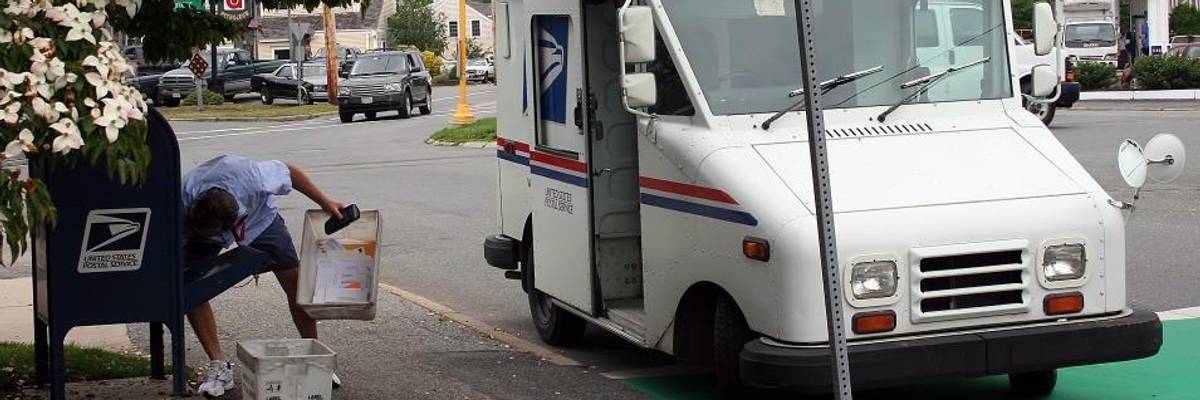
UPS, FedEx and other private carriers are far more expensive than the USPS and much less efficient. (Photo: Bob Shand/Flickr/cc)
Perhaps you've noticed there are fewer post offices around. In the past decade, the United States Postal Service has closed almost 200 facilities nationwide in an aggressive effort to do away with and eventually privatize an institution that is older than the country itself. Included in that number are post offices that used to be on Main Street near St. Vincent's Hospital and on Stratford Avenue. Like so many, they were closed and not replaced. Those closings have left Bridgeport, a city of 150,000 people, with exactly four post offices.
The rationale used by those leading the attack is that the USPS is losing money. In fact, it's a huge money maker, with operating profits in recent years of $1.4 billion. What has caused its financial problems is the 2006 Postal Accountability and Enhancement Act (PAEA), an unprecedented law pushed through by politicians who serve the 1% requiring pre-funding of health benefits for USPS retirees for 75 years.
Those who delude themselves that the heavily subsidized "private" sector can do a better job than the USPS should be careful what they wish for.
The yearly tab for that monstrosity is $5.5 billion and the intent was precisely what is happening: the gutting of one of the country's most valued resources. No other agency is required to do anything remotely like pre-fund health benefits for 75 years. That the PAEA was rammed through by politicians who serve business elites should surprise no one. Their agenda, be they Republican or Democrat, is to destroy projects that serve the common good, especially hugely successful ones like the postal service. Further exposing their agenda is the profligate pre-funding requirement
Throughout the country, postal workers and community allies have prevented the closing of many facilities. Among the actions taken were a post office occupation in Oregon and the erection of a tent city in front of a facility in California. Several years ago, similar popular pressure stopped the attempted elimination of Saturday delivery service.
The large scale elimination of facilities has had the predictable result of increasing costs because of the greater distance mail must travel. Consider that an item mailed from a Bridgeport address to another Bridgeport address, for example, now goes to a distribution facility in Kearny, New Jersey before arriving at its final destination, then consider that the same rocket scientists who came up with that one hail themselves as fiscally responsible and attack the USPS as inefficient. Fewer facilities also results in skyrocketing overtime for letter carriers unable to complete their routes in eight hours and longer commutes for workers who can be transferred as much as 50 miles with no appeal or recourse.
Over one hundred thousand good paying USPS jobs have been killed as a result of the privatization efforts, and virtually all new hires are temps whose benefits and wages are far lower than regular workers. For several years the privatizers also shifted much postal work to Staples, a company notorious for its hostility to employees, until a concerted community-worker campaign brought that to an end. Now the USPS intends to begin shifting work to Walmart, an employer with a record even worse than Staples.
One more ugly part of the story is the incestuous relationship between the USPS, privatizers and the corporate politicians. The contract to close post offices was awarded to the CBRE real estate firm whose CEO Robert Sulentic is on the Staples board of directors. Richard Blum, CBRE board chair until 2014, is married to multi-millionaire California Senator Dianne Feinstein. CBRE made millions from the deal.
Those who delude themselves that the heavily subsidized "private" sector can do a better job than the USPS should be careful what they wish for. UPS, FedEx and other private carriers are far more expensive than the USPS and much less efficient. And unlike the USPS, there are many parts of the country that private carriers do not service.
A publicly-funded, national postal service is one of our country's great achievements. It should be improved, not destroyed, and a collective demand for the repeal of the PAEA would be a big step in the right direction. The public should also join postal workers to demand an end to the contracts with Walmart just as they did with Staples as well as an end to postal facility closures.
Dear Common Dreams reader, It’s been nearly 30 years since I co-founded Common Dreams with my late wife, Lina Newhouser. We had the radical notion that journalism should serve the public good, not corporate profits. It was clear to us from the outset what it would take to build such a project. No paid advertisements. No corporate sponsors. No millionaire publisher telling us what to think or do. Many people said we wouldn't last a year, but we proved those doubters wrong. Together with a tremendous team of journalists and dedicated staff, we built an independent media outlet free from the constraints of profits and corporate control. Our mission has always been simple: To inform. To inspire. To ignite change for the common good. Building Common Dreams was not easy. Our survival was never guaranteed. When you take on the most powerful forces—Wall Street greed, fossil fuel industry destruction, Big Tech lobbyists, and uber-rich oligarchs who have spent billions upon billions rigging the economy and democracy in their favor—the only bulwark you have is supporters who believe in your work. But here’s the urgent message from me today. It's never been this bad out there. And it's never been this hard to keep us going. At the very moment Common Dreams is most needed, the threats we face are intensifying. We need your support now more than ever. We don't accept corporate advertising and never will. We don't have a paywall because we don't think people should be blocked from critical news based on their ability to pay. Everything we do is funded by the donations of readers like you. When everyone does the little they can afford, we are strong. But if that support retreats or dries up, so do we. Will you donate now to make sure Common Dreams not only survives but thrives? —Craig Brown, Co-founder |
Perhaps you've noticed there are fewer post offices around. In the past decade, the United States Postal Service has closed almost 200 facilities nationwide in an aggressive effort to do away with and eventually privatize an institution that is older than the country itself. Included in that number are post offices that used to be on Main Street near St. Vincent's Hospital and on Stratford Avenue. Like so many, they were closed and not replaced. Those closings have left Bridgeport, a city of 150,000 people, with exactly four post offices.
The rationale used by those leading the attack is that the USPS is losing money. In fact, it's a huge money maker, with operating profits in recent years of $1.4 billion. What has caused its financial problems is the 2006 Postal Accountability and Enhancement Act (PAEA), an unprecedented law pushed through by politicians who serve the 1% requiring pre-funding of health benefits for USPS retirees for 75 years.
Those who delude themselves that the heavily subsidized "private" sector can do a better job than the USPS should be careful what they wish for.
The yearly tab for that monstrosity is $5.5 billion and the intent was precisely what is happening: the gutting of one of the country's most valued resources. No other agency is required to do anything remotely like pre-fund health benefits for 75 years. That the PAEA was rammed through by politicians who serve business elites should surprise no one. Their agenda, be they Republican or Democrat, is to destroy projects that serve the common good, especially hugely successful ones like the postal service. Further exposing their agenda is the profligate pre-funding requirement
Throughout the country, postal workers and community allies have prevented the closing of many facilities. Among the actions taken were a post office occupation in Oregon and the erection of a tent city in front of a facility in California. Several years ago, similar popular pressure stopped the attempted elimination of Saturday delivery service.
The large scale elimination of facilities has had the predictable result of increasing costs because of the greater distance mail must travel. Consider that an item mailed from a Bridgeport address to another Bridgeport address, for example, now goes to a distribution facility in Kearny, New Jersey before arriving at its final destination, then consider that the same rocket scientists who came up with that one hail themselves as fiscally responsible and attack the USPS as inefficient. Fewer facilities also results in skyrocketing overtime for letter carriers unable to complete their routes in eight hours and longer commutes for workers who can be transferred as much as 50 miles with no appeal or recourse.
Over one hundred thousand good paying USPS jobs have been killed as a result of the privatization efforts, and virtually all new hires are temps whose benefits and wages are far lower than regular workers. For several years the privatizers also shifted much postal work to Staples, a company notorious for its hostility to employees, until a concerted community-worker campaign brought that to an end. Now the USPS intends to begin shifting work to Walmart, an employer with a record even worse than Staples.
One more ugly part of the story is the incestuous relationship between the USPS, privatizers and the corporate politicians. The contract to close post offices was awarded to the CBRE real estate firm whose CEO Robert Sulentic is on the Staples board of directors. Richard Blum, CBRE board chair until 2014, is married to multi-millionaire California Senator Dianne Feinstein. CBRE made millions from the deal.
Those who delude themselves that the heavily subsidized "private" sector can do a better job than the USPS should be careful what they wish for. UPS, FedEx and other private carriers are far more expensive than the USPS and much less efficient. And unlike the USPS, there are many parts of the country that private carriers do not service.
A publicly-funded, national postal service is one of our country's great achievements. It should be improved, not destroyed, and a collective demand for the repeal of the PAEA would be a big step in the right direction. The public should also join postal workers to demand an end to the contracts with Walmart just as they did with Staples as well as an end to postal facility closures.
Perhaps you've noticed there are fewer post offices around. In the past decade, the United States Postal Service has closed almost 200 facilities nationwide in an aggressive effort to do away with and eventually privatize an institution that is older than the country itself. Included in that number are post offices that used to be on Main Street near St. Vincent's Hospital and on Stratford Avenue. Like so many, they were closed and not replaced. Those closings have left Bridgeport, a city of 150,000 people, with exactly four post offices.
The rationale used by those leading the attack is that the USPS is losing money. In fact, it's a huge money maker, with operating profits in recent years of $1.4 billion. What has caused its financial problems is the 2006 Postal Accountability and Enhancement Act (PAEA), an unprecedented law pushed through by politicians who serve the 1% requiring pre-funding of health benefits for USPS retirees for 75 years.
Those who delude themselves that the heavily subsidized "private" sector can do a better job than the USPS should be careful what they wish for.
The yearly tab for that monstrosity is $5.5 billion and the intent was precisely what is happening: the gutting of one of the country's most valued resources. No other agency is required to do anything remotely like pre-fund health benefits for 75 years. That the PAEA was rammed through by politicians who serve business elites should surprise no one. Their agenda, be they Republican or Democrat, is to destroy projects that serve the common good, especially hugely successful ones like the postal service. Further exposing their agenda is the profligate pre-funding requirement
Throughout the country, postal workers and community allies have prevented the closing of many facilities. Among the actions taken were a post office occupation in Oregon and the erection of a tent city in front of a facility in California. Several years ago, similar popular pressure stopped the attempted elimination of Saturday delivery service.
The large scale elimination of facilities has had the predictable result of increasing costs because of the greater distance mail must travel. Consider that an item mailed from a Bridgeport address to another Bridgeport address, for example, now goes to a distribution facility in Kearny, New Jersey before arriving at its final destination, then consider that the same rocket scientists who came up with that one hail themselves as fiscally responsible and attack the USPS as inefficient. Fewer facilities also results in skyrocketing overtime for letter carriers unable to complete their routes in eight hours and longer commutes for workers who can be transferred as much as 50 miles with no appeal or recourse.
Over one hundred thousand good paying USPS jobs have been killed as a result of the privatization efforts, and virtually all new hires are temps whose benefits and wages are far lower than regular workers. For several years the privatizers also shifted much postal work to Staples, a company notorious for its hostility to employees, until a concerted community-worker campaign brought that to an end. Now the USPS intends to begin shifting work to Walmart, an employer with a record even worse than Staples.
One more ugly part of the story is the incestuous relationship between the USPS, privatizers and the corporate politicians. The contract to close post offices was awarded to the CBRE real estate firm whose CEO Robert Sulentic is on the Staples board of directors. Richard Blum, CBRE board chair until 2014, is married to multi-millionaire California Senator Dianne Feinstein. CBRE made millions from the deal.
Those who delude themselves that the heavily subsidized "private" sector can do a better job than the USPS should be careful what they wish for. UPS, FedEx and other private carriers are far more expensive than the USPS and much less efficient. And unlike the USPS, there are many parts of the country that private carriers do not service.
A publicly-funded, national postal service is one of our country's great achievements. It should be improved, not destroyed, and a collective demand for the repeal of the PAEA would be a big step in the right direction. The public should also join postal workers to demand an end to the contracts with Walmart just as they did with Staples as well as an end to postal facility closures.

