SUBSCRIBE TO OUR FREE NEWSLETTER
Daily news & progressive opinion—funded by the people, not the corporations—delivered straight to your inbox.
5
#000000
#FFFFFF
To donate by check, phone, or other method, see our More Ways to Give page.
Daily news & progressive opinion—funded by the people, not the corporations—delivered straight to your inbox.
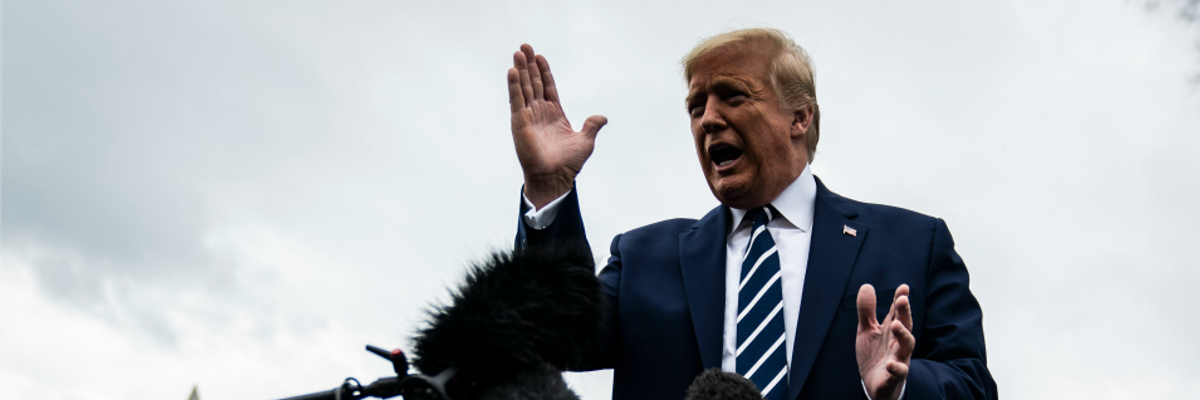
President Donald Trump stops to talk to reporters and members of the media as he walks from the Oval Office to board Marine One and depart from the South Lawn at the White House on Tuesday, March 3, 2020 in Washington, D.C. (Photo: Jabin Botsford/The Washington Post via Getty Images)
"You spotted snakes with double tongue."
Shakespeare, A Midsummer Night's Dream
It is an old and honorable profession. But not even its most successful practitioners could have ever imagined that one of theirs would attain one of the highest offices in the world from which he could continue to give their profession the exposure they all knew it deserved.
The Oxford English Dictionary defines "snake oil" as being a quack remedy or panacea.
As members of the profession, they had grown accustomed to the fact that, from time to time, there were those who belittled their efforts. Some critics even went so far as to call them "quacks," a clearly derogatory description, and not one to which those following their high calling should have been subject.
The profession to which I refer is, as many readers will have already guessed, the profession of the snake oil salesman. It is an old and honorable profession, and a description of its qualities takes up countless pages in sources as notable and reputable as Wikipedia and National Public Radio, to name just two.
Since many of my readers are almost certainly unaware of the history of this profession (of which the Trump is now its most prominent spokesman,) herewith a short lesson for which I am indebted to NPR, which many years ago devoted an entire program to the snake oil salesmen. Since that program aired in 2013 it does not, of course, make reference to the Trump, since there was no way the reporter could have anticipated the success a member of that profession would soon enjoy.
The Oxford English Dictionary defines "snake oil" as being a quack remedy or panacea. Among the many things we learn from the NPR story is that snake oil is made from "the oil of the Chinese water snake, which is rich in the omega-3 acids that help reduce inflammation." The Trump fixation on China and how it has contributed to the world pandemic is probably attributable to his knowledge, as a snake oil salesman, that snake oil was first brought into the United States by Chinese laborers who helped build the railroads in the 19th century. According to the report, the snake oil was highly effective in its original form to reduce inflammation. It was especially helpful when used to treat arthritis and bursitis.
Notwithstanding its beneficial effects as used when first brought to this country, "snake oil" soon became popular during the second half of the 19th century, when people were referring not only to snake oil but to patent medicines that were widely advertised in all sorts of media, but were of no proven medicinal value. Among other things, those medicines promised to cure chronic pain, headaches, "female complaints," and countless other ailments afflicting those seeking relief. The words have now become synonymous with "quackery" or "health fraud."
For our purposes, and in examining the prominent snake oil salesman who now lives at 1600 Pennsylvania Avenue in Washington D.C., and remembering that snake oil salesmen were also referred to as "quacks," it is useful to recall that one definition of a "quack" is a person "who pretends, professionally or publicly, to have skill, knowledge, qualification, or credentials they do not possess; a charlatan or snake oil salesman." It goes without saying that such a definition describes the Trump more perfectly than any description I could conjure up. But my attention was drawn to the Trump quackery not because of his pretense to have knowledge, qualification, or credentials he does not actually possess. I was drawn to the definition because they were the first words I thought of when the Trump began touting the virtues of drugs to combat the coronavirus about which he knew no more than the hawkers of snake oil in the latter part of the 19th century.
Trump has begun touting the virtues of two antimalarial drugs, chloroquine and hydroxychloroquine, neither of which, like snake oil of old, have been proven to have any benefit in treating the coronavirus that afflicts the world.
In the time-honored tradition of the snake oil salesman, the Trump has begun touting the virtues of two antimalarial drugs, chloroquine and hydroxychloroquine, neither of which, like snake oil of old, have been proven to have any benefit in treating the coronavirus that afflicts the world. When asked about the efficacy of the two drugs, since they are unproven, the Trump adopted the classical snake oil salesman approach saying: "I want them to try it. And it may work, and it may not work. But if it doesn't work, it's nothing lost by doing it. Nothing." You can hear long dead snake oil salesmen applauding that brilliant response, reminiscent as it may have been of responses they might have given if challenged by skeptics.
The Trump brought Clark Stanley to mind. Clark was known at the end of the 19th and beginning of the 20th centuries as the Rattlesnake King because of his success in selling "Stanley's Snake Oil" following a demonstration he put on at the 1893 World's Columbian Exposition in Chicago. In that demonstration he sliced open a rattle snake, put it in boiling water, skimmed off the fat that rose to the top, and sold it to the eager on lookers. He continued to sell the product until, in 1917, the Food and Drug Administration charged him with "misbranding" his product by "falsely and fraudulently represent[ing] it as a remedy for all pain." He was fined $20 and his empire collapsed.
The Trump empire's future may or may not depend on the effectiveness of his snake oil. With any luck, however, the ballot box, rather than the FDA, will be his undoing.
Dear Common Dreams reader, It’s been nearly 30 years since I co-founded Common Dreams with my late wife, Lina Newhouser. We had the radical notion that journalism should serve the public good, not corporate profits. It was clear to us from the outset what it would take to build such a project. No paid advertisements. No corporate sponsors. No millionaire publisher telling us what to think or do. Many people said we wouldn't last a year, but we proved those doubters wrong. Together with a tremendous team of journalists and dedicated staff, we built an independent media outlet free from the constraints of profits and corporate control. Our mission has always been simple: To inform. To inspire. To ignite change for the common good. Building Common Dreams was not easy. Our survival was never guaranteed. When you take on the most powerful forces—Wall Street greed, fossil fuel industry destruction, Big Tech lobbyists, and uber-rich oligarchs who have spent billions upon billions rigging the economy and democracy in their favor—the only bulwark you have is supporters who believe in your work. But here’s the urgent message from me today. It's never been this bad out there. And it's never been this hard to keep us going. At the very moment Common Dreams is most needed, the threats we face are intensifying. We need your support now more than ever. We don't accept corporate advertising and never will. We don't have a paywall because we don't think people should be blocked from critical news based on their ability to pay. Everything we do is funded by the donations of readers like you. When everyone does the little they can afford, we are strong. But if that support retreats or dries up, so do we. Will you donate now to make sure Common Dreams not only survives but thrives? —Craig Brown, Co-founder |
"You spotted snakes with double tongue."
Shakespeare, A Midsummer Night's Dream
It is an old and honorable profession. But not even its most successful practitioners could have ever imagined that one of theirs would attain one of the highest offices in the world from which he could continue to give their profession the exposure they all knew it deserved.
The Oxford English Dictionary defines "snake oil" as being a quack remedy or panacea.
As members of the profession, they had grown accustomed to the fact that, from time to time, there were those who belittled their efforts. Some critics even went so far as to call them "quacks," a clearly derogatory description, and not one to which those following their high calling should have been subject.
The profession to which I refer is, as many readers will have already guessed, the profession of the snake oil salesman. It is an old and honorable profession, and a description of its qualities takes up countless pages in sources as notable and reputable as Wikipedia and National Public Radio, to name just two.
Since many of my readers are almost certainly unaware of the history of this profession (of which the Trump is now its most prominent spokesman,) herewith a short lesson for which I am indebted to NPR, which many years ago devoted an entire program to the snake oil salesmen. Since that program aired in 2013 it does not, of course, make reference to the Trump, since there was no way the reporter could have anticipated the success a member of that profession would soon enjoy.
The Oxford English Dictionary defines "snake oil" as being a quack remedy or panacea. Among the many things we learn from the NPR story is that snake oil is made from "the oil of the Chinese water snake, which is rich in the omega-3 acids that help reduce inflammation." The Trump fixation on China and how it has contributed to the world pandemic is probably attributable to his knowledge, as a snake oil salesman, that snake oil was first brought into the United States by Chinese laborers who helped build the railroads in the 19th century. According to the report, the snake oil was highly effective in its original form to reduce inflammation. It was especially helpful when used to treat arthritis and bursitis.
Notwithstanding its beneficial effects as used when first brought to this country, "snake oil" soon became popular during the second half of the 19th century, when people were referring not only to snake oil but to patent medicines that were widely advertised in all sorts of media, but were of no proven medicinal value. Among other things, those medicines promised to cure chronic pain, headaches, "female complaints," and countless other ailments afflicting those seeking relief. The words have now become synonymous with "quackery" or "health fraud."
For our purposes, and in examining the prominent snake oil salesman who now lives at 1600 Pennsylvania Avenue in Washington D.C., and remembering that snake oil salesmen were also referred to as "quacks," it is useful to recall that one definition of a "quack" is a person "who pretends, professionally or publicly, to have skill, knowledge, qualification, or credentials they do not possess; a charlatan or snake oil salesman." It goes without saying that such a definition describes the Trump more perfectly than any description I could conjure up. But my attention was drawn to the Trump quackery not because of his pretense to have knowledge, qualification, or credentials he does not actually possess. I was drawn to the definition because they were the first words I thought of when the Trump began touting the virtues of drugs to combat the coronavirus about which he knew no more than the hawkers of snake oil in the latter part of the 19th century.
Trump has begun touting the virtues of two antimalarial drugs, chloroquine and hydroxychloroquine, neither of which, like snake oil of old, have been proven to have any benefit in treating the coronavirus that afflicts the world.
In the time-honored tradition of the snake oil salesman, the Trump has begun touting the virtues of two antimalarial drugs, chloroquine and hydroxychloroquine, neither of which, like snake oil of old, have been proven to have any benefit in treating the coronavirus that afflicts the world. When asked about the efficacy of the two drugs, since they are unproven, the Trump adopted the classical snake oil salesman approach saying: "I want them to try it. And it may work, and it may not work. But if it doesn't work, it's nothing lost by doing it. Nothing." You can hear long dead snake oil salesmen applauding that brilliant response, reminiscent as it may have been of responses they might have given if challenged by skeptics.
The Trump brought Clark Stanley to mind. Clark was known at the end of the 19th and beginning of the 20th centuries as the Rattlesnake King because of his success in selling "Stanley's Snake Oil" following a demonstration he put on at the 1893 World's Columbian Exposition in Chicago. In that demonstration he sliced open a rattle snake, put it in boiling water, skimmed off the fat that rose to the top, and sold it to the eager on lookers. He continued to sell the product until, in 1917, the Food and Drug Administration charged him with "misbranding" his product by "falsely and fraudulently represent[ing] it as a remedy for all pain." He was fined $20 and his empire collapsed.
The Trump empire's future may or may not depend on the effectiveness of his snake oil. With any luck, however, the ballot box, rather than the FDA, will be his undoing.
"You spotted snakes with double tongue."
Shakespeare, A Midsummer Night's Dream
It is an old and honorable profession. But not even its most successful practitioners could have ever imagined that one of theirs would attain one of the highest offices in the world from which he could continue to give their profession the exposure they all knew it deserved.
The Oxford English Dictionary defines "snake oil" as being a quack remedy or panacea.
As members of the profession, they had grown accustomed to the fact that, from time to time, there were those who belittled their efforts. Some critics even went so far as to call them "quacks," a clearly derogatory description, and not one to which those following their high calling should have been subject.
The profession to which I refer is, as many readers will have already guessed, the profession of the snake oil salesman. It is an old and honorable profession, and a description of its qualities takes up countless pages in sources as notable and reputable as Wikipedia and National Public Radio, to name just two.
Since many of my readers are almost certainly unaware of the history of this profession (of which the Trump is now its most prominent spokesman,) herewith a short lesson for which I am indebted to NPR, which many years ago devoted an entire program to the snake oil salesmen. Since that program aired in 2013 it does not, of course, make reference to the Trump, since there was no way the reporter could have anticipated the success a member of that profession would soon enjoy.
The Oxford English Dictionary defines "snake oil" as being a quack remedy or panacea. Among the many things we learn from the NPR story is that snake oil is made from "the oil of the Chinese water snake, which is rich in the omega-3 acids that help reduce inflammation." The Trump fixation on China and how it has contributed to the world pandemic is probably attributable to his knowledge, as a snake oil salesman, that snake oil was first brought into the United States by Chinese laborers who helped build the railroads in the 19th century. According to the report, the snake oil was highly effective in its original form to reduce inflammation. It was especially helpful when used to treat arthritis and bursitis.
Notwithstanding its beneficial effects as used when first brought to this country, "snake oil" soon became popular during the second half of the 19th century, when people were referring not only to snake oil but to patent medicines that were widely advertised in all sorts of media, but were of no proven medicinal value. Among other things, those medicines promised to cure chronic pain, headaches, "female complaints," and countless other ailments afflicting those seeking relief. The words have now become synonymous with "quackery" or "health fraud."
For our purposes, and in examining the prominent snake oil salesman who now lives at 1600 Pennsylvania Avenue in Washington D.C., and remembering that snake oil salesmen were also referred to as "quacks," it is useful to recall that one definition of a "quack" is a person "who pretends, professionally or publicly, to have skill, knowledge, qualification, or credentials they do not possess; a charlatan or snake oil salesman." It goes without saying that such a definition describes the Trump more perfectly than any description I could conjure up. But my attention was drawn to the Trump quackery not because of his pretense to have knowledge, qualification, or credentials he does not actually possess. I was drawn to the definition because they were the first words I thought of when the Trump began touting the virtues of drugs to combat the coronavirus about which he knew no more than the hawkers of snake oil in the latter part of the 19th century.
Trump has begun touting the virtues of two antimalarial drugs, chloroquine and hydroxychloroquine, neither of which, like snake oil of old, have been proven to have any benefit in treating the coronavirus that afflicts the world.
In the time-honored tradition of the snake oil salesman, the Trump has begun touting the virtues of two antimalarial drugs, chloroquine and hydroxychloroquine, neither of which, like snake oil of old, have been proven to have any benefit in treating the coronavirus that afflicts the world. When asked about the efficacy of the two drugs, since they are unproven, the Trump adopted the classical snake oil salesman approach saying: "I want them to try it. And it may work, and it may not work. But if it doesn't work, it's nothing lost by doing it. Nothing." You can hear long dead snake oil salesmen applauding that brilliant response, reminiscent as it may have been of responses they might have given if challenged by skeptics.
The Trump brought Clark Stanley to mind. Clark was known at the end of the 19th and beginning of the 20th centuries as the Rattlesnake King because of his success in selling "Stanley's Snake Oil" following a demonstration he put on at the 1893 World's Columbian Exposition in Chicago. In that demonstration he sliced open a rattle snake, put it in boiling water, skimmed off the fat that rose to the top, and sold it to the eager on lookers. He continued to sell the product until, in 1917, the Food and Drug Administration charged him with "misbranding" his product by "falsely and fraudulently represent[ing] it as a remedy for all pain." He was fined $20 and his empire collapsed.
The Trump empire's future may or may not depend on the effectiveness of his snake oil. With any luck, however, the ballot box, rather than the FDA, will be his undoing.