SUBSCRIBE TO OUR FREE NEWSLETTER
Daily news & progressive opinion—funded by the people, not the corporations—delivered straight to your inbox.
5
#000000
#FFFFFF
To donate by check, phone, or other method, see our More Ways to Give page.
Daily news & progressive opinion—funded by the people, not the corporations—delivered straight to your inbox.
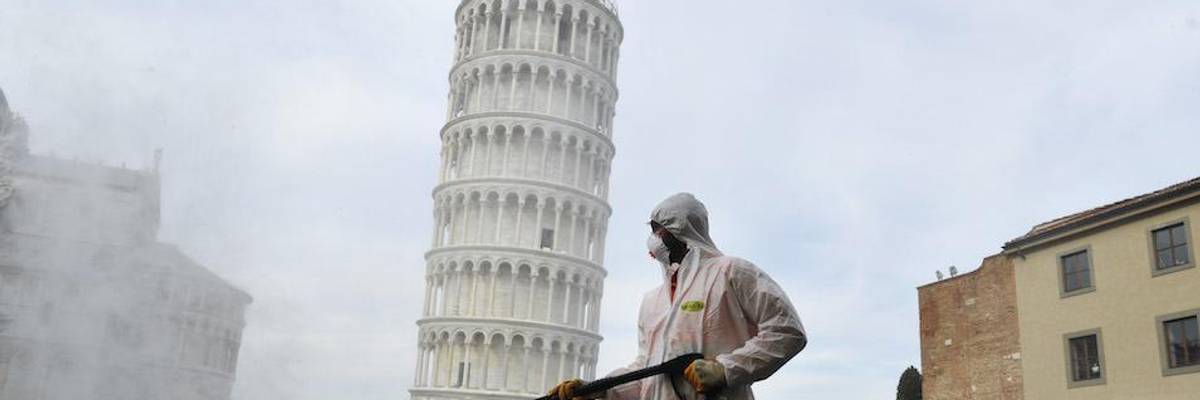
A worker carries out sanitation operations for the Coronavirus emergency in Piazza dei Miracoli near to the Tower of Pisa in a deserted town on March 17, 2020. (Photo: Laura Lezza/Getty Images)
As we move deeper into the unmapped realms brought forth by this inconceivable viral crisis, it can be helpful to consider lessons from other disaster situations for guidance. While nothing before precisely matches this moment, we might at least derive some solace from the fact that people have navigated incredibly challenging events, individually and collectively, and further recall that times of crisis can bring forth acts of great courage and compassion when people realize they're in it together or not at all.
The standard premise about what transpires "when the grid goes down"--either literally (as with a so-called "natural disaster") or more figuratively (as with the current crisis, in which usual norms are rapidly eroded)--is that people will revert to a Hobbesian "state of nature" in the absence of the social contract. In this view, the default setting of human nature is one of fear, aggression, a war of each against all, and ultimately a life that is (infamously termed) "solitary, poor, nasty, brutish, and short."
Putting aside a longer critique of Hobbesian thinking, we might at least seek agreement that at most this represents only half of our potential selves, and that the other half (or more) is equally crucial to our survival. This is the cooperative, prosocial, compassionate, collaborative, empathetic, altruistic, open-minded part of us, representing on its own terms a more appealing version of humanity and (considered in some degree with the other side of the ledger) a sense of power balanced equally with responsibility.
Which version will manifest in the uncharted waters of the coronavirus pandemic? In the short-term people may act quasi-voluntarily to "flatten the curve," but what ensues if this lingers? Official policies generally will tend toward anticipating (and thus eliciting) the worst of humankind, focusing on bans, lockdowns, cordons, and consequences. In the acute moments of the crisis, calls for "social distancing" can solidify the sense of individualism, potentially exacerbating a widespread stance of self-interest and positing others as a potential threat to one's safety and wellbeing. How then might we overcome this?
If previous disasters can serve as any sort of a ready guide, case studies indicate that people have a remarkable capacity to work together rather than tear each other apart. While the media might replay loops of individuals looting or focus on the ways that a crisis like the coronavirus "risks bringing out the worst in humanity," more in-depth works like the 2011 book Community Resilience in Natural Disasters teach us that values of volunteerism, acts of courage, and other forms of selflessness are often palpable.
Likewise, Rebecca Solnit's 2010 title A Paradise Built in Hell observes that in a profound crisis, most people will care for themselves and others, including both strangers and friends, and that "the image of the selfish, panicky, or regressively savage human being in times of disaster has little truth to it" (p.2). A 2018 New York Times article on preparing communities for a disaster quotes a New York commissioner who similarly asserts that "people are hard-wired to come together as a community after disasters."
These and other such treatments generally operate in a context where shared conditions have gotten very bad, but people are still able to meet directly, work together, and avail themselves of social bonds. The question for us now is how to maintain our bearings in a time of physical distance, especially as the reins of control inevitably tighten further in an attempt to stem the viral trajectory by imposing greater restraints on movements and interpersonal associations. Can we have distance and solidarity at once?
In recent years, people have gotten a lot savvier about technology and how our virtual selves can serve as extensions of our personae as well as forming a basis for new sorts of communities. There's much to critique about such a move to virtual personhood, but it is an emerging capacity that could be utilized constructively in the present situation by alleviating isolation, sharing information, coordinating efforts, staying productive, and retaining diversions. We've built up a capacity to construct robust virtual bonds.
Nevertheless, if the present crisis lingers and the footprint of most peoples' lives grows more insular, online interactions may be a poor substitute for in-person ones to maintain strong community ties. We can run meetings or hold classes using teleconferencing tools, but these modes will be hard-pressed to replicate the dynamic nature of face-to-face gatherings. Indeed, studies indicate that durable friendships require direct contact, while online communities can cultivate bonds of empathy only in some instances.
This will be an open question to monitor as this crisis progresses, and in particular if it deepens and continues over a significant period of time. Some simple things we can start doing (if we haven't already) include checking-in with our immediate neighbors, forging clear methods of familial communication, and helping with specific problems in your community as they emerge. These sorts of connections can be activated even with social distance, respecting others' boundaries while stoking the fires of solidarity. As well, there are a host of ways to leverage our digital presences toward actions for the social good: share your expertise and creativity widely, reconnect with friends and family, be available to others.
But let's not present a deceptively halcyon mindset about all of this. The larger lessons of disasters are more often consonant with "shock doctrine" techniques of expanding social control, testing capacities to manage behavior en masse, uniting militaristic and corporatist platforms, consolidating centralized powers, retrenching the social safety net, and eroding individual rights in ways that often outlive the acute crisis. A city can be rebuilt and a contagion can dissipate, but the shock can linger indefinitely. Still, the story of this moment is being written by all of us, and the potential reverberations are unbounded.
In a time of social upheaval, even small expressions of solidarity can serve as a wedge against complete acquiescence to imposed isolation and its individualistic overtones. The unexpected flowering of community in the midst of panic can serve to remind us of our other capacities and instincts, the ones that have never really fit with the master narrative but make life worth living in the first place. In addition to being well and staying strong, the challenge now is to not let social distancing undo this.
Dear Common Dreams reader, It’s been nearly 30 years since I co-founded Common Dreams with my late wife, Lina Newhouser. We had the radical notion that journalism should serve the public good, not corporate profits. It was clear to us from the outset what it would take to build such a project. No paid advertisements. No corporate sponsors. No millionaire publisher telling us what to think or do. Many people said we wouldn't last a year, but we proved those doubters wrong. Together with a tremendous team of journalists and dedicated staff, we built an independent media outlet free from the constraints of profits and corporate control. Our mission has always been simple: To inform. To inspire. To ignite change for the common good. Building Common Dreams was not easy. Our survival was never guaranteed. When you take on the most powerful forces—Wall Street greed, fossil fuel industry destruction, Big Tech lobbyists, and uber-rich oligarchs who have spent billions upon billions rigging the economy and democracy in their favor—the only bulwark you have is supporters who believe in your work. But here’s the urgent message from me today. It's never been this bad out there. And it's never been this hard to keep us going. At the very moment Common Dreams is most needed, the threats we face are intensifying. We need your support now more than ever. We don't accept corporate advertising and never will. We don't have a paywall because we don't think people should be blocked from critical news based on their ability to pay. Everything we do is funded by the donations of readers like you. When everyone does the little they can afford, we are strong. But if that support retreats or dries up, so do we. Will you donate now to make sure Common Dreams not only survives but thrives? —Craig Brown, Co-founder |
As we move deeper into the unmapped realms brought forth by this inconceivable viral crisis, it can be helpful to consider lessons from other disaster situations for guidance. While nothing before precisely matches this moment, we might at least derive some solace from the fact that people have navigated incredibly challenging events, individually and collectively, and further recall that times of crisis can bring forth acts of great courage and compassion when people realize they're in it together or not at all.
The standard premise about what transpires "when the grid goes down"--either literally (as with a so-called "natural disaster") or more figuratively (as with the current crisis, in which usual norms are rapidly eroded)--is that people will revert to a Hobbesian "state of nature" in the absence of the social contract. In this view, the default setting of human nature is one of fear, aggression, a war of each against all, and ultimately a life that is (infamously termed) "solitary, poor, nasty, brutish, and short."
Putting aside a longer critique of Hobbesian thinking, we might at least seek agreement that at most this represents only half of our potential selves, and that the other half (or more) is equally crucial to our survival. This is the cooperative, prosocial, compassionate, collaborative, empathetic, altruistic, open-minded part of us, representing on its own terms a more appealing version of humanity and (considered in some degree with the other side of the ledger) a sense of power balanced equally with responsibility.
Which version will manifest in the uncharted waters of the coronavirus pandemic? In the short-term people may act quasi-voluntarily to "flatten the curve," but what ensues if this lingers? Official policies generally will tend toward anticipating (and thus eliciting) the worst of humankind, focusing on bans, lockdowns, cordons, and consequences. In the acute moments of the crisis, calls for "social distancing" can solidify the sense of individualism, potentially exacerbating a widespread stance of self-interest and positing others as a potential threat to one's safety and wellbeing. How then might we overcome this?
If previous disasters can serve as any sort of a ready guide, case studies indicate that people have a remarkable capacity to work together rather than tear each other apart. While the media might replay loops of individuals looting or focus on the ways that a crisis like the coronavirus "risks bringing out the worst in humanity," more in-depth works like the 2011 book Community Resilience in Natural Disasters teach us that values of volunteerism, acts of courage, and other forms of selflessness are often palpable.
Likewise, Rebecca Solnit's 2010 title A Paradise Built in Hell observes that in a profound crisis, most people will care for themselves and others, including both strangers and friends, and that "the image of the selfish, panicky, or regressively savage human being in times of disaster has little truth to it" (p.2). A 2018 New York Times article on preparing communities for a disaster quotes a New York commissioner who similarly asserts that "people are hard-wired to come together as a community after disasters."
These and other such treatments generally operate in a context where shared conditions have gotten very bad, but people are still able to meet directly, work together, and avail themselves of social bonds. The question for us now is how to maintain our bearings in a time of physical distance, especially as the reins of control inevitably tighten further in an attempt to stem the viral trajectory by imposing greater restraints on movements and interpersonal associations. Can we have distance and solidarity at once?
In recent years, people have gotten a lot savvier about technology and how our virtual selves can serve as extensions of our personae as well as forming a basis for new sorts of communities. There's much to critique about such a move to virtual personhood, but it is an emerging capacity that could be utilized constructively in the present situation by alleviating isolation, sharing information, coordinating efforts, staying productive, and retaining diversions. We've built up a capacity to construct robust virtual bonds.
Nevertheless, if the present crisis lingers and the footprint of most peoples' lives grows more insular, online interactions may be a poor substitute for in-person ones to maintain strong community ties. We can run meetings or hold classes using teleconferencing tools, but these modes will be hard-pressed to replicate the dynamic nature of face-to-face gatherings. Indeed, studies indicate that durable friendships require direct contact, while online communities can cultivate bonds of empathy only in some instances.
This will be an open question to monitor as this crisis progresses, and in particular if it deepens and continues over a significant period of time. Some simple things we can start doing (if we haven't already) include checking-in with our immediate neighbors, forging clear methods of familial communication, and helping with specific problems in your community as they emerge. These sorts of connections can be activated even with social distance, respecting others' boundaries while stoking the fires of solidarity. As well, there are a host of ways to leverage our digital presences toward actions for the social good: share your expertise and creativity widely, reconnect with friends and family, be available to others.
But let's not present a deceptively halcyon mindset about all of this. The larger lessons of disasters are more often consonant with "shock doctrine" techniques of expanding social control, testing capacities to manage behavior en masse, uniting militaristic and corporatist platforms, consolidating centralized powers, retrenching the social safety net, and eroding individual rights in ways that often outlive the acute crisis. A city can be rebuilt and a contagion can dissipate, but the shock can linger indefinitely. Still, the story of this moment is being written by all of us, and the potential reverberations are unbounded.
In a time of social upheaval, even small expressions of solidarity can serve as a wedge against complete acquiescence to imposed isolation and its individualistic overtones. The unexpected flowering of community in the midst of panic can serve to remind us of our other capacities and instincts, the ones that have never really fit with the master narrative but make life worth living in the first place. In addition to being well and staying strong, the challenge now is to not let social distancing undo this.
As we move deeper into the unmapped realms brought forth by this inconceivable viral crisis, it can be helpful to consider lessons from other disaster situations for guidance. While nothing before precisely matches this moment, we might at least derive some solace from the fact that people have navigated incredibly challenging events, individually and collectively, and further recall that times of crisis can bring forth acts of great courage and compassion when people realize they're in it together or not at all.
The standard premise about what transpires "when the grid goes down"--either literally (as with a so-called "natural disaster") or more figuratively (as with the current crisis, in which usual norms are rapidly eroded)--is that people will revert to a Hobbesian "state of nature" in the absence of the social contract. In this view, the default setting of human nature is one of fear, aggression, a war of each against all, and ultimately a life that is (infamously termed) "solitary, poor, nasty, brutish, and short."
Putting aside a longer critique of Hobbesian thinking, we might at least seek agreement that at most this represents only half of our potential selves, and that the other half (or more) is equally crucial to our survival. This is the cooperative, prosocial, compassionate, collaborative, empathetic, altruistic, open-minded part of us, representing on its own terms a more appealing version of humanity and (considered in some degree with the other side of the ledger) a sense of power balanced equally with responsibility.
Which version will manifest in the uncharted waters of the coronavirus pandemic? In the short-term people may act quasi-voluntarily to "flatten the curve," but what ensues if this lingers? Official policies generally will tend toward anticipating (and thus eliciting) the worst of humankind, focusing on bans, lockdowns, cordons, and consequences. In the acute moments of the crisis, calls for "social distancing" can solidify the sense of individualism, potentially exacerbating a widespread stance of self-interest and positing others as a potential threat to one's safety and wellbeing. How then might we overcome this?
If previous disasters can serve as any sort of a ready guide, case studies indicate that people have a remarkable capacity to work together rather than tear each other apart. While the media might replay loops of individuals looting or focus on the ways that a crisis like the coronavirus "risks bringing out the worst in humanity," more in-depth works like the 2011 book Community Resilience in Natural Disasters teach us that values of volunteerism, acts of courage, and other forms of selflessness are often palpable.
Likewise, Rebecca Solnit's 2010 title A Paradise Built in Hell observes that in a profound crisis, most people will care for themselves and others, including both strangers and friends, and that "the image of the selfish, panicky, or regressively savage human being in times of disaster has little truth to it" (p.2). A 2018 New York Times article on preparing communities for a disaster quotes a New York commissioner who similarly asserts that "people are hard-wired to come together as a community after disasters."
These and other such treatments generally operate in a context where shared conditions have gotten very bad, but people are still able to meet directly, work together, and avail themselves of social bonds. The question for us now is how to maintain our bearings in a time of physical distance, especially as the reins of control inevitably tighten further in an attempt to stem the viral trajectory by imposing greater restraints on movements and interpersonal associations. Can we have distance and solidarity at once?
In recent years, people have gotten a lot savvier about technology and how our virtual selves can serve as extensions of our personae as well as forming a basis for new sorts of communities. There's much to critique about such a move to virtual personhood, but it is an emerging capacity that could be utilized constructively in the present situation by alleviating isolation, sharing information, coordinating efforts, staying productive, and retaining diversions. We've built up a capacity to construct robust virtual bonds.
Nevertheless, if the present crisis lingers and the footprint of most peoples' lives grows more insular, online interactions may be a poor substitute for in-person ones to maintain strong community ties. We can run meetings or hold classes using teleconferencing tools, but these modes will be hard-pressed to replicate the dynamic nature of face-to-face gatherings. Indeed, studies indicate that durable friendships require direct contact, while online communities can cultivate bonds of empathy only in some instances.
This will be an open question to monitor as this crisis progresses, and in particular if it deepens and continues over a significant period of time. Some simple things we can start doing (if we haven't already) include checking-in with our immediate neighbors, forging clear methods of familial communication, and helping with specific problems in your community as they emerge. These sorts of connections can be activated even with social distance, respecting others' boundaries while stoking the fires of solidarity. As well, there are a host of ways to leverage our digital presences toward actions for the social good: share your expertise and creativity widely, reconnect with friends and family, be available to others.
But let's not present a deceptively halcyon mindset about all of this. The larger lessons of disasters are more often consonant with "shock doctrine" techniques of expanding social control, testing capacities to manage behavior en masse, uniting militaristic and corporatist platforms, consolidating centralized powers, retrenching the social safety net, and eroding individual rights in ways that often outlive the acute crisis. A city can be rebuilt and a contagion can dissipate, but the shock can linger indefinitely. Still, the story of this moment is being written by all of us, and the potential reverberations are unbounded.
In a time of social upheaval, even small expressions of solidarity can serve as a wedge against complete acquiescence to imposed isolation and its individualistic overtones. The unexpected flowering of community in the midst of panic can serve to remind us of our other capacities and instincts, the ones that have never really fit with the master narrative but make life worth living in the first place. In addition to being well and staying strong, the challenge now is to not let social distancing undo this.