SUBSCRIBE TO OUR FREE NEWSLETTER
Daily news & progressive opinion—funded by the people, not the corporations—delivered straight to your inbox.
5
#000000
#FFFFFF
To donate by check, phone, or other method, see our More Ways to Give page.
Daily news & progressive opinion—funded by the people, not the corporations—delivered straight to your inbox.
The elephant, as a symbol of the GOP, is obsolete.
First of all, the elephant isn't the kind of fierce, diabolically resilient predator that can accurately represent the Republicans. It's true that it can stomp, kick, or squash the hell out of you. But it doesn't pounce very well. It doesn't jump out from behind a bush and take you by surprise. If you keep your distance from an elephant, chances are you'll be all right.
Furthermore, if you chop off an elephant's head or stab it through the heart, you can be confident that it will soon die and will remain dead--eternally. It won't rise from the grave to try to stomp, kick, or squash the hell out of you just when you've let your guard down.
For an illustration of this type of behavior, consider how enamored the Republican Party is with the notion of Medicaid block grants. Medicaid has always been an open-ended financial commitment. The state and federal government share the annual cost of serving all those covered by Medicaid in a given state, whatever that cost may be.
In contrast, Medicaid block grants would mean each state would receive a fixed amount of money each year and, if it's not enough to get through the year, too bad. States would have to cut eligibility or services or reimbursements or do whatever else they might have to do to compensate.
It seems to me that the new Republican animal needs to be one that isn't really dead when we all think it is.
That's why block grants are a wildly unpopular idea. In July, twenty-seven organizations, together representing more than 100 million people living with chronic or serious health conditions, sent a letter stating their "strong opposition" to Medicaid block grants to Seema Verma, administrator of the Centers for Medicare and Medicaid Services. Among these radical organizations are the American Lung Association, the American Heart Association, the March of Dimes, the Muscular Dystrophy Association and United Way.
Block grants, the letter said, "are designed to reduce federal funding for Medicaid, forcing states to either make up the difference with their own funds or make cuts to their programs that would reduce access to care." States with block grants, the letter says, "would have a greater incentive to impose additional barriers for treatments to manage their overall cost."
Medicaid block grants were a central feature of the various Republican efforts to repeal the Affordable Care Act, which is a big reason why they all crashed and burned. The raucous protests where disability rights activists were hauled out of Mitch McConnell's office and arrested were sparked primarily by outrage over Medicaid block grants.
The squatter currently occupying the White House has also attempted to convert Medicaid funding to block grants in federal budgets he proposed. That didn't fly either.
So Medicaid block grants appeared to have died a well-deserved and appropriately humiliating death. But here they are again, back from the dead, like zombies.
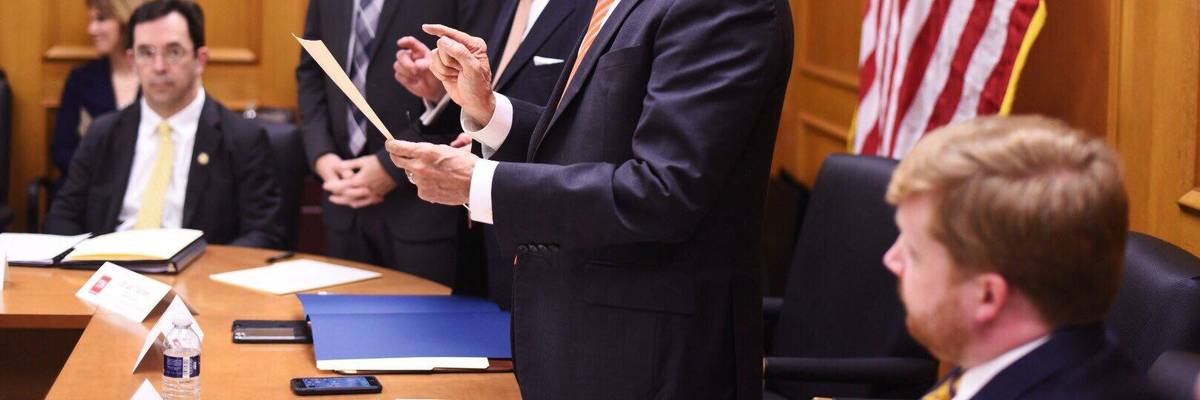
In September, Tennessee governor Bill Lee released a plan to convert that state's Medicaid funding to block grants. The Tennessee state legislature had passed a law last spring, which he signed, requiring him to do so. After a public comment period, Lee plans to submit the proposal to the Centers for Medicare and Medicaid Services for approval.
That would make Tennessee the first state to fund Medicaid with block grants. Tennessee would receive a one-year flat Medicaid appropriation of $7.9 billion. Lee calls the proposal a "modified" block grant, because it contains a provision that increases the appropriation if Tennessee Medicaid enrollment increases.
Lee insists that no one currently enrolled in Tennessee Medicaid will see a reduction in benefits. But it's simple bookkeeping math. When the money runs out, something's got to give. That's why Medicaid block grants sync so beautifully with the GOP's warped vision. They're a cowardly, backdoor way of retreating from our national commitment to Medicaid under the guise of innovation.
So, based on all this, it seems to me that the new Republican animal needs to be one that isn't really dead when we all think it is. Maybe a possum? But possums aren't fierce and predatory enough. This would have to be some sort of rabid, venomous possum with long, razor-like fangs.
I guess there is no living creature that adequately symbolizes the GOP.
Dear Common Dreams reader, It’s been nearly 30 years since I co-founded Common Dreams with my late wife, Lina Newhouser. We had the radical notion that journalism should serve the public good, not corporate profits. It was clear to us from the outset what it would take to build such a project. No paid advertisements. No corporate sponsors. No millionaire publisher telling us what to think or do. Many people said we wouldn't last a year, but we proved those doubters wrong. Together with a tremendous team of journalists and dedicated staff, we built an independent media outlet free from the constraints of profits and corporate control. Our mission has always been simple: To inform. To inspire. To ignite change for the common good. Building Common Dreams was not easy. Our survival was never guaranteed. When you take on the most powerful forces—Wall Street greed, fossil fuel industry destruction, Big Tech lobbyists, and uber-rich oligarchs who have spent billions upon billions rigging the economy and democracy in their favor—the only bulwark you have is supporters who believe in your work. But here’s the urgent message from me today. It's never been this bad out there. And it's never been this hard to keep us going. At the very moment Common Dreams is most needed, the threats we face are intensifying. We need your support now more than ever. We don't accept corporate advertising and never will. We don't have a paywall because we don't think people should be blocked from critical news based on their ability to pay. Everything we do is funded by the donations of readers like you. When everyone does the little they can afford, we are strong. But if that support retreats or dries up, so do we. Will you donate now to make sure Common Dreams not only survives but thrives? —Craig Brown, Co-founder |
The elephant, as a symbol of the GOP, is obsolete.
First of all, the elephant isn't the kind of fierce, diabolically resilient predator that can accurately represent the Republicans. It's true that it can stomp, kick, or squash the hell out of you. But it doesn't pounce very well. It doesn't jump out from behind a bush and take you by surprise. If you keep your distance from an elephant, chances are you'll be all right.
Furthermore, if you chop off an elephant's head or stab it through the heart, you can be confident that it will soon die and will remain dead--eternally. It won't rise from the grave to try to stomp, kick, or squash the hell out of you just when you've let your guard down.
For an illustration of this type of behavior, consider how enamored the Republican Party is with the notion of Medicaid block grants. Medicaid has always been an open-ended financial commitment. The state and federal government share the annual cost of serving all those covered by Medicaid in a given state, whatever that cost may be.
In contrast, Medicaid block grants would mean each state would receive a fixed amount of money each year and, if it's not enough to get through the year, too bad. States would have to cut eligibility or services or reimbursements or do whatever else they might have to do to compensate.
It seems to me that the new Republican animal needs to be one that isn't really dead when we all think it is.
That's why block grants are a wildly unpopular idea. In July, twenty-seven organizations, together representing more than 100 million people living with chronic or serious health conditions, sent a letter stating their "strong opposition" to Medicaid block grants to Seema Verma, administrator of the Centers for Medicare and Medicaid Services. Among these radical organizations are the American Lung Association, the American Heart Association, the March of Dimes, the Muscular Dystrophy Association and United Way.
Block grants, the letter said, "are designed to reduce federal funding for Medicaid, forcing states to either make up the difference with their own funds or make cuts to their programs that would reduce access to care." States with block grants, the letter says, "would have a greater incentive to impose additional barriers for treatments to manage their overall cost."
Medicaid block grants were a central feature of the various Republican efforts to repeal the Affordable Care Act, which is a big reason why they all crashed and burned. The raucous protests where disability rights activists were hauled out of Mitch McConnell's office and arrested were sparked primarily by outrage over Medicaid block grants.
The squatter currently occupying the White House has also attempted to convert Medicaid funding to block grants in federal budgets he proposed. That didn't fly either.
So Medicaid block grants appeared to have died a well-deserved and appropriately humiliating death. But here they are again, back from the dead, like zombies.
In September, Tennessee governor Bill Lee released a plan to convert that state's Medicaid funding to block grants. The Tennessee state legislature had passed a law last spring, which he signed, requiring him to do so. After a public comment period, Lee plans to submit the proposal to the Centers for Medicare and Medicaid Services for approval.
That would make Tennessee the first state to fund Medicaid with block grants. Tennessee would receive a one-year flat Medicaid appropriation of $7.9 billion. Lee calls the proposal a "modified" block grant, because it contains a provision that increases the appropriation if Tennessee Medicaid enrollment increases.
Lee insists that no one currently enrolled in Tennessee Medicaid will see a reduction in benefits. But it's simple bookkeeping math. When the money runs out, something's got to give. That's why Medicaid block grants sync so beautifully with the GOP's warped vision. They're a cowardly, backdoor way of retreating from our national commitment to Medicaid under the guise of innovation.
So, based on all this, it seems to me that the new Republican animal needs to be one that isn't really dead when we all think it is. Maybe a possum? But possums aren't fierce and predatory enough. This would have to be some sort of rabid, venomous possum with long, razor-like fangs.
I guess there is no living creature that adequately symbolizes the GOP.
The elephant, as a symbol of the GOP, is obsolete.
First of all, the elephant isn't the kind of fierce, diabolically resilient predator that can accurately represent the Republicans. It's true that it can stomp, kick, or squash the hell out of you. But it doesn't pounce very well. It doesn't jump out from behind a bush and take you by surprise. If you keep your distance from an elephant, chances are you'll be all right.
Furthermore, if you chop off an elephant's head or stab it through the heart, you can be confident that it will soon die and will remain dead--eternally. It won't rise from the grave to try to stomp, kick, or squash the hell out of you just when you've let your guard down.
For an illustration of this type of behavior, consider how enamored the Republican Party is with the notion of Medicaid block grants. Medicaid has always been an open-ended financial commitment. The state and federal government share the annual cost of serving all those covered by Medicaid in a given state, whatever that cost may be.
In contrast, Medicaid block grants would mean each state would receive a fixed amount of money each year and, if it's not enough to get through the year, too bad. States would have to cut eligibility or services or reimbursements or do whatever else they might have to do to compensate.
It seems to me that the new Republican animal needs to be one that isn't really dead when we all think it is.
That's why block grants are a wildly unpopular idea. In July, twenty-seven organizations, together representing more than 100 million people living with chronic or serious health conditions, sent a letter stating their "strong opposition" to Medicaid block grants to Seema Verma, administrator of the Centers for Medicare and Medicaid Services. Among these radical organizations are the American Lung Association, the American Heart Association, the March of Dimes, the Muscular Dystrophy Association and United Way.
Block grants, the letter said, "are designed to reduce federal funding for Medicaid, forcing states to either make up the difference with their own funds or make cuts to their programs that would reduce access to care." States with block grants, the letter says, "would have a greater incentive to impose additional barriers for treatments to manage their overall cost."
Medicaid block grants were a central feature of the various Republican efforts to repeal the Affordable Care Act, which is a big reason why they all crashed and burned. The raucous protests where disability rights activists were hauled out of Mitch McConnell's office and arrested were sparked primarily by outrage over Medicaid block grants.
The squatter currently occupying the White House has also attempted to convert Medicaid funding to block grants in federal budgets he proposed. That didn't fly either.
So Medicaid block grants appeared to have died a well-deserved and appropriately humiliating death. But here they are again, back from the dead, like zombies.
In September, Tennessee governor Bill Lee released a plan to convert that state's Medicaid funding to block grants. The Tennessee state legislature had passed a law last spring, which he signed, requiring him to do so. After a public comment period, Lee plans to submit the proposal to the Centers for Medicare and Medicaid Services for approval.
That would make Tennessee the first state to fund Medicaid with block grants. Tennessee would receive a one-year flat Medicaid appropriation of $7.9 billion. Lee calls the proposal a "modified" block grant, because it contains a provision that increases the appropriation if Tennessee Medicaid enrollment increases.
Lee insists that no one currently enrolled in Tennessee Medicaid will see a reduction in benefits. But it's simple bookkeeping math. When the money runs out, something's got to give. That's why Medicaid block grants sync so beautifully with the GOP's warped vision. They're a cowardly, backdoor way of retreating from our national commitment to Medicaid under the guise of innovation.
So, based on all this, it seems to me that the new Republican animal needs to be one that isn't really dead when we all think it is. Maybe a possum? But possums aren't fierce and predatory enough. This would have to be some sort of rabid, venomous possum with long, razor-like fangs.
I guess there is no living creature that adequately symbolizes the GOP.