
Will This Be the Next Unthinkable Act of Gun Violence?
"It's little wonder that the annual number of firearm-related deaths in the U.S. has skyrocketed during the past decade."
The early morning sun streamed softly through the windows as students, ranging from bleary-eyed to energetic, made their way to their seats. Amid rummaging through backpacks and light-hearted conversation, none of them saw or heard their instructor lock the door.
Once their fidgeting had subsided, more than a few seemed puzzled by their teacher's behavior, who, rather than initiating the day's lesson from his customary spot directly in front of the class, stood off to their right, expressionless, midway between the room's rectangular constellation of desks and its only exit.
Eventually, the eerie tandem of stillness and silence was broken by the sound of their instructor's hard-soled shoes as he walked to within arm's length of a pupil seated in the first row. He then slowly reached beneath his loose-fitting shirt, drew the lethal weapon he'd been authorized to use to protect his charges, and placed its cold, metal barrel against the forehead of his initial target. The boy had little time to process the void he saw in his teacher's eyes before he was shot.
Stunned by a real-life nightmare they never saw coming, some children remained frozen in their chairs, as the man many viewed as a stabilizing presence in their lives widened his aim and fired round after round in their direction.
Thirty interminable seconds later--and well before colleagues, guards, or local police could intervene--the shooting came to an end when the instructor took his own life. For the surviving students and their loved ones, teachers, school administrators, first-responders, hospital staff, counselors, friends, neighbors, and townspeople, the seemingly insurmountable task of overcoming their grief and trauma had just begun.
Thankfully, and for no other reason than dumb luck, our nation has yet to endure a teacher-initiated massacre like the one described above. But the clock is ticking. No less than 15 states allow teachers to carry guns in their classrooms. Add an untold number of instructors who, on any given day, could arrive at their school surreptitiously toting one of their own personal firearms, and the unimaginable becomes easier to imagine.
The justification for alarm is as simple as it is unnerving: There is not now, nor will there ever be, a definitive way to predict anyone's state of mind--be it five days, five weeks, or five years, post comprehensive background check. By their very nature, evaluations of even the highest order are, in the end, based on a snapshot in time, making them no match for the vulnerability of the human condition.
This stark reality continues to be ignored by both sides of the gun debate. Replaced, instead, by the unfounded belief that so-called responsible gun owners are somehow immune from our inherent frailty. Coupled with the fact that we now have more guns than people in America, it's little wonder that the annual number of firearm-related deaths in the U.S. has skyrocketed during the past decade.
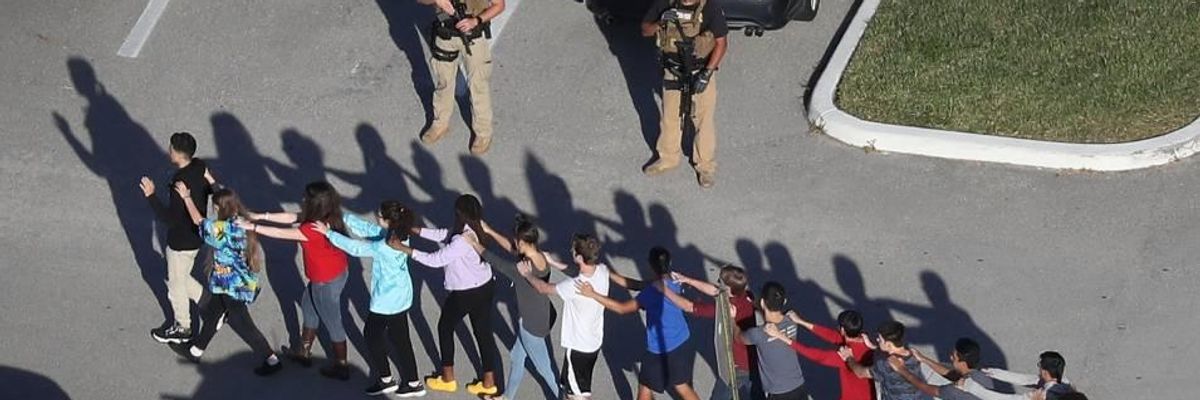
The recent string of mass shootings across our land demonstrates something else none of us wish were true: Safe havens we once took for granted are now a thing of the past.
If you are among the millions who wish to see a marked reduction in the incidence of suicide, murder, and accidental death in our country, you have a decision to make: Become part of the solution by urging everyone you know to join you in renouncing civilian gun ownership--or perpetuate the gruesome status quo by keeping your head firmly buried in the sand.
Choosing the former will bring us closer to living in a society free from gun violence. Selecting the latter will forever leave your hands stained with blood.
An Urgent Message From Our Co-Founder
Dear Common Dreams reader, It’s been nearly 30 years since I co-founded Common Dreams with my late wife, Lina Newhouser. We had the radical notion that journalism should serve the public good, not corporate profits. It was clear to us from the outset what it would take to build such a project. No paid advertisements. No corporate sponsors. No millionaire publisher telling us what to think or do. Many people said we wouldn't last a year, but we proved those doubters wrong. Together with a tremendous team of journalists and dedicated staff, we built an independent media outlet free from the constraints of profits and corporate control. Our mission has always been simple: To inform. To inspire. To ignite change for the common good. Building Common Dreams was not easy. Our survival was never guaranteed. When you take on the most powerful forces—Wall Street greed, fossil fuel industry destruction, Big Tech lobbyists, and uber-rich oligarchs who have spent billions upon billions rigging the economy and democracy in their favor—the only bulwark you have is supporters who believe in your work. But here’s the urgent message from me today. It's never been this bad out there. And it's never been this hard to keep us going. At the very moment Common Dreams is most needed, the threats we face are intensifying. We need your support now more than ever. We don't accept corporate advertising and never will. We don't have a paywall because we don't think people should be blocked from critical news based on their ability to pay. Everything we do is funded by the donations of readers like you. When everyone does the little they can afford, we are strong. But if that support retreats or dries up, so do we. Will you donate now to make sure Common Dreams not only survives but thrives? —Craig Brown, Co-founder |
The early morning sun streamed softly through the windows as students, ranging from bleary-eyed to energetic, made their way to their seats. Amid rummaging through backpacks and light-hearted conversation, none of them saw or heard their instructor lock the door.
Once their fidgeting had subsided, more than a few seemed puzzled by their teacher's behavior, who, rather than initiating the day's lesson from his customary spot directly in front of the class, stood off to their right, expressionless, midway between the room's rectangular constellation of desks and its only exit.
Eventually, the eerie tandem of stillness and silence was broken by the sound of their instructor's hard-soled shoes as he walked to within arm's length of a pupil seated in the first row. He then slowly reached beneath his loose-fitting shirt, drew the lethal weapon he'd been authorized to use to protect his charges, and placed its cold, metal barrel against the forehead of his initial target. The boy had little time to process the void he saw in his teacher's eyes before he was shot.
Stunned by a real-life nightmare they never saw coming, some children remained frozen in their chairs, as the man many viewed as a stabilizing presence in their lives widened his aim and fired round after round in their direction.
Thirty interminable seconds later--and well before colleagues, guards, or local police could intervene--the shooting came to an end when the instructor took his own life. For the surviving students and their loved ones, teachers, school administrators, first-responders, hospital staff, counselors, friends, neighbors, and townspeople, the seemingly insurmountable task of overcoming their grief and trauma had just begun.
Thankfully, and for no other reason than dumb luck, our nation has yet to endure a teacher-initiated massacre like the one described above. But the clock is ticking. No less than 15 states allow teachers to carry guns in their classrooms. Add an untold number of instructors who, on any given day, could arrive at their school surreptitiously toting one of their own personal firearms, and the unimaginable becomes easier to imagine.
The justification for alarm is as simple as it is unnerving: There is not now, nor will there ever be, a definitive way to predict anyone's state of mind--be it five days, five weeks, or five years, post comprehensive background check. By their very nature, evaluations of even the highest order are, in the end, based on a snapshot in time, making them no match for the vulnerability of the human condition.
This stark reality continues to be ignored by both sides of the gun debate. Replaced, instead, by the unfounded belief that so-called responsible gun owners are somehow immune from our inherent frailty. Coupled with the fact that we now have more guns than people in America, it's little wonder that the annual number of firearm-related deaths in the U.S. has skyrocketed during the past decade.
The recent string of mass shootings across our land demonstrates something else none of us wish were true: Safe havens we once took for granted are now a thing of the past.
If you are among the millions who wish to see a marked reduction in the incidence of suicide, murder, and accidental death in our country, you have a decision to make: Become part of the solution by urging everyone you know to join you in renouncing civilian gun ownership--or perpetuate the gruesome status quo by keeping your head firmly buried in the sand.
Choosing the former will bring us closer to living in a society free from gun violence. Selecting the latter will forever leave your hands stained with blood.
The early morning sun streamed softly through the windows as students, ranging from bleary-eyed to energetic, made their way to their seats. Amid rummaging through backpacks and light-hearted conversation, none of them saw or heard their instructor lock the door.
Once their fidgeting had subsided, more than a few seemed puzzled by their teacher's behavior, who, rather than initiating the day's lesson from his customary spot directly in front of the class, stood off to their right, expressionless, midway between the room's rectangular constellation of desks and its only exit.
Eventually, the eerie tandem of stillness and silence was broken by the sound of their instructor's hard-soled shoes as he walked to within arm's length of a pupil seated in the first row. He then slowly reached beneath his loose-fitting shirt, drew the lethal weapon he'd been authorized to use to protect his charges, and placed its cold, metal barrel against the forehead of his initial target. The boy had little time to process the void he saw in his teacher's eyes before he was shot.
Stunned by a real-life nightmare they never saw coming, some children remained frozen in their chairs, as the man many viewed as a stabilizing presence in their lives widened his aim and fired round after round in their direction.
Thirty interminable seconds later--and well before colleagues, guards, or local police could intervene--the shooting came to an end when the instructor took his own life. For the surviving students and their loved ones, teachers, school administrators, first-responders, hospital staff, counselors, friends, neighbors, and townspeople, the seemingly insurmountable task of overcoming their grief and trauma had just begun.
Thankfully, and for no other reason than dumb luck, our nation has yet to endure a teacher-initiated massacre like the one described above. But the clock is ticking. No less than 15 states allow teachers to carry guns in their classrooms. Add an untold number of instructors who, on any given day, could arrive at their school surreptitiously toting one of their own personal firearms, and the unimaginable becomes easier to imagine.
The justification for alarm is as simple as it is unnerving: There is not now, nor will there ever be, a definitive way to predict anyone's state of mind--be it five days, five weeks, or five years, post comprehensive background check. By their very nature, evaluations of even the highest order are, in the end, based on a snapshot in time, making them no match for the vulnerability of the human condition.
This stark reality continues to be ignored by both sides of the gun debate. Replaced, instead, by the unfounded belief that so-called responsible gun owners are somehow immune from our inherent frailty. Coupled with the fact that we now have more guns than people in America, it's little wonder that the annual number of firearm-related deaths in the U.S. has skyrocketed during the past decade.
The recent string of mass shootings across our land demonstrates something else none of us wish were true: Safe havens we once took for granted are now a thing of the past.
If you are among the millions who wish to see a marked reduction in the incidence of suicide, murder, and accidental death in our country, you have a decision to make: Become part of the solution by urging everyone you know to join you in renouncing civilian gun ownership--or perpetuate the gruesome status quo by keeping your head firmly buried in the sand.
Choosing the former will bring us closer to living in a society free from gun violence. Selecting the latter will forever leave your hands stained with blood.