SUBSCRIBE TO OUR FREE NEWSLETTER
Daily news & progressive opinion—funded by the people, not the corporations—delivered straight to your inbox.
5
#000000
#FFFFFF
To donate by check, phone, or other method, see our More Ways to Give page.
Daily news & progressive opinion—funded by the people, not the corporations—delivered straight to your inbox.
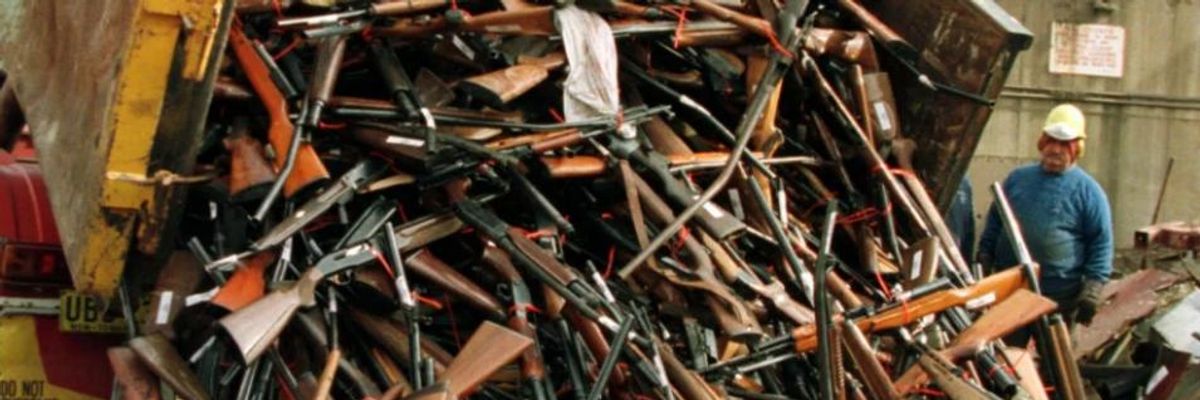
A truck unloads prohibited firearms at a scrapmetal yard in 1997 after the Port Arthur massacre a year earlier. (Photo: Reuters)
Australians over 40 can identify with the grief gripping New Zealand just now. We felt it in the aftermath of the Port Arthur massacre in 1996, when 35 people were murdered and dozens more wounded at the popular holiday location in Tasmania. Just as in Christchurch, the Port Arthur killer was a 28-year-old loner with no criminal record armed with semi-automatic weapons.
In terms of numbers, the Christchurch shooting is much larger, with a death toll of at least 50. But the scale of this new calamity is even worse if the numbers are considered in context. In the 1990s Australia had about 350 homicides a year, so the Port Arthur massacre was a more than a month's worth of homicides occurring on one day. New Zealand is a much smaller nation with usually about 50 homicides a year. This tragedy represents a whole year's homicides for the whole country, occurring on one day in Christchurch.
As well as grief and horror, Australians in 1996 were overtaken by outrage and disgust as citizens realised how easily semi-automatic weapons could be obtained. Even prime minister John Howard was shocked to discover the weakness of our gun laws. Our elected legislators, whose first responsibility was to keep the population safe, had ignored years of recommendations from experts about closing the deadly loopholes. Now New Zealanders are experiencing that same rude awakening.
New Zealand is about 20 years behind Australia in gun control - its current law resembles the laws of NSW, Queensland and Tasmania before Port Arthur. That means rapid-fire, semi-automatic rifles are easily available and there's no registration of the vast majority of guns. There's no requirement to prove a legitimate reason for owning a gun, no limit on the number you can buy and no regulation of ammunition.
It didn't have to be that way. Australia's comprehensive overhaul of firearm policy after Port Arthur should also have been applied in New Zealand. Under our National Firearms Agreement, we banned semi-auto rifles and shotguns, removed 640,000 of these weapons from circulation with a buyback, required registration of all guns and dramatically raised the standard of screening for a gun license, including the obligation to prove a legitimate reason. This scheme was developed under the auspices of the Australasian Police Ministers Council - Australasian as in Australia plus New Zealand. Our two countries routinely collaborate on matters of criminal investigation and prevention, so it made sense for the solution to be Australasian.
Under pressure from the local gun lobby, New Zealand declined to join the scheme and instead held a review of its law. Unsurprisingly, the review recommended major changes along the lines of the Australian reforms, but those recommendations were ignored and never implemented. This left New Zealand out of step, not only with Australia, but with most other industrialised countries which recognise the need for robust controls over a product designed specifically for the purpose of causing death and injury.
Prime Minister Jacinda Ardern has declared that the gun laws will change. No need to start from scratch: she should take advantage of the extensive policy thinking already done for the New Zealand review and Australia's National Firearms Agreement. Ideally, New Zealand should adopt the same measures as Australia. She should act fast, before the media spotlight moves on and gun lobby pressure begins to drain the resolve of legislators.
Meanwhile, this should also serve to snap Australians out of our complacency after 23 years without such a tragedy occurring here. The NSW election looks set to increase the power of the minor parties that are dedicated to loosening our gun law. The Christchurch shooting is a heartbreaking reminder of why we must not let them prevail.
Dear Common Dreams reader, It’s been nearly 30 years since I co-founded Common Dreams with my late wife, Lina Newhouser. We had the radical notion that journalism should serve the public good, not corporate profits. It was clear to us from the outset what it would take to build such a project. No paid advertisements. No corporate sponsors. No millionaire publisher telling us what to think or do. Many people said we wouldn't last a year, but we proved those doubters wrong. Together with a tremendous team of journalists and dedicated staff, we built an independent media outlet free from the constraints of profits and corporate control. Our mission has always been simple: To inform. To inspire. To ignite change for the common good. Building Common Dreams was not easy. Our survival was never guaranteed. When you take on the most powerful forces—Wall Street greed, fossil fuel industry destruction, Big Tech lobbyists, and uber-rich oligarchs who have spent billions upon billions rigging the economy and democracy in their favor—the only bulwark you have is supporters who believe in your work. But here’s the urgent message from me today. It's never been this bad out there. And it's never been this hard to keep us going. At the very moment Common Dreams is most needed, the threats we face are intensifying. We need your support now more than ever. We don't accept corporate advertising and never will. We don't have a paywall because we don't think people should be blocked from critical news based on their ability to pay. Everything we do is funded by the donations of readers like you. When everyone does the little they can afford, we are strong. But if that support retreats or dries up, so do we. Will you donate now to make sure Common Dreams not only survives but thrives? —Craig Brown, Co-founder |
Australians over 40 can identify with the grief gripping New Zealand just now. We felt it in the aftermath of the Port Arthur massacre in 1996, when 35 people were murdered and dozens more wounded at the popular holiday location in Tasmania. Just as in Christchurch, the Port Arthur killer was a 28-year-old loner with no criminal record armed with semi-automatic weapons.
In terms of numbers, the Christchurch shooting is much larger, with a death toll of at least 50. But the scale of this new calamity is even worse if the numbers are considered in context. In the 1990s Australia had about 350 homicides a year, so the Port Arthur massacre was a more than a month's worth of homicides occurring on one day. New Zealand is a much smaller nation with usually about 50 homicides a year. This tragedy represents a whole year's homicides for the whole country, occurring on one day in Christchurch.
As well as grief and horror, Australians in 1996 were overtaken by outrage and disgust as citizens realised how easily semi-automatic weapons could be obtained. Even prime minister John Howard was shocked to discover the weakness of our gun laws. Our elected legislators, whose first responsibility was to keep the population safe, had ignored years of recommendations from experts about closing the deadly loopholes. Now New Zealanders are experiencing that same rude awakening.
New Zealand is about 20 years behind Australia in gun control - its current law resembles the laws of NSW, Queensland and Tasmania before Port Arthur. That means rapid-fire, semi-automatic rifles are easily available and there's no registration of the vast majority of guns. There's no requirement to prove a legitimate reason for owning a gun, no limit on the number you can buy and no regulation of ammunition.
It didn't have to be that way. Australia's comprehensive overhaul of firearm policy after Port Arthur should also have been applied in New Zealand. Under our National Firearms Agreement, we banned semi-auto rifles and shotguns, removed 640,000 of these weapons from circulation with a buyback, required registration of all guns and dramatically raised the standard of screening for a gun license, including the obligation to prove a legitimate reason. This scheme was developed under the auspices of the Australasian Police Ministers Council - Australasian as in Australia plus New Zealand. Our two countries routinely collaborate on matters of criminal investigation and prevention, so it made sense for the solution to be Australasian.
Under pressure from the local gun lobby, New Zealand declined to join the scheme and instead held a review of its law. Unsurprisingly, the review recommended major changes along the lines of the Australian reforms, but those recommendations were ignored and never implemented. This left New Zealand out of step, not only with Australia, but with most other industrialised countries which recognise the need for robust controls over a product designed specifically for the purpose of causing death and injury.
Prime Minister Jacinda Ardern has declared that the gun laws will change. No need to start from scratch: she should take advantage of the extensive policy thinking already done for the New Zealand review and Australia's National Firearms Agreement. Ideally, New Zealand should adopt the same measures as Australia. She should act fast, before the media spotlight moves on and gun lobby pressure begins to drain the resolve of legislators.
Meanwhile, this should also serve to snap Australians out of our complacency after 23 years without such a tragedy occurring here. The NSW election looks set to increase the power of the minor parties that are dedicated to loosening our gun law. The Christchurch shooting is a heartbreaking reminder of why we must not let them prevail.
Australians over 40 can identify with the grief gripping New Zealand just now. We felt it in the aftermath of the Port Arthur massacre in 1996, when 35 people were murdered and dozens more wounded at the popular holiday location in Tasmania. Just as in Christchurch, the Port Arthur killer was a 28-year-old loner with no criminal record armed with semi-automatic weapons.
In terms of numbers, the Christchurch shooting is much larger, with a death toll of at least 50. But the scale of this new calamity is even worse if the numbers are considered in context. In the 1990s Australia had about 350 homicides a year, so the Port Arthur massacre was a more than a month's worth of homicides occurring on one day. New Zealand is a much smaller nation with usually about 50 homicides a year. This tragedy represents a whole year's homicides for the whole country, occurring on one day in Christchurch.
As well as grief and horror, Australians in 1996 were overtaken by outrage and disgust as citizens realised how easily semi-automatic weapons could be obtained. Even prime minister John Howard was shocked to discover the weakness of our gun laws. Our elected legislators, whose first responsibility was to keep the population safe, had ignored years of recommendations from experts about closing the deadly loopholes. Now New Zealanders are experiencing that same rude awakening.
New Zealand is about 20 years behind Australia in gun control - its current law resembles the laws of NSW, Queensland and Tasmania before Port Arthur. That means rapid-fire, semi-automatic rifles are easily available and there's no registration of the vast majority of guns. There's no requirement to prove a legitimate reason for owning a gun, no limit on the number you can buy and no regulation of ammunition.
It didn't have to be that way. Australia's comprehensive overhaul of firearm policy after Port Arthur should also have been applied in New Zealand. Under our National Firearms Agreement, we banned semi-auto rifles and shotguns, removed 640,000 of these weapons from circulation with a buyback, required registration of all guns and dramatically raised the standard of screening for a gun license, including the obligation to prove a legitimate reason. This scheme was developed under the auspices of the Australasian Police Ministers Council - Australasian as in Australia plus New Zealand. Our two countries routinely collaborate on matters of criminal investigation and prevention, so it made sense for the solution to be Australasian.
Under pressure from the local gun lobby, New Zealand declined to join the scheme and instead held a review of its law. Unsurprisingly, the review recommended major changes along the lines of the Australian reforms, but those recommendations were ignored and never implemented. This left New Zealand out of step, not only with Australia, but with most other industrialised countries which recognise the need for robust controls over a product designed specifically for the purpose of causing death and injury.
Prime Minister Jacinda Ardern has declared that the gun laws will change. No need to start from scratch: she should take advantage of the extensive policy thinking already done for the New Zealand review and Australia's National Firearms Agreement. Ideally, New Zealand should adopt the same measures as Australia. She should act fast, before the media spotlight moves on and gun lobby pressure begins to drain the resolve of legislators.
Meanwhile, this should also serve to snap Australians out of our complacency after 23 years without such a tragedy occurring here. The NSW election looks set to increase the power of the minor parties that are dedicated to loosening our gun law. The Christchurch shooting is a heartbreaking reminder of why we must not let them prevail.