SUBSCRIBE TO OUR FREE NEWSLETTER
Daily news & progressive opinion—funded by the people, not the corporations—delivered straight to your inbox.
5
#000000
#FFFFFF
To donate by check, phone, or other method, see our More Ways to Give page.
Daily news & progressive opinion—funded by the people, not the corporations—delivered straight to your inbox.
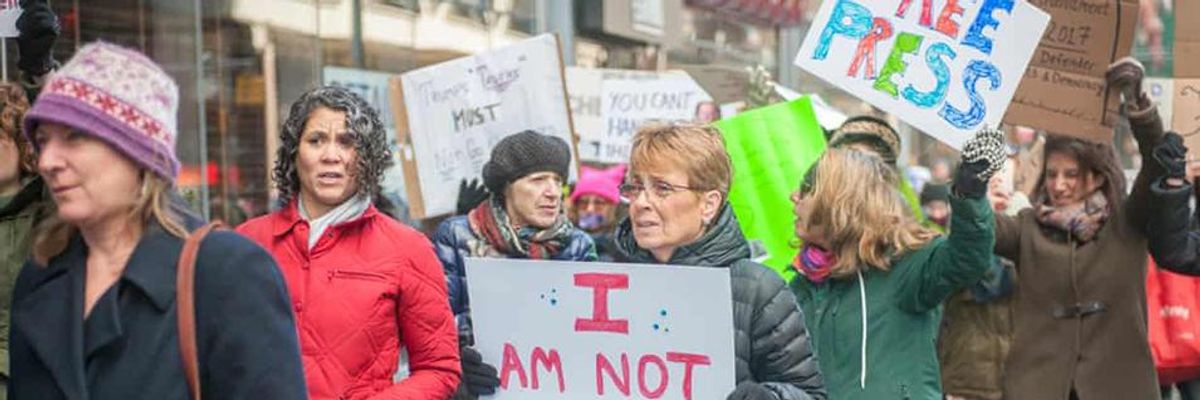
Activists rally in New York on February 26, 2017 over President Trump's branding news that disagrees with him 'fake news'. Photo: Alamy Stock
A great divide is shaping up in the newspaper business between those who want to make American Journalism "great again" and those who believe it has never been great but could be. It'll come as no surprise to anyone where I fall.
A great divide is shaping up in the newspaper business between those who want to make American Journalism "great again" and those who believe it has never been great but could be. It'll come as no surprise to anyone where I fall.
Local papers have taken a hit. There's no debate about that. The same miserable mob that mauled Main Street banks has plundered and pillaged newspapers across the country. Pursuing only profits, private hedge funds bought and stripped even long-lived legacy papers, leaving them for dead. One in five local papers has shut up shop in the last 10 years, according to a recent report from the Knight Foundation.
In response, Knight has announced a record-breaking $300 million investment in local news. At its annual Media Forum this March in Miami, CEO Alberto Ibarguen told the crowd that trust in news media is at an all-time low, but despite this, "There is strength in local and local leads to trust."
The same forum featured a slew of speakers who never had that trust--people like Bettina Chang of the City Bureau in Chicago, a bottom-up reporting operation founded and operated by young inner-city residents.
"American journalism was never great," said Chang, "but the crisis facing it now is an unprecedented opportunity to create an equitable journalism ecosystem." The Bureau has benefited from creative grantmaking by a consortium of funders who decided, for once, not to fund the high-brow and high volume sort of media, but rather the low-down and not-yet-recognized kind.
After all, the so-called "legacy" papers have a specific legacy that isn't everyone's. For all the changes that have hit the news, some things have remained the same: a handful of mostly pale, male editors and publishers downtown have defined who and what is newsworthy and who gets to tell the news. All too often, the result has been stale and disparaging to a whole hunk of the population, which is why the Black press and the Spanish-speaking media and so many ethnic presses have emerged and thrived in the US over the generations.
Today could be a new day. With the Democracy Fund, The MacArthur Foundation is giving over $3 million to Illinois's community Field Foundation to fund local African, Latinx, Asian, Arab, and Native American media. One of those, City Bureau, surveyed their neighbors, found out what they lacked, and then provided it, setting up a new open-door newsroom for readers, a low-price professional school for would-be journalists, and free trainings for volunteers willing to attend and take notes on the city's many unreported public meetings. Now people are signing up in droves, reporting is coming in from every corner, and Chicagoans are excited about journalism at every level.
As Knight's CEO said, the problem of journalism can't be left to government or the market to fix. It's a "we the people problem." To which I'd only add, it's the same "we the people" problem we've been having in every industry. Who gets to be part of that we?
Dear Common Dreams reader, It’s been nearly 30 years since I co-founded Common Dreams with my late wife, Lina Newhouser. We had the radical notion that journalism should serve the public good, not corporate profits. It was clear to us from the outset what it would take to build such a project. No paid advertisements. No corporate sponsors. No millionaire publisher telling us what to think or do. Many people said we wouldn't last a year, but we proved those doubters wrong. Together with a tremendous team of journalists and dedicated staff, we built an independent media outlet free from the constraints of profits and corporate control. Our mission has always been simple: To inform. To inspire. To ignite change for the common good. Building Common Dreams was not easy. Our survival was never guaranteed. When you take on the most powerful forces—Wall Street greed, fossil fuel industry destruction, Big Tech lobbyists, and uber-rich oligarchs who have spent billions upon billions rigging the economy and democracy in their favor—the only bulwark you have is supporters who believe in your work. But here’s the urgent message from me today. It's never been this bad out there. And it's never been this hard to keep us going. At the very moment Common Dreams is most needed, the threats we face are intensifying. We need your support now more than ever. We don't accept corporate advertising and never will. We don't have a paywall because we don't think people should be blocked from critical news based on their ability to pay. Everything we do is funded by the donations of readers like you. When everyone does the little they can afford, we are strong. But if that support retreats or dries up, so do we. Will you donate now to make sure Common Dreams not only survives but thrives? —Craig Brown, Co-founder |
A great divide is shaping up in the newspaper business between those who want to make American Journalism "great again" and those who believe it has never been great but could be. It'll come as no surprise to anyone where I fall.
Local papers have taken a hit. There's no debate about that. The same miserable mob that mauled Main Street banks has plundered and pillaged newspapers across the country. Pursuing only profits, private hedge funds bought and stripped even long-lived legacy papers, leaving them for dead. One in five local papers has shut up shop in the last 10 years, according to a recent report from the Knight Foundation.
In response, Knight has announced a record-breaking $300 million investment in local news. At its annual Media Forum this March in Miami, CEO Alberto Ibarguen told the crowd that trust in news media is at an all-time low, but despite this, "There is strength in local and local leads to trust."
The same forum featured a slew of speakers who never had that trust--people like Bettina Chang of the City Bureau in Chicago, a bottom-up reporting operation founded and operated by young inner-city residents.
"American journalism was never great," said Chang, "but the crisis facing it now is an unprecedented opportunity to create an equitable journalism ecosystem." The Bureau has benefited from creative grantmaking by a consortium of funders who decided, for once, not to fund the high-brow and high volume sort of media, but rather the low-down and not-yet-recognized kind.
After all, the so-called "legacy" papers have a specific legacy that isn't everyone's. For all the changes that have hit the news, some things have remained the same: a handful of mostly pale, male editors and publishers downtown have defined who and what is newsworthy and who gets to tell the news. All too often, the result has been stale and disparaging to a whole hunk of the population, which is why the Black press and the Spanish-speaking media and so many ethnic presses have emerged and thrived in the US over the generations.
Today could be a new day. With the Democracy Fund, The MacArthur Foundation is giving over $3 million to Illinois's community Field Foundation to fund local African, Latinx, Asian, Arab, and Native American media. One of those, City Bureau, surveyed their neighbors, found out what they lacked, and then provided it, setting up a new open-door newsroom for readers, a low-price professional school for would-be journalists, and free trainings for volunteers willing to attend and take notes on the city's many unreported public meetings. Now people are signing up in droves, reporting is coming in from every corner, and Chicagoans are excited about journalism at every level.
As Knight's CEO said, the problem of journalism can't be left to government or the market to fix. It's a "we the people problem." To which I'd only add, it's the same "we the people" problem we've been having in every industry. Who gets to be part of that we?
A great divide is shaping up in the newspaper business between those who want to make American Journalism "great again" and those who believe it has never been great but could be. It'll come as no surprise to anyone where I fall.
Local papers have taken a hit. There's no debate about that. The same miserable mob that mauled Main Street banks has plundered and pillaged newspapers across the country. Pursuing only profits, private hedge funds bought and stripped even long-lived legacy papers, leaving them for dead. One in five local papers has shut up shop in the last 10 years, according to a recent report from the Knight Foundation.
In response, Knight has announced a record-breaking $300 million investment in local news. At its annual Media Forum this March in Miami, CEO Alberto Ibarguen told the crowd that trust in news media is at an all-time low, but despite this, "There is strength in local and local leads to trust."
The same forum featured a slew of speakers who never had that trust--people like Bettina Chang of the City Bureau in Chicago, a bottom-up reporting operation founded and operated by young inner-city residents.
"American journalism was never great," said Chang, "but the crisis facing it now is an unprecedented opportunity to create an equitable journalism ecosystem." The Bureau has benefited from creative grantmaking by a consortium of funders who decided, for once, not to fund the high-brow and high volume sort of media, but rather the low-down and not-yet-recognized kind.
After all, the so-called "legacy" papers have a specific legacy that isn't everyone's. For all the changes that have hit the news, some things have remained the same: a handful of mostly pale, male editors and publishers downtown have defined who and what is newsworthy and who gets to tell the news. All too often, the result has been stale and disparaging to a whole hunk of the population, which is why the Black press and the Spanish-speaking media and so many ethnic presses have emerged and thrived in the US over the generations.
Today could be a new day. With the Democracy Fund, The MacArthur Foundation is giving over $3 million to Illinois's community Field Foundation to fund local African, Latinx, Asian, Arab, and Native American media. One of those, City Bureau, surveyed their neighbors, found out what they lacked, and then provided it, setting up a new open-door newsroom for readers, a low-price professional school for would-be journalists, and free trainings for volunteers willing to attend and take notes on the city's many unreported public meetings. Now people are signing up in droves, reporting is coming in from every corner, and Chicagoans are excited about journalism at every level.
As Knight's CEO said, the problem of journalism can't be left to government or the market to fix. It's a "we the people problem." To which I'd only add, it's the same "we the people" problem we've been having in every industry. Who gets to be part of that we?