SUBSCRIBE TO OUR FREE NEWSLETTER
Daily news & progressive opinion—funded by the people, not the corporations—delivered straight to your inbox.
5
#000000
#FFFFFF
To donate by check, phone, or other method, see our More Ways to Give page.
Daily news & progressive opinion—funded by the people, not the corporations—delivered straight to your inbox.
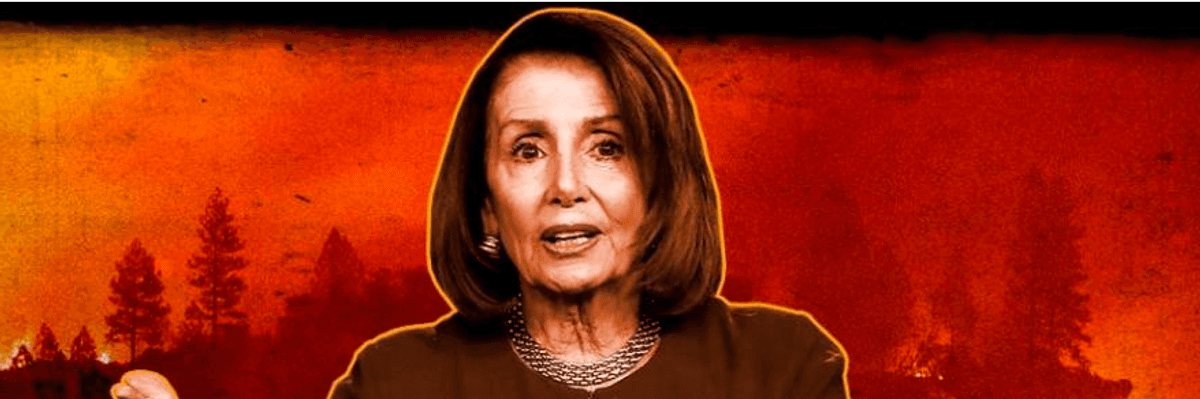
If the scientists are right, "isn't Pelosi's incrementalist approach to climate absurdly inadequate?" he writes. "Isn't it, in fact, like trying to put out a forest fire with a plant mister?"(Photo: Illustrated | Mark Wilson/Getty Images, JOSH EDELSON/AFP/Getty Images)
limate change has vaulted to the top of the political discourse, with the rollout of the Green New Deal policy framework and the subsequent discussion of what policies it should contain. Washington Gov. Jay Inslee (D), for instance, recently announced he is running for president with a platform laser-focused on climate change.
All this has political moderates rolling their eyes. "The green dream or whatever they call it, nobody knows what it is, but they're for it right?" scoffed Speaker of the House Nancy Pelosi. Sen. Dianne Feinstein (D-Calif.) scolded a bunch of children who came to her office begging her to support the Green New Deal, saying "I know what I'm doing ... it's not a good resolution." New York Times columnist Bret Stephens concludes that if famed lefty Pelosi doesn't support it, the GND must be basically silly: "[I]t's time to move climate policy beyond impractical radicalism and feckless virtue-signaling to something that can achieve a plausible, positive, and bipartisan result."
All this reveals the bankruptcy of so-called "realism" on climate change.
The remarkable thing about Stephens' column is that he perceives the problem with the Democratic moderate climate stance with perfect accuracy. Unlike Stephens in his Wall Street Journal incarnation, Feinstein and Pelosi do not deny the science of climate change. But if the scientists are right, "isn't Pelosi's incrementalist approach to climate absurdly inadequate?" he writes. "Isn't it, in fact, like trying to put out a forest fire with a plant mister?"
Yep! But contrary to Stephen's conclusion that Pelosi's political reasoning must be correct, one can easily accept climate science while refusing to accept the obvious policy implications -- that we need radical policy to wrench down emissions as fast as possible. It is its own version of climate denial, in a sense.
Read the full article here.
Dear Common Dreams reader, It’s been nearly 30 years since I co-founded Common Dreams with my late wife, Lina Newhouser. We had the radical notion that journalism should serve the public good, not corporate profits. It was clear to us from the outset what it would take to build such a project. No paid advertisements. No corporate sponsors. No millionaire publisher telling us what to think or do. Many people said we wouldn't last a year, but we proved those doubters wrong. Together with a tremendous team of journalists and dedicated staff, we built an independent media outlet free from the constraints of profits and corporate control. Our mission has always been simple: To inform. To inspire. To ignite change for the common good. Building Common Dreams was not easy. Our survival was never guaranteed. When you take on the most powerful forces—Wall Street greed, fossil fuel industry destruction, Big Tech lobbyists, and uber-rich oligarchs who have spent billions upon billions rigging the economy and democracy in their favor—the only bulwark you have is supporters who believe in your work. But here’s the urgent message from me today. It's never been this bad out there. And it's never been this hard to keep us going. At the very moment Common Dreams is most needed, the threats we face are intensifying. We need your support now more than ever. We don't accept corporate advertising and never will. We don't have a paywall because we don't think people should be blocked from critical news based on their ability to pay. Everything we do is funded by the donations of readers like you. When everyone does the little they can afford, we are strong. But if that support retreats or dries up, so do we. Will you donate now to make sure Common Dreams not only survives but thrives? —Craig Brown, Co-founder |
limate change has vaulted to the top of the political discourse, with the rollout of the Green New Deal policy framework and the subsequent discussion of what policies it should contain. Washington Gov. Jay Inslee (D), for instance, recently announced he is running for president with a platform laser-focused on climate change.
All this has political moderates rolling their eyes. "The green dream or whatever they call it, nobody knows what it is, but they're for it right?" scoffed Speaker of the House Nancy Pelosi. Sen. Dianne Feinstein (D-Calif.) scolded a bunch of children who came to her office begging her to support the Green New Deal, saying "I know what I'm doing ... it's not a good resolution." New York Times columnist Bret Stephens concludes that if famed lefty Pelosi doesn't support it, the GND must be basically silly: "[I]t's time to move climate policy beyond impractical radicalism and feckless virtue-signaling to something that can achieve a plausible, positive, and bipartisan result."
All this reveals the bankruptcy of so-called "realism" on climate change.
The remarkable thing about Stephens' column is that he perceives the problem with the Democratic moderate climate stance with perfect accuracy. Unlike Stephens in his Wall Street Journal incarnation, Feinstein and Pelosi do not deny the science of climate change. But if the scientists are right, "isn't Pelosi's incrementalist approach to climate absurdly inadequate?" he writes. "Isn't it, in fact, like trying to put out a forest fire with a plant mister?"
Yep! But contrary to Stephen's conclusion that Pelosi's political reasoning must be correct, one can easily accept climate science while refusing to accept the obvious policy implications -- that we need radical policy to wrench down emissions as fast as possible. It is its own version of climate denial, in a sense.
Read the full article here.
limate change has vaulted to the top of the political discourse, with the rollout of the Green New Deal policy framework and the subsequent discussion of what policies it should contain. Washington Gov. Jay Inslee (D), for instance, recently announced he is running for president with a platform laser-focused on climate change.
All this has political moderates rolling their eyes. "The green dream or whatever they call it, nobody knows what it is, but they're for it right?" scoffed Speaker of the House Nancy Pelosi. Sen. Dianne Feinstein (D-Calif.) scolded a bunch of children who came to her office begging her to support the Green New Deal, saying "I know what I'm doing ... it's not a good resolution." New York Times columnist Bret Stephens concludes that if famed lefty Pelosi doesn't support it, the GND must be basically silly: "[I]t's time to move climate policy beyond impractical radicalism and feckless virtue-signaling to something that can achieve a plausible, positive, and bipartisan result."
All this reveals the bankruptcy of so-called "realism" on climate change.
The remarkable thing about Stephens' column is that he perceives the problem with the Democratic moderate climate stance with perfect accuracy. Unlike Stephens in his Wall Street Journal incarnation, Feinstein and Pelosi do not deny the science of climate change. But if the scientists are right, "isn't Pelosi's incrementalist approach to climate absurdly inadequate?" he writes. "Isn't it, in fact, like trying to put out a forest fire with a plant mister?"
Yep! But contrary to Stephen's conclusion that Pelosi's political reasoning must be correct, one can easily accept climate science while refusing to accept the obvious policy implications -- that we need radical policy to wrench down emissions as fast as possible. It is its own version of climate denial, in a sense.
Read the full article here.