SUBSCRIBE TO OUR FREE NEWSLETTER
Daily news & progressive opinion—funded by the people, not the corporations—delivered straight to your inbox.
5
#000000
#FFFFFF
To donate by check, phone, or other method, see our More Ways to Give page.
Daily news & progressive opinion—funded by the people, not the corporations—delivered straight to your inbox.
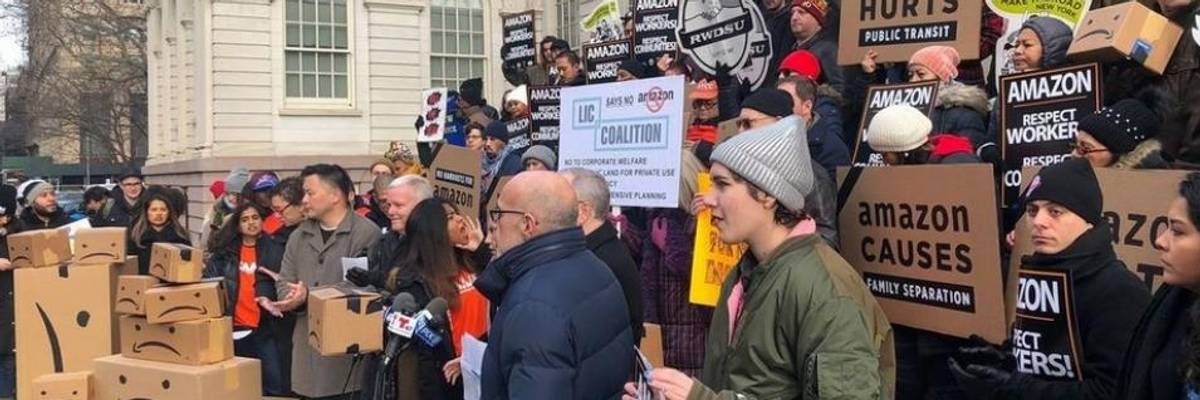
Demonstrators from local worker advocacy groups assembled outside New York's City Hall in December as the City Council held a hearing on Amazon's now-canceled plan to establish a new headquarters in Queens. (Photo: @GoMadeIn/Twitter)
Now that activists in New York City successfully chased Amazon and its "HQ2" plan out of New York City, there is a new challenge: Can the organizers and elected leaders who successfully blocked the kind of economic development they opposed bring about the kind of economic development they want?
That was a question that Cheyenna Weber, general coordinator for the Cooperative Economics Alliance of New York City, was wrestling with in New York City hours after Amazon announced on Thursday that it was canceling a planned complex in Long Island City, Queens that they said would bring 25,000 jobs to the area.
CEANYC offers support and advocacy for a sprawling group of cooperatives and other community-based enterprises that exist under the umbrella of the "solidarity economy." It's a particularly robust ecosystem--a 2017 directory lists 2,000 enterprises and orgnizations--that operate based on such values as worker democracy, sustainability, social justice and mutualism. "New York City is unique in that there is every type of solidarity economy entity going on here," she said, from community food gardens to daycare cooperatives. "That density and diversity don't exist anywhere else in the country."
But, as Weber points out, it's also fragmented and fragile. "We've been talking a lot about scale in particular and what it would mean to resource a solidarity economy that is really governed by the people who use it," she said. That includes getting the nurturing of this economic democracy movement further up the priority list of the city and state political leadership.
The goal to make this new economy a viable alternative to the tactic of using tax giveaways to woo large corporations, whose promises of jobs often don't make up for the consequences of disrupted communities and starved social services.
It was that fear of costs outweighing benefits that drove the anger against Amazon's plan to bring a New York hub to an already gentrifying corner of Queens. The business behemoth--already dominating retail and cloud computing and seeking dominance in home technology, entertainment and government contracting--promised the economic ripple effects of the jobs it was bringing would more than make up for the $3 billion in tax breaks and incentives it was receiving from the state. But residents in Long Island City were already seeing property values being bid up in anticipation of Amazon's arrival, a sign that they would no longer be able to afford to live in the neighborhood and enjoy the promised improvements. New York State Sen. Michael Gianaris, one of the leading supporters-turned-opponents of the Amazon deal, told CNBC that Amazon's presence in its home town of Seattle has been a net negative for local commerce and for affordable housing. "When they come in and take over a community like that, the community dies," he said.
Worker advocates added their concerns about Amazon's notorious treatment of its low-wage workforce, and its adamant refusal to remain neutral in the event that any portion of its New York workforce sought to unionize.
Amazon's withdrawal has been framed in the establishment commentariat as a triumph of radicalism over common sense. And indeed, if the "common sense" is defined that the way a city does economic development is to look at a big corporate savior to come into a community, meet its demands for tax giveaways, and then hope for the best, then, indeed, radicalism prevailed. That radicalism is this: Community development should start with the people and institutions in the community, and with their needs and aspirations. Often, a community already has what it needs for its own revival, but those resources are being sucked out of the community rather than being marshaled to strengthen it.
That's the lesson of cities like Cleveland, Ohio, where anchor institutions like universities and hospitals were connected to newly formed cooperatives that hire and train local residents to do the support work that would otherwise be done by large contracting businesses not rooted in the community. Across the Atlantic In the United Kingdom city of Preston, a dying industrial town that failed in the early 2000s to attract a large retailer to supports its economic development, leaders instead looked within and developed business enterprises that enabled capital that had been flowing out of the city as fast as it flowed in to recirculate through the community. The result is that the city has been cited as the most improved city in the UK, and a showcase for the Labour Party's program of transforming the British economy.
These models could begin to answer the critics who say that the only real option to continued economic decline for cities like New York City is to meet the demands of big corporations for subsidies, even when those subsidies are demonstrably unnecessary. (That's particularly true for Amazon, which earned $11 billion in profits in 2018 and still paid nothing in federal taxes.) And New York City is particularly ripe for showing how economic democracy can be a powerful tool to ensure that prosperity is dispersed fairly and justly through all of our communities.
"Politicians are hungry for alternatives" for dealing with the economic crises in their cities, Weber said. "Co-ops are seen as a way of poverty amelioration," she said, but the elements of the democratic economy aim at a goal that is much broader. It's also about, as Weber put it, "how do we take power and use these instruments so that they are benefiting our people?"
Dear Common Dreams reader, It’s been nearly 30 years since I co-founded Common Dreams with my late wife, Lina Newhouser. We had the radical notion that journalism should serve the public good, not corporate profits. It was clear to us from the outset what it would take to build such a project. No paid advertisements. No corporate sponsors. No millionaire publisher telling us what to think or do. Many people said we wouldn't last a year, but we proved those doubters wrong. Together with a tremendous team of journalists and dedicated staff, we built an independent media outlet free from the constraints of profits and corporate control. Our mission has always been simple: To inform. To inspire. To ignite change for the common good. Building Common Dreams was not easy. Our survival was never guaranteed. When you take on the most powerful forces—Wall Street greed, fossil fuel industry destruction, Big Tech lobbyists, and uber-rich oligarchs who have spent billions upon billions rigging the economy and democracy in their favor—the only bulwark you have is supporters who believe in your work. But here’s the urgent message from me today. It's never been this bad out there. And it's never been this hard to keep us going. At the very moment Common Dreams is most needed, the threats we face are intensifying. We need your support now more than ever. We don't accept corporate advertising and never will. We don't have a paywall because we don't think people should be blocked from critical news based on their ability to pay. Everything we do is funded by the donations of readers like you. When everyone does the little they can afford, we are strong. But if that support retreats or dries up, so do we. Will you donate now to make sure Common Dreams not only survives but thrives? —Craig Brown, Co-founder |
Now that activists in New York City successfully chased Amazon and its "HQ2" plan out of New York City, there is a new challenge: Can the organizers and elected leaders who successfully blocked the kind of economic development they opposed bring about the kind of economic development they want?
That was a question that Cheyenna Weber, general coordinator for the Cooperative Economics Alliance of New York City, was wrestling with in New York City hours after Amazon announced on Thursday that it was canceling a planned complex in Long Island City, Queens that they said would bring 25,000 jobs to the area.
CEANYC offers support and advocacy for a sprawling group of cooperatives and other community-based enterprises that exist under the umbrella of the "solidarity economy." It's a particularly robust ecosystem--a 2017 directory lists 2,000 enterprises and orgnizations--that operate based on such values as worker democracy, sustainability, social justice and mutualism. "New York City is unique in that there is every type of solidarity economy entity going on here," she said, from community food gardens to daycare cooperatives. "That density and diversity don't exist anywhere else in the country."
But, as Weber points out, it's also fragmented and fragile. "We've been talking a lot about scale in particular and what it would mean to resource a solidarity economy that is really governed by the people who use it," she said. That includes getting the nurturing of this economic democracy movement further up the priority list of the city and state political leadership.
The goal to make this new economy a viable alternative to the tactic of using tax giveaways to woo large corporations, whose promises of jobs often don't make up for the consequences of disrupted communities and starved social services.
It was that fear of costs outweighing benefits that drove the anger against Amazon's plan to bring a New York hub to an already gentrifying corner of Queens. The business behemoth--already dominating retail and cloud computing and seeking dominance in home technology, entertainment and government contracting--promised the economic ripple effects of the jobs it was bringing would more than make up for the $3 billion in tax breaks and incentives it was receiving from the state. But residents in Long Island City were already seeing property values being bid up in anticipation of Amazon's arrival, a sign that they would no longer be able to afford to live in the neighborhood and enjoy the promised improvements. New York State Sen. Michael Gianaris, one of the leading supporters-turned-opponents of the Amazon deal, told CNBC that Amazon's presence in its home town of Seattle has been a net negative for local commerce and for affordable housing. "When they come in and take over a community like that, the community dies," he said.
Worker advocates added their concerns about Amazon's notorious treatment of its low-wage workforce, and its adamant refusal to remain neutral in the event that any portion of its New York workforce sought to unionize.
Amazon's withdrawal has been framed in the establishment commentariat as a triumph of radicalism over common sense. And indeed, if the "common sense" is defined that the way a city does economic development is to look at a big corporate savior to come into a community, meet its demands for tax giveaways, and then hope for the best, then, indeed, radicalism prevailed. That radicalism is this: Community development should start with the people and institutions in the community, and with their needs and aspirations. Often, a community already has what it needs for its own revival, but those resources are being sucked out of the community rather than being marshaled to strengthen it.
That's the lesson of cities like Cleveland, Ohio, where anchor institutions like universities and hospitals were connected to newly formed cooperatives that hire and train local residents to do the support work that would otherwise be done by large contracting businesses not rooted in the community. Across the Atlantic In the United Kingdom city of Preston, a dying industrial town that failed in the early 2000s to attract a large retailer to supports its economic development, leaders instead looked within and developed business enterprises that enabled capital that had been flowing out of the city as fast as it flowed in to recirculate through the community. The result is that the city has been cited as the most improved city in the UK, and a showcase for the Labour Party's program of transforming the British economy.
These models could begin to answer the critics who say that the only real option to continued economic decline for cities like New York City is to meet the demands of big corporations for subsidies, even when those subsidies are demonstrably unnecessary. (That's particularly true for Amazon, which earned $11 billion in profits in 2018 and still paid nothing in federal taxes.) And New York City is particularly ripe for showing how economic democracy can be a powerful tool to ensure that prosperity is dispersed fairly and justly through all of our communities.
"Politicians are hungry for alternatives" for dealing with the economic crises in their cities, Weber said. "Co-ops are seen as a way of poverty amelioration," she said, but the elements of the democratic economy aim at a goal that is much broader. It's also about, as Weber put it, "how do we take power and use these instruments so that they are benefiting our people?"
Now that activists in New York City successfully chased Amazon and its "HQ2" plan out of New York City, there is a new challenge: Can the organizers and elected leaders who successfully blocked the kind of economic development they opposed bring about the kind of economic development they want?
That was a question that Cheyenna Weber, general coordinator for the Cooperative Economics Alliance of New York City, was wrestling with in New York City hours after Amazon announced on Thursday that it was canceling a planned complex in Long Island City, Queens that they said would bring 25,000 jobs to the area.
CEANYC offers support and advocacy for a sprawling group of cooperatives and other community-based enterprises that exist under the umbrella of the "solidarity economy." It's a particularly robust ecosystem--a 2017 directory lists 2,000 enterprises and orgnizations--that operate based on such values as worker democracy, sustainability, social justice and mutualism. "New York City is unique in that there is every type of solidarity economy entity going on here," she said, from community food gardens to daycare cooperatives. "That density and diversity don't exist anywhere else in the country."
But, as Weber points out, it's also fragmented and fragile. "We've been talking a lot about scale in particular and what it would mean to resource a solidarity economy that is really governed by the people who use it," she said. That includes getting the nurturing of this economic democracy movement further up the priority list of the city and state political leadership.
The goal to make this new economy a viable alternative to the tactic of using tax giveaways to woo large corporations, whose promises of jobs often don't make up for the consequences of disrupted communities and starved social services.
It was that fear of costs outweighing benefits that drove the anger against Amazon's plan to bring a New York hub to an already gentrifying corner of Queens. The business behemoth--already dominating retail and cloud computing and seeking dominance in home technology, entertainment and government contracting--promised the economic ripple effects of the jobs it was bringing would more than make up for the $3 billion in tax breaks and incentives it was receiving from the state. But residents in Long Island City were already seeing property values being bid up in anticipation of Amazon's arrival, a sign that they would no longer be able to afford to live in the neighborhood and enjoy the promised improvements. New York State Sen. Michael Gianaris, one of the leading supporters-turned-opponents of the Amazon deal, told CNBC that Amazon's presence in its home town of Seattle has been a net negative for local commerce and for affordable housing. "When they come in and take over a community like that, the community dies," he said.
Worker advocates added their concerns about Amazon's notorious treatment of its low-wage workforce, and its adamant refusal to remain neutral in the event that any portion of its New York workforce sought to unionize.
Amazon's withdrawal has been framed in the establishment commentariat as a triumph of radicalism over common sense. And indeed, if the "common sense" is defined that the way a city does economic development is to look at a big corporate savior to come into a community, meet its demands for tax giveaways, and then hope for the best, then, indeed, radicalism prevailed. That radicalism is this: Community development should start with the people and institutions in the community, and with their needs and aspirations. Often, a community already has what it needs for its own revival, but those resources are being sucked out of the community rather than being marshaled to strengthen it.
That's the lesson of cities like Cleveland, Ohio, where anchor institutions like universities and hospitals were connected to newly formed cooperatives that hire and train local residents to do the support work that would otherwise be done by large contracting businesses not rooted in the community. Across the Atlantic In the United Kingdom city of Preston, a dying industrial town that failed in the early 2000s to attract a large retailer to supports its economic development, leaders instead looked within and developed business enterprises that enabled capital that had been flowing out of the city as fast as it flowed in to recirculate through the community. The result is that the city has been cited as the most improved city in the UK, and a showcase for the Labour Party's program of transforming the British economy.
These models could begin to answer the critics who say that the only real option to continued economic decline for cities like New York City is to meet the demands of big corporations for subsidies, even when those subsidies are demonstrably unnecessary. (That's particularly true for Amazon, which earned $11 billion in profits in 2018 and still paid nothing in federal taxes.) And New York City is particularly ripe for showing how economic democracy can be a powerful tool to ensure that prosperity is dispersed fairly and justly through all of our communities.
"Politicians are hungry for alternatives" for dealing with the economic crises in their cities, Weber said. "Co-ops are seen as a way of poverty amelioration," she said, but the elements of the democratic economy aim at a goal that is much broader. It's also about, as Weber put it, "how do we take power and use these instruments so that they are benefiting our people?"