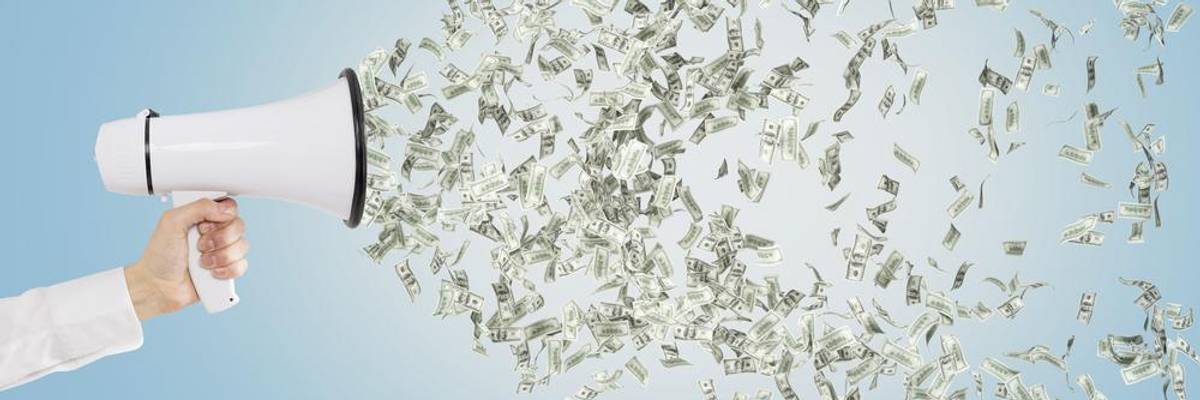
Candidates bolt out of the gates because they know it takes a long time to raise the mega-millions required for a White House run.(Photo: Shutterstock)
If You Hate Campaign Season, Blame Money in Politics
The fact that 2020 candidates are announcing now is a testament to the huge expense of elections. Can a new law change that?
Amy Klobuchar could've waited for the temperature to rise above 15 degrees before launching her 2020 presidential bid. Instead, she chose to risk frostbite and make her pitch in the middle of a snowstorm--all for an election more than 600 days away.
The Minnesota senator is just one of around a dozen Democrats who've already thrown their hats into the presidential ring or hinted they intend to soon.
What's the big rush?
People in other countries think we're insane for having such long political races. By one count, in the timeframe of the 2016 U.S. election, you could've fit about four elections in Mexico, seven in Canada, 14 in the UK, and 41 in France.
If lengthy campaigns boosted voter education and turnout, I'd be all for them. But there's scarce evidence of that. The United States ranks 26th out of 32 industrialized countries in the share of the voting age population that shows up at the polls.
So what can we do to avoid contests that shift politicians' focus away from governing to endless campaigning?
We could try to compress our interminable primary process. But that wouldn't make much difference when candidates are launching their bids a full year before the Iowa caucus.
A more effective step would be to slash the cost of competing for higher office. Candidates bolt out of the gates because they know it takes a long time to raise the mega-millions required for a White House run.
Imagine how many phone calls and fundraisers went into amassing the $6.5 billion spent on the 2016 election.
Imagine how many phone calls and fundraisers went into amassing the $6.5 billion spent on the 2016 election. A quarter of that huge sum came from donors who contributed at least $100,000.
Unfortunately, the U.S. Supreme Court ruled in 2014 that it was unconstitutional to place overall limits on federal campaign contributions. But we're seeing a rise in candidates who voluntarily rebuff deep-pocketed donors.
"We need to end the unwritten rule of politics that says that anyone who wants to run for office has to start by sucking up to a bunch of rich donors on Wall Street and powerful insiders," Massachusetts Senator Elizabeth Warren told the crowd at her own frigid campaign launch. She won't be taking a dime from political action committees (PACs).
Senator Bernie Sanders showed in 2016 that it's possible to raise large sums from individual donors. His total haul: $228 million.
A proposal by House Democrats would go a long way towards boosting small contributions as a counter to the mega-donors.
As part of a sweeping anti-corruption initiative, H.R. 1 would grant tax credits for contributions of no more than $50. Candidates could also volunteer for a public financing option through which the federal government would put $6 into their coffers for every $1 raised in small donations (of no more than $200).
The Democratic proposal would also force Super PACs, which can raise unlimited sums to advocate for or against candidates, to make their donors public. This might discourage some of the shadiest forces from attempting to buy elections.
The bill includes a number of other important pro-democracy proposals. It would crack down on partisan gerrymandering of congressional districts and corrupt lobbying practices. It would also make Election Day a holiday for federal employees, hoping private sector businesses would also give their workers the day off.
None of these changes, I'm afraid, would have an immediate impact on the duration of U.S. election campaigns. But by making the process more equitable, these reforms might make the 600-plus days at least seem shorter.

Urgent. It's never been this bad.
Dear Common Dreams reader, It’s been nearly 30 years since I co-founded Common Dreams with my late wife, Lina Newhouser. We had the radical notion that journalism should serve the public good, not corporate profits. It was clear to us from the outset what it would take to build such a project. No paid advertisements. No corporate sponsors. No millionaire publisher telling us what to think or do. Many people said we wouldn't last a year, but we proved those doubters wrong. Together with a tremendous team of journalists and dedicated staff, we built an independent media outlet free from the constraints of profits and corporate control. Our mission from the outset was simple. To inform. To inspire. To ignite change for the common good. Building Common Dreams was not easy. Our survival was never guaranteed. When you take on the most powerful forces—Wall Street greed, fossil fuel industry destruction, Big Tech lobbyists, and uber-rich oligarchs who have spent billions upon billions rigging the economy and democracy in their favor—the only bulwark you have is supporters who believe in your work. But here’s the urgent message from me today. It’s never been this bad out there. And it’s never been this hard to keep us going. At the very moment Common Dreams is most needed and doing some of its best and most important work, the threats we face are intensifying. Right now, with just four days to go in our Spring Campaign, we are not even halfway to our goal. When everyone does the little they can afford, we are strong. But if that support retreats or dries up, so do we. Can you make a gift right now to make sure Common Dreams not only survives but thrives? There is no backup plan or rainy day fund. There is only you. —Craig Brown, Co-founder |
Amy Klobuchar could've waited for the temperature to rise above 15 degrees before launching her 2020 presidential bid. Instead, she chose to risk frostbite and make her pitch in the middle of a snowstorm--all for an election more than 600 days away.
The Minnesota senator is just one of around a dozen Democrats who've already thrown their hats into the presidential ring or hinted they intend to soon.
What's the big rush?
People in other countries think we're insane for having such long political races. By one count, in the timeframe of the 2016 U.S. election, you could've fit about four elections in Mexico, seven in Canada, 14 in the UK, and 41 in France.
If lengthy campaigns boosted voter education and turnout, I'd be all for them. But there's scarce evidence of that. The United States ranks 26th out of 32 industrialized countries in the share of the voting age population that shows up at the polls.
So what can we do to avoid contests that shift politicians' focus away from governing to endless campaigning?
We could try to compress our interminable primary process. But that wouldn't make much difference when candidates are launching their bids a full year before the Iowa caucus.
A more effective step would be to slash the cost of competing for higher office. Candidates bolt out of the gates because they know it takes a long time to raise the mega-millions required for a White House run.
Imagine how many phone calls and fundraisers went into amassing the $6.5 billion spent on the 2016 election.
Imagine how many phone calls and fundraisers went into amassing the $6.5 billion spent on the 2016 election. A quarter of that huge sum came from donors who contributed at least $100,000.
Unfortunately, the U.S. Supreme Court ruled in 2014 that it was unconstitutional to place overall limits on federal campaign contributions. But we're seeing a rise in candidates who voluntarily rebuff deep-pocketed donors.
"We need to end the unwritten rule of politics that says that anyone who wants to run for office has to start by sucking up to a bunch of rich donors on Wall Street and powerful insiders," Massachusetts Senator Elizabeth Warren told the crowd at her own frigid campaign launch. She won't be taking a dime from political action committees (PACs).
Senator Bernie Sanders showed in 2016 that it's possible to raise large sums from individual donors. His total haul: $228 million.
A proposal by House Democrats would go a long way towards boosting small contributions as a counter to the mega-donors.
As part of a sweeping anti-corruption initiative, H.R. 1 would grant tax credits for contributions of no more than $50. Candidates could also volunteer for a public financing option through which the federal government would put $6 into their coffers for every $1 raised in small donations (of no more than $200).
The Democratic proposal would also force Super PACs, which can raise unlimited sums to advocate for or against candidates, to make their donors public. This might discourage some of the shadiest forces from attempting to buy elections.
The bill includes a number of other important pro-democracy proposals. It would crack down on partisan gerrymandering of congressional districts and corrupt lobbying practices. It would also make Election Day a holiday for federal employees, hoping private sector businesses would also give their workers the day off.
None of these changes, I'm afraid, would have an immediate impact on the duration of U.S. election campaigns. But by making the process more equitable, these reforms might make the 600-plus days at least seem shorter.
Amy Klobuchar could've waited for the temperature to rise above 15 degrees before launching her 2020 presidential bid. Instead, she chose to risk frostbite and make her pitch in the middle of a snowstorm--all for an election more than 600 days away.
The Minnesota senator is just one of around a dozen Democrats who've already thrown their hats into the presidential ring or hinted they intend to soon.
What's the big rush?
People in other countries think we're insane for having such long political races. By one count, in the timeframe of the 2016 U.S. election, you could've fit about four elections in Mexico, seven in Canada, 14 in the UK, and 41 in France.
If lengthy campaigns boosted voter education and turnout, I'd be all for them. But there's scarce evidence of that. The United States ranks 26th out of 32 industrialized countries in the share of the voting age population that shows up at the polls.
So what can we do to avoid contests that shift politicians' focus away from governing to endless campaigning?
We could try to compress our interminable primary process. But that wouldn't make much difference when candidates are launching their bids a full year before the Iowa caucus.
A more effective step would be to slash the cost of competing for higher office. Candidates bolt out of the gates because they know it takes a long time to raise the mega-millions required for a White House run.
Imagine how many phone calls and fundraisers went into amassing the $6.5 billion spent on the 2016 election.
Imagine how many phone calls and fundraisers went into amassing the $6.5 billion spent on the 2016 election. A quarter of that huge sum came from donors who contributed at least $100,000.
Unfortunately, the U.S. Supreme Court ruled in 2014 that it was unconstitutional to place overall limits on federal campaign contributions. But we're seeing a rise in candidates who voluntarily rebuff deep-pocketed donors.
"We need to end the unwritten rule of politics that says that anyone who wants to run for office has to start by sucking up to a bunch of rich donors on Wall Street and powerful insiders," Massachusetts Senator Elizabeth Warren told the crowd at her own frigid campaign launch. She won't be taking a dime from political action committees (PACs).
Senator Bernie Sanders showed in 2016 that it's possible to raise large sums from individual donors. His total haul: $228 million.
A proposal by House Democrats would go a long way towards boosting small contributions as a counter to the mega-donors.
As part of a sweeping anti-corruption initiative, H.R. 1 would grant tax credits for contributions of no more than $50. Candidates could also volunteer for a public financing option through which the federal government would put $6 into their coffers for every $1 raised in small donations (of no more than $200).
The Democratic proposal would also force Super PACs, which can raise unlimited sums to advocate for or against candidates, to make their donors public. This might discourage some of the shadiest forces from attempting to buy elections.
The bill includes a number of other important pro-democracy proposals. It would crack down on partisan gerrymandering of congressional districts and corrupt lobbying practices. It would also make Election Day a holiday for federal employees, hoping private sector businesses would also give their workers the day off.
None of these changes, I'm afraid, would have an immediate impact on the duration of U.S. election campaigns. But by making the process more equitable, these reforms might make the 600-plus days at least seem shorter.