SUBSCRIBE TO OUR FREE NEWSLETTER
Daily news & progressive opinion—funded by the people, not the corporations—delivered straight to your inbox.
5
#000000
#FFFFFF
To donate by check, phone, or other method, see our More Ways to Give page.
Daily news & progressive opinion—funded by the people, not the corporations—delivered straight to your inbox.
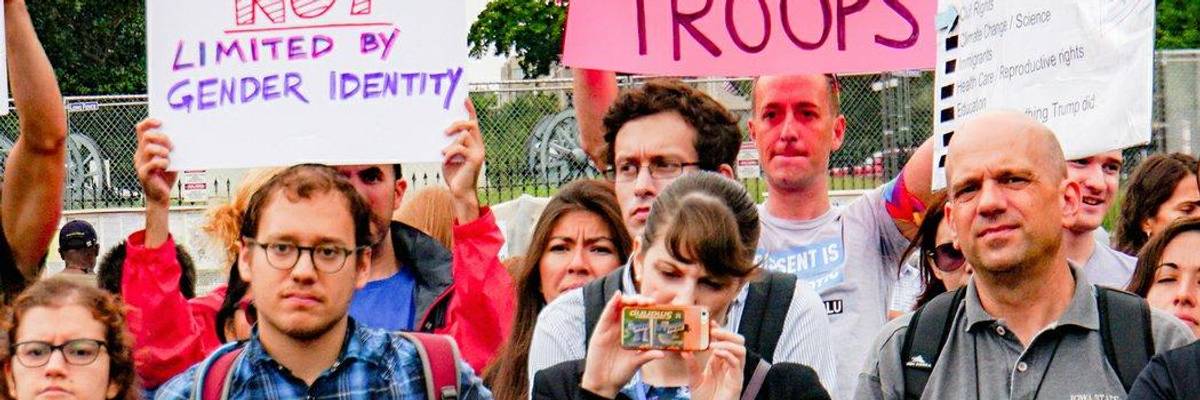
"Glossing over institutionalized transphobia to debate the reprehensibility of U.S. military policy comes from a place of privilege," writes Vanderheiden, "and divides people of the progressive coalition." (Photo: Ted Eytan)
On January 22, the U.S. Supreme Court reversed two injunctions against President Donald Trump's proposed policy banning transgender Americans from serving in the U.S. military, making way for the implementation of parts of the policy in the near future, while ongoing legal challenges play out.
For me, as a transgender veteran of the Iraq War, this reversal hits close to home. Of course, it will harm transgender service members, many of whom are dear friends of mine. The Department of Defense is the largest employer of transgender people in the country. Banning them from military service limits the economic and educational opportunity of a minority class that already faces massive obstacles in those and other areas.
But, even more troubling, the ban sets a precedent for the blatant exclusion of transgender people from public life. This is especially important, given that many forms of integration in the United States began within our military.
This includes racial integration as well as the inclusion of women. And even though the military was late to embrace gay and lesbian service members, the 2010 repeal of "Don't Ask Don't Tell" may be read as a precursor to marriage equality. All of these now broadly accepted societal shifts got a leg up from developments within the military.
Yet some progressive critics argue that the expansive military-industrial complex does so much harm in the world, it should not matter who can and cannot participate in state-sanctioned violence. As one critic expressed, "We don't need more trans bodies to act as bullet shields in lands we have no business occupying."
But glossing over institutionalized transphobia to debate the reprehensibility of U.S. military policy comes from a place of privilege--and divides people of the progressive coalition.
"Glossing over institutionalized transphobia to debate the reprehensibility of U.S. military policy comes from a place of privilege."
Division at the expense of transgender people is nothing new. There is a persistent debate as to whether transgender rights are entirely at odds with women's liberation. Queer and transgender immigrants have struggled to get their unique challenges to be recognized as part of the movement for immigration reform. And even within the LGBTQ+ community, trans people have encountered difficulty being seen as an important part of the movement for queer civil liberties.
A prime example is the Employment Non-Discrimination Act, a bill that would have protected members of the LGBTQ community from discrimination. In 2007, even with Democratic majorities in both the House and the Senate, many lawmakers on the left decided the bill was unpassable because of its inclusion of protections for transgender people. Those protections were dropped, dividing the coalition and killing the bill. Attempts to revitalize the bill since then have failed.
The truth is, many people seem to have no problem with making transgender protections a last priority. But we know from experience that this only works to undermine all of our goals. When it comes to the transgender military ban, it is clear that on the road to equity, we must hold a united front.
This country and this world are at a monumental crossroads. US voters have an opportunity to beat back the forces of fascism and confront the billionaires who are rigging the economy, our media system, and our democracy, making it increasingly impossible for ordinary people to get by. We’re not just talking about the election. We’re talking about what must be done once these fascist elements are vanquished from power. We need a bolder set of solutions than what either major party has so far been willing to offer and a working-class movement ready to fight like hell for it. Trump didn't emerge from nowhere. The conditions that fueled MAGA authoritarianism were created by decades of radical neoliberal economic policies and a corrupt political system dominated by corporate interests. They slashed taxes on the super-rich, promising that the benefits would trickle down. They said giveaways to the corporate titans would make life more affordable for the rest of us. It was all bullshit. And when a bitter, betrayed populace searches for someone to blame, right-wing demagogues have little trouble finding scapegoats. People know when they're being lied to, but you won't hear any of this from the corporate media. Only independent journalism—powered and funded by people who believe in building a better world—can deliver truly trustworthy daily news. If you share our vision, please contribute whatever you can to sustain our work. |
On January 22, the U.S. Supreme Court reversed two injunctions against President Donald Trump's proposed policy banning transgender Americans from serving in the U.S. military, making way for the implementation of parts of the policy in the near future, while ongoing legal challenges play out.
For me, as a transgender veteran of the Iraq War, this reversal hits close to home. Of course, it will harm transgender service members, many of whom are dear friends of mine. The Department of Defense is the largest employer of transgender people in the country. Banning them from military service limits the economic and educational opportunity of a minority class that already faces massive obstacles in those and other areas.
But, even more troubling, the ban sets a precedent for the blatant exclusion of transgender people from public life. This is especially important, given that many forms of integration in the United States began within our military.
This includes racial integration as well as the inclusion of women. And even though the military was late to embrace gay and lesbian service members, the 2010 repeal of "Don't Ask Don't Tell" may be read as a precursor to marriage equality. All of these now broadly accepted societal shifts got a leg up from developments within the military.
Yet some progressive critics argue that the expansive military-industrial complex does so much harm in the world, it should not matter who can and cannot participate in state-sanctioned violence. As one critic expressed, "We don't need more trans bodies to act as bullet shields in lands we have no business occupying."
But glossing over institutionalized transphobia to debate the reprehensibility of U.S. military policy comes from a place of privilege--and divides people of the progressive coalition.
"Glossing over institutionalized transphobia to debate the reprehensibility of U.S. military policy comes from a place of privilege."
Division at the expense of transgender people is nothing new. There is a persistent debate as to whether transgender rights are entirely at odds with women's liberation. Queer and transgender immigrants have struggled to get their unique challenges to be recognized as part of the movement for immigration reform. And even within the LGBTQ+ community, trans people have encountered difficulty being seen as an important part of the movement for queer civil liberties.
A prime example is the Employment Non-Discrimination Act, a bill that would have protected members of the LGBTQ community from discrimination. In 2007, even with Democratic majorities in both the House and the Senate, many lawmakers on the left decided the bill was unpassable because of its inclusion of protections for transgender people. Those protections were dropped, dividing the coalition and killing the bill. Attempts to revitalize the bill since then have failed.
The truth is, many people seem to have no problem with making transgender protections a last priority. But we know from experience that this only works to undermine all of our goals. When it comes to the transgender military ban, it is clear that on the road to equity, we must hold a united front.