SUBSCRIBE TO OUR FREE NEWSLETTER
Daily news & progressive opinion—funded by the people, not the corporations—delivered straight to your inbox.
5
#000000
#FFFFFF
To donate by check, phone, or other method, see our More Ways to Give page.
Daily news & progressive opinion—funded by the people, not the corporations—delivered straight to your inbox.
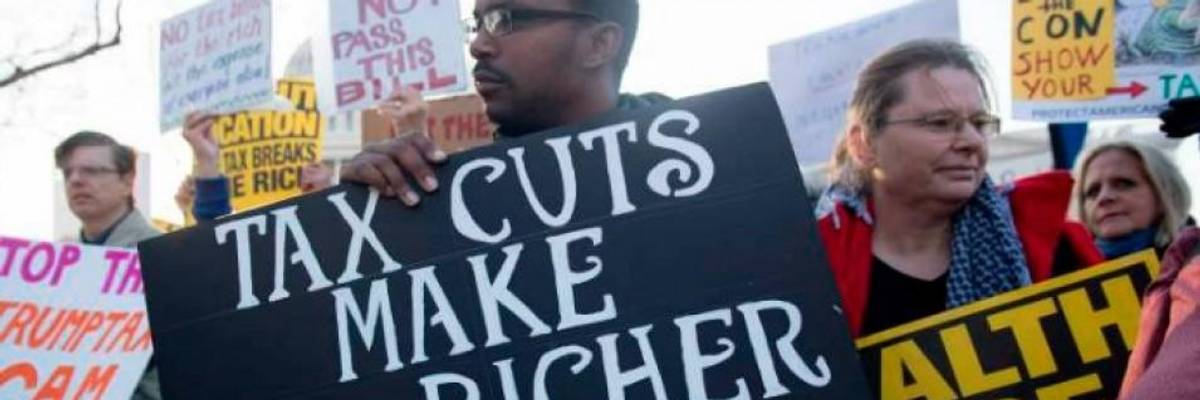
We're facing precisely the sort of economic downturn that Congress promised the tax cut would prevent. (Photo: Saul Loeb/AFP/Getty Images)
The Tax Cuts and Jobs Act of 2017 -- the only major piece of legislation passed by the Trump administration -- turns one year old this week. The law's advocates promised it would create an economic bonanza for working people. Instead, its biggest corporate backers have laid off employees and offshored jobs while the promised investment boom is nowhere to be found. And for all of the talk about rising GDP and a tight labor market, millions are still barely making ends meet.
But that's not all. As critics warned when the bill was being drafted, the legislation gave disproportionate benefits to one massive, reviled industry: Wall Street. The nation's six biggest banks enjoyed estimated $14 billion in tax cuts this year -- enough to give every teacher in America a $4,000 raise. The banking industry also saw a record $62 billion in profit in the third quarter of 2018, thanks in large part to the tax cuts.
If any industry benefited from the law, it was banking. So, has Wall Street behaved as promised, and invested in American prosperity? Of course not. Wall Street has reinvested in Wall Street.
Taken together, it's staggering how much of the tax cut legislation was really a barely-cloaked present to the same financiers who crashed the world economy in 2008.
Like most industries, America's banking boardrooms spent their tax cut gobbling up shares of their own stock to artificially inflate share prices without actually improving business performance. Indeed, rates of lending -- Wall Street's main contribution to the economy -- are actually lower this year than in 2017. These buybacks used to be considered illegal stock manipulation, but -- thanks to deregulation -- they're business as usual now.
JPMorgan Chase got almost $3 billion in tax cuts this year, but spent over $20 billion on stock buybacks -- in other words, their entire tax cut funded just 14 percent of their stock manipulation. Bank of America's $3.5 billion handout funded just 16.9 percent of their buybacks. Meanwhile, the company laid off 575 of its employees.
The most repulsive actor was easily Wells Fargo. Their massive $3.7 billion tax cut paid for 10 percent of what the bank spent on buying up its own shares. Meanwhile, the bank fired almost 2,500 people and was implicated in scandal after scandal after scandal. In one case, Wells Fargo admitted to foreclosing on hundreds of homes in error because management failed to create a reliable computer system, traumatizing the suddenly-homeless families that paid for their incompetence. For this, Wells enjoyed a tax break big enough to pay for 66,000 infrastructure jobs.
Then there's the fact that Citigroup and JPMorgan are among the top five beneficiaries of further potential tax breaks after repatriating their offshore funds. But despite the oft-repeated promise that corporate tax cuts make their way down to workers, America's biggest banks actually spent less on paying their employees this year than they did the year before.
Taken together, it's staggering how much of the tax cut legislation was really a barely-cloaked present to the same financiers who crashed the world economy in 2008. And as the sugar-high of stock buybacks has faded, more and more people are predicting another financial crisis in the near future. We're facing precisely the sort of economic downturn that Congress promised the tax cut would prevent.
There were plenty of organizations, including Americans for Financial Reform, where I work, who called out the tax cut as a gift to Wall Street the minute that it was proposed. They were ignored.
Why? Because policies that could actually protect and help consumers might cut into Wall Street profits. It will take braver politicians and bolder initiatives to finally end finance's stranglehold on the economy.
Dear Common Dreams reader, It’s been nearly 30 years since I co-founded Common Dreams with my late wife, Lina Newhouser. We had the radical notion that journalism should serve the public good, not corporate profits. It was clear to us from the outset what it would take to build such a project. No paid advertisements. No corporate sponsors. No millionaire publisher telling us what to think or do. Many people said we wouldn't last a year, but we proved those doubters wrong. Together with a tremendous team of journalists and dedicated staff, we built an independent media outlet free from the constraints of profits and corporate control. Our mission has always been simple: To inform. To inspire. To ignite change for the common good. Building Common Dreams was not easy. Our survival was never guaranteed. When you take on the most powerful forces—Wall Street greed, fossil fuel industry destruction, Big Tech lobbyists, and uber-rich oligarchs who have spent billions upon billions rigging the economy and democracy in their favor—the only bulwark you have is supporters who believe in your work. But here’s the urgent message from me today. It's never been this bad out there. And it's never been this hard to keep us going. At the very moment Common Dreams is most needed, the threats we face are intensifying. We need your support now more than ever. We don't accept corporate advertising and never will. We don't have a paywall because we don't think people should be blocked from critical news based on their ability to pay. Everything we do is funded by the donations of readers like you. When everyone does the little they can afford, we are strong. But if that support retreats or dries up, so do we. Will you donate now to make sure Common Dreams not only survives but thrives? —Craig Brown, Co-founder |
The Tax Cuts and Jobs Act of 2017 -- the only major piece of legislation passed by the Trump administration -- turns one year old this week. The law's advocates promised it would create an economic bonanza for working people. Instead, its biggest corporate backers have laid off employees and offshored jobs while the promised investment boom is nowhere to be found. And for all of the talk about rising GDP and a tight labor market, millions are still barely making ends meet.
But that's not all. As critics warned when the bill was being drafted, the legislation gave disproportionate benefits to one massive, reviled industry: Wall Street. The nation's six biggest banks enjoyed estimated $14 billion in tax cuts this year -- enough to give every teacher in America a $4,000 raise. The banking industry also saw a record $62 billion in profit in the third quarter of 2018, thanks in large part to the tax cuts.
If any industry benefited from the law, it was banking. So, has Wall Street behaved as promised, and invested in American prosperity? Of course not. Wall Street has reinvested in Wall Street.
Taken together, it's staggering how much of the tax cut legislation was really a barely-cloaked present to the same financiers who crashed the world economy in 2008.
Like most industries, America's banking boardrooms spent their tax cut gobbling up shares of their own stock to artificially inflate share prices without actually improving business performance. Indeed, rates of lending -- Wall Street's main contribution to the economy -- are actually lower this year than in 2017. These buybacks used to be considered illegal stock manipulation, but -- thanks to deregulation -- they're business as usual now.
JPMorgan Chase got almost $3 billion in tax cuts this year, but spent over $20 billion on stock buybacks -- in other words, their entire tax cut funded just 14 percent of their stock manipulation. Bank of America's $3.5 billion handout funded just 16.9 percent of their buybacks. Meanwhile, the company laid off 575 of its employees.
The most repulsive actor was easily Wells Fargo. Their massive $3.7 billion tax cut paid for 10 percent of what the bank spent on buying up its own shares. Meanwhile, the bank fired almost 2,500 people and was implicated in scandal after scandal after scandal. In one case, Wells Fargo admitted to foreclosing on hundreds of homes in error because management failed to create a reliable computer system, traumatizing the suddenly-homeless families that paid for their incompetence. For this, Wells enjoyed a tax break big enough to pay for 66,000 infrastructure jobs.
Then there's the fact that Citigroup and JPMorgan are among the top five beneficiaries of further potential tax breaks after repatriating their offshore funds. But despite the oft-repeated promise that corporate tax cuts make their way down to workers, America's biggest banks actually spent less on paying their employees this year than they did the year before.
Taken together, it's staggering how much of the tax cut legislation was really a barely-cloaked present to the same financiers who crashed the world economy in 2008. And as the sugar-high of stock buybacks has faded, more and more people are predicting another financial crisis in the near future. We're facing precisely the sort of economic downturn that Congress promised the tax cut would prevent.
There were plenty of organizations, including Americans for Financial Reform, where I work, who called out the tax cut as a gift to Wall Street the minute that it was proposed. They were ignored.
Why? Because policies that could actually protect and help consumers might cut into Wall Street profits. It will take braver politicians and bolder initiatives to finally end finance's stranglehold on the economy.
The Tax Cuts and Jobs Act of 2017 -- the only major piece of legislation passed by the Trump administration -- turns one year old this week. The law's advocates promised it would create an economic bonanza for working people. Instead, its biggest corporate backers have laid off employees and offshored jobs while the promised investment boom is nowhere to be found. And for all of the talk about rising GDP and a tight labor market, millions are still barely making ends meet.
But that's not all. As critics warned when the bill was being drafted, the legislation gave disproportionate benefits to one massive, reviled industry: Wall Street. The nation's six biggest banks enjoyed estimated $14 billion in tax cuts this year -- enough to give every teacher in America a $4,000 raise. The banking industry also saw a record $62 billion in profit in the third quarter of 2018, thanks in large part to the tax cuts.
If any industry benefited from the law, it was banking. So, has Wall Street behaved as promised, and invested in American prosperity? Of course not. Wall Street has reinvested in Wall Street.
Taken together, it's staggering how much of the tax cut legislation was really a barely-cloaked present to the same financiers who crashed the world economy in 2008.
Like most industries, America's banking boardrooms spent their tax cut gobbling up shares of their own stock to artificially inflate share prices without actually improving business performance. Indeed, rates of lending -- Wall Street's main contribution to the economy -- are actually lower this year than in 2017. These buybacks used to be considered illegal stock manipulation, but -- thanks to deregulation -- they're business as usual now.
JPMorgan Chase got almost $3 billion in tax cuts this year, but spent over $20 billion on stock buybacks -- in other words, their entire tax cut funded just 14 percent of their stock manipulation. Bank of America's $3.5 billion handout funded just 16.9 percent of their buybacks. Meanwhile, the company laid off 575 of its employees.
The most repulsive actor was easily Wells Fargo. Their massive $3.7 billion tax cut paid for 10 percent of what the bank spent on buying up its own shares. Meanwhile, the bank fired almost 2,500 people and was implicated in scandal after scandal after scandal. In one case, Wells Fargo admitted to foreclosing on hundreds of homes in error because management failed to create a reliable computer system, traumatizing the suddenly-homeless families that paid for their incompetence. For this, Wells enjoyed a tax break big enough to pay for 66,000 infrastructure jobs.
Then there's the fact that Citigroup and JPMorgan are among the top five beneficiaries of further potential tax breaks after repatriating their offshore funds. But despite the oft-repeated promise that corporate tax cuts make their way down to workers, America's biggest banks actually spent less on paying their employees this year than they did the year before.
Taken together, it's staggering how much of the tax cut legislation was really a barely-cloaked present to the same financiers who crashed the world economy in 2008. And as the sugar-high of stock buybacks has faded, more and more people are predicting another financial crisis in the near future. We're facing precisely the sort of economic downturn that Congress promised the tax cut would prevent.
There were plenty of organizations, including Americans for Financial Reform, where I work, who called out the tax cut as a gift to Wall Street the minute that it was proposed. They were ignored.
Why? Because policies that could actually protect and help consumers might cut into Wall Street profits. It will take braver politicians and bolder initiatives to finally end finance's stranglehold on the economy.