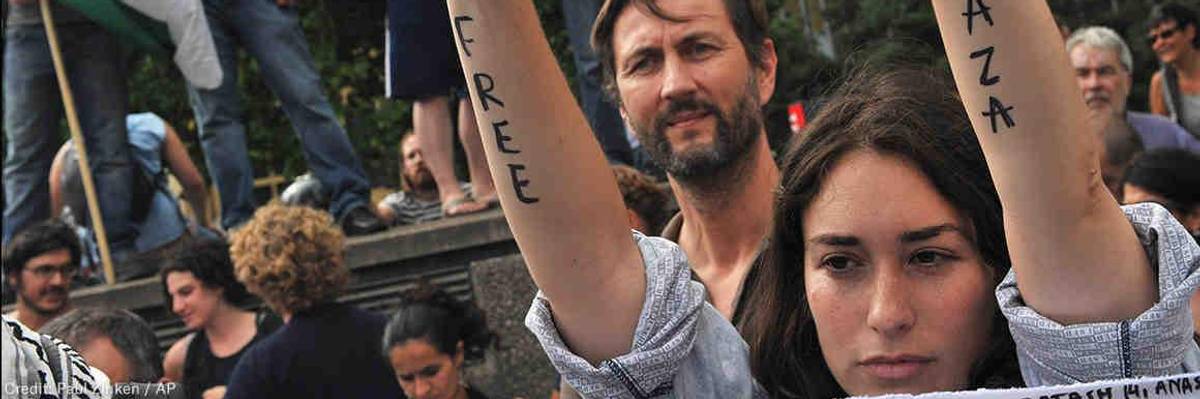
This is a full-scale attack on Americans' First Amendment freedoms. (Photo: Paul Zinkin/ Associated Press)
Congress Is Trying to Use the Spending Bill to Criminalize Boycotts of Israel and Other Countries
If the First Amendment means anything, it’s that the government cannot suppress political expression it doesn’t like
According to recent reports, congressional leaders from both sides of the aisle are planning to sneak a bill criminalizing politically motivated boycotts of Israel into the end-of-the-year omnibus spending bill.
The bill's original sponsor, Sen. Ben Cardin (D-Md.), is pushing Democratic leadership to include this bill, which has not moved forward thus far primarily because it violates the First Amendment. Senate Minority Leader Chuck Schumer (D-N.Y.) and House Minority Leader Nancy Pelosi (D-Calif.) are reportedly leaning toward slipping the text into the spending bill, which needs to pass for the government to stay open.
The ACLU has long opposed the Israel Anti-Boycott Act through its multiple iterations because the bill would make it a crime to participate in political boycotts protected by the First Amendment.
The ACLU has long opposed the Israel Anti-Boycott Act through its multiple iterations because the bill would make it a crime to participate in political boycotts protected by the First Amendment. Now, the bill's sponsors are attempting to avoid public scrutiny by including the bill's unconstitutional criminal penalties in must-pass legislation scheduled for a vote just days before Congress' holiday recess -- likely because it will be harder to pass in the new Congress.
Earlier versions of the Israel Anti-Boycott Act would have made it a crime -- possibly even subject to jail time -- for American companies to participate in political boycotts aimed at Israel and its settlements in the occupied Palestinian territories when those boycotts were called for by international governmental organizations like the United Nations. The same went for boycotts targeting any country that is "friendly to the United States" if the boycott was not sanctioned by the United States.
Last week, the ACLU saw an updated version being considered for inclusion in the spending bill (though this text is not publicly available). While Hill offices claim the First Amendment concerns have been resolved, and potential jail time has indeed been eliminated as a possible punishment, the bill actually does nothing to cure its free speech problems. Furthermore, knowingly violating the bill could result in criminal financial penalties of up to $1 million. Were this legislation to pass, federal officials would have a new weapon at their disposal to chill and suppress speech that they found objectionable or politically unpopular.
Consider, for example, if the United Nations advocated boycotting Saudi Arabia in response to the murder of Jamal Khashoggi, the Washington Post journalist, or Russia in response to its alleged election interference around the world. That would mean American companies, small business owners, and even non-profits, potentially some religious institutions, and people acting on their behalf in support of the boycott could be subject to criminal penalties.
Members of Congress who support this bill should take note of the fact that just this year, two federal courts blocked state laws seeking to suppress boycotts of Israel.
This is a full-scale attack on Americans' First Amendment freedoms. Political boycotts, including boycotts of foreign countries, have played a pivotal role in this nation's history -- from the boycotts of British goods during the American Revolution to the Montgomery Bus Boycott to the campaign to divest from apartheid South Africa. And in NAACP v. Claiborne Hardware, the Supreme Court made clear that the First Amendment protects the right to participate in political boycotts. Although the bill states that nothing in the act "shall be construed to diminish or infringe upon any right protected under the Constitution of the United States," such hollow assurances do not undo its core purpose of penalizing First Amendment activities and silencing speech.
Members of Congress who support this bill should take note of the fact that just this year, two federal courts blocked state laws seeking to suppress boycotts of Israel. Those laws, like many copycats around the country, required state contractors to certify that they are not participating in boycotts of Israel as a condition of doing business with the state. The courts agreed with the ACLU that these anti-boycott laws violate Americans' First Amendment rights. The Israel Anti-Boycott Act is another page from the same unconstitutional playbook.
It is clear why congressional leaders fear an open debate on this legislation. Restricting Americans' freedom of expression is rarely a popular policy. But that is no excuse for smuggling controversial new crimes into a last-minute appropriations package. If the First Amendment means anything, it's that the government cannot suppress political expression it doesn't like.
Whatever their views on the Israel-Palestine conflict, members of Congress should oppose any effort to include this unconstitutional law within the omnibus spending bill. Americans' First Amendment rights are at stake.

FINAL DAY! This is urgent.
Dear Common Dreams reader, It’s been nearly 30 years since I co-founded Common Dreams with my late wife, Lina Newhouser. We had the radical notion that journalism should serve the public good, not corporate profits. It was clear to us from the outset what it would take to build such a project. No paid advertisements. No corporate sponsors. No millionaire publisher telling us what to think or do. Many people said we wouldn't last a year, but we proved those doubters wrong. Together with a tremendous team of journalists and dedicated staff, we built an independent media outlet free from the constraints of profits and corporate control. Our mission from the outset was simple. To inform. To inspire. To ignite change for the common good. Building Common Dreams was not easy. Our survival was never guaranteed. When you take on the most powerful forces—Wall Street greed, fossil fuel industry destruction, Big Tech lobbyists, and uber-rich oligarchs who have spent billions upon billions rigging the economy and democracy in their favor—the only bulwark you have is supporters who believe in your work. But here’s the urgent message from me today. It’s never been this bad out there. And it’s never been this hard to keep us going. At the very moment Common Dreams is most needed and doing some of its best and most important work, the threats we face are intensifying. Right now, with just hours left in our Spring Campaign, we're still falling short of our make-or-break goal. When everyone does the little they can afford, we are strong. But if that support retreats or dries up, so do we. Can you make a gift right now to make sure Common Dreams not only survives but thrives? There is no backup plan or rainy day fund. There is only you. —Craig Brown, Co-founder |
According to recent reports, congressional leaders from both sides of the aisle are planning to sneak a bill criminalizing politically motivated boycotts of Israel into the end-of-the-year omnibus spending bill.
The bill's original sponsor, Sen. Ben Cardin (D-Md.), is pushing Democratic leadership to include this bill, which has not moved forward thus far primarily because it violates the First Amendment. Senate Minority Leader Chuck Schumer (D-N.Y.) and House Minority Leader Nancy Pelosi (D-Calif.) are reportedly leaning toward slipping the text into the spending bill, which needs to pass for the government to stay open.
The ACLU has long opposed the Israel Anti-Boycott Act through its multiple iterations because the bill would make it a crime to participate in political boycotts protected by the First Amendment.
The ACLU has long opposed the Israel Anti-Boycott Act through its multiple iterations because the bill would make it a crime to participate in political boycotts protected by the First Amendment. Now, the bill's sponsors are attempting to avoid public scrutiny by including the bill's unconstitutional criminal penalties in must-pass legislation scheduled for a vote just days before Congress' holiday recess -- likely because it will be harder to pass in the new Congress.
Earlier versions of the Israel Anti-Boycott Act would have made it a crime -- possibly even subject to jail time -- for American companies to participate in political boycotts aimed at Israel and its settlements in the occupied Palestinian territories when those boycotts were called for by international governmental organizations like the United Nations. The same went for boycotts targeting any country that is "friendly to the United States" if the boycott was not sanctioned by the United States.
Last week, the ACLU saw an updated version being considered for inclusion in the spending bill (though this text is not publicly available). While Hill offices claim the First Amendment concerns have been resolved, and potential jail time has indeed been eliminated as a possible punishment, the bill actually does nothing to cure its free speech problems. Furthermore, knowingly violating the bill could result in criminal financial penalties of up to $1 million. Were this legislation to pass, federal officials would have a new weapon at their disposal to chill and suppress speech that they found objectionable or politically unpopular.
Consider, for example, if the United Nations advocated boycotting Saudi Arabia in response to the murder of Jamal Khashoggi, the Washington Post journalist, or Russia in response to its alleged election interference around the world. That would mean American companies, small business owners, and even non-profits, potentially some religious institutions, and people acting on their behalf in support of the boycott could be subject to criminal penalties.
Members of Congress who support this bill should take note of the fact that just this year, two federal courts blocked state laws seeking to suppress boycotts of Israel.
This is a full-scale attack on Americans' First Amendment freedoms. Political boycotts, including boycotts of foreign countries, have played a pivotal role in this nation's history -- from the boycotts of British goods during the American Revolution to the Montgomery Bus Boycott to the campaign to divest from apartheid South Africa. And in NAACP v. Claiborne Hardware, the Supreme Court made clear that the First Amendment protects the right to participate in political boycotts. Although the bill states that nothing in the act "shall be construed to diminish or infringe upon any right protected under the Constitution of the United States," such hollow assurances do not undo its core purpose of penalizing First Amendment activities and silencing speech.
Members of Congress who support this bill should take note of the fact that just this year, two federal courts blocked state laws seeking to suppress boycotts of Israel. Those laws, like many copycats around the country, required state contractors to certify that they are not participating in boycotts of Israel as a condition of doing business with the state. The courts agreed with the ACLU that these anti-boycott laws violate Americans' First Amendment rights. The Israel Anti-Boycott Act is another page from the same unconstitutional playbook.
It is clear why congressional leaders fear an open debate on this legislation. Restricting Americans' freedom of expression is rarely a popular policy. But that is no excuse for smuggling controversial new crimes into a last-minute appropriations package. If the First Amendment means anything, it's that the government cannot suppress political expression it doesn't like.
Whatever their views on the Israel-Palestine conflict, members of Congress should oppose any effort to include this unconstitutional law within the omnibus spending bill. Americans' First Amendment rights are at stake.
According to recent reports, congressional leaders from both sides of the aisle are planning to sneak a bill criminalizing politically motivated boycotts of Israel into the end-of-the-year omnibus spending bill.
The bill's original sponsor, Sen. Ben Cardin (D-Md.), is pushing Democratic leadership to include this bill, which has not moved forward thus far primarily because it violates the First Amendment. Senate Minority Leader Chuck Schumer (D-N.Y.) and House Minority Leader Nancy Pelosi (D-Calif.) are reportedly leaning toward slipping the text into the spending bill, which needs to pass for the government to stay open.
The ACLU has long opposed the Israel Anti-Boycott Act through its multiple iterations because the bill would make it a crime to participate in political boycotts protected by the First Amendment.
The ACLU has long opposed the Israel Anti-Boycott Act through its multiple iterations because the bill would make it a crime to participate in political boycotts protected by the First Amendment. Now, the bill's sponsors are attempting to avoid public scrutiny by including the bill's unconstitutional criminal penalties in must-pass legislation scheduled for a vote just days before Congress' holiday recess -- likely because it will be harder to pass in the new Congress.
Earlier versions of the Israel Anti-Boycott Act would have made it a crime -- possibly even subject to jail time -- for American companies to participate in political boycotts aimed at Israel and its settlements in the occupied Palestinian territories when those boycotts were called for by international governmental organizations like the United Nations. The same went for boycotts targeting any country that is "friendly to the United States" if the boycott was not sanctioned by the United States.
Last week, the ACLU saw an updated version being considered for inclusion in the spending bill (though this text is not publicly available). While Hill offices claim the First Amendment concerns have been resolved, and potential jail time has indeed been eliminated as a possible punishment, the bill actually does nothing to cure its free speech problems. Furthermore, knowingly violating the bill could result in criminal financial penalties of up to $1 million. Were this legislation to pass, federal officials would have a new weapon at their disposal to chill and suppress speech that they found objectionable or politically unpopular.
Consider, for example, if the United Nations advocated boycotting Saudi Arabia in response to the murder of Jamal Khashoggi, the Washington Post journalist, or Russia in response to its alleged election interference around the world. That would mean American companies, small business owners, and even non-profits, potentially some religious institutions, and people acting on their behalf in support of the boycott could be subject to criminal penalties.
Members of Congress who support this bill should take note of the fact that just this year, two federal courts blocked state laws seeking to suppress boycotts of Israel.
This is a full-scale attack on Americans' First Amendment freedoms. Political boycotts, including boycotts of foreign countries, have played a pivotal role in this nation's history -- from the boycotts of British goods during the American Revolution to the Montgomery Bus Boycott to the campaign to divest from apartheid South Africa. And in NAACP v. Claiborne Hardware, the Supreme Court made clear that the First Amendment protects the right to participate in political boycotts. Although the bill states that nothing in the act "shall be construed to diminish or infringe upon any right protected under the Constitution of the United States," such hollow assurances do not undo its core purpose of penalizing First Amendment activities and silencing speech.
Members of Congress who support this bill should take note of the fact that just this year, two federal courts blocked state laws seeking to suppress boycotts of Israel. Those laws, like many copycats around the country, required state contractors to certify that they are not participating in boycotts of Israel as a condition of doing business with the state. The courts agreed with the ACLU that these anti-boycott laws violate Americans' First Amendment rights. The Israel Anti-Boycott Act is another page from the same unconstitutional playbook.
It is clear why congressional leaders fear an open debate on this legislation. Restricting Americans' freedom of expression is rarely a popular policy. But that is no excuse for smuggling controversial new crimes into a last-minute appropriations package. If the First Amendment means anything, it's that the government cannot suppress political expression it doesn't like.
Whatever their views on the Israel-Palestine conflict, members of Congress should oppose any effort to include this unconstitutional law within the omnibus spending bill. Americans' First Amendment rights are at stake.