SUBSCRIBE TO OUR FREE NEWSLETTER
Daily news & progressive opinion—funded by the people, not the corporations—delivered straight to your inbox.
5
#000000
#FFFFFF
To donate by check, phone, or other method, see our More Ways to Give page.
Daily news & progressive opinion—funded by the people, not the corporations—delivered straight to your inbox.
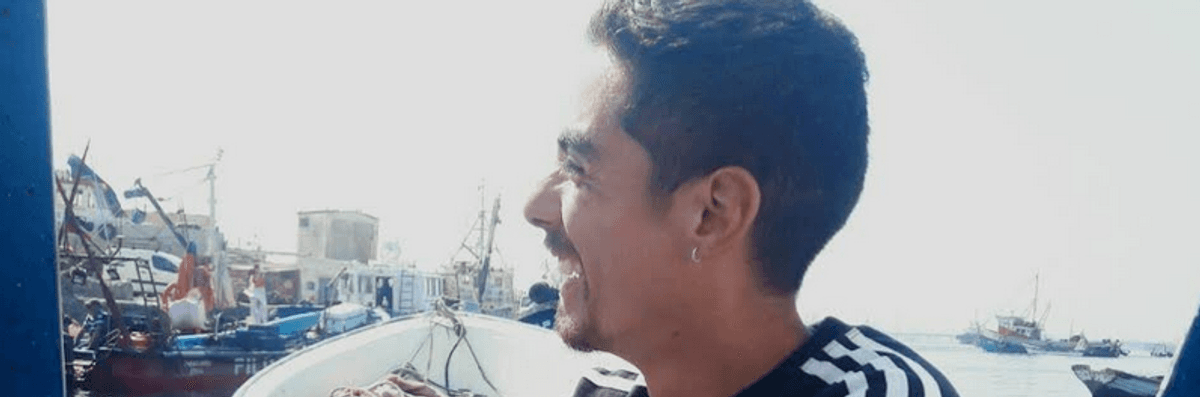
Alejandro Castro, a fisherman and union leader, was fighting local pollution before his death. (Photo: via Facebook)
One day after protesting massive chemical pollution, Alejandro Castro was found, hanging. The artisanal fisherman union leader had just pulled off a mass mobilization against acute chemical intoxication. Defending a community against polluters is an increasingly dangerous activity. The number of environmentalists killed is up from one a week just a decade ago to four a week nowadays.
The Chilean government calls it suicide, but girlfriend Pollet Urrutia said: "he was not in a state of mind for that. He was willing to keep up the fight and had many plans." Alejandro's death is under investigation. The police says he received death threats. Congressman Latorre called for the revision of the cameras located where Alejandro was found. Alejandro's case comes in the wake of the Maracena Valdez case, who was found dead in 2016 and the Mapuche leader Nicolasa Quitreman, who was found dead in 2013. While first labelled as suicides, a police investigation later recognized that Macarena's dead was not a suicide.
Sacrifice zones
The area of the incident is Puchuncavi-Quintero, but the region is better known as one of Chile's four "sacrifice zones." It earned this dubious title because several industries have been operating without public monitoring since 1964, dumping different types of toxic chemicals in unknown quantities. The term is used by socio-ecological movements in Chile to characterize geographical areas where industry and waste are so heavy that the whole area and the people living in it are considered sacrificed on the altar of economic growth. But those people are increasingly well informed and actively resisting the scandalous situation. As schools closed and social actions increased, the so-called special forces and the navy deployed an unusual amount of force, with water cannons, rubber bullets and tear gas. Quintero has turned into a battle zone.
As of today, there are at least 12 high-impact industries operating in the Puchuncavi zone in an area of 8.5 square km, including oil refining, chemical processing, thermoelectric industry and a copper processing plant. According to the Chilean legislation, an area can be called saturated due to the pollutant's concentration. But environmental legislation does not prohibit installation of new facilities and a cleaning plan can take up to nine years before it becomes a reality. Two researchers, Bolados and Sanchez, studied the Puchuncavi zone and wrote that "At the end of the 1980s, pioneering studies indicated that the toxic agents in the Puchuncavi air posed risks for the quality of life ... that led, in 1993, to declare Puchuncavi as a Saturated Zone for particulate matter (PM) and sulphur dioxide (SO2)", adding this is "a condition that continues to this day."
The Chilean Medical Union Association recently requested the government to declare a health emergency in the area. Today there are more than a thousand people intoxicated by local pollutants, including two police experts who were conducting research in the area. President Pinera's administration announced cosmetic measures. However, up to today, the acute intoxication continues. Maybe Alejandro's dead at a time of tensions will change the equation. Special police forces seized the offices of some companies, including state-owned oil refinery company ENAP. However, this in turn led to protests from the ENAP unions who want to keep the refinery open.
Chile's downgrading of protection for the protectors
Pinera's administration recently dropped out of the Escazu agreement, which seeks to improve environmental governance through access to information, participation and environmental justice. This agreement was initially proposed by Chile, among other countries, and is now sponsored by the United Nations, through ECLAC, in line with the 10th principle of the Rio Declaration. The Escazu Agreement, among others, protects environmental activists.
Alejandro's death is another grim reminder of the urgent need to protect the protectors. Today, four people protecting the planet are killed each week - up from only one a week ten years ago. An economic system that sacrifices whole zones on the altar of growth will continue to contaminate, displace and kill ever more people, animals and plants. But from the mines to the landfills and from the harbours to the farms: across the globe peoples are fighting back to save their community.
Dear Common Dreams reader, It’s been nearly 30 years since I co-founded Common Dreams with my late wife, Lina Newhouser. We had the radical notion that journalism should serve the public good, not corporate profits. It was clear to us from the outset what it would take to build such a project. No paid advertisements. No corporate sponsors. No millionaire publisher telling us what to think or do. Many people said we wouldn't last a year, but we proved those doubters wrong. Together with a tremendous team of journalists and dedicated staff, we built an independent media outlet free from the constraints of profits and corporate control. Our mission has always been simple: To inform. To inspire. To ignite change for the common good. Building Common Dreams was not easy. Our survival was never guaranteed. When you take on the most powerful forces—Wall Street greed, fossil fuel industry destruction, Big Tech lobbyists, and uber-rich oligarchs who have spent billions upon billions rigging the economy and democracy in their favor—the only bulwark you have is supporters who believe in your work. But here’s the urgent message from me today. It's never been this bad out there. And it's never been this hard to keep us going. At the very moment Common Dreams is most needed, the threats we face are intensifying. We need your support now more than ever. We don't accept corporate advertising and never will. We don't have a paywall because we don't think people should be blocked from critical news based on their ability to pay. Everything we do is funded by the donations of readers like you. When everyone does the little they can afford, we are strong. But if that support retreats or dries up, so do we. Will you donate now to make sure Common Dreams not only survives but thrives? —Craig Brown, Co-founder |
One day after protesting massive chemical pollution, Alejandro Castro was found, hanging. The artisanal fisherman union leader had just pulled off a mass mobilization against acute chemical intoxication. Defending a community against polluters is an increasingly dangerous activity. The number of environmentalists killed is up from one a week just a decade ago to four a week nowadays.
The Chilean government calls it suicide, but girlfriend Pollet Urrutia said: "he was not in a state of mind for that. He was willing to keep up the fight and had many plans." Alejandro's death is under investigation. The police says he received death threats. Congressman Latorre called for the revision of the cameras located where Alejandro was found. Alejandro's case comes in the wake of the Maracena Valdez case, who was found dead in 2016 and the Mapuche leader Nicolasa Quitreman, who was found dead in 2013. While first labelled as suicides, a police investigation later recognized that Macarena's dead was not a suicide.
Sacrifice zones
The area of the incident is Puchuncavi-Quintero, but the region is better known as one of Chile's four "sacrifice zones." It earned this dubious title because several industries have been operating without public monitoring since 1964, dumping different types of toxic chemicals in unknown quantities. The term is used by socio-ecological movements in Chile to characterize geographical areas where industry and waste are so heavy that the whole area and the people living in it are considered sacrificed on the altar of economic growth. But those people are increasingly well informed and actively resisting the scandalous situation. As schools closed and social actions increased, the so-called special forces and the navy deployed an unusual amount of force, with water cannons, rubber bullets and tear gas. Quintero has turned into a battle zone.
As of today, there are at least 12 high-impact industries operating in the Puchuncavi zone in an area of 8.5 square km, including oil refining, chemical processing, thermoelectric industry and a copper processing plant. According to the Chilean legislation, an area can be called saturated due to the pollutant's concentration. But environmental legislation does not prohibit installation of new facilities and a cleaning plan can take up to nine years before it becomes a reality. Two researchers, Bolados and Sanchez, studied the Puchuncavi zone and wrote that "At the end of the 1980s, pioneering studies indicated that the toxic agents in the Puchuncavi air posed risks for the quality of life ... that led, in 1993, to declare Puchuncavi as a Saturated Zone for particulate matter (PM) and sulphur dioxide (SO2)", adding this is "a condition that continues to this day."
The Chilean Medical Union Association recently requested the government to declare a health emergency in the area. Today there are more than a thousand people intoxicated by local pollutants, including two police experts who were conducting research in the area. President Pinera's administration announced cosmetic measures. However, up to today, the acute intoxication continues. Maybe Alejandro's dead at a time of tensions will change the equation. Special police forces seized the offices of some companies, including state-owned oil refinery company ENAP. However, this in turn led to protests from the ENAP unions who want to keep the refinery open.
Chile's downgrading of protection for the protectors
Pinera's administration recently dropped out of the Escazu agreement, which seeks to improve environmental governance through access to information, participation and environmental justice. This agreement was initially proposed by Chile, among other countries, and is now sponsored by the United Nations, through ECLAC, in line with the 10th principle of the Rio Declaration. The Escazu Agreement, among others, protects environmental activists.
Alejandro's death is another grim reminder of the urgent need to protect the protectors. Today, four people protecting the planet are killed each week - up from only one a week ten years ago. An economic system that sacrifices whole zones on the altar of growth will continue to contaminate, displace and kill ever more people, animals and plants. But from the mines to the landfills and from the harbours to the farms: across the globe peoples are fighting back to save their community.
One day after protesting massive chemical pollution, Alejandro Castro was found, hanging. The artisanal fisherman union leader had just pulled off a mass mobilization against acute chemical intoxication. Defending a community against polluters is an increasingly dangerous activity. The number of environmentalists killed is up from one a week just a decade ago to four a week nowadays.
The Chilean government calls it suicide, but girlfriend Pollet Urrutia said: "he was not in a state of mind for that. He was willing to keep up the fight and had many plans." Alejandro's death is under investigation. The police says he received death threats. Congressman Latorre called for the revision of the cameras located where Alejandro was found. Alejandro's case comes in the wake of the Maracena Valdez case, who was found dead in 2016 and the Mapuche leader Nicolasa Quitreman, who was found dead in 2013. While first labelled as suicides, a police investigation later recognized that Macarena's dead was not a suicide.
Sacrifice zones
The area of the incident is Puchuncavi-Quintero, but the region is better known as one of Chile's four "sacrifice zones." It earned this dubious title because several industries have been operating without public monitoring since 1964, dumping different types of toxic chemicals in unknown quantities. The term is used by socio-ecological movements in Chile to characterize geographical areas where industry and waste are so heavy that the whole area and the people living in it are considered sacrificed on the altar of economic growth. But those people are increasingly well informed and actively resisting the scandalous situation. As schools closed and social actions increased, the so-called special forces and the navy deployed an unusual amount of force, with water cannons, rubber bullets and tear gas. Quintero has turned into a battle zone.
As of today, there are at least 12 high-impact industries operating in the Puchuncavi zone in an area of 8.5 square km, including oil refining, chemical processing, thermoelectric industry and a copper processing plant. According to the Chilean legislation, an area can be called saturated due to the pollutant's concentration. But environmental legislation does not prohibit installation of new facilities and a cleaning plan can take up to nine years before it becomes a reality. Two researchers, Bolados and Sanchez, studied the Puchuncavi zone and wrote that "At the end of the 1980s, pioneering studies indicated that the toxic agents in the Puchuncavi air posed risks for the quality of life ... that led, in 1993, to declare Puchuncavi as a Saturated Zone for particulate matter (PM) and sulphur dioxide (SO2)", adding this is "a condition that continues to this day."
The Chilean Medical Union Association recently requested the government to declare a health emergency in the area. Today there are more than a thousand people intoxicated by local pollutants, including two police experts who were conducting research in the area. President Pinera's administration announced cosmetic measures. However, up to today, the acute intoxication continues. Maybe Alejandro's dead at a time of tensions will change the equation. Special police forces seized the offices of some companies, including state-owned oil refinery company ENAP. However, this in turn led to protests from the ENAP unions who want to keep the refinery open.
Chile's downgrading of protection for the protectors
Pinera's administration recently dropped out of the Escazu agreement, which seeks to improve environmental governance through access to information, participation and environmental justice. This agreement was initially proposed by Chile, among other countries, and is now sponsored by the United Nations, through ECLAC, in line with the 10th principle of the Rio Declaration. The Escazu Agreement, among others, protects environmental activists.
Alejandro's death is another grim reminder of the urgent need to protect the protectors. Today, four people protecting the planet are killed each week - up from only one a week ten years ago. An economic system that sacrifices whole zones on the altar of growth will continue to contaminate, displace and kill ever more people, animals and plants. But from the mines to the landfills and from the harbours to the farms: across the globe peoples are fighting back to save their community.