SUBSCRIBE TO OUR FREE NEWSLETTER
Daily news & progressive opinion—funded by the people, not the corporations—delivered straight to your inbox.
5
#000000
#FFFFFF
To donate by check, phone, or other method, see our More Ways to Give page.
Daily news & progressive opinion—funded by the people, not the corporations—delivered straight to your inbox.
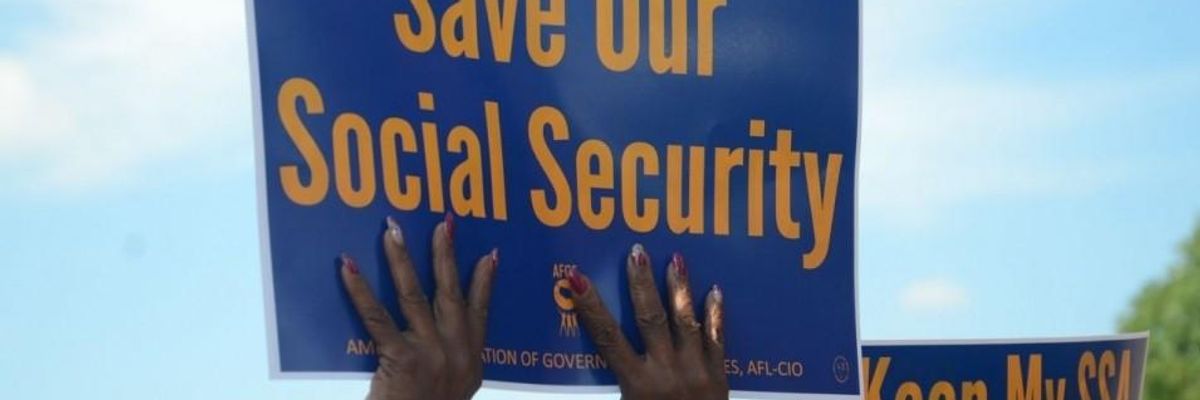
After a lifetime of work, Americans should have enough guaranteed Social Security to maintain their standards of living. (Photo: Courtesy of AFGE, Flickr | CC 2.0)
As a result of inflation, people on fixed incomes find that their incomes decline in value over time. One extremely important feature of Social Security is that its benefits are adjusted every year automatically to offset increases in inflation so that the modest, but vital, benefits do not erode over time. It is important to understand that these adjustments are not increases. They are intended to simply allow people to tread water, to maintain their purchasing power.
Unfortunately, the government's cost of living adjustment for Social Security is based on inflation experienced by workers, not by retirees and people with disabilities who are unable to work. Older people and people with disabilities have, on average, higher health care costs. Those costs tend to rise considerably faster than overall inflation. For that and other reasons, Social Security beneficiaries generally experience higher costs of living than workers, so Social Security adjustments are often inappropriately low. Consequently, Social Security beneficiaries are not even treading water, but rather losing ground.
That is why Democrats who want to expand Social Security propose a more generous, accurate measure of inflation. In contrast, Republicans think that even the current inadequate measure is too generous. They want to enact a stingier measure, the chained CPI, which would cause Social Security's modest benefits to erode even faster.
Everyone who cares about Social Security must fight for a more accurate measure and for those who support it. We all must resist Republican efforts to enact a stingier measure.
Of course, even inadequate adjustments are better than none. For 2019, Social Security beneficiaries will receive a cost of living adjustment of 2.8 percent. That is good news for Social Security beneficiaries, many of whom have little or no other income. The bad news is that millions of people likely will not experience that full increase; some may not see any increase at all and others might see a decline in their overall income, as the result of rising health care costs.
Most people with Medicare who receive monthly Social Security benefits have their Medicare Part B premiums deducted directly from those Social Security payments. For these people, Congress has provided that the annual increase in the Medicare Part B premium must be no larger than the Social Security cost of living adjustment. (An exception to this rule is if you are higher income and subject to the Income-Related Higher Income Amount.)
People who are protected can't go below zero, and lose some of their Social Security benefits, but they can certainly see no cost of living adjustment, despite the 2.8 percent increase. In 2018, about one-quarter of beneficiaries saw no increase whatsoever and another 18 percent received a monthly benefit that was only $5.00 or less.
For those who do not have their Medicare premiums deducted automatically from their Social Security benefits, they can, indeed, wind up with less net income, despite the increase. And, of course, in addition to premiums for health insurance covering doctors' costs, there are premiums for prescription drugs, as well as costs for co-pays and deductibles. As a result, instead of treading water, beneficiaries are sinking below the surface. Indeed, bankruptcies among those aged 65 and older are skyrocketing.
This is unacceptable. After a lifetime of work, Americans should have enough guaranteed Social Security to maintain their standards of living. The solution is threefold. First, Congress should enact a better, more accurate measure of inflation for people receiving Social Security benefits. In addition, benefits, which are modest, but vital, should be increased, as the Democratic Party officially advocates.
In addition to expanding Social Security, Congress should improve Medicare by expanding it to cover such vital services as hearing aids, dental work, and vision care. Premiums, co-pays, and deductibles should be eliminated. And everyone should be covered. Improved Medicare for All will improve the nation's health outcomes while costing a fraction of what we pay today.
It is long past time to enact a more accurate cost of living adjustment for Social Security, expand its benefits, improve Medicare, and extend it to everyone. That is profoundly wise policy. It also represents the views of the vast majority of us.
If you want Congress to expand Social Security, please sign this petition.
This article was produced by the Independent Media Institute.
Dear Common Dreams reader, It’s been nearly 30 years since I co-founded Common Dreams with my late wife, Lina Newhouser. We had the radical notion that journalism should serve the public good, not corporate profits. It was clear to us from the outset what it would take to build such a project. No paid advertisements. No corporate sponsors. No millionaire publisher telling us what to think or do. Many people said we wouldn't last a year, but we proved those doubters wrong. Together with a tremendous team of journalists and dedicated staff, we built an independent media outlet free from the constraints of profits and corporate control. Our mission has always been simple: To inform. To inspire. To ignite change for the common good. Building Common Dreams was not easy. Our survival was never guaranteed. When you take on the most powerful forces—Wall Street greed, fossil fuel industry destruction, Big Tech lobbyists, and uber-rich oligarchs who have spent billions upon billions rigging the economy and democracy in their favor—the only bulwark you have is supporters who believe in your work. But here’s the urgent message from me today. It's never been this bad out there. And it's never been this hard to keep us going. At the very moment Common Dreams is most needed, the threats we face are intensifying. We need your support now more than ever. We don't accept corporate advertising and never will. We don't have a paywall because we don't think people should be blocked from critical news based on their ability to pay. Everything we do is funded by the donations of readers like you. When everyone does the little they can afford, we are strong. But if that support retreats or dries up, so do we. Will you donate now to make sure Common Dreams not only survives but thrives? —Craig Brown, Co-founder |
Nancy Altman is president of Social Security Works and chair of the Strengthen Social Security Coalition. She is co-author of two books and author of three, including her most recent, The Road to Medicare for All: A Call to Action.
As a result of inflation, people on fixed incomes find that their incomes decline in value over time. One extremely important feature of Social Security is that its benefits are adjusted every year automatically to offset increases in inflation so that the modest, but vital, benefits do not erode over time. It is important to understand that these adjustments are not increases. They are intended to simply allow people to tread water, to maintain their purchasing power.
Unfortunately, the government's cost of living adjustment for Social Security is based on inflation experienced by workers, not by retirees and people with disabilities who are unable to work. Older people and people with disabilities have, on average, higher health care costs. Those costs tend to rise considerably faster than overall inflation. For that and other reasons, Social Security beneficiaries generally experience higher costs of living than workers, so Social Security adjustments are often inappropriately low. Consequently, Social Security beneficiaries are not even treading water, but rather losing ground.
That is why Democrats who want to expand Social Security propose a more generous, accurate measure of inflation. In contrast, Republicans think that even the current inadequate measure is too generous. They want to enact a stingier measure, the chained CPI, which would cause Social Security's modest benefits to erode even faster.
Everyone who cares about Social Security must fight for a more accurate measure and for those who support it. We all must resist Republican efforts to enact a stingier measure.
Of course, even inadequate adjustments are better than none. For 2019, Social Security beneficiaries will receive a cost of living adjustment of 2.8 percent. That is good news for Social Security beneficiaries, many of whom have little or no other income. The bad news is that millions of people likely will not experience that full increase; some may not see any increase at all and others might see a decline in their overall income, as the result of rising health care costs.
Most people with Medicare who receive monthly Social Security benefits have their Medicare Part B premiums deducted directly from those Social Security payments. For these people, Congress has provided that the annual increase in the Medicare Part B premium must be no larger than the Social Security cost of living adjustment. (An exception to this rule is if you are higher income and subject to the Income-Related Higher Income Amount.)
People who are protected can't go below zero, and lose some of their Social Security benefits, but they can certainly see no cost of living adjustment, despite the 2.8 percent increase. In 2018, about one-quarter of beneficiaries saw no increase whatsoever and another 18 percent received a monthly benefit that was only $5.00 or less.
For those who do not have their Medicare premiums deducted automatically from their Social Security benefits, they can, indeed, wind up with less net income, despite the increase. And, of course, in addition to premiums for health insurance covering doctors' costs, there are premiums for prescription drugs, as well as costs for co-pays and deductibles. As a result, instead of treading water, beneficiaries are sinking below the surface. Indeed, bankruptcies among those aged 65 and older are skyrocketing.
This is unacceptable. After a lifetime of work, Americans should have enough guaranteed Social Security to maintain their standards of living. The solution is threefold. First, Congress should enact a better, more accurate measure of inflation for people receiving Social Security benefits. In addition, benefits, which are modest, but vital, should be increased, as the Democratic Party officially advocates.
In addition to expanding Social Security, Congress should improve Medicare by expanding it to cover such vital services as hearing aids, dental work, and vision care. Premiums, co-pays, and deductibles should be eliminated. And everyone should be covered. Improved Medicare for All will improve the nation's health outcomes while costing a fraction of what we pay today.
It is long past time to enact a more accurate cost of living adjustment for Social Security, expand its benefits, improve Medicare, and extend it to everyone. That is profoundly wise policy. It also represents the views of the vast majority of us.
If you want Congress to expand Social Security, please sign this petition.
This article was produced by the Independent Media Institute.
Nancy Altman is president of Social Security Works and chair of the Strengthen Social Security Coalition. She is co-author of two books and author of three, including her most recent, The Road to Medicare for All: A Call to Action.
As a result of inflation, people on fixed incomes find that their incomes decline in value over time. One extremely important feature of Social Security is that its benefits are adjusted every year automatically to offset increases in inflation so that the modest, but vital, benefits do not erode over time. It is important to understand that these adjustments are not increases. They are intended to simply allow people to tread water, to maintain their purchasing power.
Unfortunately, the government's cost of living adjustment for Social Security is based on inflation experienced by workers, not by retirees and people with disabilities who are unable to work. Older people and people with disabilities have, on average, higher health care costs. Those costs tend to rise considerably faster than overall inflation. For that and other reasons, Social Security beneficiaries generally experience higher costs of living than workers, so Social Security adjustments are often inappropriately low. Consequently, Social Security beneficiaries are not even treading water, but rather losing ground.
That is why Democrats who want to expand Social Security propose a more generous, accurate measure of inflation. In contrast, Republicans think that even the current inadequate measure is too generous. They want to enact a stingier measure, the chained CPI, which would cause Social Security's modest benefits to erode even faster.
Everyone who cares about Social Security must fight for a more accurate measure and for those who support it. We all must resist Republican efforts to enact a stingier measure.
Of course, even inadequate adjustments are better than none. For 2019, Social Security beneficiaries will receive a cost of living adjustment of 2.8 percent. That is good news for Social Security beneficiaries, many of whom have little or no other income. The bad news is that millions of people likely will not experience that full increase; some may not see any increase at all and others might see a decline in their overall income, as the result of rising health care costs.
Most people with Medicare who receive monthly Social Security benefits have their Medicare Part B premiums deducted directly from those Social Security payments. For these people, Congress has provided that the annual increase in the Medicare Part B premium must be no larger than the Social Security cost of living adjustment. (An exception to this rule is if you are higher income and subject to the Income-Related Higher Income Amount.)
People who are protected can't go below zero, and lose some of their Social Security benefits, but they can certainly see no cost of living adjustment, despite the 2.8 percent increase. In 2018, about one-quarter of beneficiaries saw no increase whatsoever and another 18 percent received a monthly benefit that was only $5.00 or less.
For those who do not have their Medicare premiums deducted automatically from their Social Security benefits, they can, indeed, wind up with less net income, despite the increase. And, of course, in addition to premiums for health insurance covering doctors' costs, there are premiums for prescription drugs, as well as costs for co-pays and deductibles. As a result, instead of treading water, beneficiaries are sinking below the surface. Indeed, bankruptcies among those aged 65 and older are skyrocketing.
This is unacceptable. After a lifetime of work, Americans should have enough guaranteed Social Security to maintain their standards of living. The solution is threefold. First, Congress should enact a better, more accurate measure of inflation for people receiving Social Security benefits. In addition, benefits, which are modest, but vital, should be increased, as the Democratic Party officially advocates.
In addition to expanding Social Security, Congress should improve Medicare by expanding it to cover such vital services as hearing aids, dental work, and vision care. Premiums, co-pays, and deductibles should be eliminated. And everyone should be covered. Improved Medicare for All will improve the nation's health outcomes while costing a fraction of what we pay today.
It is long past time to enact a more accurate cost of living adjustment for Social Security, expand its benefits, improve Medicare, and extend it to everyone. That is profoundly wise policy. It also represents the views of the vast majority of us.
If you want Congress to expand Social Security, please sign this petition.
This article was produced by the Independent Media Institute.